Published by The Prehn Institute, Book 2
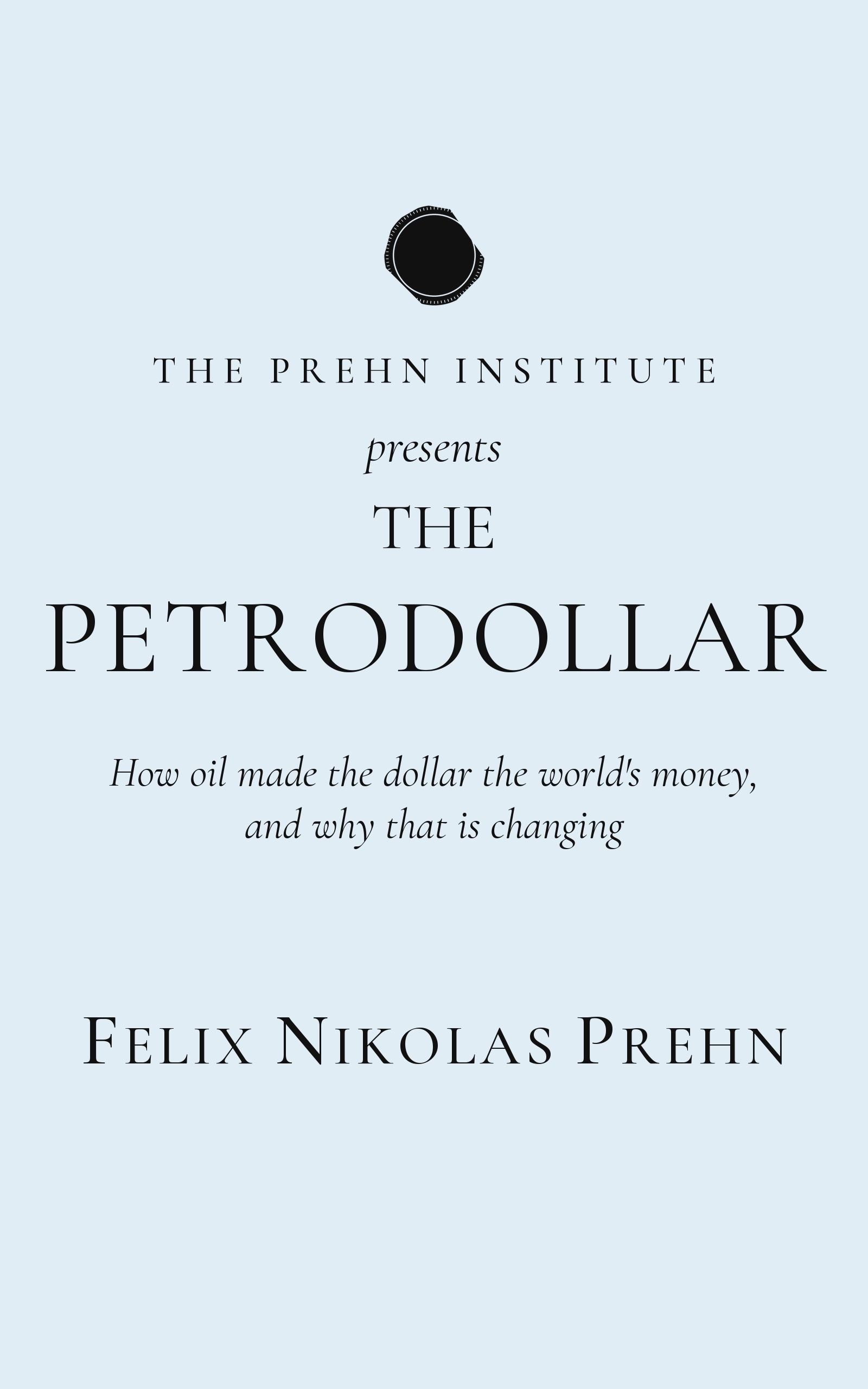
The Petrodollar
How oil made the dollar the world's money, and why that is changing
Kindle ISBN 979-8-9984091-3-4. Paperback ISBN 979-8-9984091-4-1. Hardcover ISBN 979-8-9984091-5-8.
The dollar came to price the world's oil. The published figures show what that privilege gives the United States and how far the world has moved away from it.
What the book covers
The world burns about 104 million barrels of oil a day, and the price of every one of them is quoted in dollars. That has been so for more than fifty years. Delegates from 44 nations met at Bretton Woods in July 1944 and fixed the dollar to gold at $35 an ounce. On 15 August 1971 the United States closed the gold window. In the autumn of 1973 the posted price of Saudi crude went from under three dollars a barrel to $11.65. In July 1974 the United States Treasury Secretary flew to Jeddah, and Saudi Arabia agreed to place its new wealth in Treasury debt through a channel the Treasury kept confidential for forty years, until it disclosed holdings of $116.8 billion in May 2016.
The dollar's share of currency reserves fell from about 71 per cent in 1999 to about 57 per cent in 2026. Foreign holders owned about half of marketable Treasury debt in 2008 and under a third by the end of 2025. After about $300 billion of Russian central bank reserves were frozen in 2022, central banks bought more than 1,000 tonnes of gold in each of the following three years, against an average of 473 tonnes a year in the decade before. The dollar still stands on one side of about 89 per cent of all currency trades.
There was no signed treaty to price oil in dollars, and no fifty-year agreement expired in 2024. The arrangements that did exist are set out in order, beginning with the gold-backed system agreed in 1944 and ending with the reserve managers now buying gold instead of Treasury debt.
Why Felix Nikolas Prehn wrote it
Felix Nikolas Prehn took the subject from advice a mentor on an energy desk gave him early in his career: follow the energy. It argues no political case and offers no prediction. Claims the record supports are stated flat, and the book says so when the record does not support one. The author labels his own readings as his.
Chapters
- Chapter 1. Follow the Energy
- Chapter 2. As Good as Gold
- Chapter 3. The Nixon Shock
- Chapter 4. 1973: War, Oil and the Arrangement
- Chapter 5. The Recycling Loop
- Chapter 6. Three Advantages
- Chapter 7. The Economic Nuke
- Chapter 8. The Backup Plans
- Chapter 9. Three Risks
- Chapter 10. Three Places the Money May Go
- Chapter 11. Why It Has Not Collapsed
- Chapter 12. The Newspaper Moment
- Afterword
Sources
Every figure is taken from the Treasury, the Federal Reserve, the IMF, the BIS, the World Gold Council or a named scholar, and each is cited. The numbers are dated 27 September 2026, and the notes give the path back to the original document.
Editions
| Edition | ISBN | Details | Where |
|---|---|---|---|
| Kindle | 979-8-9984091-3-4 | The Prehn Institute, 2026 | Not yet listed |
| Paperback | 979-8-9984091-4-1 | The Prehn Institute, 2026, 88 pages | Amazon, Lulu |
| Hardcover | 979-8-9984091-5-8 | The Prehn Institute, 2026, 88 pages | Lulu |
Also by Felix Nikolas Prehn
About the author
Felix Nikolas Prehn is an economist and former investment banker. He co-founded TradeVision.io and founded Winston Daily and The Prehn Institute. Winston is his adopted golden retriever. Felix is a vocal advocate for animal rescue.