Transcript
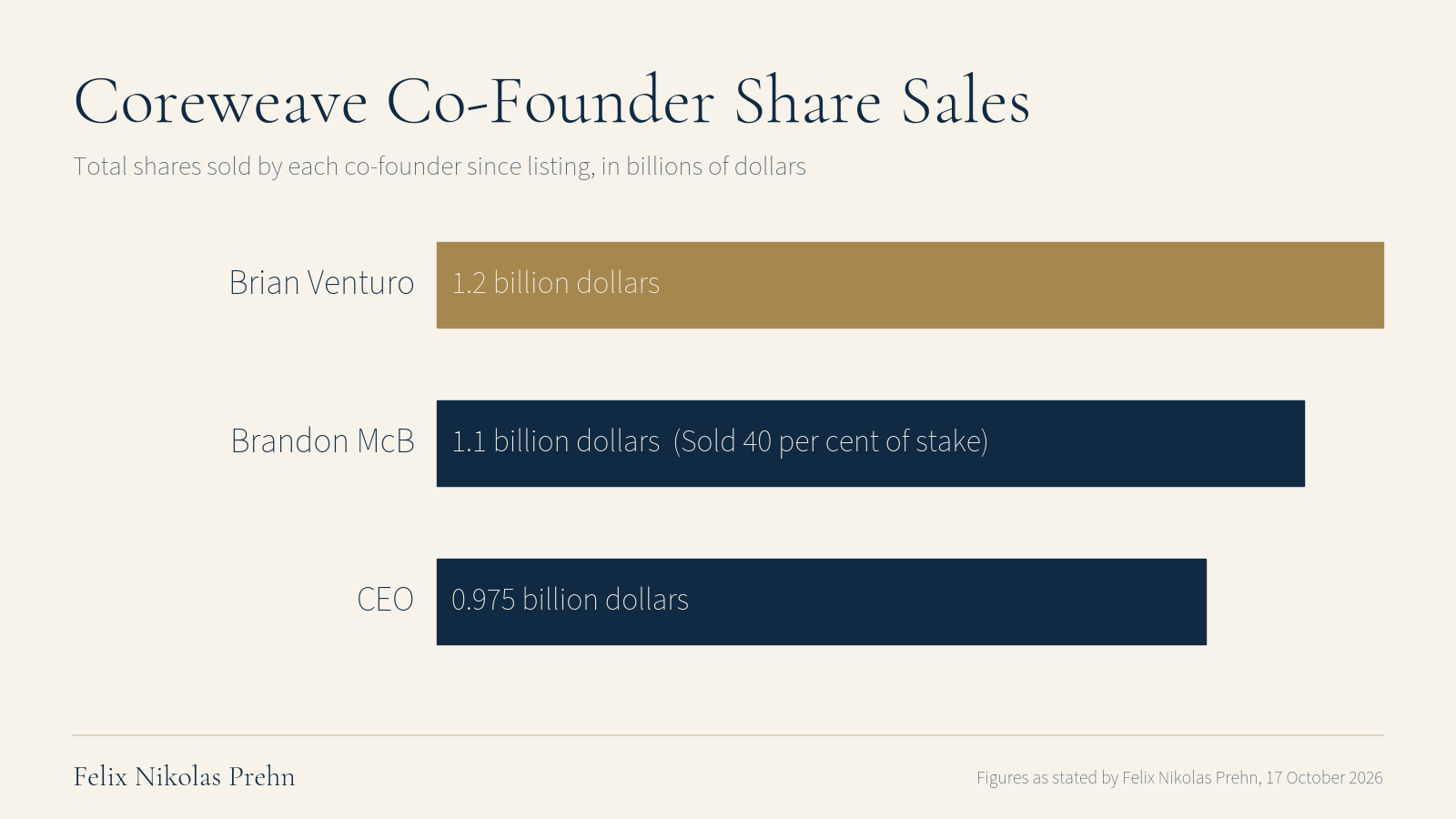
Three men built the company that the whole AI boom runs through. And since it went public, listed in New York, they've sold $3.3 billion of their own shares. And right now, that company's debt trades like the debt of a business in some serious trouble. Share price is down about 65 per cent from the top. And the cost of ensuring its debt against bankruptcy hit a record high.
And most of the stock market hasn't really noticed. Your index fund is still full of the same AI names, but some people have noticed. Goldman Sachs's own trading desk just told its institutional clients how it thinks this is going to play out. The hedge funds and the big pension fund money. They've been told, not you.
Now, I've read the report. Winston's read the report. And there is one line in it that I believe you also deserve to understand because the last time the market fell in love with the companies building the future and the money behind them started to crack and leave the building, the global stock market reset. It took 15 years to come back. My name is Felix Nicholas Pin.
I'm an economist and former investment banker. And that of course down there is Winston. We're also the founder of the Prune Institute where we publish research on how financials markets operate and we also provide instruction on it. There's no sponsorship here. There is no endorsement ever.
And it means Winston and I can say whatever the heck we like. So ask yourself this, do they know something you don't? And by the end of this video, you will know what they know. Stick around. Now, I'm going to go through quite a lot of numbers today.
So I put all of that into a short report. the filings, the charts, the Goldman Sachs stuff and the list of what I'm watching. It's completely free. There is nothing to buy. The link is down below. Felixfriends.org/market reset.
And if you're watching this at all, you're already ahead of like 99 per cent of people because most of them will hear about this from a headline about their pension or they'll look at their portfolio in a while and they look at it long after they could do anything to help themselves. So, who are these three men and what have they built? Well, the company is called Coreweave and most people have never heard of it. Made some headlines this week, but the business is basic basically very simple. Coreweave buys enormous numbers of Nvidia chips.
It puts them in data centres and it rents them out to AI companies by the hour. Think of it as the uh prostitute of the AI world. I'm sure that's what the pitch tag said. All right. So, people know they have a better name for it.
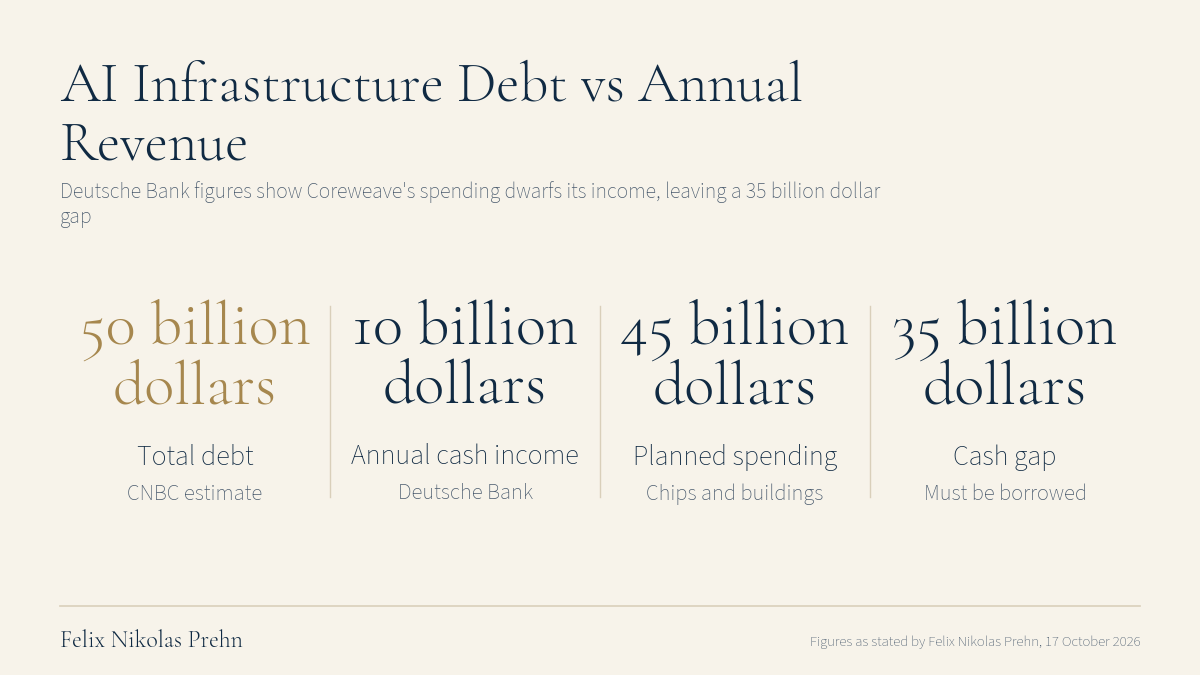
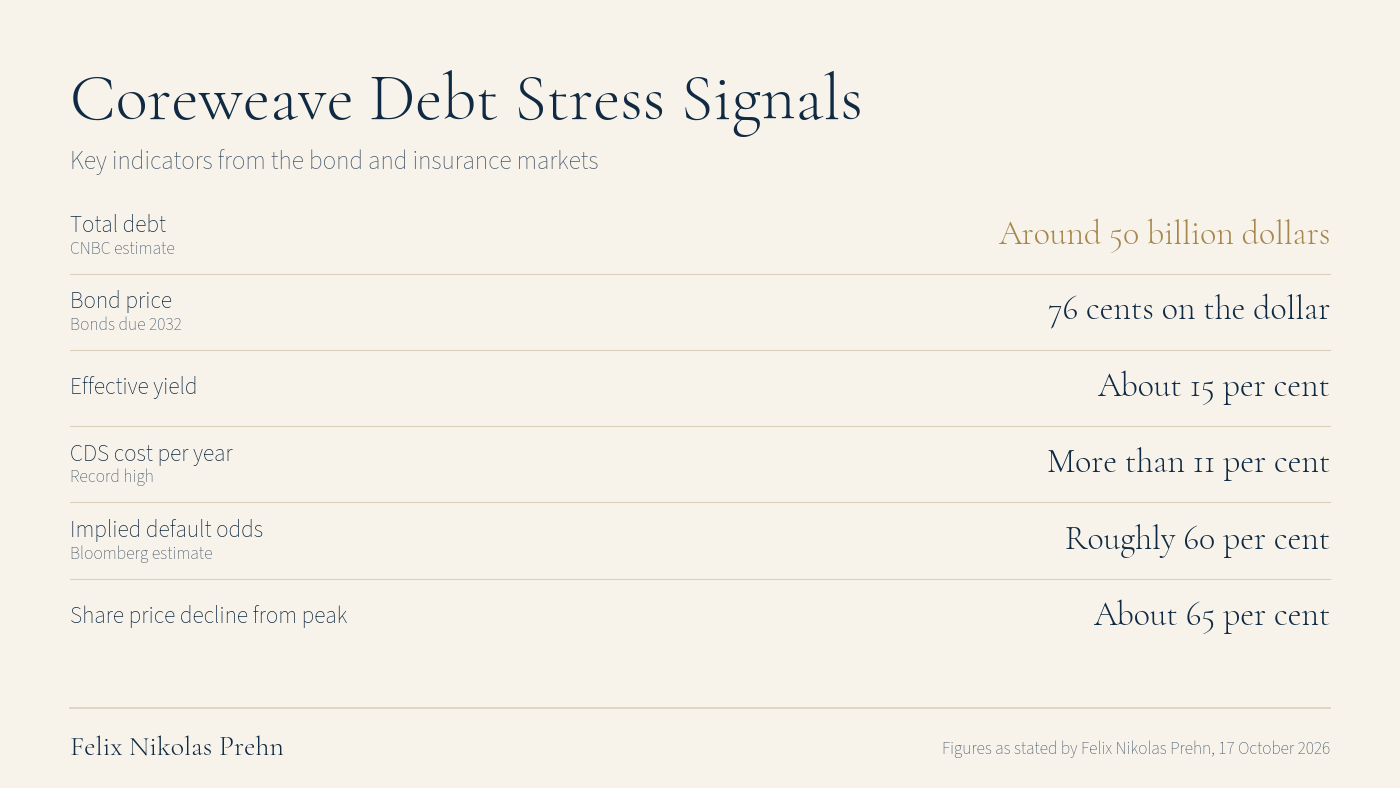
They call it Neocloud. is a little bit more attractive. And a neocloud company built only for AI. And how does it pay for all those chips? Well, with borrowed money. CNBC puts its debt of around $50 billion.
Let me see where Let me see where Winston has it. Well, this is kind of interesting. Winston here says they have three months cash left before they run out of money. That's a little concerning. But either way, it's pretty staggering for a company that only listed like last March.
Literally last March. Now, the founders, so when a director or a senior executive of an American company buys or sells shares, the law says they have to tell the regulators, the SEC, actually within two days, which is pretty decent, right? Politicians and funds is like months. And it's called a form four, and anybody can read it. So, of course, nobody reads it.
But what we've done instead is that again in the Winston up here, there's a link down below if you guys want to play around with it for free for a month. Um, you can see these little red arrows here, right? Well, these are insider cells and they're pretty significant. Uh, we're talking $77 million in the last since like September, right? Pretty crazy stuff.
Now, if you owned this company, you could also get notifications on it and then it would just ping on your phone and then you'd know about it. than I do that for the companies that I own because that way I'm informed. But these things happen before most people. But if you add up every sale by these three co-founders, here's a screenshot. We actually did this work before. Um, add them all up.
CEO 975 million. Brandon McB the co-founder 1.1 billion. And Brian Venturo, they all called Brian. Uh, 1.2 billion. That one's called Bron.
That's a funny name, isn't it? Parents couldn't spell much. Okay. being I'm being mean now. I take it back. I'm sorry.
I mean, look at my name. Try spelling that. Good luck. So, pretty significant. Why?
Because, well, according to Bloomberg, the MCB chap sold 40 per cent of its stake. Now, these guys still own about a fifth of the company, right? So, there's nothing illegal here, but you'd want to know, wouldn't you? The people who know a business best, keep selling. You at least want to ask why.
Now, the debt. A bond is an IOU. You lend a company $1,000. It pays you interest every year and it gives you $1,000 back on a set date. So Coreweave has these bonds that pay just under 10 per cent interest and they get repaid in 2032.
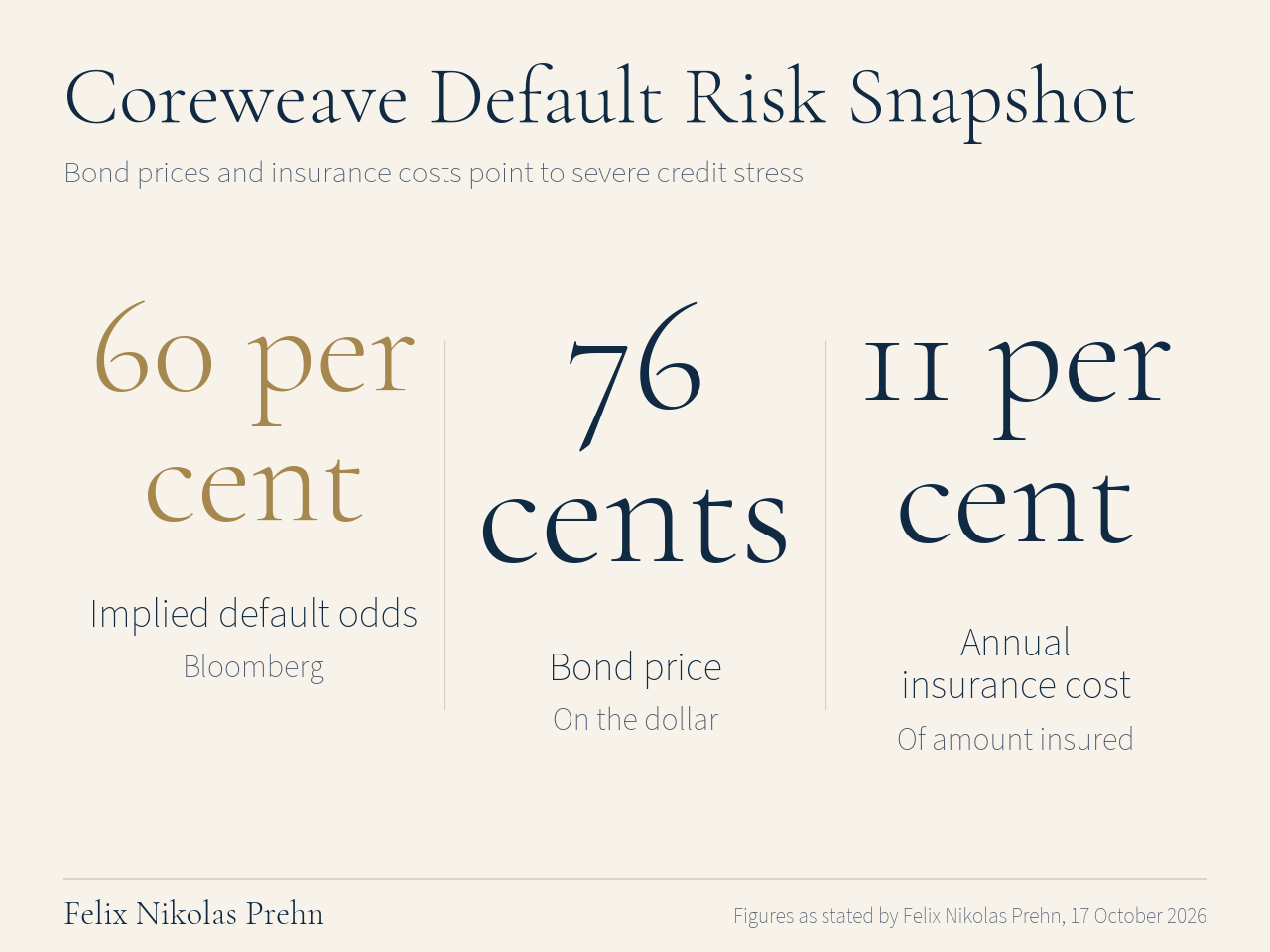
Now you can now buy that bond for 76 cents. So that means you are effectively going to get 15 per cent interest to lend these buggers money. Now, when do you ask someone for 15 per cent interest? Well, when you're not sure you're going to get your money back. And then, of course, it gets worse.
There is an insurance markets for debt. It's called credit default swaps. And you might remember them from 2008 because all the mortgages were also insured that way.
So, if the company can't pay, this policy will pay out. The riskier the company, the more the insurance costs. Insurance. Ensuring corewave's debt for just five years now costs more than 11 per cent of the amount insured every year. It's a record, not a good kind of record.
Bloomberg says the impress implies roughly 60 per cent odds of default, i.e. bankrupts. So how does that happen to a company with so many customers?
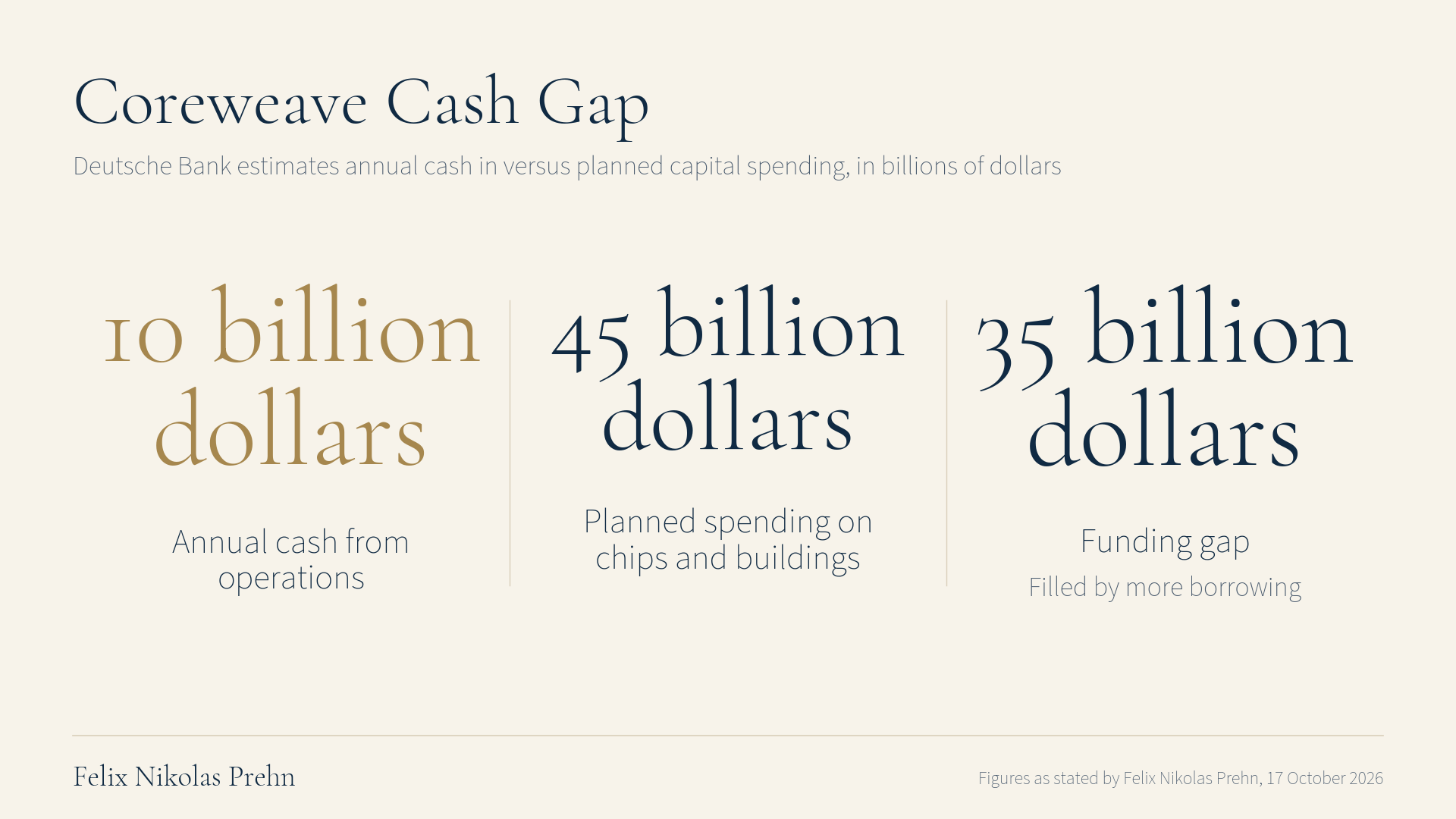
Well, Deutsche Bank did the sums. Corweaf brings in about 10 billion a year in cash from running the business. It plans to spend 45 billion on ships and buildings which leaves a gap of $35 billion. And a gap like that gets filled with more borrowing. Yeah, they they've learned from the US government.
I think now in fairness, Deutsche thinks the shares are still a buy. Coreweave has 104 billion of signed work waiting waiting waiting to be delivered. About twothirds of that is with customers who have very strong credit ratings. So the CEO called the selloff irrational. Maybe maybe he's right.
But think about what happens to your portfolio and your pension and your ISIS and everything else if the lenders stop lending core. That's the question most people can't answer. And it isn't because they're not clever enough. Just reading what the debt market is telling you before the share price catches up is a skill. It's a skill you were never taught.
You were taught a load of jibber and nonsense about geography and everything else, but you weren't taught this. So, it's not your fault. But it is your responsibility to to learn it if you want to keep what you've spent your whole working life building. And you can learn it. You've learned plenty of skills already, right?
You know, walking, swimming, riding a bike, that sort of thing. Nobody was born knowing any of that stuff, right? We'd all be crawling around on on on you know what. So, I'm going to teach it to you for free in a live training. I'll show you how a reset in AI is going to reach your portfolio and your pension.
How to tell the companies that own scarce computing power from the ones that just borrowed to rent it out and which warning lights in the debt market I check first and how the skilled money is actually positioning right now before any of this lands in mainstream media. So mostly will prepare after a reset and by then the prices have already moved. So the time to prepare is now while the NASDAQ is still sitting um the all-time highs and you still have choices and it is completely free. It is completely live. You can ask me questions.
So how do you do that? Well, you go to grab to to survivethebubble.com. The link is down below in the in the comments in the description. And then you put the word act in the comments so I know that you're coming. Just three letters.
So ask yourself, has this happened before? Well, it has. And the parallels are a little uncomfortable. Go back to the spring of 2000. This is not doom and gloom.
This is a lesson. The internet was going to change everything. And it did.
That part was genuinely true. The company everybody wanted to own was called Cisco. Cisco made routters. Not the thong guy, the routter guy, or routers, I think, as you might say. And they made the switches that carried internet traffic. the plumbing.
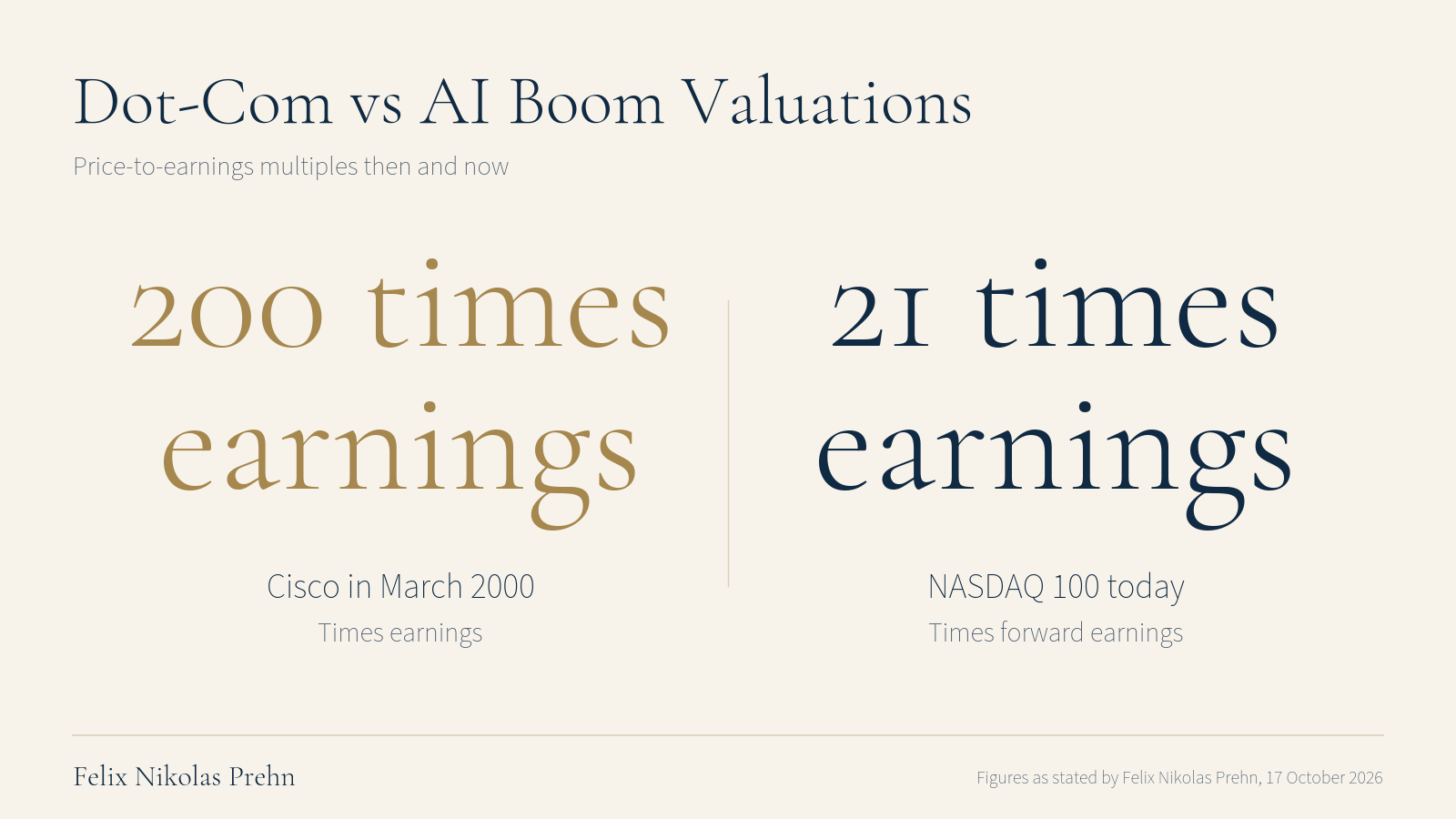
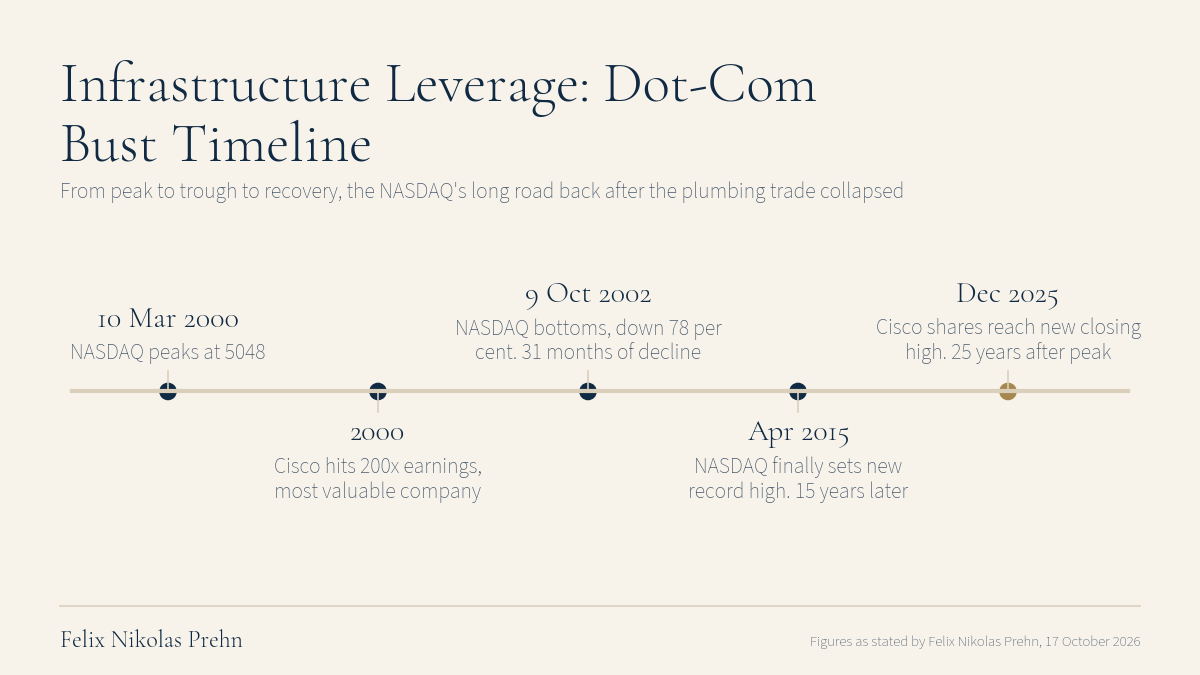
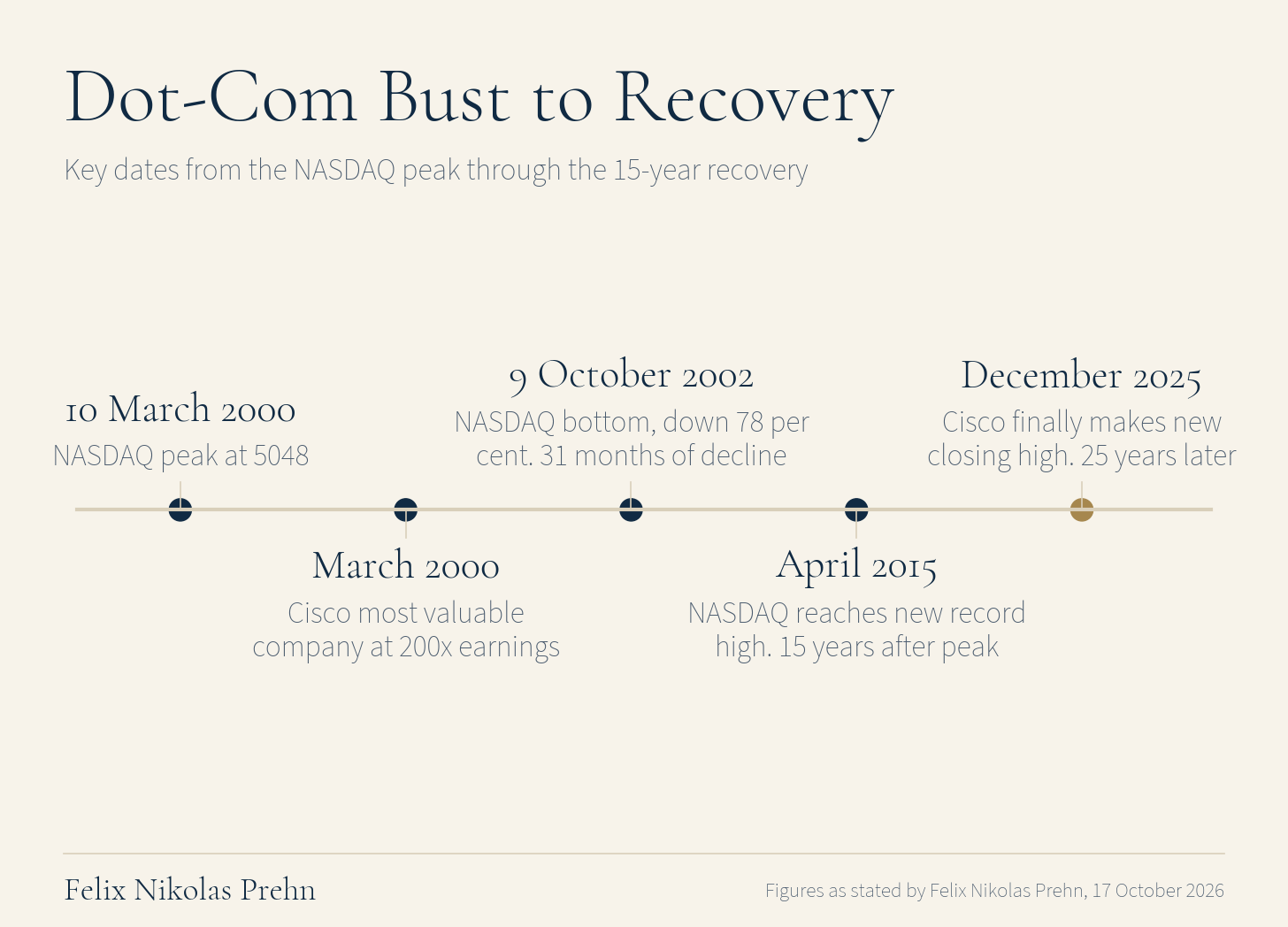
And if you believed in the internet, you bought the plumbing, which sounds a little familiar. So in March 2000, Cisco became the most valuable company in the world, worth about half a trillion dollars. It shares traded around 200 times its profits. So for every dollar of profit Cisco made in a year, buyers were paying $200 for the shares. Now, the NASDAQ is the American stock index packed with tech companies.
And on the 10th of March 2000, it closed at 5,048 points. That was the top. And then the money changed its mind. So what does that actually mean? A boom like this runs on other people's money.
Shareholders buy new shares. Banks and bond buyers lend. And the companies spended building things. As long as the money keeps coming in, everything looks wonderful. But what happens when the lenders get a little bit nervous or the cost of borrowing goes up?
Some companies can't borrow at all, so they cut their spending and the companies that were selling to them suddenly have fewer orders. That's how boom turns. It's not with one big announcement. It's with a lot of quiet decisions to stop lending. Pets.com is the one everybody remembers.
It sold Pet Food online. It listed its shares in February 2011. It spent $1.2 $2 million in a Super Bowl advert with a sock puppet and then the cash ran out. 268 days after listing, it announced it was shutting down. The shares ended in n at 19 cents.
Now, Pets.com was a silly business. You'd expect it to fail. The harder lesson is what happens to the good ones. Amazon was a real company with real customers buying real things every day and a business that would go on to change how the whole world shops. its shares fell 94 per cent from the peak.
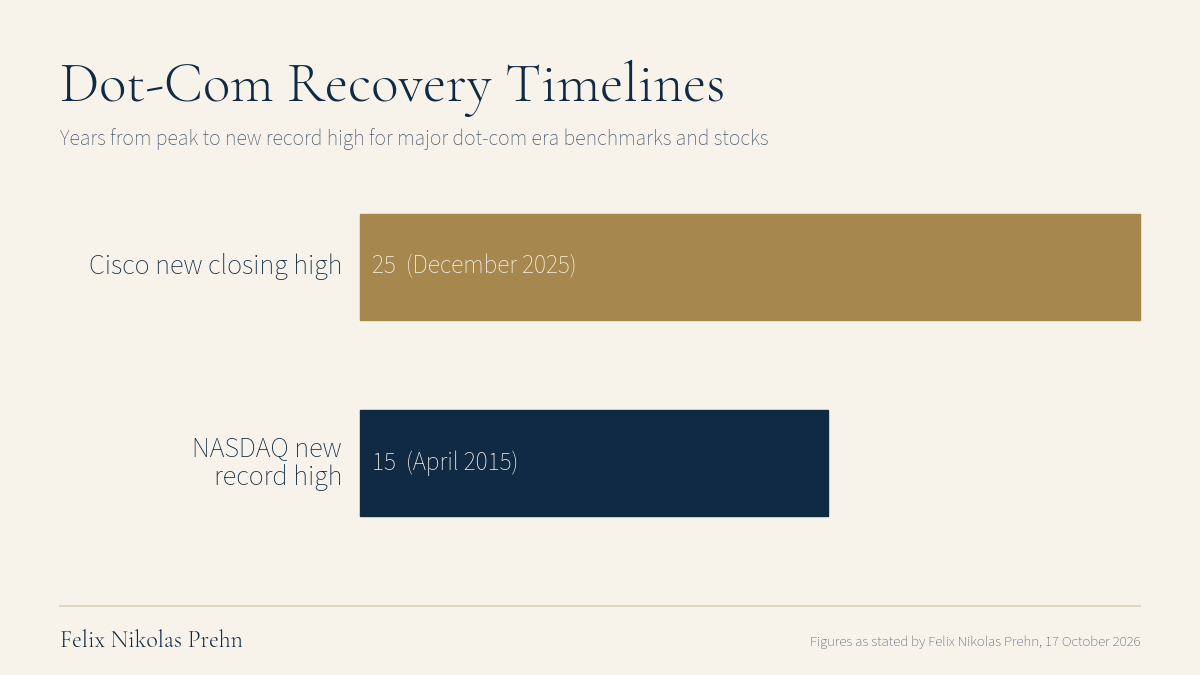
So if you put a $10,000 at the top, you'd have $600 left. In Cisco, the plumbing with the genuine profits, it shares didn't make a new closing high until December 2025. That's 25 years later. So even if you picked the best company of the whole era and you paid the wrong price, you waited 25 years just to get your money back. And of course, you would have missed out on 25 years of rally. until you were massively poorer.
But the company was actually fine. It was just that the price you paid was the problem. The NASDAQ kept falling for 31 months and it finally hit bottom on the 9th of October 2002, 78 per cent below the peak. And again, we didn't get a record high again until April 2015, 15 years. Now, it didn't fall in a straight line.
There were big rallies on the way down.
Every one of them convinced people that the worst was over. People bought the dip and then they bought it again. And that's what made it so painful. Hope kept pulling them back in. So what does a 78 per cent fall feel like?
Well, say you were 55 in 2000 and you had $200,000 in tech stocks. Well, 2 and a half years later, you had $44,000 and you were 70 by the time it's back to where you started. That's what a stock market reset really looks like. The technology carried on. The number of people online kept growing every single year and things like email and shopping online went from a novelty to just normality.
Yet the share prices kept collapsing. But the prices people had paid for it had come back to Earth and the companies that had run out of other people's money just disappeared. So why does this matter? Why? Because the shape is the same.
A technology that really is changing the world. Sitting on top of a small group of plumbing companies that everyone feels they have to own.
In 2000, the plumbing was routers and fiber optic cables. Today, the plumbing is AI chips and data centres. And Coreweave is about as pure a plumbing company as you can buy. It doesn't make the chips. It doesn't write the AI.
It borrows money. It buys the chips. It rents them out. And that works brilliantly while the lenders are happy to lend. Now, it gets very hard, very, very fast when they're not.
And you might say, "Felix Corweave is one company. Who cares?" Well, Core doesn't own every building it uses. It rents a lot of its data centres on other companies. Some of those companies raised money by selling bonds. And the thing that pays those bonds is Corore's rent.
So, if Corwe struggles, their lenders have a problem, too. And Deutsche Bank says Cororeweave will need to raise more money over the next 12 to 18 months just to deliver the work it has already signed contracts for. So where does that money come from? If the lenders are already demanding 15 per cent interest, see the money that lent Corweaf, the money that lent to Coreweave doesn't live in a box on its own. It comes from the same funds, the same banks, and in some cases the same pension schemes that own the rest of the market.
So when one big borrower wobbles, the lenders start asking harder questions of everyone else who borrowed to build AI. And it isn't only cool either. A measure of what it costs to ensure the debt of tech companies has been rising. The last time that measure spiked, the NASDAQ shrugged and kept climbing. This time the NASDAQ is falling alongside it.
So when the lenders and the shareholders get nervous at the same moment, you should pay attention. And that's how a problem in just one little corner becomes a problem for the whole index and everybody else. But if you go back, the story didn't end in 2002. And the next part is the reason I'm not panicking. While everybody was selling the future, which was being built at bargain prices, well, guess what?
Google IPOed in 2004 at $85. That was less than two years after the bottom. In March 2006, Amazon launched a service called S3. It let any business rent storage on Amazon's computers instead of buying its own. And that was the start of what people call the cloud.
And it's exactly the business core we in today, only with AI chips instead of hard drives. Apple launched the iPhone in 2007, and by 2009, Amazon shares were back above their old peak and on the way to becoming one of the biggest companies on Earth. So the reset didn't kill the technology, it just moved the money away from the companies that needed endless borrowing and towards the ones that could stand on their own feet. So if you understood that in 2002, it was the opportunity of a lifetime. If you didn't, it was the end of your retirement plan.
So today, is it the same? Well, not exactly. And you need to hear both sides of this. First, the press. Analysts use something called price toearnings ratio which I think is actually fairly useless but essentially you take the share price and you divide it by the profits per share.
So it tells you how many years of today's profits are you paying for. Now in 2000 Cisco was trading at 200 times earnings. Today the NASDAQ 100 biggest tech companies traded about 21 times the profit analyst expects next year. That's from Bloomberg. and it's back near the lowest level since the AI boom took off in 2023. So, is it expensive?
Well, yes, but it's a long way from the crazy numbers of 2000. And second, the demand is real. The price to rent the most advanced Nvidia chips by the hour is still strong. Even older chips still good prices, so computing power is still scarce. And when something is scarce, the people who already own it tend to do well.
And then third, look at who's paying for most of the building. The biggest tech companies, the ones that run their own giant clouds, pay for a lot of the AI spending out of the profits from businesses that they already have. Search at office software, online shopping. So core doesn't have a business like that underneath it. It has rental contracts and a lot of debt.
In 2000, far more of the boom was running on borrowed money though and and just hope than today. So if we go back to what Goldman Sachs said, one of its senior traders told clients just how brutal the last few days have been for hedge funds. These are the funds that bet on some shares going up and others going down at the same time. And a systematic version of that strategy fell 1.4 per cent in a day.
That sounds small, but that move is something that statistically almost never happens. Funds were selling the shares they owned and buying back the shares they'd bet against all at once because they had to rather than because they wanted to. It was forced selling. Funds that track chip companies traded their biggest volumes for a long time. And Goldman Sachs suspects that day may turn out to have been a local bottom, a short-term low.
He thinks the fear about debt had gotten ahead of itself for now. And that's worth hearing. Not every scare city, sorry, not every scare becomes a crash. Plenty of sell-offs in the last few years looked frightening and then simply stopped or we kept going up. But then he wrote the one line I mentioned at the start.
He said too much capital is chasing too little investable power ready compute capacity. And he said the repricing could happen gradually or through a violent dislocation that spills into broader markets. Now, broader markets is your index fund. It's your retirement. And what does violent dislocation mean?
Well, it looks like a share falling 15 per cent in a day. Cool. We've did roughly out this week. Now, think what would think now think what that would do to one of the giant AI names that sits in almost every index fund in pension. So, what do we learn?
Well, the chips are scarce. The power to run them is scarce, but the money borrowed to buy them is enormous. Somebody gets paid in that squeeze and somebody gets left holding the debt. There's a research firm called Gartner and they expect more than 80 per cent of these neocloud companies to stop operating independently by 2030. Some will be bought, some will fail.
And being bought in a downturn usually means bought cheaply, which is great for the buyer. It's great if you're Amazon, but it's rarely good for the shareholder who paid the full price. They also reckon that three and a half trillion of AI infrastructure is at risk of being written down in value, written off. And there is one more signal that I don't like. Since September, the NASDAQ and the interest rate on America's debt have moved together.
Falling rates would normally help tech shares. This time, both are falling. Now, when people expect growth to slow, they pile into government bonds for safety, and that pushes the interest rate down. So, it usually means the market is worried about growth, not about interest rates. So, there are two ways this goes.
Either the NASDAQ holds its line, the profits come in, and this turns out to be just a scap or the most indebted part of AI gets repriced the way the dot plumbing got repriced. And my view is that it's a reset of the borrowed layer, not the end of AI. But my view doesn't pay your bills.
So you need a plan for both outcomes. So what am I watching? Well, first the NASDAQ line. The NASDAQ 100 has a rising trend line that has held since the lows in April. It's 100 day moving average.
The average closing price of the last 100 days has climbed up to meet it. In the last sell-off, the index dropped to that level. and then bounced hard. Traders call it a sort of a hammer pattern. Now, if that level holds, the scare may be over for now. If it breaks and stays broken, I'd expect the selling to speed up, forced selling.
The second thing is Corey's bonds and its insurance price. If the cost of ensuring its debt keeps climbing, lenders are getting more nervous. Whatever the share price does, if it falls back, the panic is easing. So the debt market usually tells you first they're a little bit smarter than us share people stock people and then there is something that's third and that is the profit reports. Goldman Sachs makes the point that at 21 times profits the earnings could do some of the hefty lifting.
The profits arrive and they're bigger than we thought the valuations look more reasonable. But if they don't well we're in trouble. Now, there was a fourth thing, who's selling. So, I keep the insider hub thing open on some of the most important stocks out there, and I simply set myself an alert. Show you how you do that.
So, I just click on the little save thing here at the top, add to my stocks, uh, done, and then I'm going to get alerts on those, uh, including, you know, the insider selling and the insider buying and everything else. So, here it says it's on your watch list. And you could simply do that with some of the, you know, AI infrastructure companies here. You could add a bunch of these. Doesn't have to be all of them, but just a couple of the major ones and just see if there's anything, you know, interesting happening to those guys and then you're going to get those notifications and you're going to be informed.
So, start making a plan for yourself. And that plan starts with understanding what you're looking at, what you own. I mean, in 2010, two people sold Amazon at $6 because the headlines told them the internet was finished and the whole thing was a giant mistake.
And of course, it wasn't. The internet was just getting started. It was the share prices that had gone too far. The people who could tell the difference are the ones who came out of this very very well because a reset is when wealth changes hands. It moves from the people who didn't understand what they earned to the people who did.
And which side of that you ended up on comes down to what you do in the next few weeks. Not in the next few years. You haven't got that luxury. So, in the live training next Saturday, I'll take you through all of this step by step, how a reset and AI will reach your portfolio and your pension, how to read a bond price and the insurance price. So, you hear the warning before everybody else, how to sort the owners from the borrowers, and how the smart money is positioning right now before any of this lands in mainstream media news.
And no, you don't need to be a trader for this. You don't need to have a finance degree. You just need to be willing to learn a skill nobody ever taught you. And most people won't look at this until it's too late. So you can prepare for it before.
It's completely free. It's completely live. You can ask me anything. So grab your seat. That's about the bubble.com links down below.
And if you got some value out of this, share this with somebody who might get some benefit from this G. I wish you all the best. >> Right now, I think we're going through some sort of weird phase transition. And normally when you get bad economic news or you get bad jobs data that people are going to fly to safety into the bond.