Transcript
Of the people I talk to feel like they're well running on a treadmill. They're doing all the things they were told to do. They're working hard. They're saving their bit. They're investing it.
And they look at their account and it just isn't really going anywhere. It's up and down. And if that's you, the first thing I want to say to you, it's not your fault. Because you were handed a plan. Work hard, earn a decent wage, save a bit, buy a house, put the rest in the market, and leave it alone.
Right? And the idea was that one day you'd get to be comfortable. That was the deal your parents got. And for them it mostly worked. The trouble is that plan was written for a world that doesn't really exist anymore.
The rules of money got rewritten somewhere in the last 20 years or so and nobody sent you the the update. There's no alert on your phone. So, you've been playing by a rulebook that simply stopped working and then you blame yourself when the numbers don't really add up to what you want them to be. So, what I want to do today is walk you through some of the things almost everyone still believes about money. Things that used to be true and are now actually costing you dearly.
And there's a warning that comes with this, a health warning from Winston here, especially the last one, the third one. You're going to want to argue with me about that one. And I kind of want you to argue with me about that in your head. And I think you see why that's actually the whole point here. So, if you're wondering who I am, this here, of course, is Winston, who's done all the hard thinking on this one, who's our in-house adopted little golden retriever research champ.
And my name is Felix Nicholas Pin. I'm an economist. I'm a former investment banker. And these days, my mentors and I spend our time teaching regular people how this stuff actually works. We take no sponsorships, no endorsements ever.
And that's one of the reasons I can tell you the truth even when it's a little awkward. That's sort of the whole deal of this community here. Now, everything I'm about to walk you through, I've written it up in full in plain English. Um, you can download it at felixfens.org/it working because we're going to run through quite a lot here. I want to make this info dense for you.
Checklist in there you can actually run through right now while you're watching this video or straight afterwards. So, grab it. Felix.org/it working. uh and it's also obviously linked to down below in the description. Now the first rule before we get into the investing part because this is the foundation of investing is you were told a good salary will make you wealthy right that's sort of the imp implication that was the deal maybe you went to college maybe you didn't maybe you're running a business maybe you are you know blue collar worker the story is always the same work hard and wealth will follow and your parents and your teachers believed that because for them it was basically true a steady wage a bit of patience bought you a house, vacation, savings, a pension, the salary bit, the the the wages actually did their work.
And today, if you look at, you know, your parents, pardon my handwriting, if you look at your parents salary, well, yours is way higher, right? In terms of numbers, probably is anyway. For most people, it probably is. But you see, it wasn't about the size of the wage. It's about what the wage can actually buy.
And that's the part that's actually fallen apart. Take a house. I've got a little chart here. The average price of new houses sold in the United States from this year is in 1965. We'll try to make this a bit bigger hopefully in the edit.
And this year is now met.
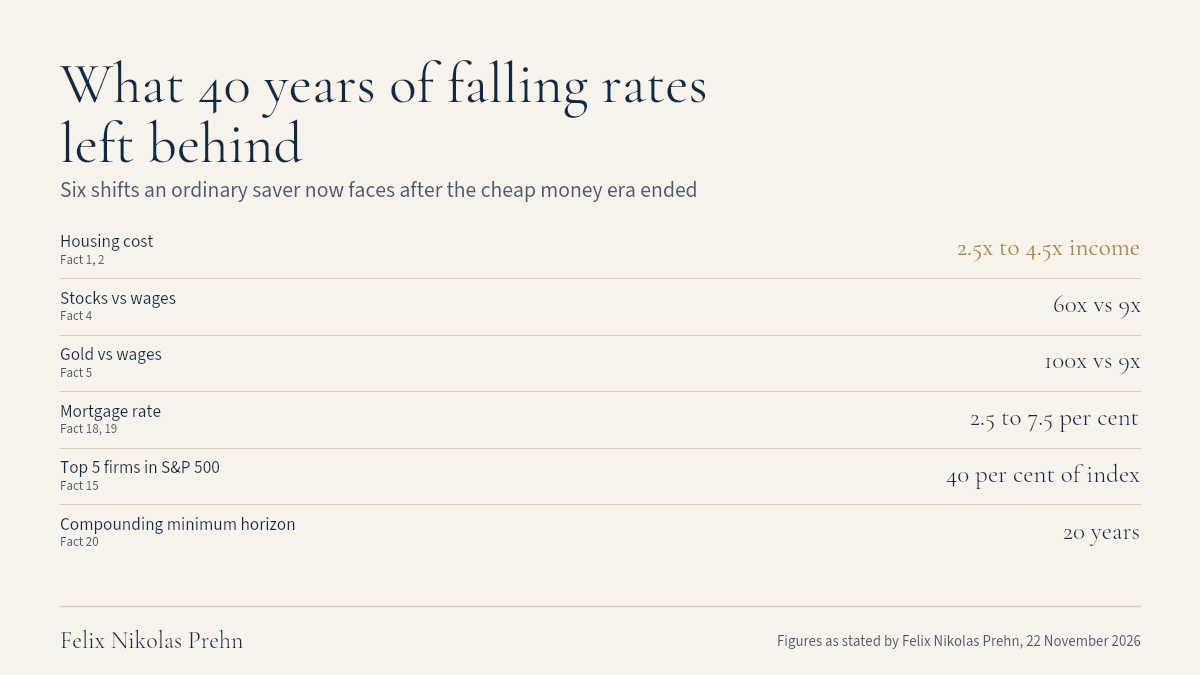
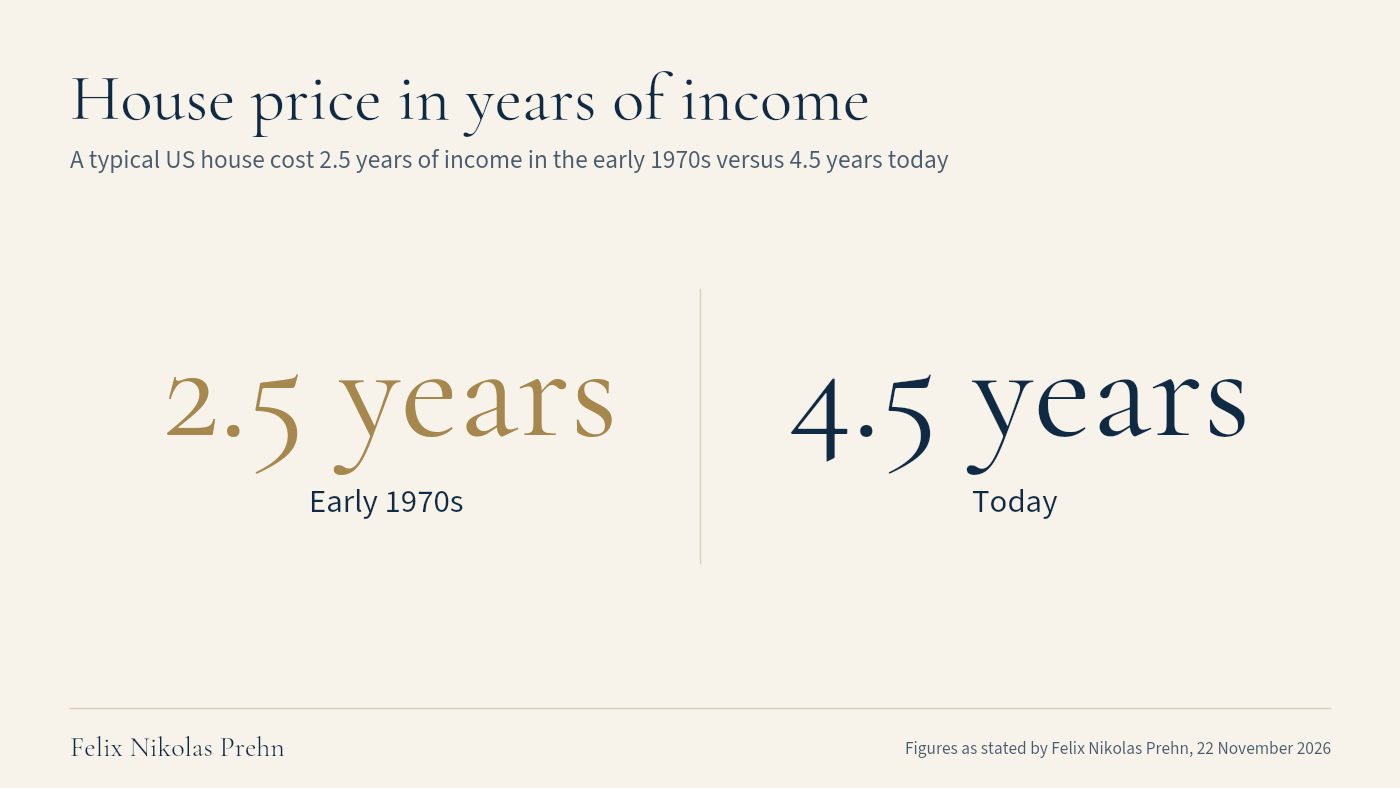
And even in the early '7s, a typical house in America cost you 2.5 times your income. Okay, that was here. Now, today that same house costs you 4.5 times your income. So, you had to work two and a half years for a house. Now, you have to work four and a half years for a house.
And that's, you know, not the stuff that's left over. That's your full income before everything. It's just obviously all the money and it's obviously it's going to take you longer. House hasn't changed. Same, you know, place, same all of that.
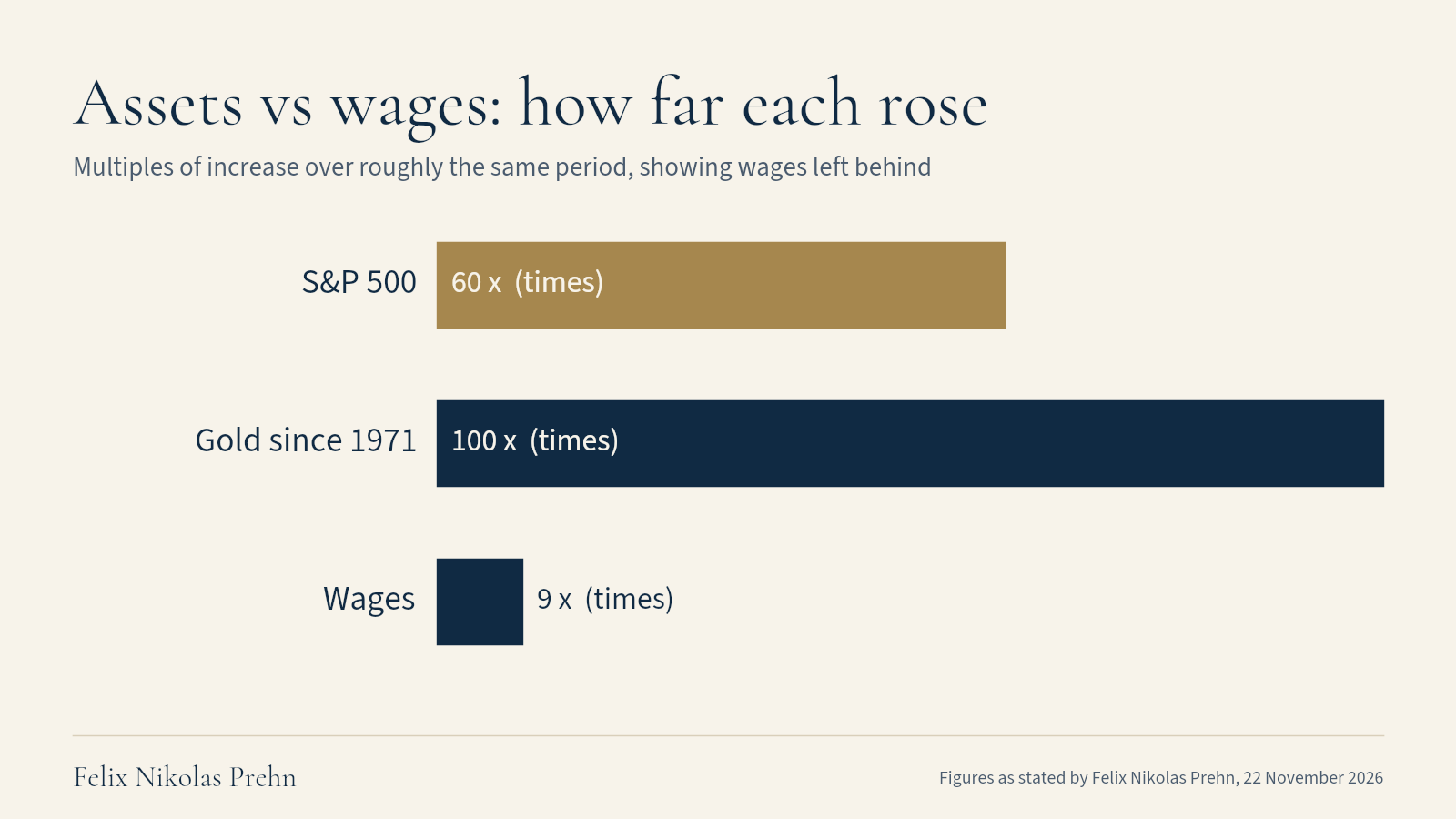
So, the price of a house measured in years of your life is basically doubled. Now, it isn't just houses. Think about the stock market. The S&P 500 is up more than 60x 60 times over that same time period. Now, so these are stock prices, right?
Stocks. Now, your wages on average have gone up 9x.
So the thing you're trying to buy ran up 60 times and your pay is just here. So you didn't get worse at your job. You're just well or your salary just didn't keep up with the stock market at all. And I'll give you another one. Gold.
Let's measure your salary against gold. So if you go to 1971 up to today, gold has basically gone up a hundred times. Right now, your salary, we've already established that, went up nine times, right? So, that's you. So, you can see why buying gold is so much more expensive.
It's like more than 10 times more expensive than it was for your parents in 1971. So, when you were told a good salary is going to make you wealthy, go and get a good job. Um, well, it's kind of a losing race, right? Winston here agrees, which is why he came back. He said this doesn't work anymore.
Do something different. So your bucket your rather your wage is basically like a bucket with a leak in the bottom of it and no salary increase has ever been big enough to outrun that leak. Um it's one of the things that me and my mentors work on at our our institute. We've actually done a research paper on that measuring exactly how much your purchasing power leaks every year. And you can calculate that um as well.
So what does that mean? Well, it means that earning is no longer the skill. Everybody earns some money, right? Everyone's got a job. Everyone's got an income that isn't quite big enough.
So, the real skill is knowing what to do with the money so your work stops leaking value when it lands in your account or your brokerage account. Which brings me to exactly what Winston and I would like to invite you to. Because the uncomfortable bit here, two more important things to cover is that you've never been taught this, right? No one's ever showing you these data points. Otherwise, you probably wouldn't have made half the decisions you've already made in your life.
But don't beat yourself up. And the good news is me and my mentors ever so often we run a live seminar on this truly live where we actually teach you precisely how to get better at the money management part. Because we've all manage money. We all buy shares or index funds or bonds or whatnot. We've all got a pension plan or or something like that.
So, you're all making decisions around money. It's just most of us haven't been tortured, right? Some of us have been very lucky. We got a job in a bank. So, we got tortured by our boss and we teach other people.
Now, we do that completely for free in the live seminar to get you up to better level where you can make better decisions. So, if you want to join us for the next one, um go and click on the on the link down below. The the link on the screen here is actually wrong. Lovely. But it's it's correct in the description down below.
Just click on that and and and see when when the next one is and and and attend it because it's going to be it's going to be insightful. It's going to change the way you think. And you can also ask me questions live about anything that's going on in your in your mind. So, if you're going to join us for that, just write join in the comments down below and I'll look out for you and I know that you'll be there.
Okay, that brings us to the second rule. Buy and hold. Who's been told buy and hold? Just just put just put hold in the chat down below if you've been told told that because most of us have been indoctrinated with this idea. Do the sensible thing the thing that every single person basically points you to.
I'm not saying you should stop investing but very very much the opposite. So you put your money in the market and you let it compound right and look compounding is an absolutely amazing marvelous wondrous thing that you can do. And I just show you the impact of that. You can just type uh compound interest and then pin pin institute which is my strange surname um in in there and it'll there you go. It'll pop it up for you.
Just click on that first link. And let's just say for numbers sake say you have $50,000. You could have a lot more. You could have a lot less. And say every month you're going to put $1,000 into it.
It could be $100. It could be $10,000. It doesn't really matter.
Um and say everyone thinks you make 10 per cent a year in the market. Right? That's sort of the generally accepted number out there. And say you do that for 30 years. So you hit calculate and yeah, you're going to have $3.2 million down the road.
So you're like, brilliant, right? That's the plan. And the wonderful thing is if you look at this chart here, the gold bit is the bit that you put in. That's the bit that you are working for. That is your wages doing its job.
Now the dark blue bit here that bit is the market or rather compounding at 10 per cent a year. So it's brilliant right the longer you do this for the bigger basically the free bit is that you get so you know you are happy you retire wealthy you have a wonderful life and you can obviously run this through with your own numbers um just just just Google it right so that's the plan but while that is beautiful on paper it isn't the full story it is a lie sold to you by the fund industry and now let me explain that before you you know go for my throat. For a lot of people, it doesn't work out that way. Why? You put the money in and you never seem to get quite to that figure that you were aiming for.
And the reason is that that neat 10 per cent a year line hides something really big because you're thinking, I put money in like that beautiful chart I showed you and it'll just go up and up and up and up and up and up over the next, you know, 10, 20, 30 years, right?
But the reality is very, very different. This here is the actual reality. Returns are lumpy. That 10 per cent is an average stretched out over a lifetime. And you don't get to live in the average.
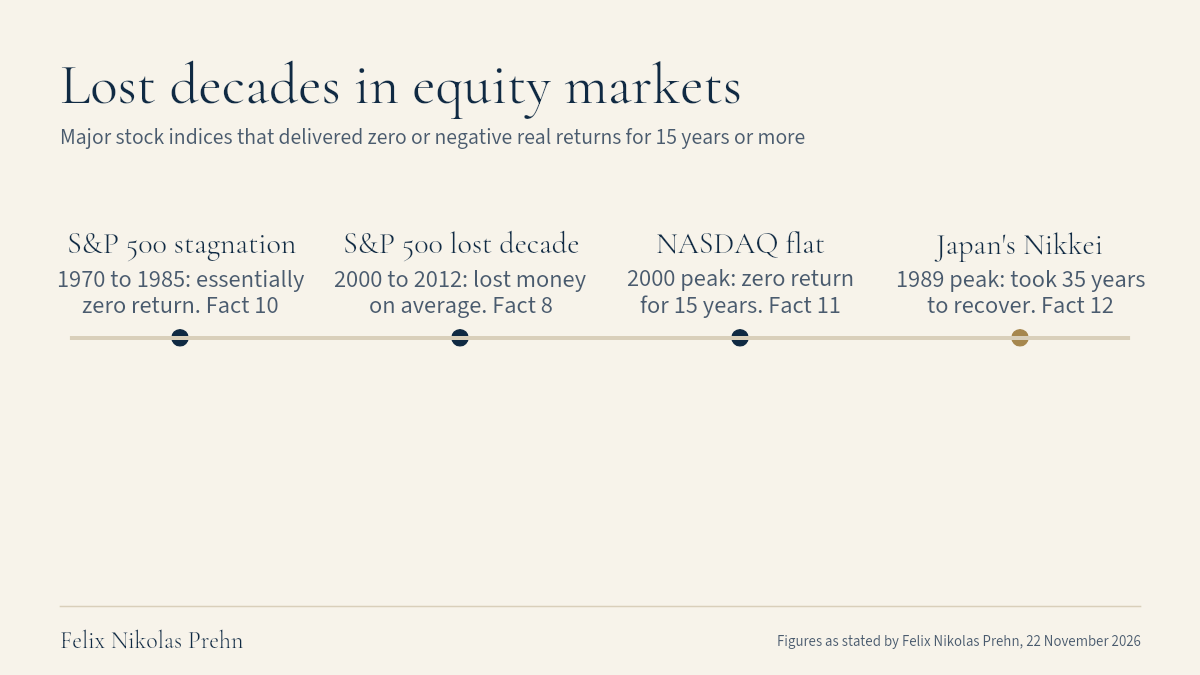
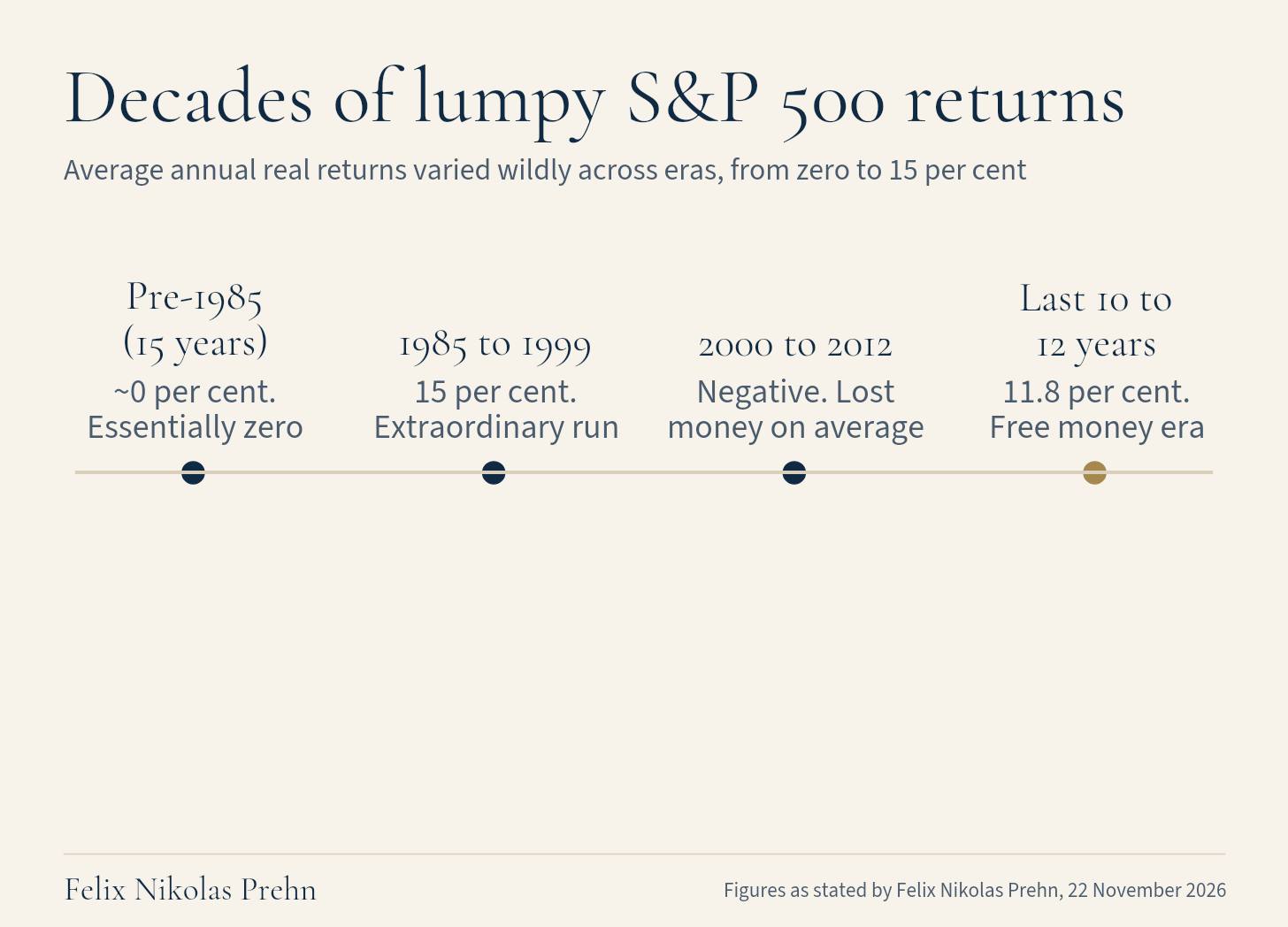
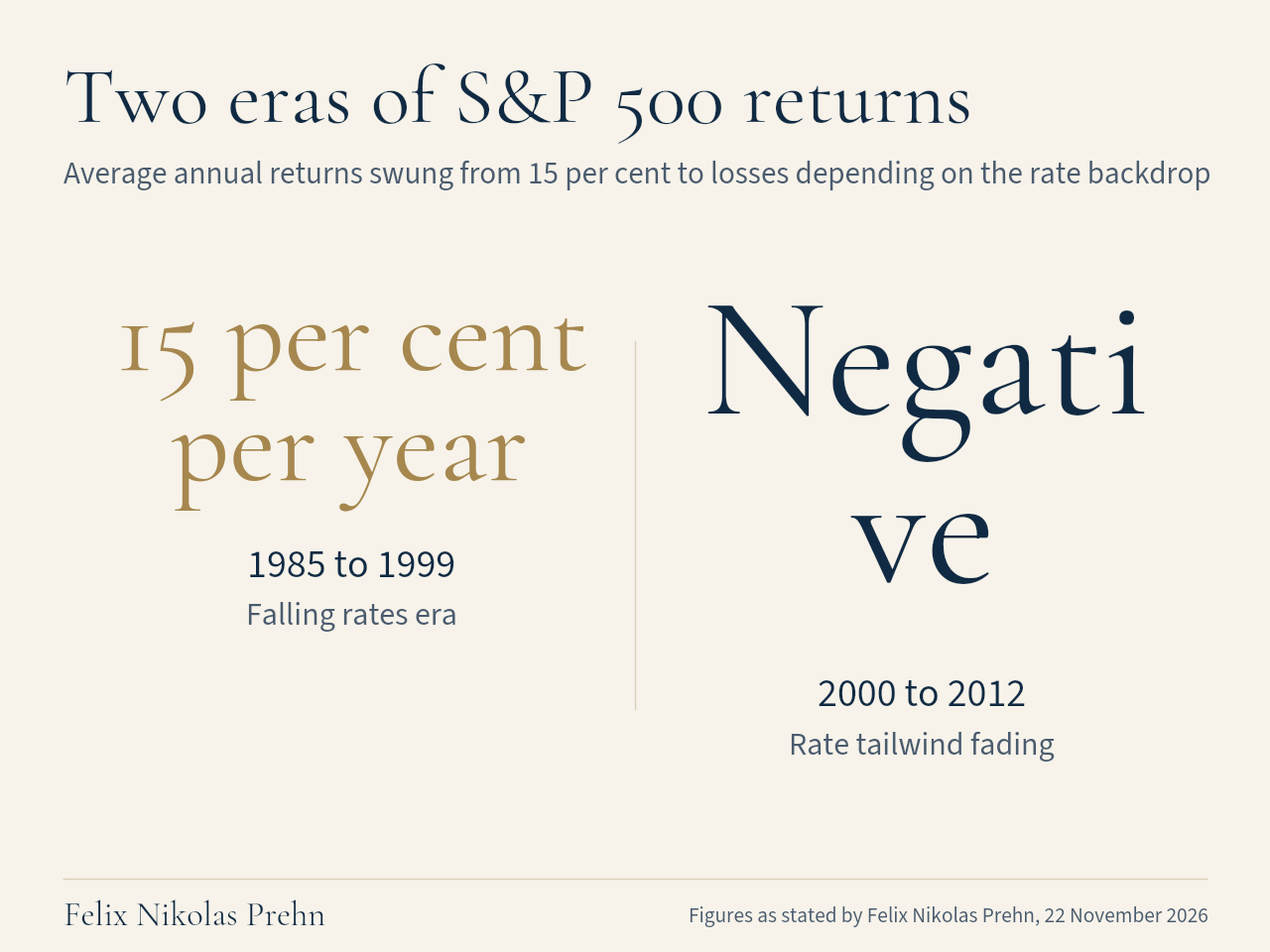
You live in the actual reality. Now, some of the years and some of the decades are actually really, really, really brutal. If you look at the S&P 500 real returns by by era here, well, the last 10 12 years have been brilliant. 11.8 per cent returns per year on average. It also happens to be the era of free money, lots of money printing, and lots of government bailouts.
Now, the previous 12 years, 2000 to 2012, on average, you lost money every year. So, it didn't work for that 12 years at all. So what if you were like 55 in 2000 and then the next 12 years you got zero return. How did that 10 per cent per year compounding work out out for you? Not so well, right?
And then we had in 1985 to 1999 which was an extraordinary period on average every year you made 15 per cent. Brilliant, right? But again the 15 years before that you made absolutely nothing at all. Zero. And you know, I don't have to walk you through an entire history of the stock market, but you see it comes through very lumpy.
So, you're either lucky that the next 101 15 years are one of the bouncy juicy years, or you're unlucky. Well, given that we've just had this extraordinary run, low interest rates, free money, and all of that, well, what's the likelihood that this is going to continue for another 10 or 20 years? Well, it's pretty low if you ask me. It's just sort of statistics. we kind of revert back to the average, which means we're due for a decade of pretty shitty returns on average. Or look at the tech market.
This is the NASDAQ. I know it's a little bit small. Uh look at 2000. That was up there. That was 2000.
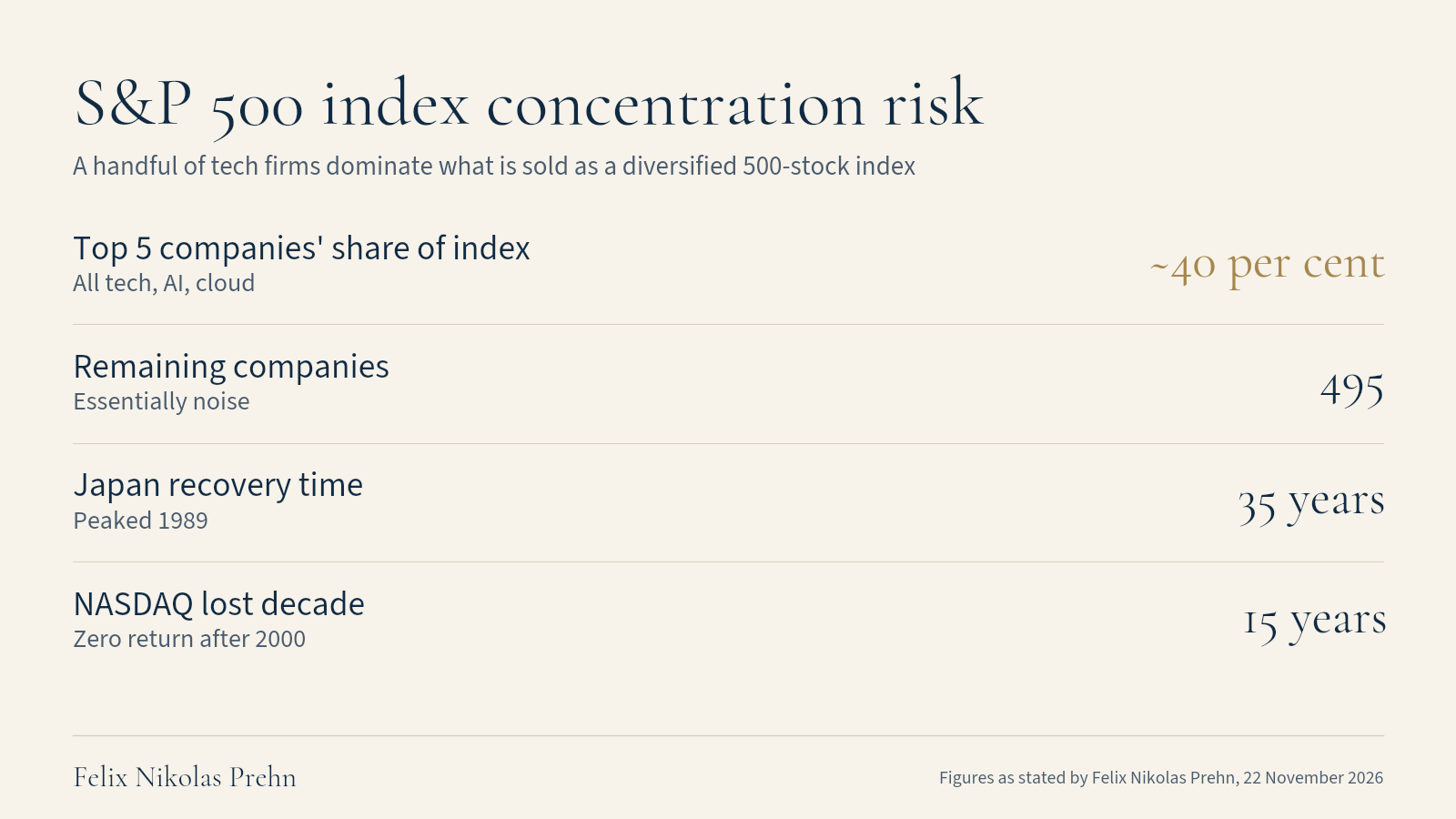
And then for the next 15 years, five years, the return was zero. Nothing for 15 years. Right. Yeah. And then it went up gloriously.
But doesn't that mean it's possible that we're going to get another period like that? I'm not a doom and gloom say. I'm not saying it's going to happen. I've got a crystal ball, but it's a possibility, isn't it? And if your entire retirement and your enjoyment of life depends on this, well, wouldn't it be nice if you could do something a little bit better?
See, compounding works statistically only if you have 20 years or more to leave it alone. So buy and hold works only if you can buy and hold for 20 years plus and yes you have to buy the index not individual stocks because they can go to zero. So my question to you then is do you have 20 years or more to get financially comfortable? If you do keep buying the index right do it every month never ever stop never ever touch the money but if you ever need to touch the money in the next 20 years you are actually in trouble. So next time someone says to you, buy and hold.
It's brilliant. Well, you got to add this bit. Buy and hold if you have 20 years or more. Otherwise, it doesn't work. It could be very, very, very painful.
So why did it work in the past? Why are people preaching this? Well, let me show you why.
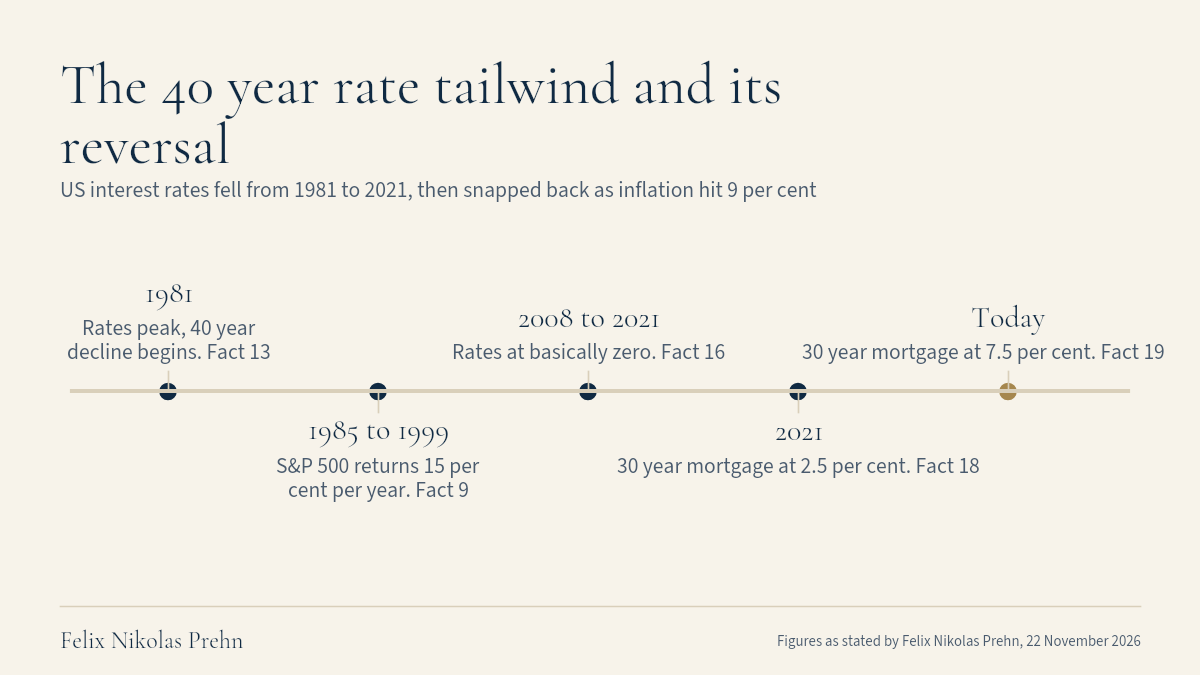
From 1981, and I'm showing you here um basically interest rates, which I know is something that'll kill people because nobody wants to talk about interest rates, but what do you see on this chart? Well, from 1981, which was here, interest rates in the US went down and down and down and down to basically zero. And what did that mean? It meant that money got cheaper and cheaper for 40 years. For 40 years, money just got cheaper and cheaper and cheaper.
And it just means that buying a hold made you look like a genius because it makes asset prices go up. You could have bought anything and you would have been a genius. But you weren't a genius. It was just a wave of money getting cheaper and therefore the non-money things, the things that money wants to buy to make a return went up a lot. But guess what?
That wave is broken. Rates are going up again. And again, history teaches us, patterns teach us, and that's what I learned from my mentors is that it is always like this. It is always a pattern. And people will always say at this point, oh my god, it's forever down.
At this point, they'll say it's ever going to go up. So, wherever you're watching this right now, as I'm recording this, everyone's saying AI profits are going to go to the moon forever after. That isn't going to happen. Everyone's saying interest rates are going to go up and stay up. That's also isn't going to happen.
It is a pattern, but these patterns can take a really long time. And the last one took 40 years, 45 years in fact. So, falling interest rates for 40 years lifted every portfolio. That fall is over.
We now know that. And maybe you think, ah, don't worry about it. whatever crash happens, it'll recover. You know, I love the optimism. Well, let me show you Japan. A beautiful little country that is actually not so little.
Well, they topped out in 1989 and it took them 35 years to go back to zero. Right? just to show you that a wealthy country with a great economy and you know tremendous technology and brilliant smart people and everything else stable government all of that it took him 35 years. So if you think that the com crash which took 15 years is bad well it could again be a lot longer. So people wanted to retire on their money but they probably died before they went back to zero. So the it always comes back theory is just it's just not true.
It is sold to you by people who want to sell you funds.
First mutual funds now index funds um because it's a pretty good sales pitch. Just buy our stuff. It always goes up in the you know on average. It'll always go up on average and it will but again you need that at least 20 years statistically. But there's another layer to this.
People say buy the index the whole market in one basket. You're diversified, you're safe, but brilliant, right? But the trouble is that today a tiny handful of giant tech names make up 30 to 40 per cent of all that money. So you got about five companies, which are, by the way, all tech companies, all AI companies, all cloud computing companies that all do the same thing more or less, and they're about 40 per cent of your diversified buy and hold forever index fund. And what does that mean?
It doesn't It means you're not really buying 500 companies and spreading your risk. You're making a massive bet on the top companies and the other 495 companies are basically noise. Right? So again, they sell it to you as diversified, but what's under the bonnet is anything but. Right?
So in my opinion, it is far far better to hold the S&P 500 than to not be invested. No doubt about it. But holding isn't really passive anymore because you hold very few things in reality. You're not really that diversified as you thought you were. And all the statistics they're showing you of why it's wonderful are from the 40-year period where interest rates were going down and down and down to 40 years straight.
This is dinner time. So Albert here will um assist us for the rest of this uh lesson. Won't you Albert? So from 2008 up to 2021, money was basically free. What do I mean by that?
I mean by that interest rates were basically zero. Inflation was sort of a thing that we didn't really have. I'm not sure everybody wants to see your backside, Albert. This is Albert, also known as Daggy Cat, because he uh fathered five kittens, which was really not the plan, was it?
So you've developed habits by growing up no matter what age you are these last 15 years with this thesis of borrow lots of money. Debt's cheap. Chase whatever is the latest tech growth thing at any price because there is sort of no cost to waiting because money is free. Cash is trash. So never hold any.
And just be in the market any market because free money will lift the lot. That's been the theory. And every one of those habits was actually right for that particular world that we were living in. And every one of them is now basically uh well, it's kind of like paper cuts, but lots of them every single day because that world is ended pretty hard. Inflation is back.
Inflation was at officially 9 per cent. I was chewing my pen, which is really helpful. Um, inflation was at officially 9 per cent here, right? If I have enough space on this desk, please, would you mind? Apparently, he does.
Worst inflation in 40 years. And to fight it, interest rates went up. So, money isn't free anymore. And it won't be free anymore because they have to run inflation to inflate away the government debt, which is a weird concept. But if you think about that, inflation makes your money worth less.
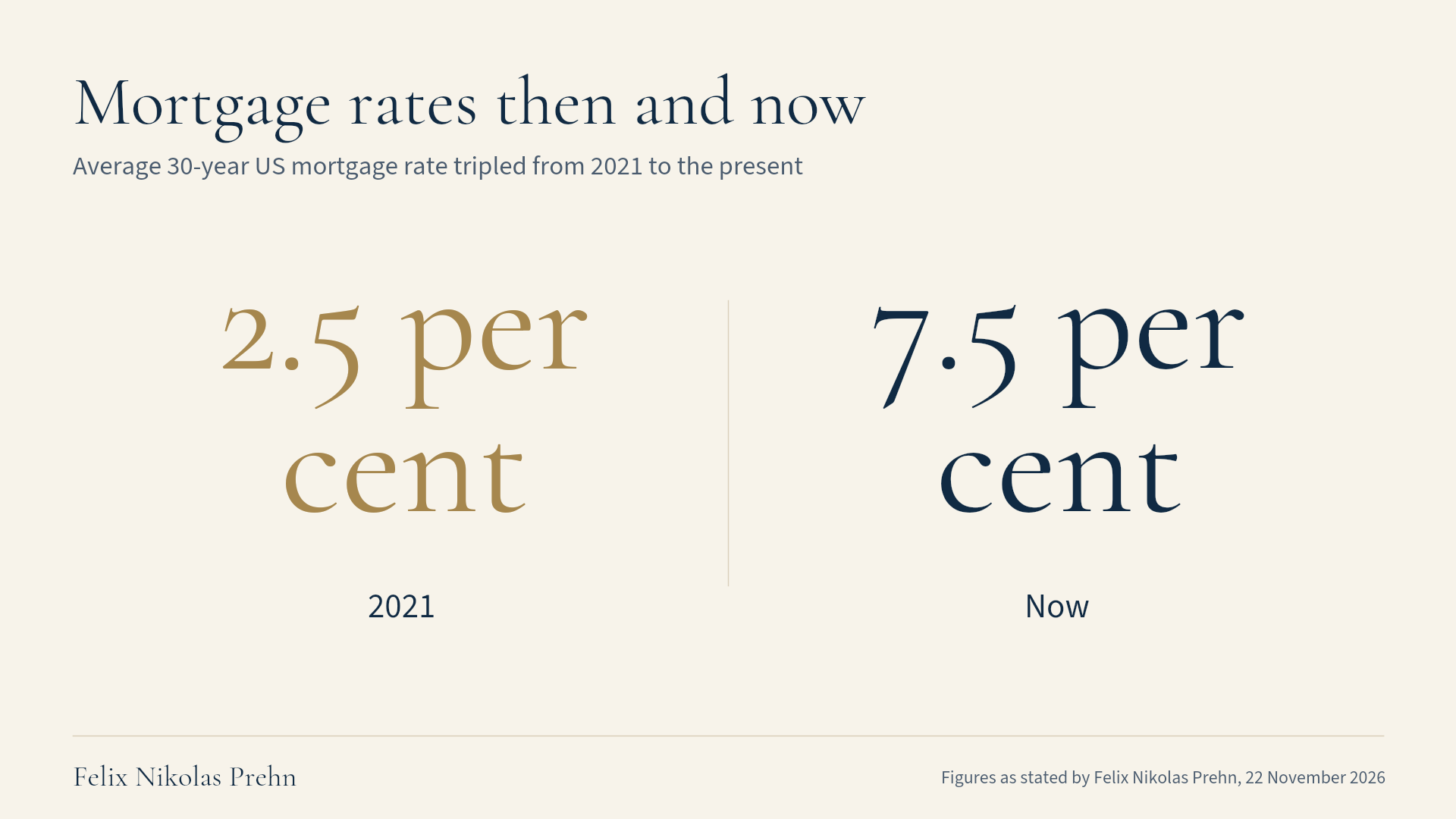
And debt is just money. Well, how do you make the debt worth less? Well, you run inflation. And if you don't believe me on that, well, have a look at have a look at this chart here. This is the average 30 year so 20-year mortgage rate in the United States.
And you know what the word mortgage stands for, right? Mort is of course the word for death. Um um mortgage rates were sort of 2 and a half per cent in 2021. They're now at 7.5 per cent. This is again Fed data here.
I'm not making this up. Which is pretty extraordinary, right? So, we're back to sort of 90s levels. So, the theory that is cheaper and cheaper and cheaper to borrow is no longer true. But because we've experienced this for so long, we've all been ingrained with this theory that well, you can actually be lazy.
It doesn't really cost you anything. You can just leave the money in cash or in the market and it'll be just fine because it's going to go up. there's no consequence. And now every one of those defaults has a very very significant price tag on it. And it's judged to you every single month whether you notice it or not. And generally the wisdom around investing and what to do with your money just hasn't really caught up with us.
So in a world where money costs something and inflation is wide awake, it's here. Well, this old autopilot idea, chase the shiny growth thing, right? Never mind what interest rates are and all that stuff. They are very dangerous. So you've got to drive the car now because no one's driving it for you.
And every single person who manages institutional money that I have talked to in the last few years, they've always said this.
They said it's an active investor market. It is no longer passive buy and hold. So if we step back for a second, we talked about how a salary doesn't make you wealthy anymore. We talked about how buy and hold and leaving it alone and we talked about how money was basically free. They looked like three sort of different bits here, right?
But they all actually rest on the exact same foundation. Every single one of them was written for a world of falling interest rates for 40 years which just lifted everything up. There was a world where your currency mostly kept its value and markets only ever went one way and that world just simply ended. The money stopped holding its value. The wave is coming back down and every rule that you've been taught, you've somehow adopted, you've heard again and again and again, and you believe to be true.
Well, they've stopped working all at the same time because they all had the same thing underneath them that was holding them up and making them true. So, you haven't done anything wrong. It isn't your fault. You were taught the right rules, but for the wrong decade. They didn't do it to be cruel, right?
Your parents or teachers or whatever, they were just handing down what worked for them. But now, you know that things have actually changed and shifted. And I know some of you are still thinking, "Oh, no, it's fine. buy and hold's going to be fine. My salary is just fine. This guy is just being dramatic and all that.
Um and and and stay with that for a bit because it's a reflex we get, right? It's the old rule book defending itself in your mind because it's that deeply embedded. And if you're thinking that, well, it's typically a pretty good sign because it's a good sign that I've landed on the very rule, the very belief system that matters most for you and is most important for your life plan. And the hopeful bit I want to leave you with is this. For 40 years, there was this tide under all of us.
And most people never had to understand it. They just sort of floated up. But that free right's over. But the tide didn't actually vanish. It just changed direction.
And the people who work out which direction it's flowing, they're now going to be just fine. And I believe you can be one of them. You've just got to learn the new map, the new rules, and you got to actually well get in the water and got to be a little bit more active than maybe you're used to. So, come and learn it with us. Me and my mentors will walk you through exactly what to do with all of these three.
You can ask me whatever you like. Um, check out the link down below whenever we're going to do the next. The link here is still wrong, but go for the one that's in the description. Just click on the one in the description or in the pinned comment. And as I said, there is also a free workbook here.
I'll put that link down below as well, so you can chew through this and and and argue with yourself about it. And of course, put put in the comments whatever whatever you you think about all of this. And if you got some value out of this, just just share it with somebody. You might also get some value out of this. Our whole mission here is just to spread the kind of knowledge that I was very lucky to be part of party because I got a job in banking by fluke.
I mean complete chance uh completely random and that knowledge has allowed me to be retired for quite a few years and and live a beautiful free life and I genuinely think everybody deserves that. I used to work corporate jobs so I didn't particularly enjoy and it was very hard and all of that. Um and I've seen both sides of that coin. So all I'd say to you is the bit that's still true 40 years ago and right now is that the money you earn if you invest that proper that is the ticket to freedom. But you have to spend a little bit more effort now to manage it well than you did in the last 40 years just because rates are not going to zero. inflation is here to stay and therefore everything you've been taught.
It's not really working quite the way you'd like it to and I know they don't really want to hear that because everybody wants wants an easy life and everybody wants things to continue the way they have. But just look at what's going on in markets and I think you you can see there is some truth to this and I appreciate you watching this and I wish you all the best. Goldman Sachs just sent their 2027 gold research report, here is in its full glory, out to its institutional clients. Not to you, of course, not to me.