Transcript
The president of the United States just told a magazine on the record that he's going to pay the debt off with, wait for it, inflation. Very rapidly, he said. And then he said it again, very rapidly. Now, politicians don't normally say that part out loud. They deny inflation. They promise to beat it and they stand at the podium and they tell you, "It's temporary. It's under control. It's somebody else's fault."
This president told a journalist, "It's the actual plan. Here's the actual article." And nobody who really read that interview caught the next part. In the same breath, he said there were other ways to deal with the debt, other means. He wouldn't say what those were. So what are the means a president will admit exist, but he will not name?
Well, I will show you because they're not really secret. They are public. And if you know where to look, you'll understand this at a very different level. There is literally a date pencilled against the next move. And the people who run the dollar have already signalled it.
It's going to change the value of every dollar that you're holding, your wages, your pension, the cash sitting in your account right now in your portfolio. Now, I want to say two things before we go a step further because they matter. This is not me being dramatic. Every number in this video is on the record. I'll show you the source for each.
This is really not political. I genuinely do not care who you voted for. Love them, can't stand them, forget it. I don't care. What I care about is what happens to your money and my money when a government decides the quiet way out of its own debt is to make your money worth less, because history is very, very clear about who wins when that happens and who loses when that happens.
Now, there's going to be a lot of information, a lot of data in this video in the next few minutes. So, Winston here has put together for you an actual research report which you can download completely for free at felixfriends.org/repression. Just download it, read it alongside the video or read it afterwards, and you will know more than 90% of people out there, including people who work in banking.
So, the fact that you're watching this video means you're a rarified creature, which is a good thing because it means you're going to understand something and you're going to be able to make better decisions. And if you're new here, my name is Felix Nikolas Prehn. I'm an economist. I'm a former investment banker. I'm also the founder of the Prehn Institute where we publish research on financial markets and give instruction on how they actually work.
Zero sponsorships, zero endorsements ever on this channel, so I can say whatever the heck I like, which is just how Winston and I like it. This, of course, is Winston, the most important introduction of all, the brains behind it all.
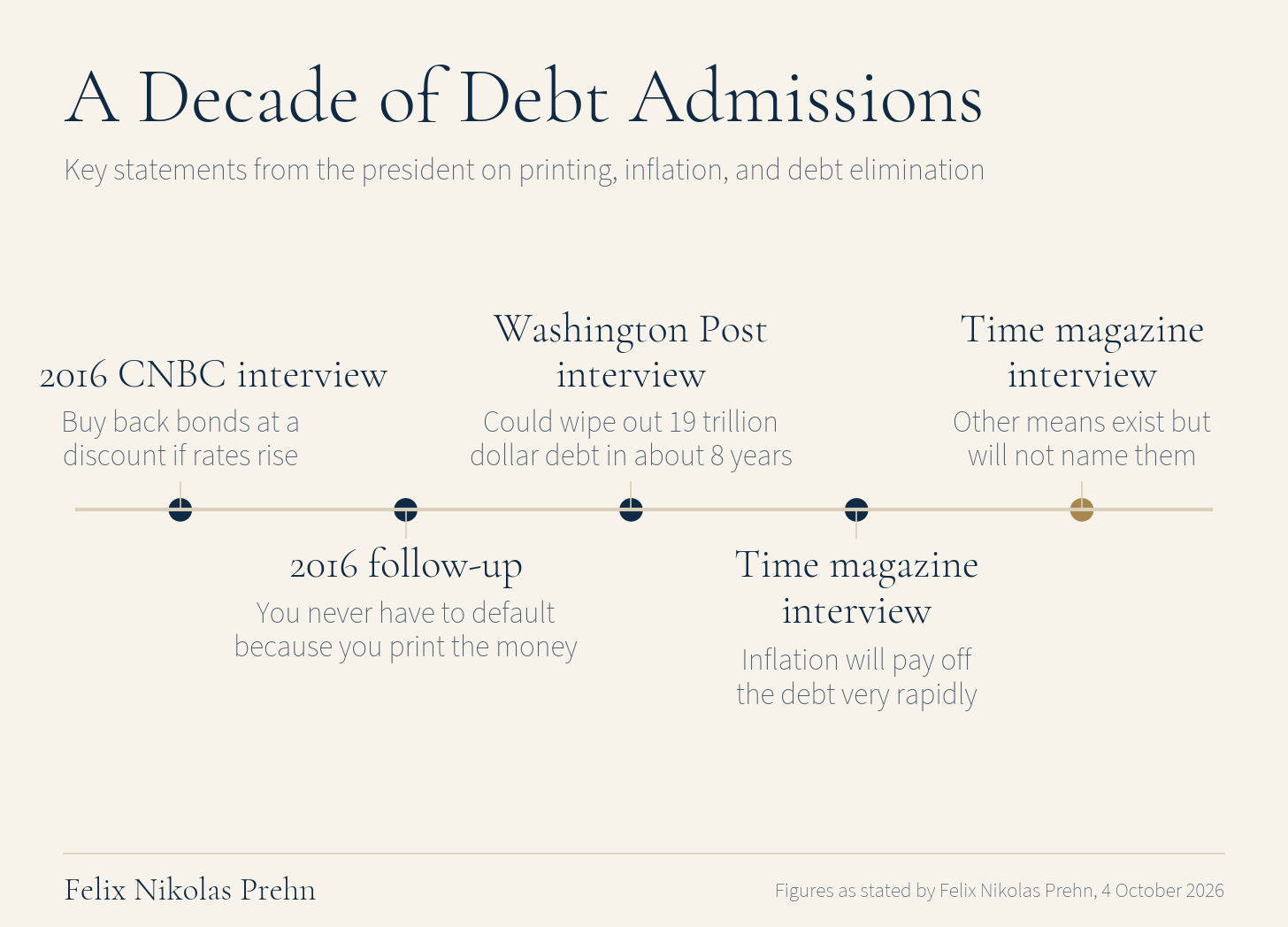
But let me give you the quote that we started with in full because it's better than any summary that I could possibly give you. Time magazine pointed out to the president that the national debt had grown around $11 trillion in the 5 years he's in office. And his answer was, inflation, certain levels of inflation will also pay off that debt very rapidly, very rapidly.
And then, I know I'm the best in the world, the best. I don't want to tell you what those means are but you can pay it off through other means. So there it is. Inflation pays off the debt very rapidly, and there are some other means that he doesn't want to tell you about.
Now, some of you might be thinking, well, he says a lot of things, he's a politician, which is probably fair, but this isn't a slip. You see, he's been saying a version of this for literally 10 years. If you go to a CNBC interview from 2016, he told CNBC that America could buy back its own bonds at a discount if rates went up, interest rates went up, and people read that as a default threat.
So, a few days later, he went on television to tidy it up. And his words were this. You never have to default because you print the money. And I hate to tell you, a month before that, he told the Washington Post he could wipe out what was then a $19 trillion debt over about 8 years. Now, that debt of course has doubled since, so it hasn't been done yet. But it is a settled view.
There is, in fact, an Alan Greenspan quote which I watched yesterday, which is exactly the same thing. This is accepted Washington central banking knowledge and wisdom. You pay the debt by printing and the printing shows up in inflation and the inflation does the quiet work for you.
And it isn't just presidential. His own treasury secretary Scott Bessent said there's nothing magic about $40 trillion. We can grow our way out of that. Now notice what no one's saying. No one's saying we're going to cut spending, we're going to raise taxes, we got to balance the budget. No one's saying that. They're just saying it's a number that we're going to shrink by making the dollars it is written in worth less.
So, it is a complete admission of what I've been shouting from the pulpit, if you will, for the last year or so. They are literally telling you what's happening. Yet, most people are not prepared for it. And then there are the other means. They admit there are other means to deal with this but they're not going to tell you what those are. Now if it was good news, some magic trick, they'd tell you because politicians tell you the stuff that's good for you because that's how they get popular.
But they hide the part that costs them something. So, we're not going to sit here guessing at what those other means are other than the obvious choices and the obvious paths that they've now literally told us, because the mechanism has a name and it is an ugly word that they are avoiding. Economists like myself call it financial repression.
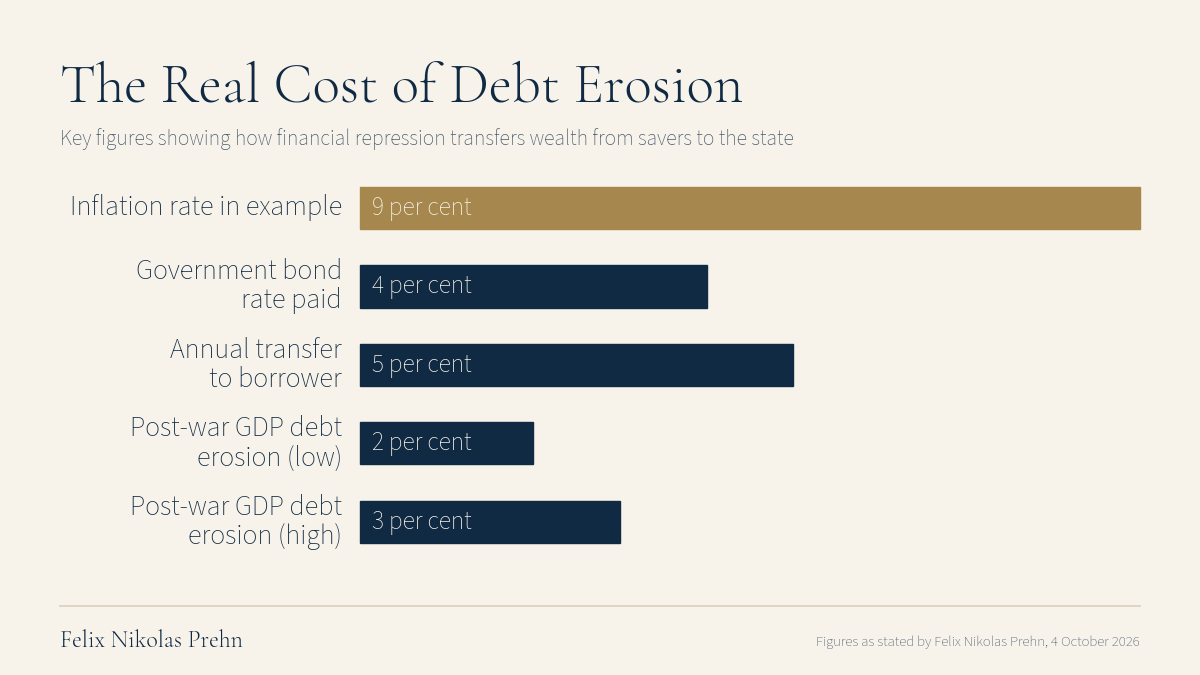
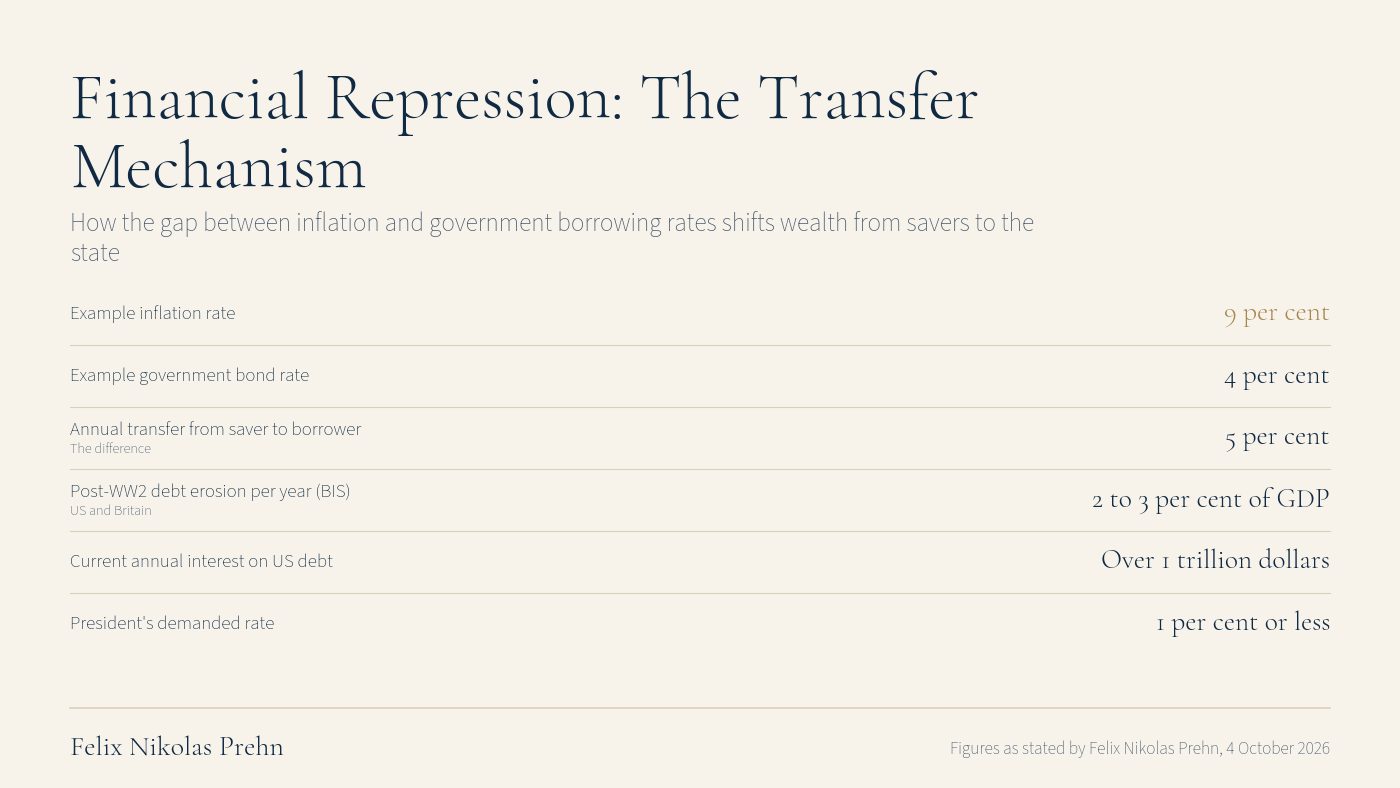
It's very simple. The government keeps interest rates that it pays below the rate of inflation. That's the whole trick. It's a magic trick. If prices are rising at say 9% and the government is only paying you 4% to hold its debt, then every single year the difference, that 5%, moves from you, the saver, to them, the borrower. You don't get a letter about it. You're going to notice just slowly your money does the hard work and it compounds in a very negative way year after year after year.
And it isn't a theory that someone dreamed up for this video. There is a Bank for International Settlements study from 2011 that actually measured and studied that. And it found that in the decades after the Second World War, this exact method wiped out debt worth 2 to 3% of the economy every year in America and also in Britain. That's how the West paid down the enormous debt ran up during World War 2.
Now, they didn't pay the debt back. They inflated it away while holding rates down. So, it's the savers who covered the bill without really asking to be the ones to pay the bill and certainly not realising it.
And think this through, say you're in charge of the United States, you're the president, right? And you have $40 trillion debt. So, you got 3 honest options, right? You can raise taxes enough to pay it down, which no one who wants to win the next election will ever do. You can cut spending enough to pay it down, which is the same problem. You're going to have to close schools, kindergartens, cut back social. No one's going to do that because you're going to be out faster than you can say balance the budget.
Or you can default. You can just refuse to pay it, which would blow up the entire system. It would blow up every pension. Everybody would be poorer. The world's economy would collapse. You would cause 1929. So none of those 3 things can happen.
So you go for the 4th door. You do not pay the debt. You shrink what it's worth. You debase the thing that's measured, which is the dollar. You inflate the assets and you let the wages fall behind and you simply manage the complaints as they come in and realise most people are not really going to notice until it's too late and you're out of office.
There was never another politically survivable plan for a system carrying this much debt. It's the only door available to them. And they've just told you they are walking through it. This is no longer a conspiracy theory. This is confirmed by the commander-in-chief. I should probably say the money printer chief.
So if you followed what I've just laid out, you've probably felt your stomach drop a little, right? So I'll say that plainly. In this plan, your savings are not the thing being protected. Your savings are the ones paying for it. The cash in your account is literally what they're spending to shrink the debt. Your salary is what they're using to pay for the debt. So, if you're sitting still and you're doing the sensible thing you're always told to do, well, it guarantees that you pay for this.
So the only real question left is which side of this do you want to stand on. The side whose assets rise in value while this happens and therefore get wealthier, or the side whose wages fall behind, whose savings fall behind as it happens, because those are the only two seats. There is no third or a fourth door. You haven't got the luxury of being a politician. And I want to teach you how to be on the winning side of this.
And I want to do that with you live. I want to do that with you for 2 hours because that's how long it takes to get this down. And I actually see this as the greatest stock market opportunity before the end of the year. And I'm going to walk you through live how the money printing and the inflation actually moves markets. Which kind of assets have historically done the work in that period that's good for you. What industries do better in this inflationary world we're entering into?
And which ones historically have got lost behind. And I'll show you how to watch what the institutional money is quietly doing with their capital right now. Not some theory, but the actual playbook. It is going to be live, is going to be free and there will be no replay. You have to show up in person and you can also ask me questions. So if you are keen to come out on the right side of this, click on the link down below in the description, get yourself a free seat.
There is no catch. There's no credit card. This is completely free. It works if you're in the US. It works if you're in the UK or in Europe. By the way, this affects everybody in the world because US inflation spills over. And you go to greatestplaybook.com, links in the description, and you grab yourself a seat. And I will see you on the weekend, I'll be nearest Europe at the time.
But let me just show you the catch first of this plan. And the catch is the whole reason there is a deadline on all of this financial repression, which is what this really is. It only works if a government can borrow at a rate below inflation. That's the entire plan. And right now the US government cannot. The government is paying more to borrow than prices are rising.
Not sure how clearly you can see this chart here. Maybe we can put a bigger one on the screen hopefully for you. But there are two lines here. The little dashed line is the official inflation number, CPI. They call it consumer inflation. The solid line is how much the US government has to pay for interest for a 10-year bond. And it's the highest level, and you can see that here since 2023. Certainly higher than since any point since, actually it's higher than any point since 2019 at this point.
So the debt at this point isn't shrinking. It is actually getting bigger and it gets worse because of the size of it. The interest on the debt now is over $1 trillion a year. And every time an old cheap loan, because they have these old cheap loans from when we had zero interest rates, and those come due and get rolled over at today's higher rates, it gets more and more expensive. It gets harder and harder to do this task.
So the longer rates stay up there, the more the whole thing compounds against them. So they are on a clock and because they're spending more and more, which is what this crazy chart is, and because the longer the interest rates are high, the bigger the bill gets because of all this refinancing they have to do, they know the math gets worse every single month. Which tells you exactly what has to happen next for this plan to work. They have to force the interest rates down well below inflation and hold it there.
That's the only choice they have. And that's the thing pencilled in with a date against it. The president is publicly demanding rates of 1% or less. He's told interviewers the people setting rates are hurting the country more than inflation is. And his own pick now sits on the board of the Fed and makes those decisions. And there's a rate meeting before the year is out.
And you don't need a secret document. You just need to watch who's being appointed, what they're being told to do, and when they next meet. And that's also the kind of moment where it pays to know exactly which companies are standing in front of this train right now. So if you want to look that up, and I would definitely do that, there's two things I would do.
I would right now go into the Winston app and I'll put a free link down below for a trial and you can look at how exposed are you to inflation. And I just put in here Google, Intel, some of the stocks that I presently own. And it shows you in green the sectors and where your stocks are that are safe-ish. And then in red the stocks that are most affected in a negative way by inflation. That's the first thing I would look at and that way you know what your exposure is to what's coming.
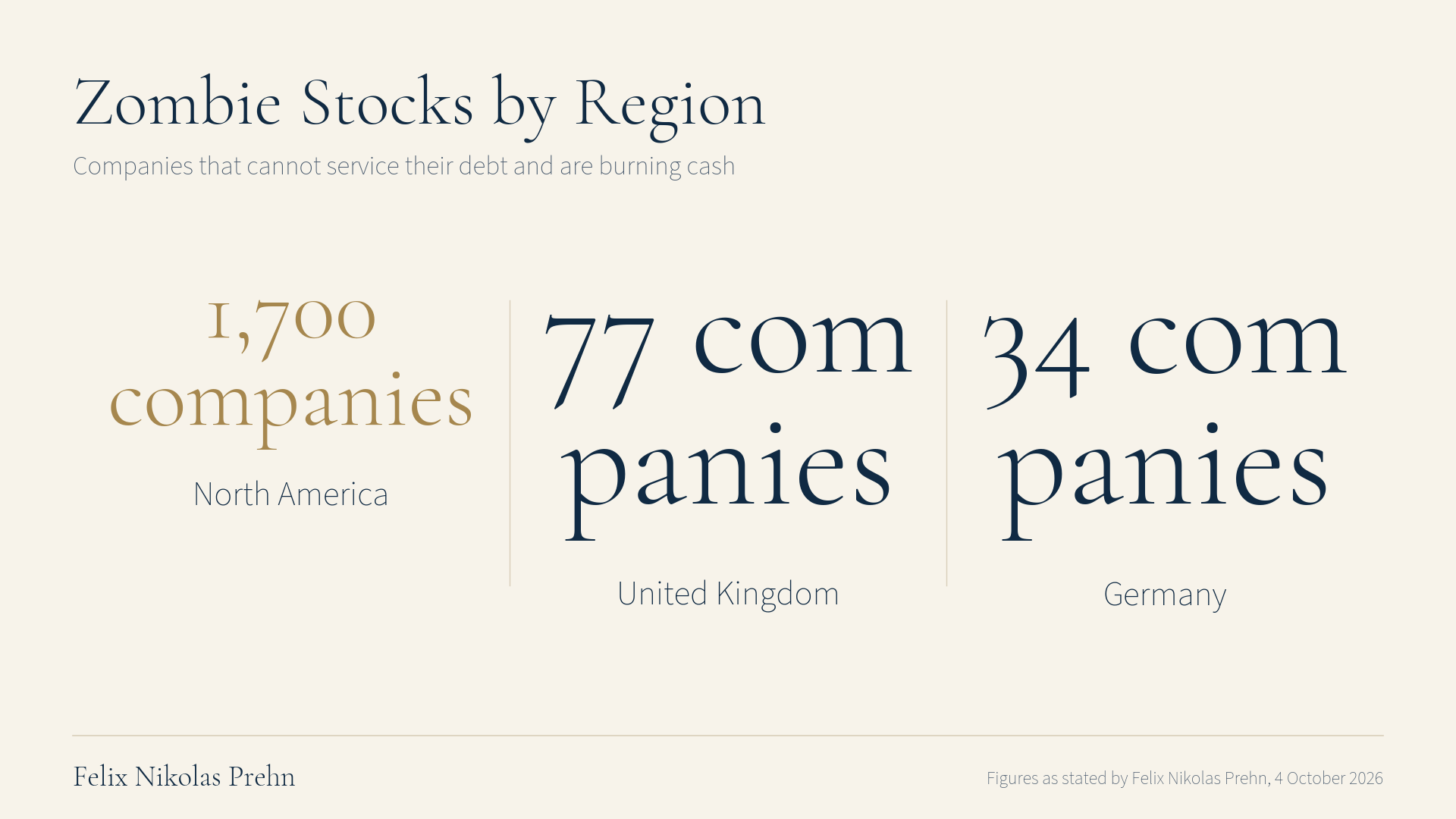
Then secondly, go into the stock filter and click on danger zone. Silly name, but it basically tells you the companies that cannot service their debt and are burning cash. Those stocks carry extreme risk. And right now, there are 1,700 of those just in North America. If you think you're in the UK and you're safe, well, there's still 77 in the UK. Even the Germans, who are very, very responsible with their borrowing, I'm one of those, they have 34 zombie stocks. Check out whether any of the companies you own are zombie stocks. You might want to know that.
Let's make this really, really clear. Someone's got to pay for this debt. You can't forgive debt. You can't magic it away. That's all nonsense. So let me tell you the part that doesn't make it into front pages because it isn't very popular. This is going to fall onto one very specific group.
When you debase the dollar and inflate away the debt, the people who own the assets, the shares, the property, the gold, they get wealthier and we don't have to lift a finger. Their stuff is priced in dollars and the dollars are being made smaller. So the price of their stuff goes up. Now people who don't own these assets or not enough of these assets, they're the people who hold their wealth in wages and in cash. They fall behind. Their pay now buys less each year. Their savings melt.
They end up taking on debt just to stand still. And it's called a K-shaped economy. And it's basically this here. Not the greatest chart in the world, but it's from the Fed. One line goes up. That's the share of net worth held by the 1%. And then the little dashed line down there is the share of the wealth held by the bottom 50%.
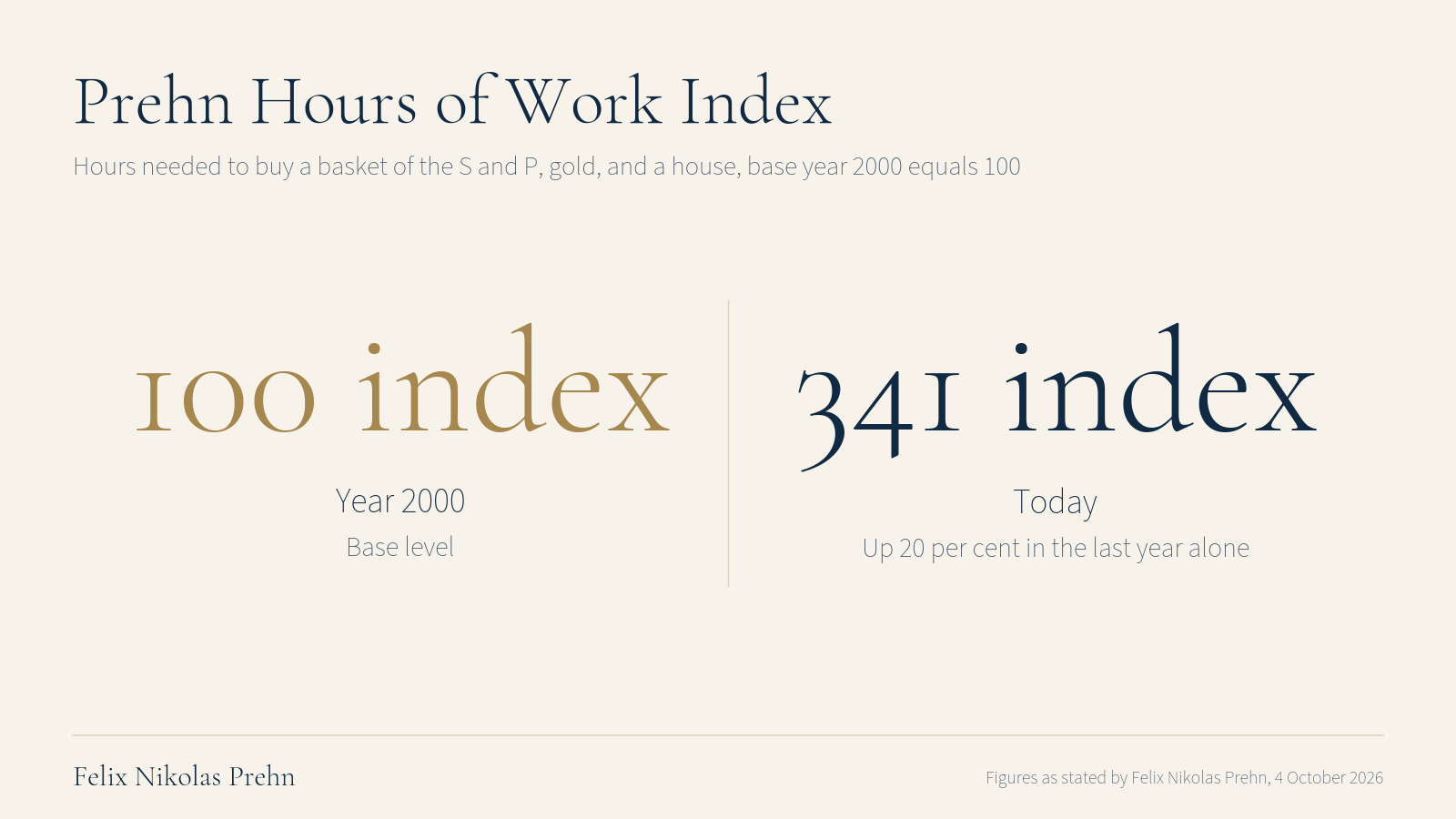
And it's called a K-shaped economy because it's like a K. It widens. A policy of inflation widens this gap more and more and more. And you can measure exactly how much ground the ordinary salary man has lost. And we've done the measuring at the Prehn Institute. That's what we do now. We do some research and one of the things we've done is we put out the Prehn Hours of Work Index and it shows you the hours to buy the basket of the S&P, gold and a new house.
And in 2000 that index was at 100. Now right now it is at 341. So you don't need to be a rocket scientist to figure out that it now takes 341 hours to buy what it took 100 hours to buy in 2000. So the question to ask is simple. How many hours does an ordinary American have to work to buy the things people save for? A slice of the stock market, an ounce of gold, a piece of a house. This has gone up 20% in the last year alone.
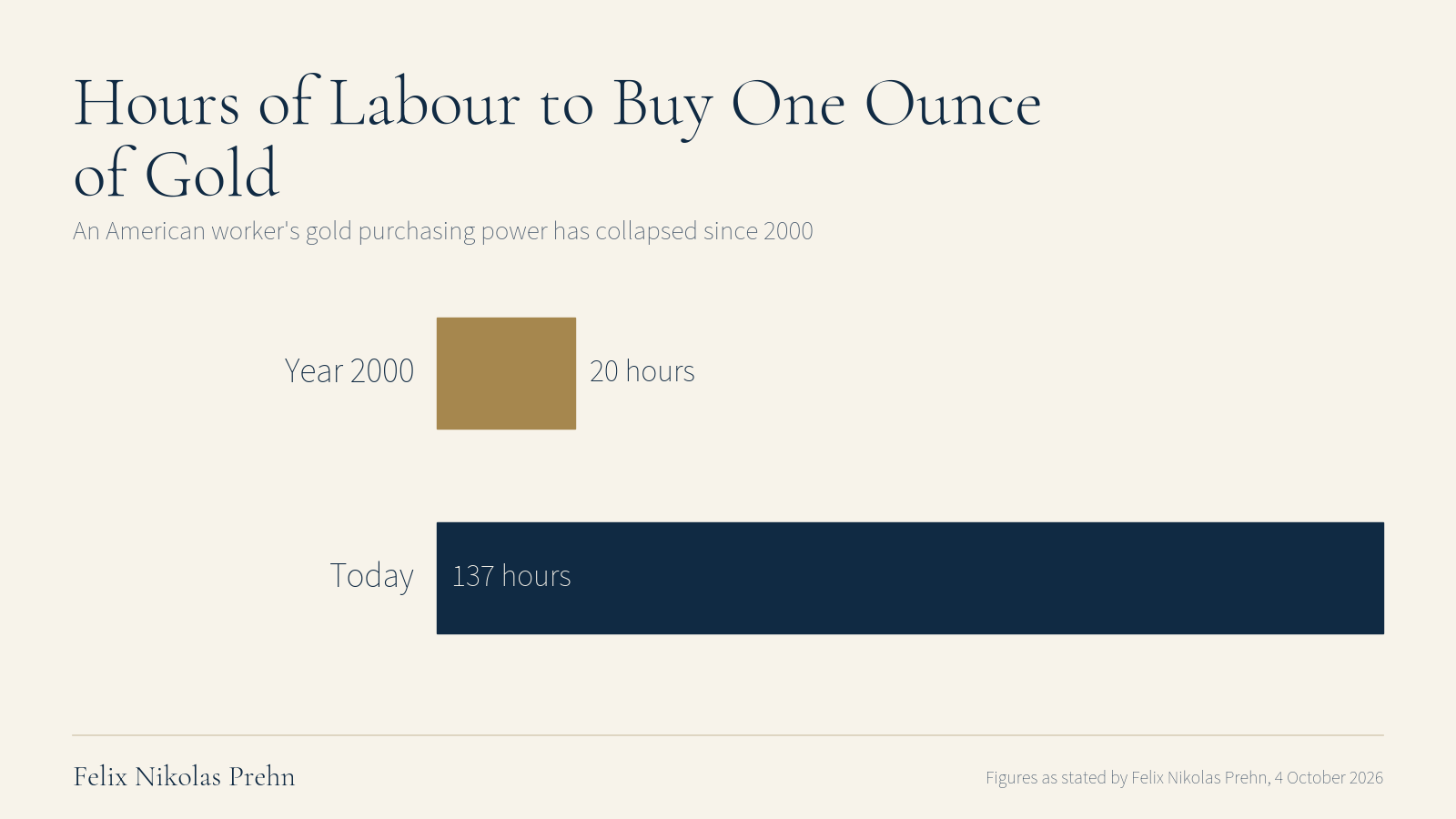
And if you look at just gold on its own, in 2000 an ounce of gold cost an American worker about 20 hours of labour. They could literally buy 2 ounces a week. So 20 hours for that. Today, one ounce of gold costs 137 hours of labour. So your hour of work didn't get weaker. Still doing the work. But the dollar you are paid in is worthless.
And if you look at the house, just a normal the median average family house, a house now costs the best part of 6 and a half years of a typical person's entire income before tax and everything else. So 6 and a half years of every penny earned before food, before rent, before a single tax is paid. Now a generation ago that number was a fraction of what it is today. And that's why the losing line of this K actually feels pretty shitty to the people affected.
So you're working harder. Your pay packet has a bigger number on it than what your parents ever saw. But the basic things of life, a house, keep drifting further and further out of reach.
Then we come to what's probably the hardest part here and the title of this video. Because to keep this machine running, they have to sacrifice something else. And it is a little bigger than
Most people realise forcing rates below inflation does something to the dollar itself. If you're a foreign government or a global investor and America is deliberately paying you less than inflation to hold its money, why would you hold its money? You wouldn't, would you? You take your money and you put it somewhere else where it's treated better. A weaker dollar deliberately engineered is the price of making the debt lighter.
The dollar's great privilege is that the whole world holds it, trusts it, settles all its trade in it, and that is what lets America borrow so much so cheaply. Now, what financial repression does is spend that privilege. The standing of the dollar in the world is eroding. Its special status is fading and the people running the policy accept that because the alternative would be to pay down the debt. Honestly, politically not survivable.
So there's a serious warning attached to this and I want to give that to you very clearly. One well-regarded strategist laid out that a weaker dollar and higher inflation really yes can shrink the burden. Britain did its version of that after the war. Dalio called it a beautiful deleveraging. But he added the sting. If the policy looks erratic, if it looks like the people in charge are improvising, then the trust in the dollar does not fade gently, it can break more dramatically and the money will flee.
And instead of shrinking the debt, you get capital flight. You get a currency people are running away from and a debt that actually ends up larger, not smaller. And if you look at this little chart here on the screen, again, hopefully we can find a bigger version of this, the dollar share of world reserves has been drifting down for years. Central banks have been adding gold and trimming their dollars.
So this isn't a crash. It is this voluntary sacrifice. It's designed to be like this, not a dramatic event. It's not all going to happen on Tuesday or something like some lunatics tell you. No, but this direction only goes one way while the plan is underway.
So now you know the bet being placed with your money, that they can debase the dollar just enough to lighten the debt, sacrifice just enough of the global standing to keep the system alive and manage the consequences without the whole thing getting away from them. It's the most consequential gamble in modern finance since World War II. And it's being quietly, deliberately, and with almost nobody voting for it, done at the highest level.
So this is really a story that is about which line of that K-shaped chart I showed you you want to be on. You are left with one plain instruction here that the people in charge have in their own words just handed you. You know this is not about genuinely fixing the debt. It's about surviving the debt at your expense. And you can't vote this away. Whoever you vote for is going to do the same thing.
But you're also not helpless. You get to choose which side of that widening wealth gap you stand on. The people who come out of this intact or even richer will be the ones who understood it early because they understood that sitting in cash, sitting on the sidelines feeling safe, is the one that's guaranteed to be on the losing side of this. And the ones who move their wealth into the things that hold value historically while the dollar is declining in value are the ones who come out of this smiling.
And that's what I'm going to walk you through live and for free for literally 2 hours this coming weekend. I call it the greatest stock market opportunity before the end of the year because once you really understand this, you actually see there is a massive, massive silver lining, maybe even a golden lining to this. So come and join me. Come and join and learn how the institutional money is moving their money about as a result. It is live. There's no replay.
It's open to anybody whether you're in North America or in Europe or the UK or anywhere else in the world that it should work for you time zone wise. So don't be the person who watched rather lengthy videos. I apologise for that. I just think it's too important to not explain this clearly. And then be aware of it and then do nothing about it. Be the person who does something about it and actually come out of this thriving. And if that's what is going to be you, put a thrive in the comments so I know you'll be there. And I look forward to seeing you on the weekend.
Right now, I think we're going through some sort of weird phase transition. And normally when you get bad economic news or you get bad jobs data, people are going to fly to safety into the bond