Transcript
The biggest rally of our lifetime may have just started this week. That's what Winston just told me. And it is set off by the one thing everybody was told would crash the stock market. For months, people had warned that this exact election result, a Democratic sweep would wreck voices and stocks. So, they sold.
They went to cash. And 90 per cent of them are now sitting there waiting for a crash. Well, that hasn't really come. unless you're one very specific sector.
And this has happened seven times since 1954. If you've been watching me, you already know about this. A Republican president loses both halves of Congress to Democrats. A year later, every single time stocks were higher and this week made it the eighth. Wall Street knew the Dow has had its best day of the year, but the market does not go up as one.
And maybe some of you are in pain. If you're in pain right now, put pain in the comments down below. It's all your fault, but we'll fix it for you. Because while the Dow threw its party, one corner got hammered and the stocks everybody had piled into for the last two years dropped under a line that the pros watch harder than almost anything. Now, the next thing is annoying, but I was positioned for that before the votes were counted.
I will pull up all of this life in a minute, including how far stocks ran those seven previous times. So stick with me. This one really, really does matter. My name is Felix Nicholas Pin. I'm an economist and former investment banker.
I'm also the founder of the PIN Institute where we publish research on financial markets and also instructions on on how they actually work. I take zero sponsorships, zero endorsements ever. So I can say whatever I like and that's just the way I like it. And no, this is not a political video. I get accused of that all the time.
I don't care who you voted for. Red, blue, green, yellow, whatever. It's fine by me. Your money doesn't have a party and it shouldn't. So, there's a lot of stuff that's moving this week.
Very, very important to understand the election, oil, the chip stocks, gold, the lots. I put all of that research behind this video into one free report from our institute. It's got the full table of those seven elections with what stocks did one month, three months, six months, 12 months later, the sectors that have tended to lead after midterms, the ones that have lagged, a checklist, tons of stuff. It's all free. felixfriends.org/boom is where you get that. It's down below in the description in the link as well.
And I absolutely love that you're watching this because I love people who want to learn about how the markets really work because in my humble opinion, it's the path to freedom. So, let's start with the bit everybody gets raw. For most this year, you couldn't open up social media without someone telling you the stock market would crash. I may have been guilty of that once or twice myself, but once you make it past the headline, you'll understand what I'm actually talking about. If the Democrats took Congress, people were saying this, and I saw one post this week that put it perfectly.
Somebody wrote out this line, "The stock market will crash when Democrats are elected." And underneath it, it said the market, and it showed a chart of a dollar invested in American stocks since 1926. Well, have a look at the red presidents on this chart. It's on the screen here. Blue president. And what happens?
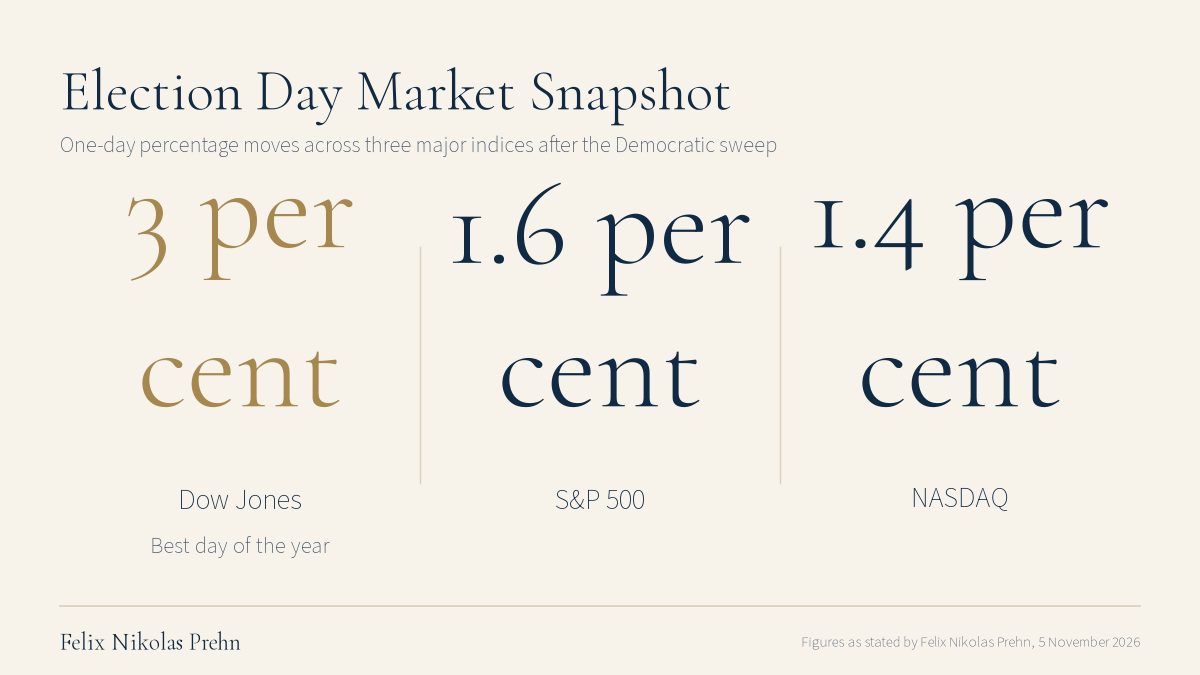
Well, the line just goes up and up and up and up. Nearly a hundred years of it. Then the results came in. Democrats took the House and the Senate. And the next day, the Dow Jones, which tracks 30 of America's biggest, oldest, shiniest companies, went up 3 per cent.
That's 1500 points. Best day of the year. The S&P, America's 500 biggest companies, went up 1.6 per cent. And the NASDAQ, which is stuffed with those technology companies, was up 1.4 per cent. So, who got hurt?
Well, not the people who did nothing for once. The people who got hurt are the ones who did something. They sold in October and they went into cash because they got scared and now they got a terrible choice. Buy back in higher or sit and watch. There's a second group that also got hurt and they don't even know it yet.
Say you're, you know, 50 years old. You did everything right. You put your money in a big fund years ago and you got on with your life. You worked hard. Well, look at your fund this week and it probably looks fine because the index went up, but underneath it was carnage in places.
Energy stocks down over 6 per cent. This is a sector rotation thing you can track in the Winston app. Links down below, free trial and all that you don't like if you cancel it. So, the chip stocks also fell through a line the professionals treat as the difference between an uptrend and a downtrend.
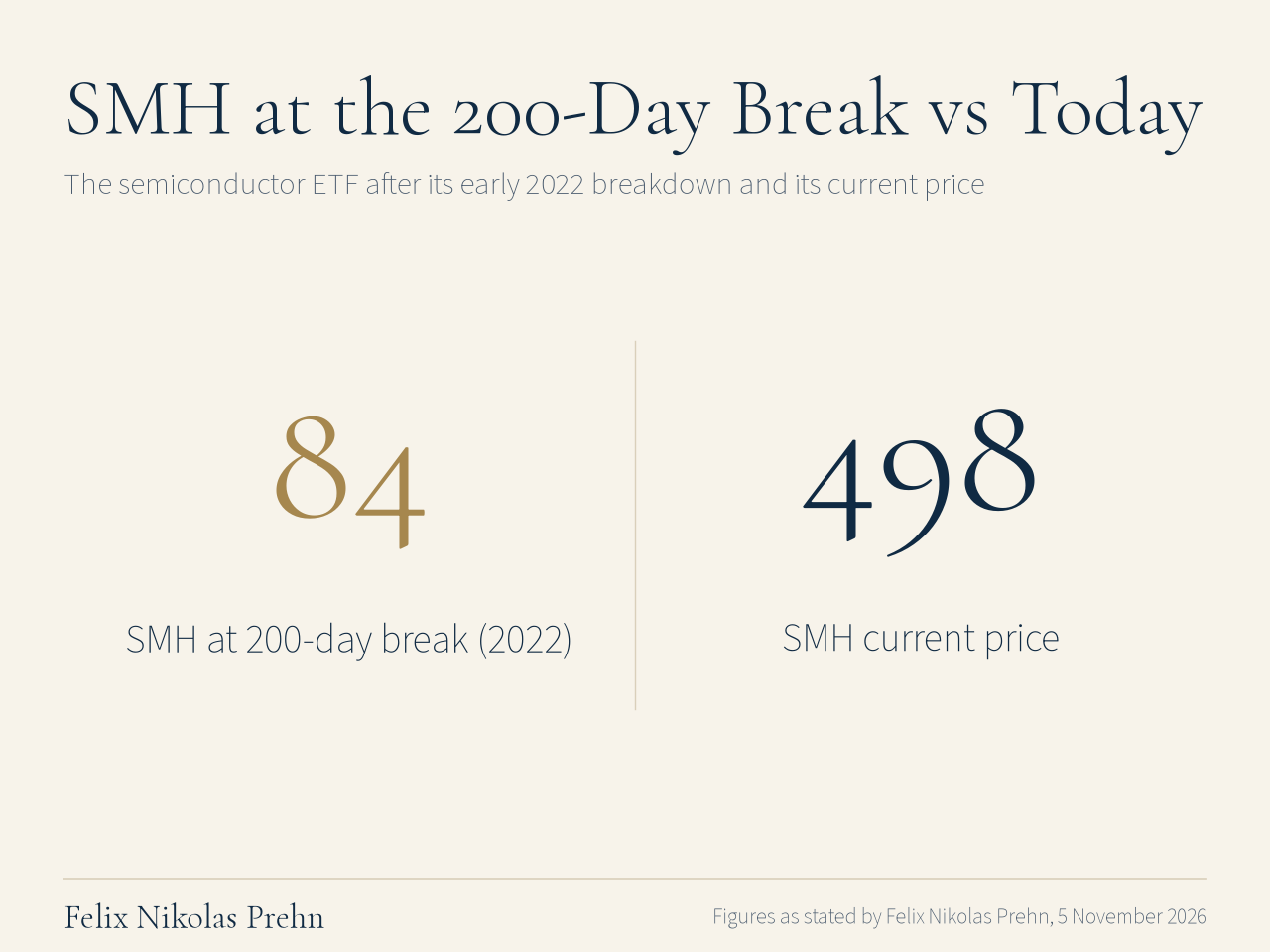
And I put it on the screen here for you. This is SMH, which is the semiconductor index fund. the sort of major one and there's the line on here which is blue right and I have to check the glasses make it green and um it's it's my version of you know LSD it's it's it's healthier for you and um that 200 day moving average line which is what that is we've just dropped below it was the last time we did that well we last did that in April 2025 which was actually a pretty good buying opportunity if you go back to it right the previous time we did that meaningfully was in September mber or rather sort of early 2022, right? It was trading at 84, then it's trading at 498 right now. Again, I'm not telling you to buy this. I'm just saying these little dips have historically been pretty good.
Why? Because the world actually runs on semiconductors whether you like them or not. So, what went up? Well, consumer discretionary, consumer staples, real estate, financials, healthcare. These went up against more than the index, right?
If you look at the absolute returns, they did even better. But I always like to go look at compare it against the index because that's kind of tells me a lot more about where the money is really flowing. But you can see some big beautiful winners and some pretty horrendous losers. But remember the market overreacts both ways every time. It overreacted to the fear in October.
Some corners overreacted this week in my humble opinion. And if you can't tell which bit is the overreaction, you end up selling the bottom on the one thing and holding the top on another.
And it's never really very much fun. And spotting that is a skill, a skill that can be definitely learned. So think about where that leaves you right now. Your money is sitting in a market that just changed leadership in 24 hours. Oil fell 8 per cent in a day.
Energy got thrown out of the window with a baby in the bathroom water, right? Um which is good for me because I made money out of it. But the chip stocks that carried the whole market for two years, they're like beaten up and crying in the corner. And at the same time, the shops, the banks, the big platforms that own the data centres were bid apart. I explain to you why that happened.
But if your money is in the wrong pot, and these are just 12 of these pots. They're actually about 150 in total, but this is just a simplification. Well, it doesn't really matter how good the index looks. You lose. You lose slowly, and you don't notice until, you know, your retirement gets pushed back by a few years.
In my humble opinion, the window on this is short. Look at those seven elections again in a minute and I'll and you will see the biggest part of the move came in the first three months. On average, stocks were up more than 10 per cent within three months of that vote. I'm not promising you that I haven't got a crystal ball, but that's the historic pattern. The clock started ticking on Tuesday.
Spotting where the money is going next is a skill, a skill you were never taught because school and college is largely useless when it comes to money. So, our whole mission here is to write that wrong. So, this Saturday, the 7th of November, I'm going to teach you live and for free. And I call it the great pivot because the money pivots from chips into something else. It's at 9:00 a.m.
New York time, 2 p.m. London time, 300 p.m. If you live on the Soviet continent of Europe, uh if you're in Asia or down under, you're going to have to figure out what time it is. You may have to be up a little bit late and ask for parents permission. And our goal there is to leave you with a game plan for not just this market but for every market to come so that you are more skilled.
Not a stock tip list but make you more skilled. So on Saturday I'll show you exactly how I worked out what was actually going to happen here. And I'm not always right. Absolutely not. But the point is not to be horribly wrong.
And if you just learn that you're going to do a lot better. So join us at greatpivot.org. Link is down in the description down below. Dualingo stock is flying by the way. Apparently everyone's going to learn Spanish in the US.
Uh so back to those seven elections. This is a chart from I don't know who.
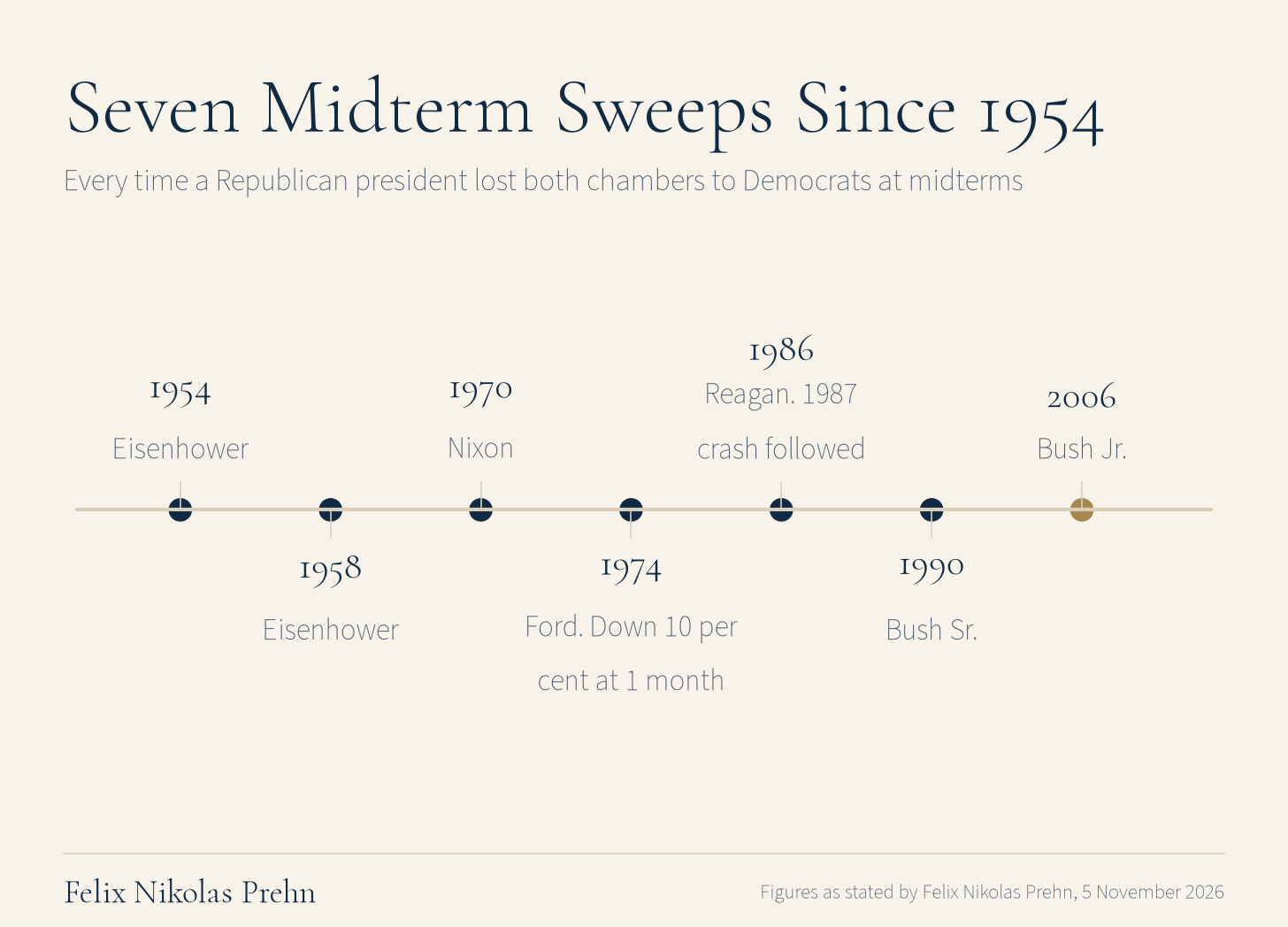
Um looks a bit like the FT but it's probably AI. Um it shows every time since 1954 that a Republican president has lost Congress to the Democrats at midterms. 1954 and 1958 that was Eisenhower. 70 was Nixon. 74 was Ford.
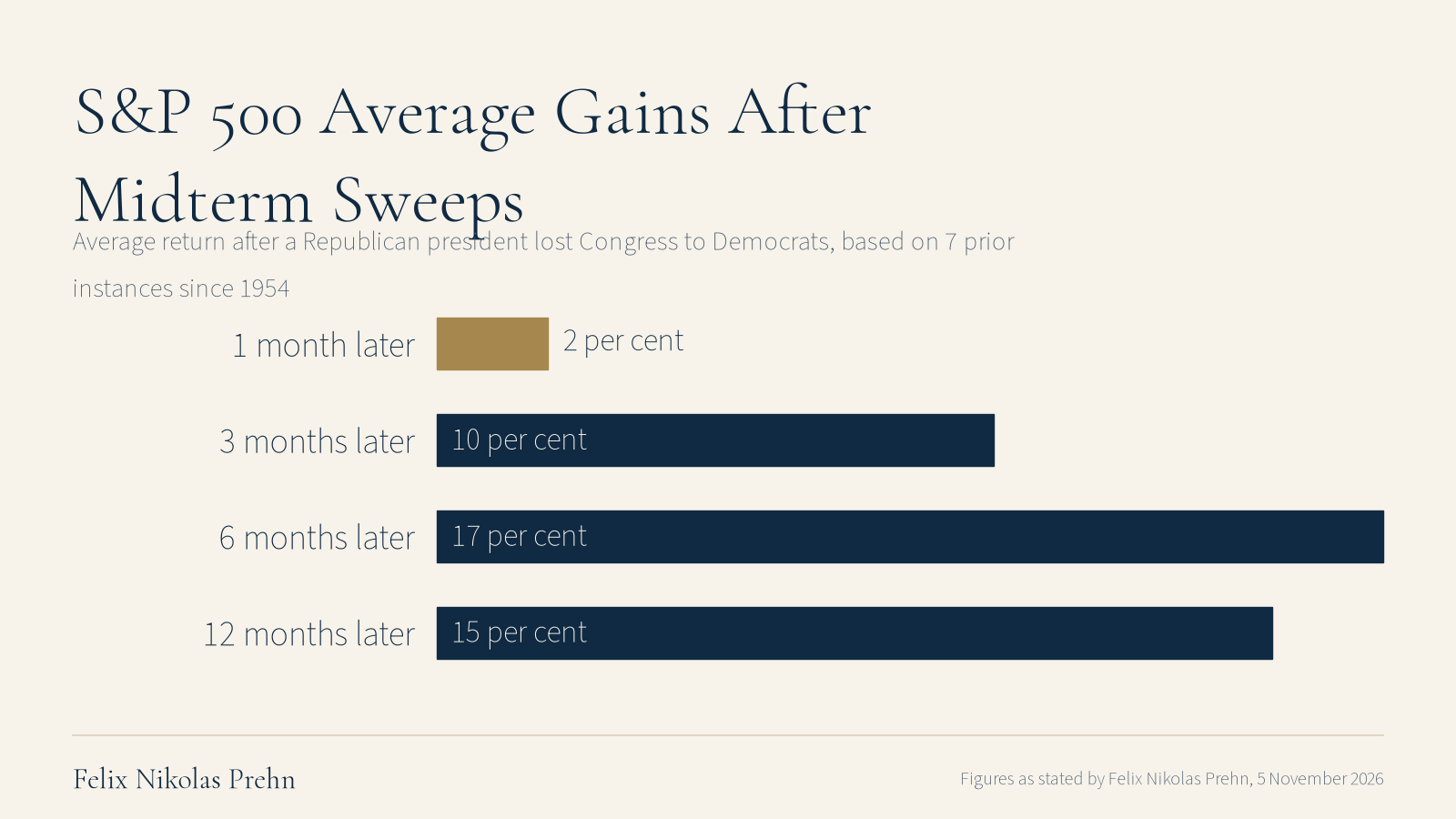
86 was Reagan 90 under the you know Bush the the primary uh and then 2006 under Bush the secondary and that happened seven times. So it also shows what the S&P did afterwards. That's what these little bars are. One month later 2 per cent up on average. 3 months later 10 per cent up on average.
6 months later 17 per cent up on average. And a year later 15 per cent up on average. Positive all seven times. And that's pretty extraordinary, isn't it? 15 per cent in a year on average after the exact results that some of you are celebrating and some of you are terrified of depending on what side of the aisle you happen to wake up.
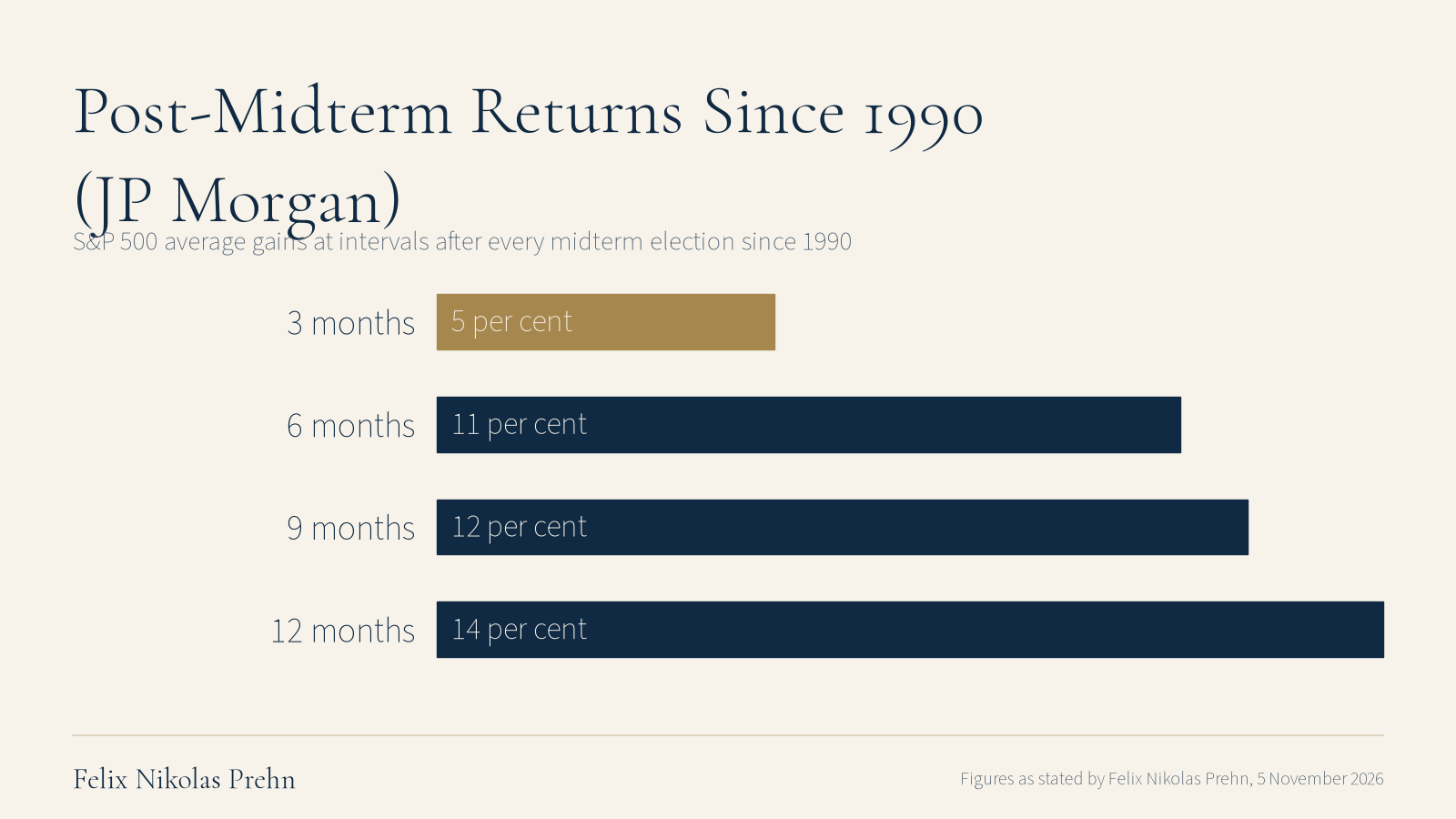
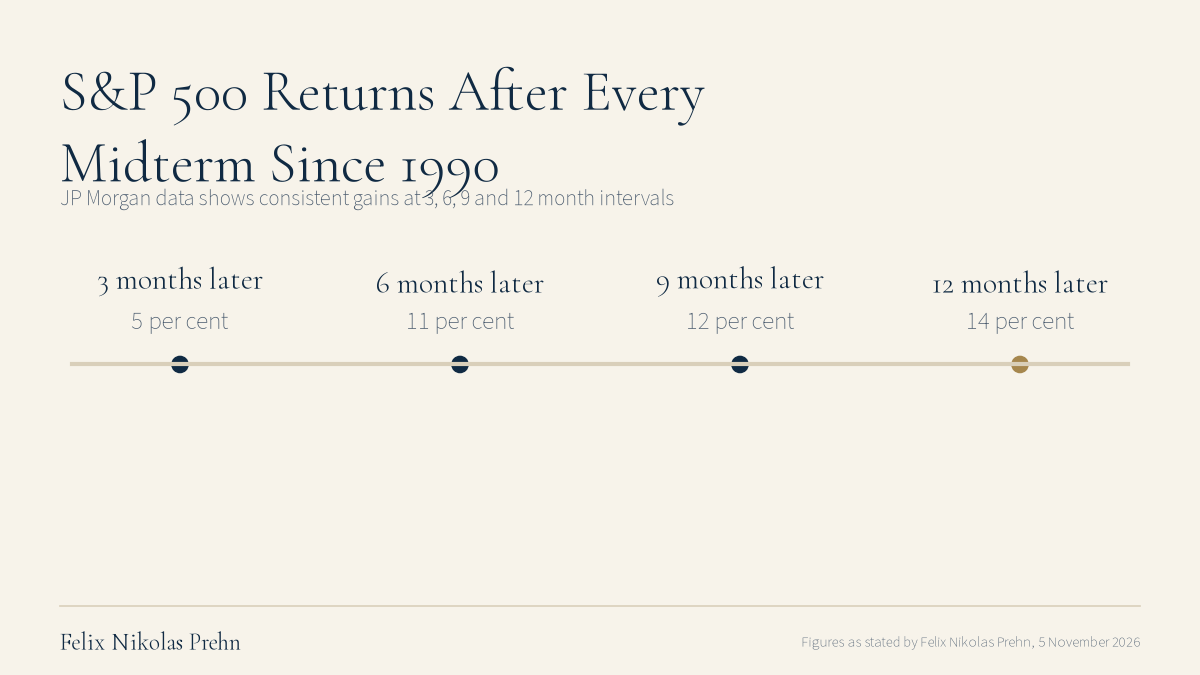
And Trump is now the eighth president on this list. And it isn't just me putting this out. JP Morgan, the mighty, their market intelligence team, which apparently is the most intelligent team in the world. Just ask them, they'll tell you. They put out a note this week and they say the S&P 500 has been up a year after every single midterm election since 1950. who ever won with an average gain of around 15 per cent which is what I just talked to and since 1990 they've broken it down even further.
Here it is three months after the midterms 5 per cent up six months after 11 per cent up 9 months after 12 per cent up a year after 14 per cent up and so on. So it's been up every single time since 1990.
So why why would Wall Street cheer a government that can't agree on anything because that's what's going to happen. But let me put it in in in in as plain English as I can. When the White House and Congress are run by different parties, almost nothing big gets done. Taxes stay where they are. Regulation doesn't really change.
It's like having well gridlock. And guess what? The market loves gridlock. The more gridlocked your government, the better the stock market. Why?
Because it's predictable. We know nothing big's going to happen. No bright shiny ideas, no new, you know, let's save the world type things. Um, wonderful. If you're an investor and maybe you think it's terrible because you really wanted your party to do something particularly special, but you know what?
The stock market, your money doesn't care for special or any kind of change. The right now the constant is just about good enough. Now, is there an exception to this? Yes. Ford 1974, we were down 10 months 10 per cent a month later, 18 per cent up a year higher.
Why? It was high oil and sticky inflation. And there's of course some parallels to what's happening in the Middle East there. So pay attention to that. And Reagan just did a well it was up a per cent later because we had the 1987 crash.
So this does not say be blind everything is going to go up in a straight line by the way. Right? Always invest and trade with a plan. But let me just break down one or two more of these rotations because it's so important that here's that table again I was just showing you. And it's really really personal to you and your portfolio because the market is not one market.
It doesn't go up as one. Right? Look at the sector rotation again. It splits the American stock market into its 11 big sectors and it shows which ones are leading and which ones are lagging. And I've got it set to just one day last day, right?
Day after election. And I compare it against the S&P 500 here. And energy went down over 6 per cent against the market in the singleton. So the energy sector, which is an index fund called XLE, fell like just under 5 per cent that day. The S&P went up 1.5 per cent that day.
So, you know, there you are. Industrials were down, technology was down, utilities were down. Meanwhile, the money poured into shops, restaurants, consumer discretionary, the stuff people buy when they feel good for the same day, same market, and the gap between the best sector and the worst sector was almost 9 percentage points. And that's what I mean when I say money doesn't leave the market. It moves from one pot to another.
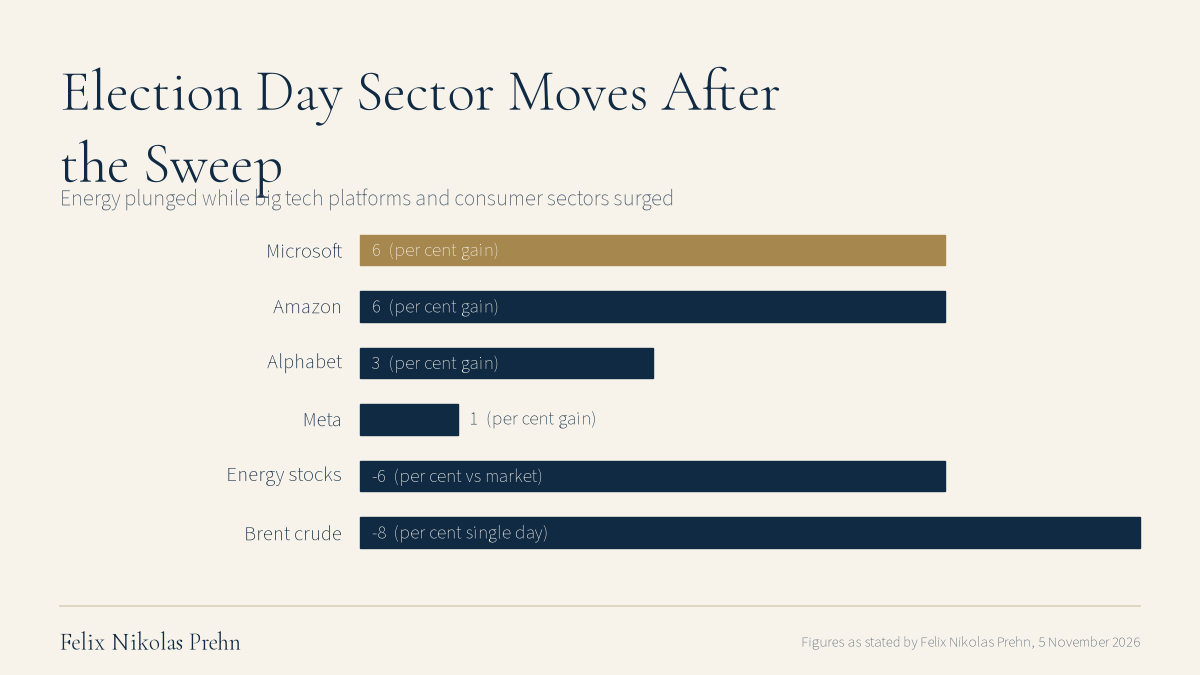
So, why did energy get hit so hard? Well, oil Brent crude the global oil price fell 8 per cent in a day. Why? Because people will think that Trump has less backing to continue the Middle East war because he has just less sort of political cloud right now, right? And here is that actual chart and you can see the the harsh pullback.
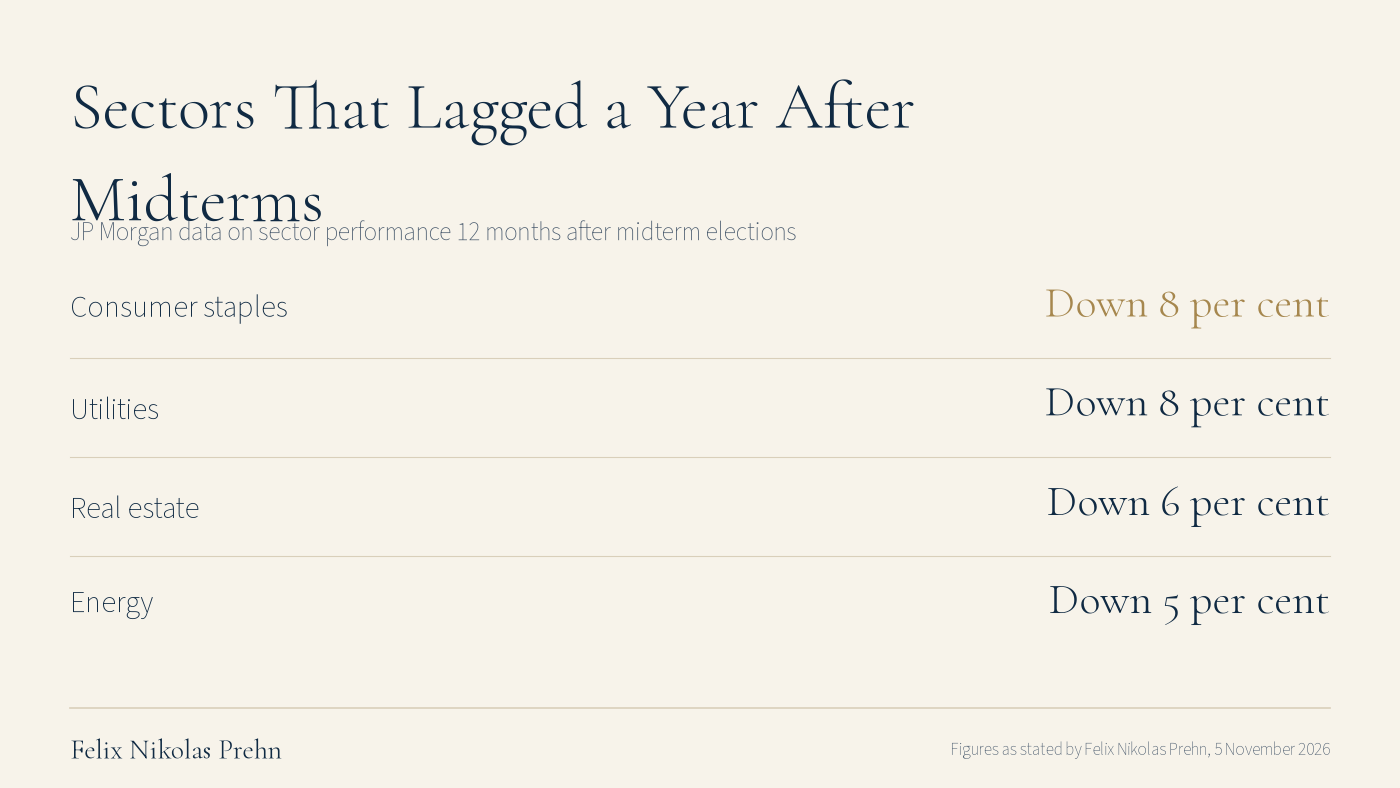
You can see this consumer discretionary which is absolutely flying. So, what did I do before this election? Well, I was short energy and I was long most other things. Uh, doesn't really matter what I do, but maybe take a screenshot of this one here because this is actually quite important. A year after midterms, again, this is JP Morgan data, you know, hail the the mighty uh and and all that.
There really are wonderful people, the best people in the world. Absolutely. You know, cure cancer and everything else that just in it for the little man and then saving humankind and you know, that kind of thing, which probably makes me get away with using that charts. Um, so yes, the index did well, 15 per cent up almost on the year, but look at consumer staples. They were down 8 per cent on the year.
Energy was down 5 per cent on the year. Real estate was down 6 per cent a year. Utilities went on 8 per cent on the year. So, it wasn't bloody equal, was it? It wasn't all the same.
So, if you potentially want to outperform, you might need to understand at least these 11 sectors and what it moves them and why. I think oil is really the one to watch. Let's see what the American buildup in the Middle East is doing, whether we're going to see another, you know, bombardment or whether it's the final fireworks or or whatever. We'll see. And that'll obviously have an impact.
But if you are like many people just purely in chip stocks, and this popped up in my Twitter feed, and I don't know who this guy is, no diss him whatsoever, but he says, "We are effed. Absolutely effed.
The AI trade is over. We all top blasted and holding bags now. I can't believe it. How could we have been so wrong? This market makes no sense.
My spleen hurts. I haven't seen green in such a long time. I miss money. I miss smiling. I miss sleeping, not checking my phone every one minute.
I miss waking up happy. I should have stayed in cash. Um the problem is that this chap unfortunately gives you real-time alerts, those trades, and presumably there's a payment for that. the delight and and I guess imagine that this is his portfolio yesterday which is basically a pure bet on pure AI, right? Which is just unfortunate. I feel very sorry for the chat, but he doesn't realise that there is a world out there that isn't AI.
He doesn't realise the healthcare stocks, real estate stocks, consumer staple stocks, material stocks, really boring crap that would have shielded him from this horrible thing that's now making him lose sleep. And my goal is that less and less people will make those mistakes because yes, semiconductors got clobbered like a baby seal. That's a professional Wall Street term by the way, not mine. It's a very nice term, is it? Um but um if you bet all your money on one thing and if you're feeling some pain right now, use it as a lesson.
Use it as a motivation to not do it again. Because this chap I just showed you clearly hasn't learned the lesson because he then rambles on about how hedge funds manipulate the market and and and you know all that sort of stuff. Doesn't for a second think that he might have a skill gap and that he's actually to blame for it. Right? I'm always to blame for all my losses.
I'm also to blame for my winners. And it's the same for you. If you want to take credit for the winners, you need to take credit for the losses. And if you have outsized losses, and outsized simply means you are checking your phone every 5 minutes, you're not sleeping well, you're thinking about it, and you're not a happy person, you've got too much risk on, right? So, we need to do something about that.
So, come and join us on on on Saturday and we'll we'll we'll fix that for you. And quite honestly, I think we're nearing a point where semiconductors are becoming an opportunity again and I will I will then, you know, buy them again. um not quite yet but I will at some point. But the real play, this is really what I wanted to understand is there were a lot of stocks that did really well in the last day. And who was it?
It was Amazon. It was it was Google. It was um Microsoft. Why? Because these are the guys with the biggest data centres on the planet and they're already built.
They've already got power. And if we're now entering a world where US now democratic states like Texas will say, "No, we're not going to build as many data centres because we're short of electricity or whatever." Um, then who benefits from this? Well, these guys effectively become monopolies. And all these neoc companies and the memory and the chip guys and so on, they love less demand. But it also means if you're Microsoft or Amazon or Google, you can now justify spending less on chips and memory and data centres because they can't get build.
But you're still the guy with the biggest, you know, data centre. That's what you're thinking, isn't it? Um, and and therefore, you win, right? It's actually brilliant for them. So, if you were Microsoft or Amazon or Google, what would you have done?
You would have funded the Democrats in Texas to your heart's content, right? I don't know if they did that, but that would have been the smart thing to do from a pure money point of view because Texas really matters. Texas has 27 per cent of all planned American data centre capacity, says Wellelss Fargo, who also getting clobbered to death yesterday. The new governor said, "We're going to have a moratorum, which is a fancy word for we will all die." No, it's a fancy word for uh we will freeze everything and not approve another one. They also want Georgia, Ohio, and Pennsylvania apparently, and they'll do the same thing there.
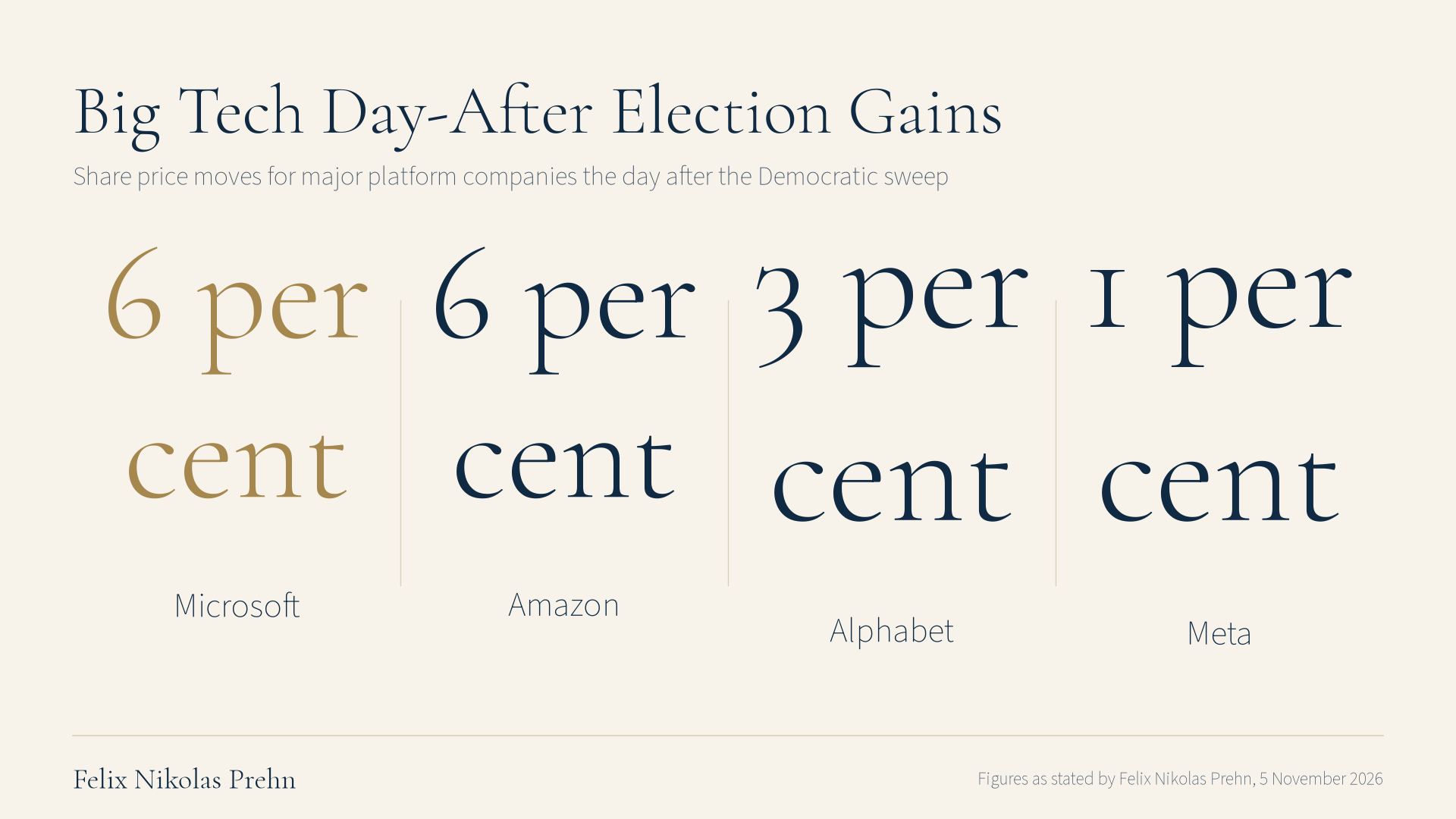
So Microsoft up 6 per cent, Amazon up 6 per cent, Alphabet up 3 per cent, Meta up 1 per cent. These guys win, chip suppliers lose, the builders lose, Coreweeef, Nebus, Irene, all these, you know, these companies are amazing. Now some of those companies, if you go back into them, they used to mine cryptocurrency about 18 months ago and before that it was whatever the latest thing was. So always be a little bit careful with companies that chase after the latest thing. So some beautiful charts here on on on some of the big tech guys.
Um but the chip guys will have to adjust potentially their their future because the chip orders will get spread over a longer period of time which will slow down uh their their growth and and neoclouds um well I've warned about that previously. Uh it's a not where I would put my money. Core we here uh I I trade it sometimes. I make money out of it hopefully. But yeah now there is something that is important.
The market overreacts. So always look at if you want to trade something like that which is the least and and the most risky and again that's one of the things we look up in the in the Winston app. So so if you go into stocks look at look at are there any of those in the danger zone and you can go into hey say AI infrastructure and you can look at there are some zombies here call is is a zombie company. What do I mean by that? Well they've got no cash they can't pay their interest.
They owe 3.7 times the value of their company as debt, right? So, yes, they've got a bit of cash in the bank, three billion or so, but that's going to likely run out. So, these companies are the riskiest out there that I would be very, very, very cautious of. And I would look that up actually for every sector and every bit of something that you own because it's important. Again, link down below.
Now, quick word on gold. Gold's at the lowest price more or less in a year. Um, I'm quite liking it. Why? Because we've had some serious margin calls on gold.
And the more Let me pull up a gold chart for you. And the longer you get these sell-off periods, people get flushed out. So, we started to see the last two days here a little bit of nibbling 3 per cent 1.7 per cent um on on on gold again on some relatively decent volume. biggest green candle we've seen since uh you know a while since sort of August which was a mini sort of fake breakout there. So the longer these sideways journeys go on for right the longer we do bugger all essentially the better the setup because the people with we wanted to sell already sold right last year that was the setup right so we're now looking at a period that is actually equivalent in terms of length I hope it goes further and more sideways for longer because that will then potentially set up a much much bigger more beautiful more shiny any breakout and gold breakouts are very very shiny. Commerce Bank pay no attention to the lunatics say gold's October reaction was overdone.
Now I would trust Commerce Bank about as far as I can throw them. I imagine they're fairly heavy. Um but how does a margin call work? Well, say you um borrowed to buy tech stocks and your tech stocks got clobbered yesterday and they're down 10 per cent. Your broker says, "Show me the money." And you haven't got any.
So your broker will then say, "Well, sell something or we'll do it for And one of the things that's the fastest to sell, especially on a day like yesterday, was gold because it was going up.
So margin calls are a beautiful thing if you're not on them. But this is a lovely chart here and we should credit whoever made it. Uh, whoever Peter Malucas, good on you. Well done on the chart. It's a very good chart.
And he said of the last 50 years inflation was 6x. I think it was a lot more, but that's the official government lie, sorry, number. Um, treasury bills went up eight times. The S&P 500 went up 277 times. So being invested is the winning path.
Now being invested better is better than being invested terribly. So think about that like that poor chap um who is you know losing sleep right now. So be an owner. That's what I would definitely say. And just to summarise why I think this is a wonderful setup, the divided government keeps rules steady as in bug is going to happen in Washington next two years.
Uh oil could drop a lot if the appetite for bombing another Middle Eastern country into the dust uh is is a little bit less, you know, pronounced.
And historically, the pattern is that we get very very strong years after this kind of election which you may love or loaf. It doesn't really matter. Slight warning, and I would write this down. Funding runs out on the 11th of December for the US government. Uh, expect a a squabble or a wobble.
The Fed could raise interest rates in December. The market expects it. Now, if oil comes down, that won't happen. If oil stays up, that is more likely to happen. And beyond the midterms, Congress faces converging year-end deadlines.
I don't know what that means, so we'll scroll past it. And uh, yeah, chip stocks are um, under that 200 day moving average line for a reason. So, the market needs to adjust to that. I wouldn't be too early on the dip buying there. Um, and and obviously a Middle Eastern deal is isn't easy because on the one side you've got the commander-in-chief.
On the other side, you have the uh um almighty himself, the the Ayatollah. Quite a hard crowd to get to, you know, become reasonable. So, put it all together, energy chip stocks are out.
The MAG five or whatever they are are um are doing wonderfully. Uh, gold got dumped by forced sellers. It then bounced. I see that as a good sign. I'm hoping it's going to go sideways for longer.
And I think we have an tremendous pivot in the market coming up where no, Nvidia will not go up in a straight line forever after. Um, because people will de more slowly then you know what the whole the whole growth story gets elongated. Um, not clobbered to death but just it's just more gradual, more slow, which the market has to adjust to. So come and learn how this pivots, build your game plan, spot them where the money is moving, and know when to do something about it at greatpivot.org at this s Saturday, the 7th of November, 9:00 a.m. New York time, 2 p.m.
London time, 3 p.m. in Europe, and at ungodly hours everywhere else. The question is just whether you want to learn it. No, there will not be a replay. We don't do those because people don't watch them. It's true.
I know you are one exception, but it's just true. the data. So, join us live. You can ask me questions and I'm excited to see you there. And if you got some value out of this, well, share this with a friend. Share the great pivot.org with a friend.
And I wish you all the best. >> Right now, I think we're going through some sort of weird phase transition. And normally when you get bad economic news or you get bad jobs data that people are going to fly to safety into the bond.