Transcript
$1.2 trillion disappeared from the NASDAQ in a single afternoon this week. And if you own any stocks at all, any big tech name, some of that money was yours. And everyone's now screaming crash. AI is over. Get out right now.
My name is Felix Nicholas Pin. And I'm going to tell you what actually happened because it wasn't a crash. It was something much more specific. And once you understand it, you'll know exactly which part of your portfolio is sitting on the firing line and which isn't because the skilled money, they were already positioned.
They were betting against these exact stocks that just crashed the level we haven't seen in five years. They were red. You probably weren't. So, do they know something you don't? Well, by the end of this video, you will. and stick around till the end because I've also got one trade with a 77 per cent chance of profit I'm going to put on today and I'll explain that for you as a little bonus.
Now, if you've watched your stomach dropped to this this week because it looks pretty hideous. Now, if you felt your stomach drop, you're in good company. And I think the worst bit is the not knowing, isn't it? It's the uncertainty. Do you sit tight?
Do you sell? What do you do? And no one on the news gives you a straight answer to this. So, I put everything from this video into a free companion report, the Goldman Sachs numbers and every chart. I'm about to walk you through in plain English to read on your own with your, you know, golden retriever or whatever.
And it's completely free and you can download it down below at uh what's the link? Felix.org/rotation. Right.
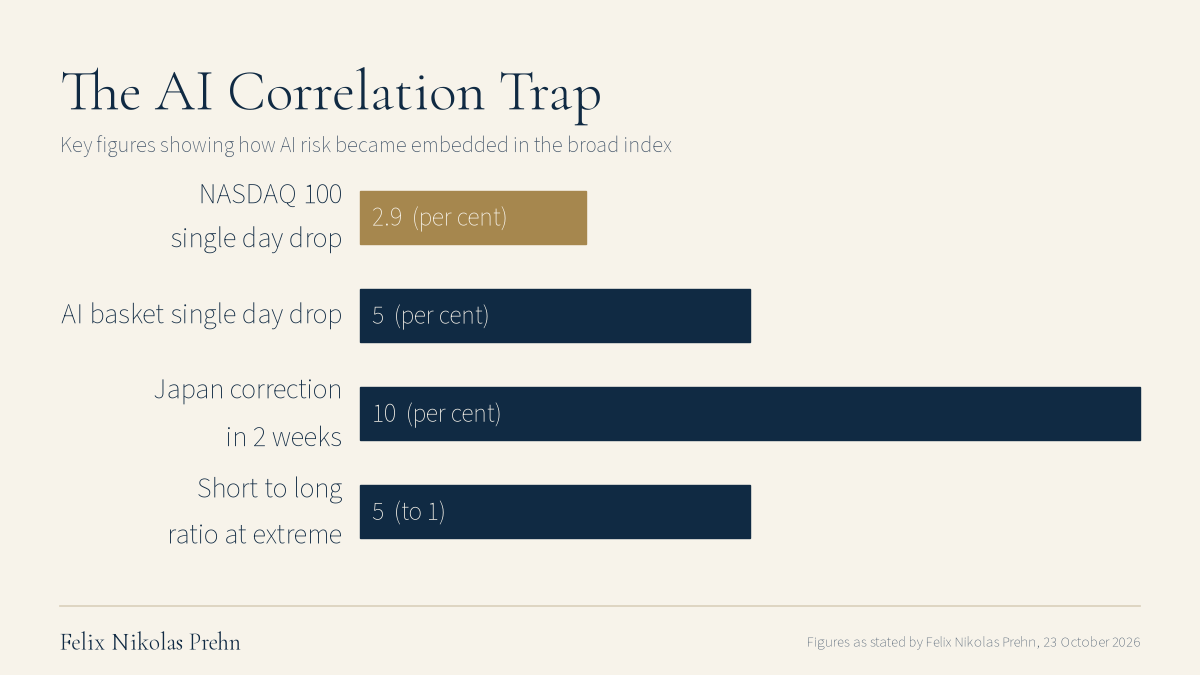
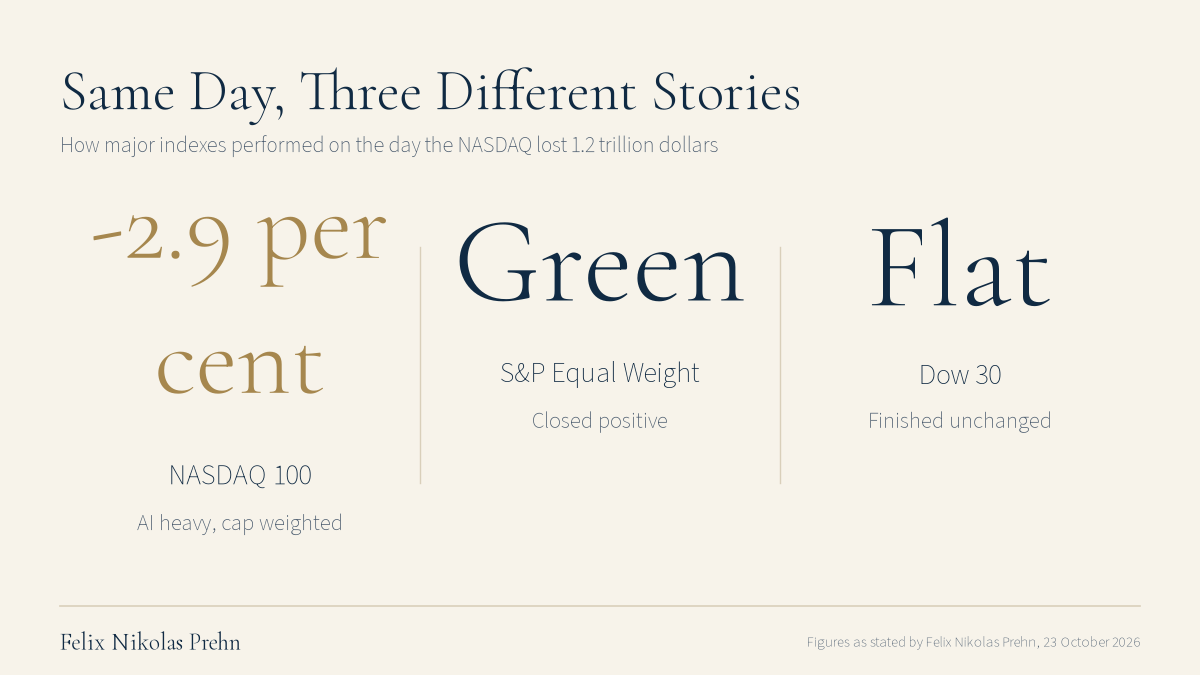
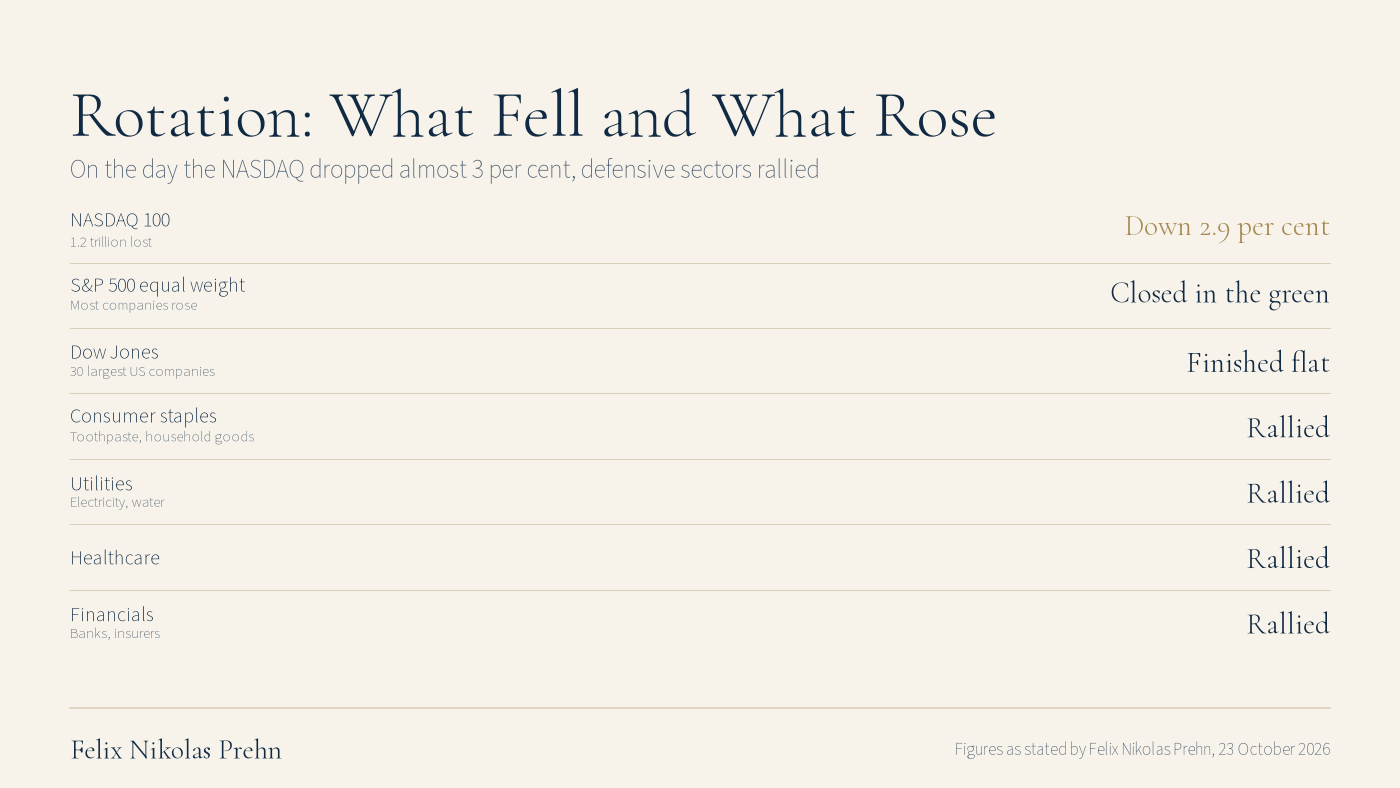
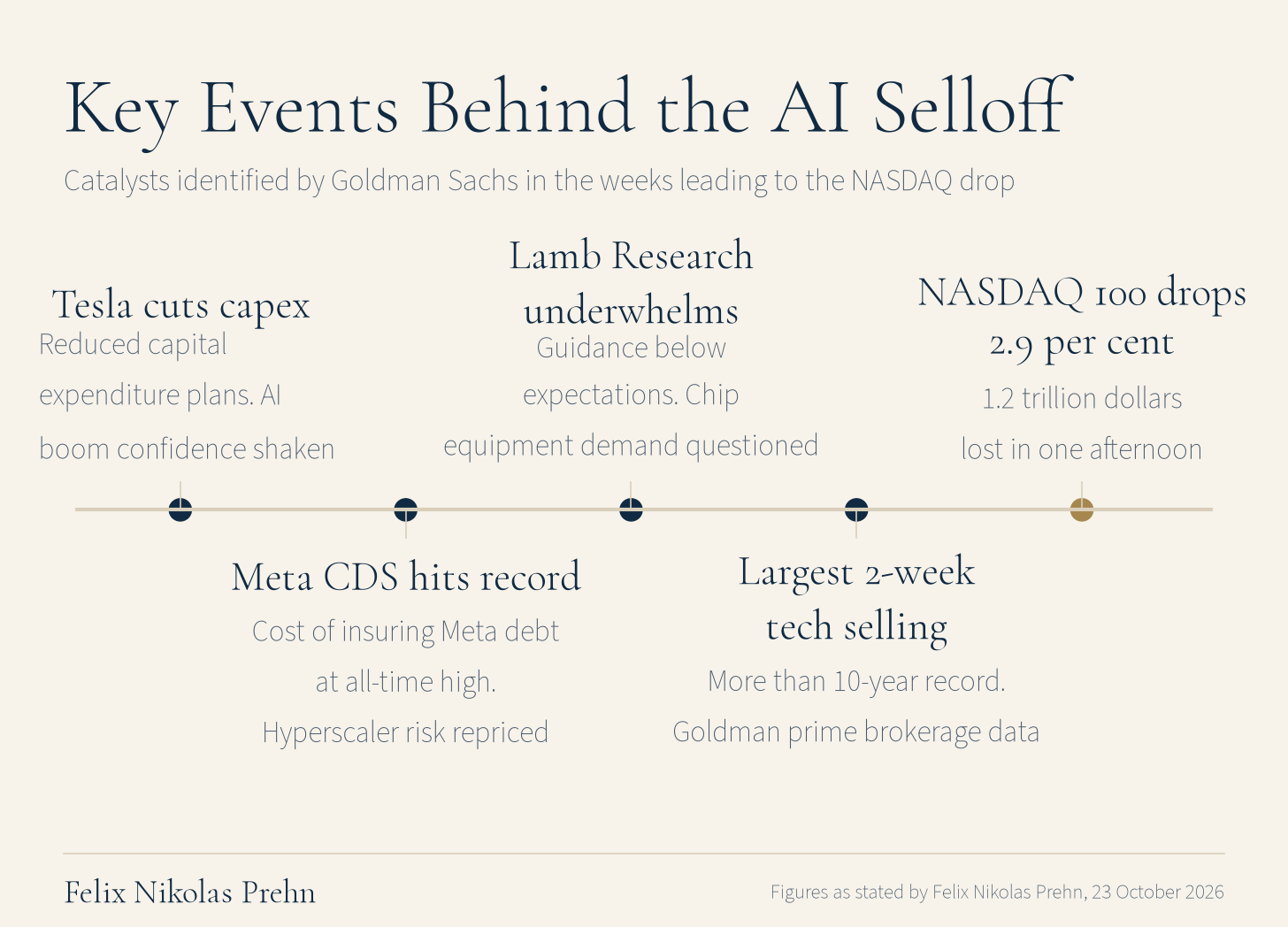
So, let's start out with the loud bit. The NASDAQ 100 is the 100 biggest companies on the NASDAQ exchange. It's mostly tech. This week it fell 2.9 per cent in one day. Biggest drop in quite a few months. $1.2 trillion seem to have vanished.
So what broke? Well, the banker phrase is that the AI trade is derating. And what that really means is that investors won't pay such a high price for these companies anymore. Picture a street where every Now picture a street where everybody suddenly wanted to live. prices went really silly and then a few buyers starting ask and then a few buyers started asking whether the new train station was ever going to actually open and the whole street got repriced to sant same houses just lower prices now a trade Goldman Sachs wrote to his clients yesterday that it's been and I'm quoting him a trying couple of weeks for the AI complex and he listed the reasons put it on the screen for you here first Tesla is cutting capex Capex is short for capital expenditure.
The money a company spends on big longlasting things like factories and computer chips and so on. So think of the difference between your weekly food shop and building an extension on your house, right? The extension is capex. The whole AI boom rests on companies building enormous extensions. So when a big name like Tesla says it's going to spend less, everyone selling the bricks as in the chips feels it.
Then second, Meta's AI spending sent the cost of insuring its debt to a record. That insurance is called a credit default swap or CDS. It's like insurance on money you've lent to a friend. If your friend can't pay you back, the insurance pays you instead. The more worried people are about the friend, the more the insurance costs.
Meta is one of the hyperscalers. That's the name for the giant tech companies building huge data centres for AI. The others are Microsoft Amazon Google and so on.
Now third, Lamb Research, which makes the machines that make computer chips, gave guidance that underwhelmed. Guidance is a company telling you what it expects to earn next, and investors had hoped for more. So Goldman says the disappointment in big tech earnings reignited concerns as to the durability of the trend. In plain English, people are wondering whether the AI spending spree can actually last because if AI spending slows, the first companies to get hurt are the ones living on borrowed money. Right?
We're going to come back to borrowed money in a second. Now, most people here freeze. They see a red day, a red week, a second red week, and then either they sell everything at the bottom, or they do nothing, and they just hope. Now, reading what the skilled money is doing while the news and the headlines are screaming at you is actually a skill set and it's a skill you were never taught and it's not your fault. Nobody sat you down at school and explained how money actually worked, right?
If they did, put it in the comments down below. I doubt anybody had that lovely experience. But once we realise it is a skill and that there are people who are actually making money out of this and that actually did quite well yesterday, I think it's something we might want to learn. And you can learn it by the way. You've picked up way harder things than this because driving is more complicated.
I I think I think getting a mortgage is probably more complicated than this. So I'm going to do something for you tomorrow. I'm going to teach you this completely for free. And by tomorrow I mean Saturday. I'll show you how the skilled money is positioning right now before this is going to really hit you because so far we're down a few percentage points.
It's uh it's manageable. But once the damage is already done, prices have moved, well the good options are gone. And honestly, I'd rather worry you a little now than see you get hurt later. Uh and I because I think I think this will will get a lot worse. Possibly not next week, but at some point because when it comes, it's going to be it's going to be a pretty hard punch in the stomach and it's going to hit people's pensions, their life savings, their portfolios, stuff they were counting on for the next 20 years.
So, learn how to be ready before it lands. That's our whole mission here. It's completely free. It's completely live. You can ask me questions.
So, you need to just show up. Just go to the link down below in the description. Grab your seat at survivethebubble.com and once you got your seat, put act in the comments because you have acted and that makes you special.
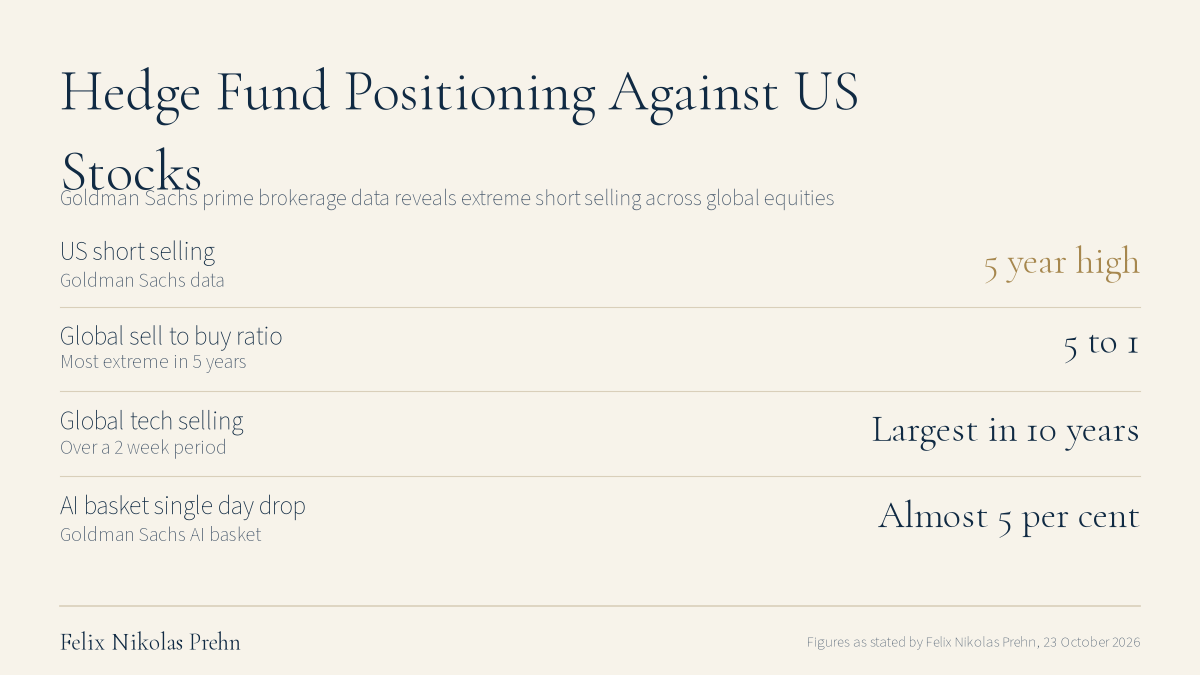
You know, not that kind of special, but special in a good way. So, let's go back to the skilled money and what were they doing? Well, the hedge funds according to Goldman Sachs who run a lot of their money says hedge funds are now shorting US stocks at a fiveyear high. What's shorting? Shorting is betting the price is going to fall.
So, you sell a share you don't own and then you buy it back later and you hope you can buy it back at a cheaper price. It's sort of the opposite of what most retail investors are doing. Imagine imagine your neighbour lends you his lawn mower. Lawnmowers are selling for $300. So, you sell his lawn mower for $300.
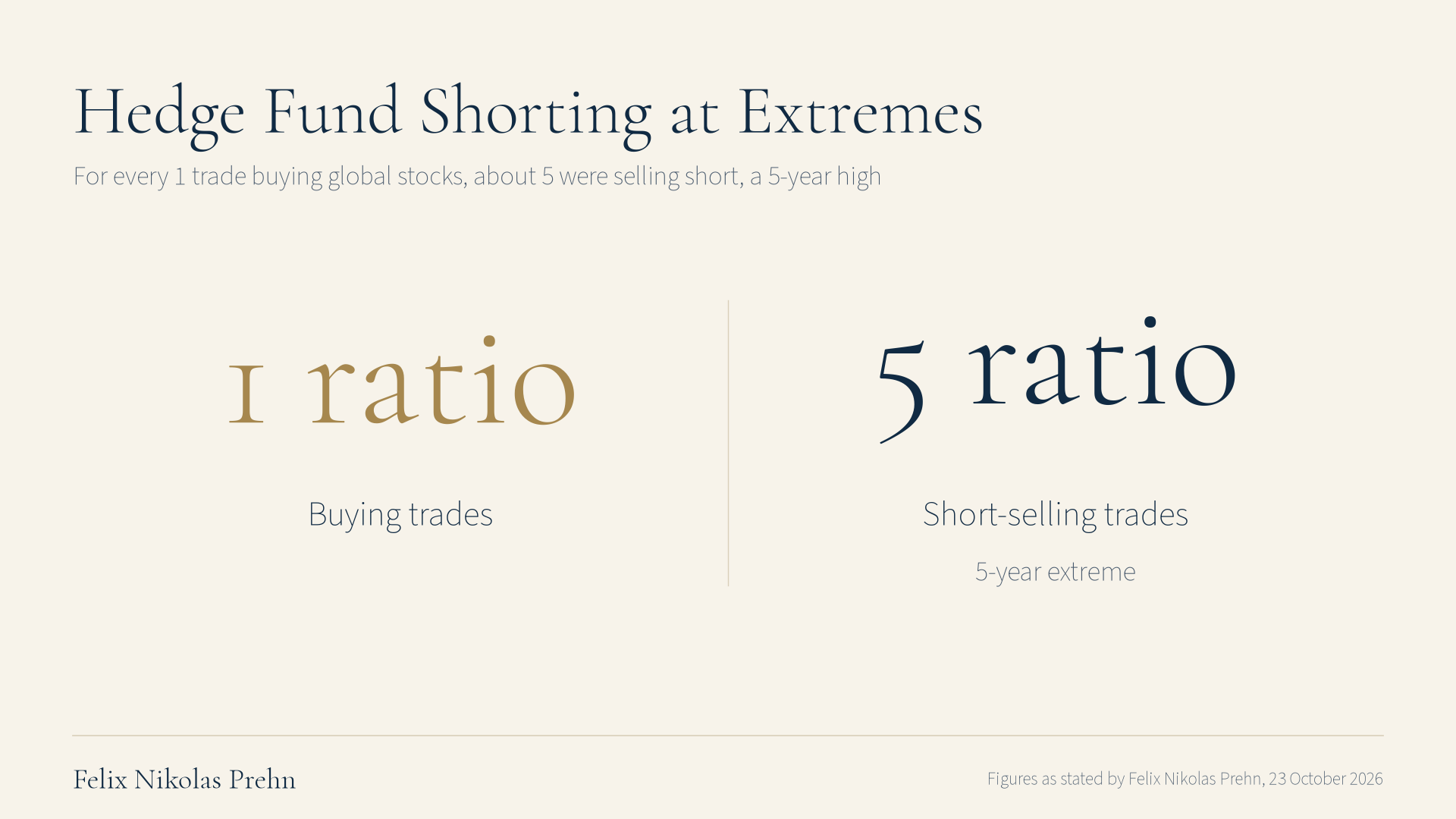
You're not a very good friend or neighbour. Now, a month later, they're now on offer at $200. So you go and buy one back and you give it back to him and you keep the $100. That's a short and it's lovely when prices fall and it's very painful when they rise and your neighbour wants his lawn mower back. Now market data and and this is Goldman's data says that across global stocks for every one trade buying there were about five selling short betting on that fault.
5 to1. That's at the very very very extreme of what we've seen in 5 years. And it gets more extreme. Goldman Sachs calls something that they call a prime brokerage. That's the part of the bank that lends money and shares to hedge funds and holds their trades for them.
So it can actually see what the hedge funds are really doing with their money. And its data showed the largest two week selling of global tech stock in more than 10 years. 10 years. On top of that, we have the the short leverage I was just mentioning. And it isn't just America.
Japan's stock market just entered what is called a technical correction. Basically, it dropped 10 per cent in two weeks. Now, the twisters. Goldman Sachs says all the shorting raises the chance of a short squeeze. Remember the lawn mower?
Imagine lawn mower prices suddenly jump to $500 and you still owe your neighbour a mower, so you have to buy one back whatever it costs.
So does everybody else who borrowed one. They all rush to the shop at the same time and the rush itself pushes up the prices. It's like a packed theatre when the fire alarm goes off and there's only one door. Everyone heads for the same narrow door at once. That's a short school.
And it's why prices can suddenly shoot up even in a horrible week. So what does that mean for you? Well, two things. First, if you're tempted to sell everything at the bottom because a headline told you to, remember the lawn mower? When this many people are betting on the fall, the snapback can be fairly violent and the people who sold in a panic usually get fairly frustrated.
Now, the second thing that worries me a little bit more is that the skilled money doesn't bet this heavily against something without a reason. They've got the Goldman research notes and the prime brokerage data and they've got analysts on speed app. You've got a notification on your phone that says tech selloff. That gap's fairly big and that's the whole reason I make these videos. So, do they know something?
Well, yes, sort of. And the part they know is something the headlines completely miss. If you only watch the news, you think the whole market fell off a cliff. Well, it didn't. This was an AI trade selloff, not a market selloff.
And to see that, you need to know about a slightly different version of the S&P 500. The S&P 500, the one that's probably in your pension fund or the index funds, is weighted by size. The bigger the company, the bigger it slice. It's like a It's like a slice of pizza where the Nvidias and Microsofts get massive slices and hundreds of other companies are tiny tiny little crumbs each. Well, on the day that the NASDAQ dropped almost 3 per cent.
The S&P equal weight closed in the green, which means most companies actually did quite well. The Dow, which is 30 of the biggest American companies, finished flat. So, what actually rallied? Well, consumer staples, which is the stuff you buy, whatever the economy is doing, like, you know, toothpaste washing up liquid. It's utilities, it's electricity and water companies, right?
Healthcare, financials, the banks, the insurers, and some of them went up quite a lot. So, the money that left the hyperscalers, those giant AI spenders, didn't leave the market. It went to into boring stuff. And this has a name. This is called rotion, rotation.
And rotation just means your money is moving from one group of the stocks to another. Sort of like a like a you know one where those outdoor pub gardens they have in the UK on a sunny afternoon a big cloud rolls over and everybody picks up their drinks and moves inside to the bar because I think it's going to rain. It's the same pub. This is a different room. They were outside now they're inside.
Same people now. You can actually watch that because I literally just put into Winston app which is sort of our our newspaper and data source of what's going on with your stocks. Uh, I just added in here a sector rotation chart and it shows you for the day or for the week what is underperforming and what is outperforming the S&P. So I have it set on versus S&P. You can also look at the absolute numbers.
And what do you see? Well, tech and communication services and I put the index funds in here for you so you can see it. They did horribly, right? But healthcare, financials, materials, utilities and so on, consumer staples did actually really, really, really well. And I think you're going to want to keep an eye on that over the next few days and next few weeks.
And I think you're going to learn a lot literally just from a heat map of just 11 sectors. If you want to get access to that, there's a link down below with a free trial to as well. So So check that out. If you don't like it, just cancel the trial. No questions asked.
So that's a little reassuring, right? A calm rotation sounds good. But it only stays calm while the thing the money is rotating away from doesn't break. And that's what I worry about because underneath these AI stocks there is a pile of debt that nobody's really talking about because it's a bit boring. So if we go back to that Goldman trader in his paper he says the real trouble in recent weeks has been loans to riskier companies and his quote is this.
It has really been the credits of lower rated borrowers that have been the eye of the storm. Now credit means loans and and and bonds. Lower rated borrowers are riskier companies. So when a company borrows by selling bonds, the rating agencies give it a grade. It's a bit like a school report.
The safest company get top marks A's and they borrow cheaply. The riskier ones get C's and they have to pay a lot more for that debt. It's called junk bonds or high yield bonds. It's like a mortgage, right? If you have a great credit history, you pay less than than your neighbour who's got a, you know, average one.
So why is the junk the eye of the storm? Well, Goldman says the market is having a hard rethink about whether the AI building boom really pays. Interest rates are higher, so it's more expensive. Energy costs could rise. And to understand why all that matters, you need to know something about project finance.
Project finance is borrowing for one single project where the loan only gets paid back out of that project's own income.
So, imagine lending a friend money to open a cafe. And the deal is the only way you get your money back is if the cafe makes money. There is no house you can take. You know, he's not going to pay you back. There's no salary you can do.
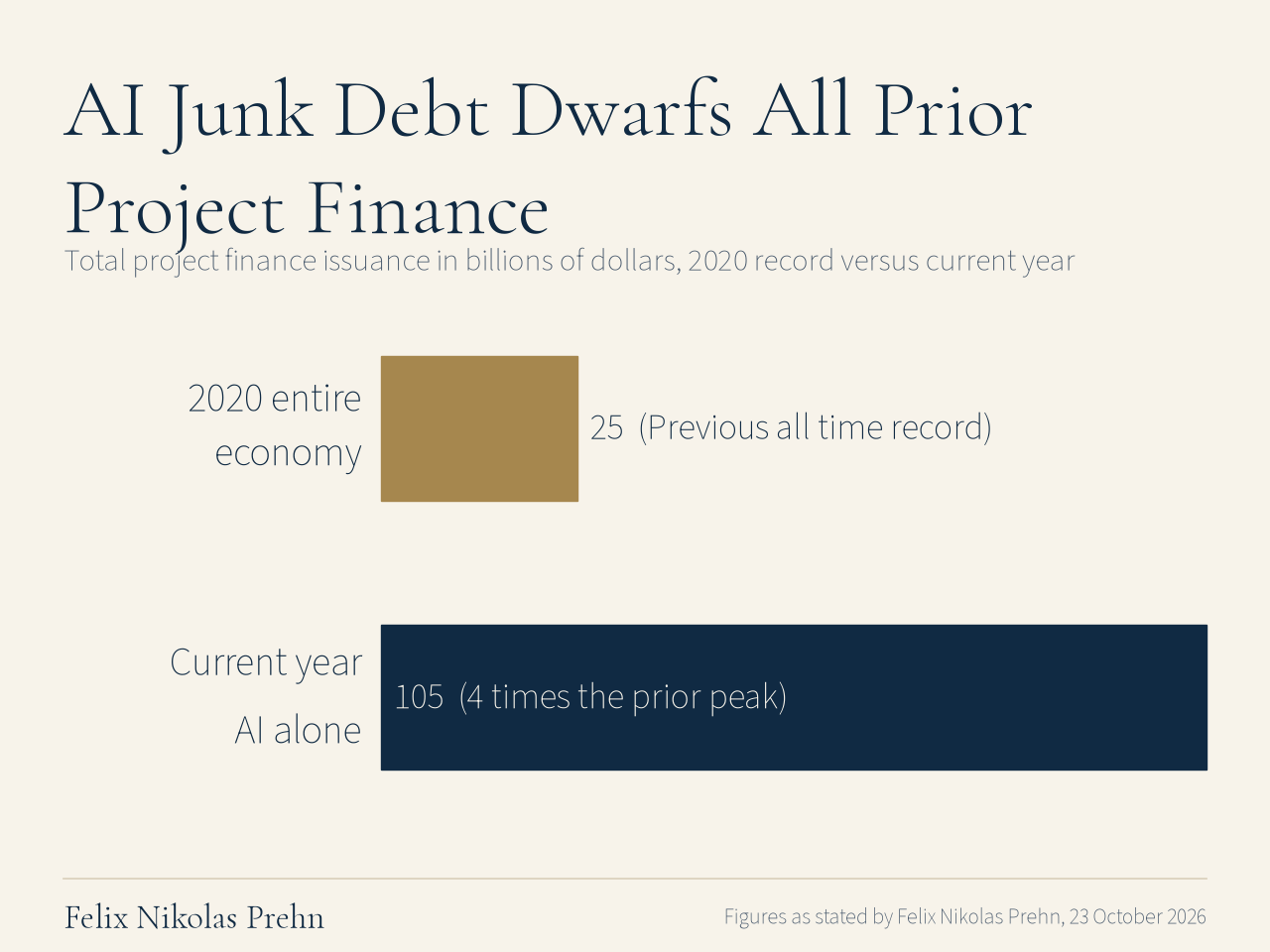
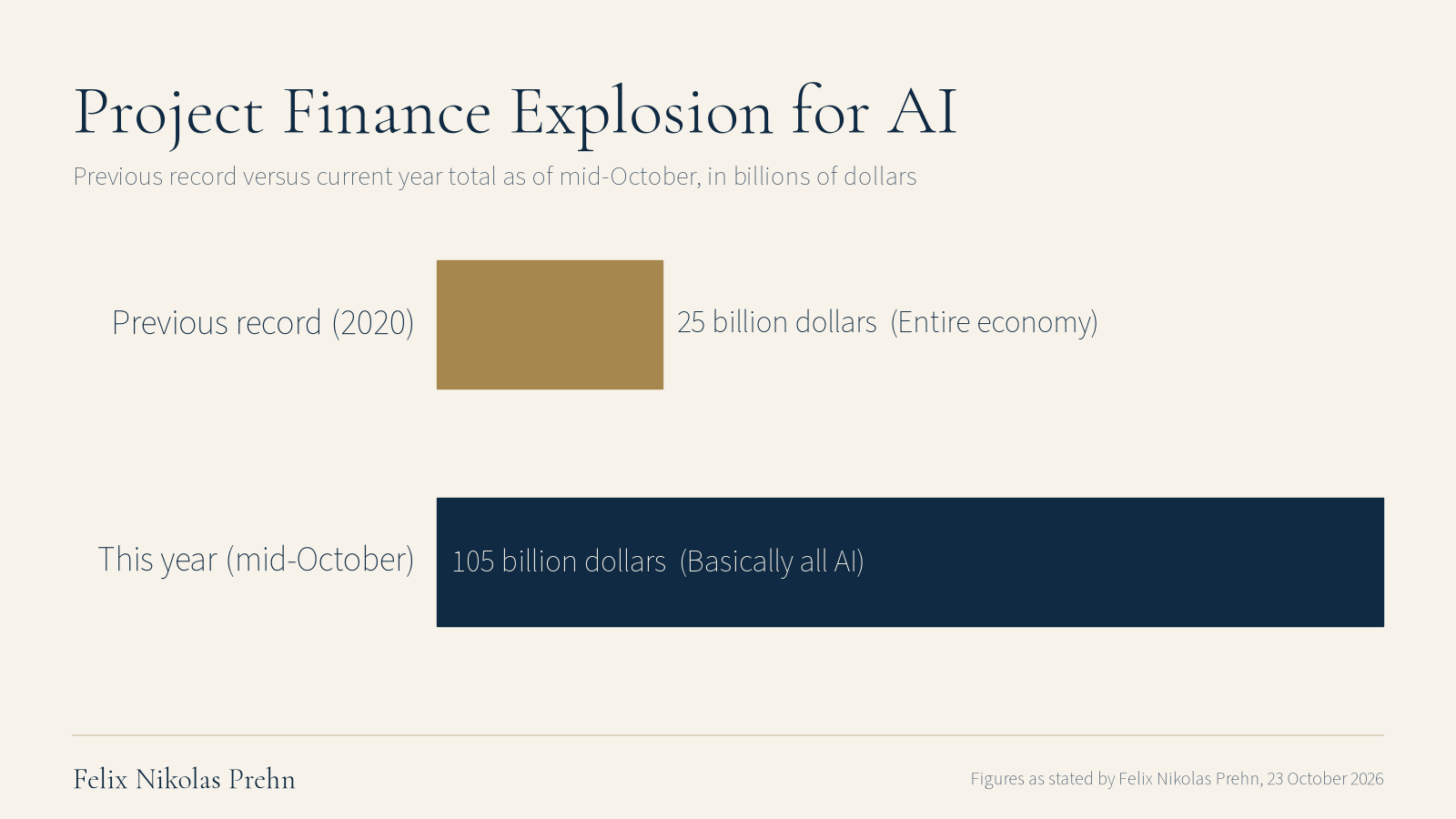
Nothing. It's just the cafe. So for decades, project finance was for power stations, pipelines, toll roads because you know there is an income stream coming. Now the biggest project finance record we've set was in 2020, 25 billion for the entire economy. This year, as of mid-occtober, it's 105 billion.
And basically, all of that is AI. And this is four times the maximum we've seen before. And the lenders are getting nervous. They're asking for danger money. It's the extra interest these junk rated data centre borrowers have to pay on top of what you know the government has to pay to borrow.
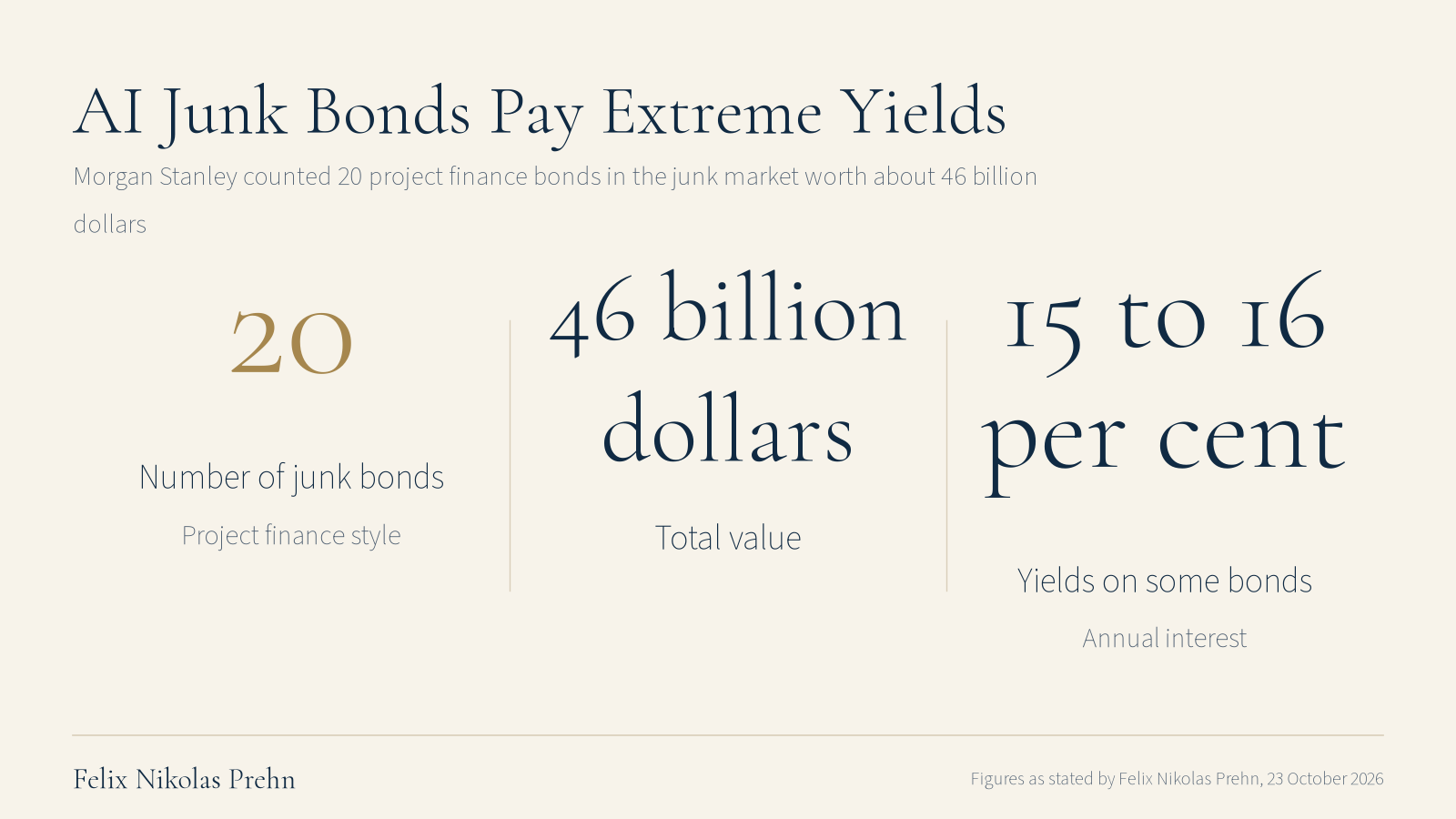
And Goldman's own chart here, if you can see that on the screen, shows the danger money has more than doubled since the summer. So when lenders demand double, it's because they just don't think they're going to get paid back necessarily. So they want to get some money up front. And good old Morgan Stanley counted 20 of these project finance style bonds in the junk market worth about $46 billion. Some of them pay 15 and 16 per cent a year, which is just insane, isn't it?
I mean, I'd like to buy a bond that pays me 15 per cent. But then I look at it and I go, "Ah, the risk is crazy. I don't want to own this junk." And you remember the Core story, that sort of cloud company that's teetering on the brink. Well, a lot of these data centres here on the screen were built because Coreweee said they'd lease them. Well, what if Coreweave goes away?
Who's going to lease them? Ah, nobody, right? So, borrowed money is expensive. The AI building boom runs on borrowed money. So remember that phrase I mentioned earlier.
Um this is where it comes back. This is how an AI problem becomes your problem. Goldman's basket of AI stocks dropped wherever I got it.
I don't know where the chart went. Anyway, it went down almost 5 per cent in a single day. And the correlation between that basket the S&P has jumped to almost one. Now correlation measures how closely two things move together. A correlation of one means they move in perfect lock step like two dancers doing exactly the same step.
Zero means there's no connection and one is running off the dance floor and one is doing you know whatever. So AI being down now means everything is down. And by everything I mean the S&P 500 the thing what's in your pension fund in your index funds it's a safe and sensible spread out investment. Right? That's what they say.
So this is the unthinkable. The fund you were told was boring, safe, and well, it's now moving almost in lock step with a handful of AI stocks. And the building boom behind these stocks is leaning more and more on expensive junk greater debt. The skilled money read all of this weeks ago. And that's why they were short.
They were betting on the fall. They made money. You got a headline that said AI is over. And that's exactly what I'll walk you through in the live training, including how to check how much of your own money is tied to this trade. The links down below, but first, I will give you that and walk you through that trade I promised you.
And this is something that may or may not sink in fully, and that's completely fine. And I don't say that to sound condescending like I know something better. It's just there is a bit of a skill to this. Please don't do this trade. I'm not recommending this trade.
There is tremendous amount of risk tied to this. Uh, so you know, you've been warned. But what am I doing? Well, first of all, this is not personal advice because I'm not a financial adviser. I don't know situation and and and you should never put something money into something you don't fully understand, especially the risk.
So, what is this? This is silver. Now, silver's been trending down. Everyone's saying, "Oh, it's all over." So, what am I doing? I'm selling puts on silver, and I'm selling puts at this price here of $46.
So, my break even price is down here. And that means, and this is a bit funky to understand, silver goes up, I make money. If silver goes sideways, I make money. And if silver drops about $4, I still make money. I have a 77 per cent chance of profit.
Doesn't guarantee a profit, but it's a 77 per cent chance of profit. And and if it plays out in my favor, I could potentially make up to 13 per cent by November 20th. Um, so what what is this? It's a slight contrarian move, but with a very high probability and it's those kind of trades that I'm doing at the moment because they seem to me a little bit safer than buying these stocks outright, which could, you know, go one way or the other. Uh, and we could do similar things on stocks that we think are going to drop.
Again, we have this sort of buffer zone here. So, I'm not going to teach you all of that on uh on Saturday because options trading takes a little bit longer to learn. But all I really want to show you and I'll put on the screen here again so you can see it is um and please don't copy this is that there are always ways to make money in any market in all markets and there are also ways to simply protect your money which is I think what a lot of you might actually want to be doing.
So let's put this all together. The crash on the news is an AI selloff. The skilled money had bet on it. They at record levels the money that left tech moved into the boring corners of the market. And underneath all of that is this mountain of crazy expensive junk debt with the S&P 500 now tied to this AI trade more than it's really ever been.
And you can't control what Goldman Sachs's clients do or what the NASDAQ does next week. Nobody does and nobody knows. But you can control whether you understand it before it reaches your portfolio. So come and join me in the live training. I'll walk you through how the skilled money is positioning right now.
And now to check what you actually own. It's completely free. It's completely live. Uh, no, there is no replay. So, you actually got to be there.
There's a link down below. Survivethebubble.com. And if you are actually going to be there, write act in the link down below and share this video with somebody who might benefit from it, benefit from it. And I wish you all the best. Right now, I think we're going through some sort of weird phase transition.
And normally when you get bad economic news or you get bad jobs data that people are going to fly to safety into the bond.