Transcript
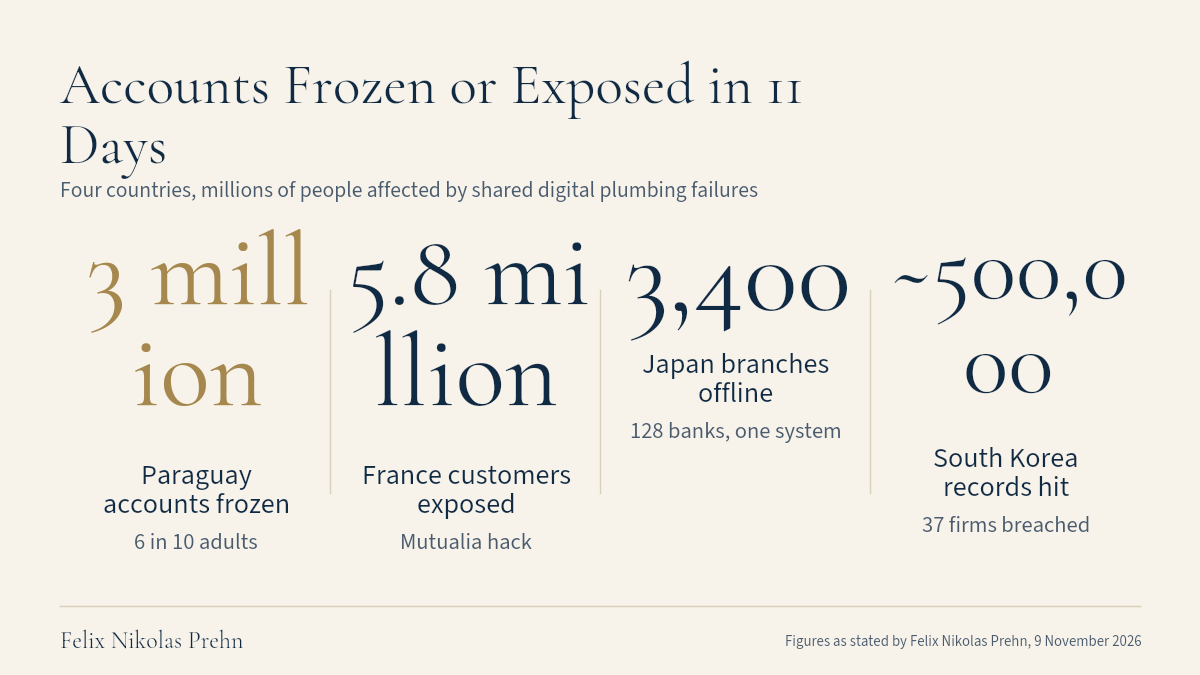
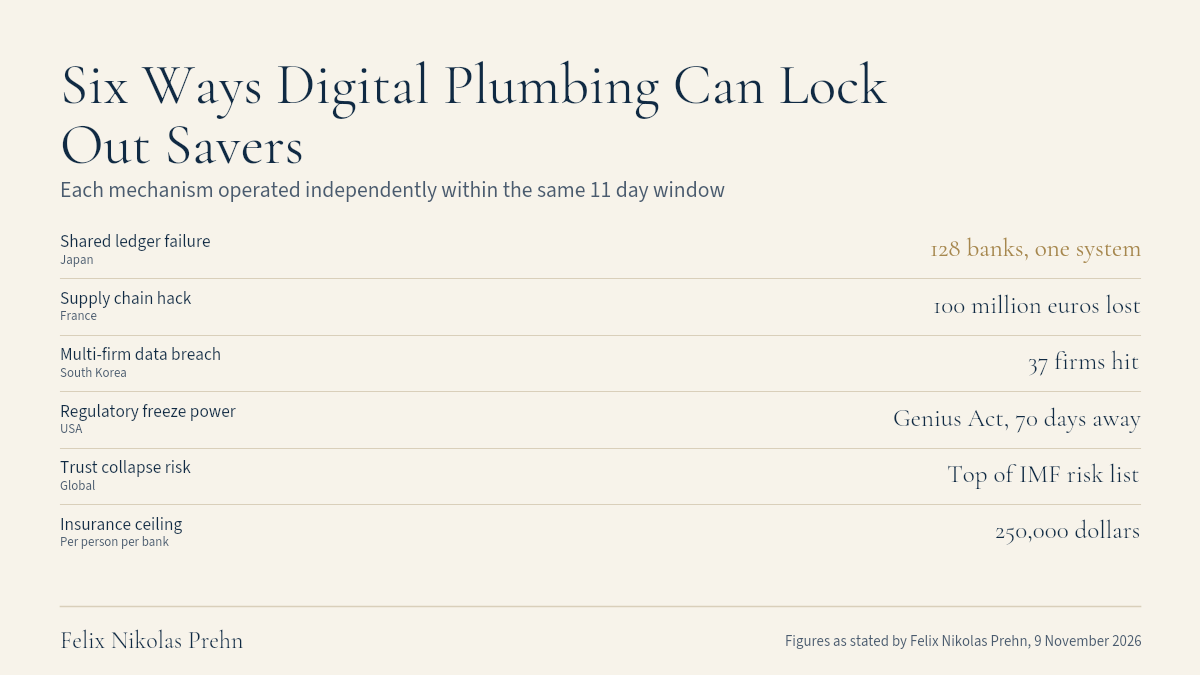
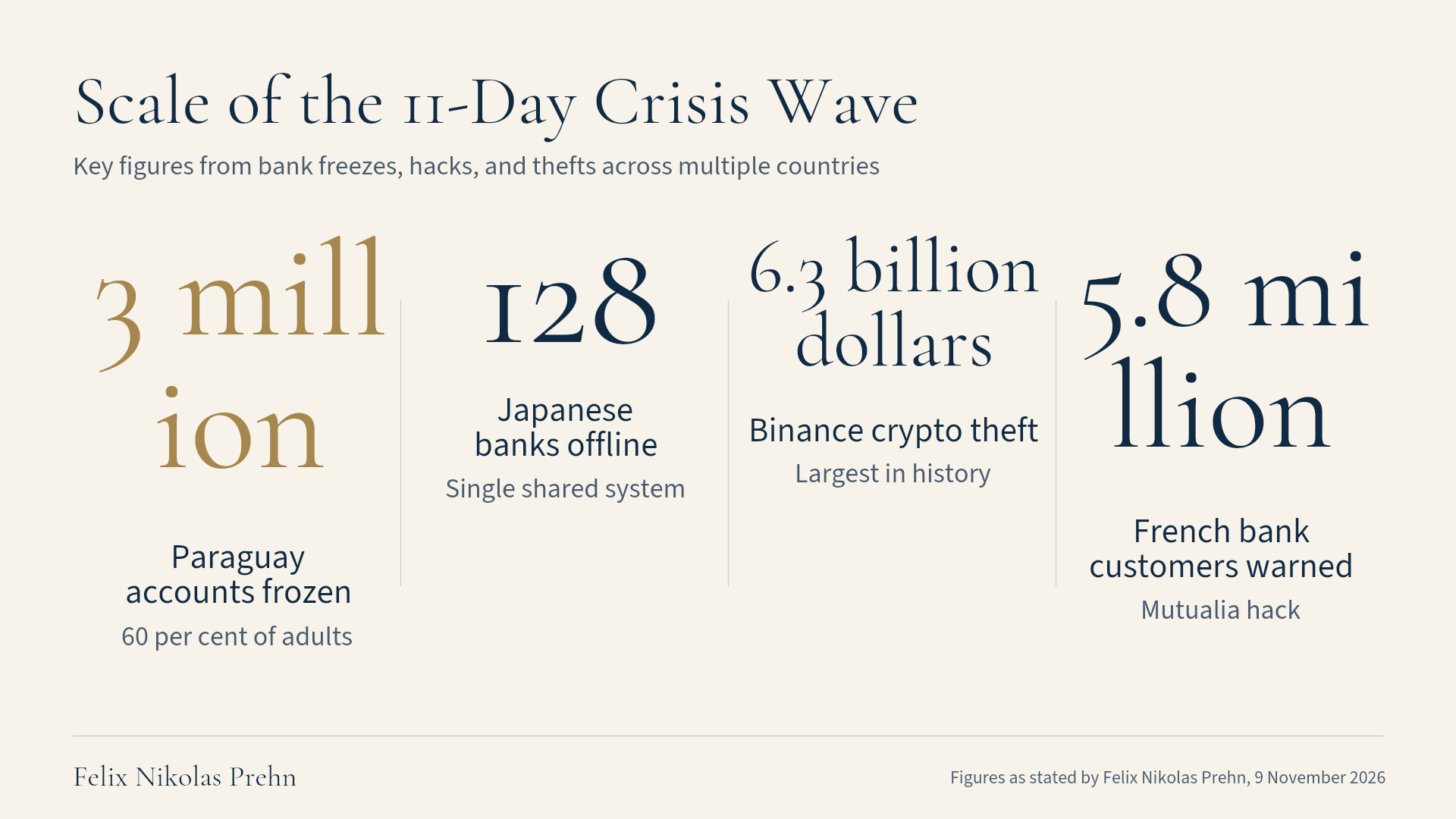
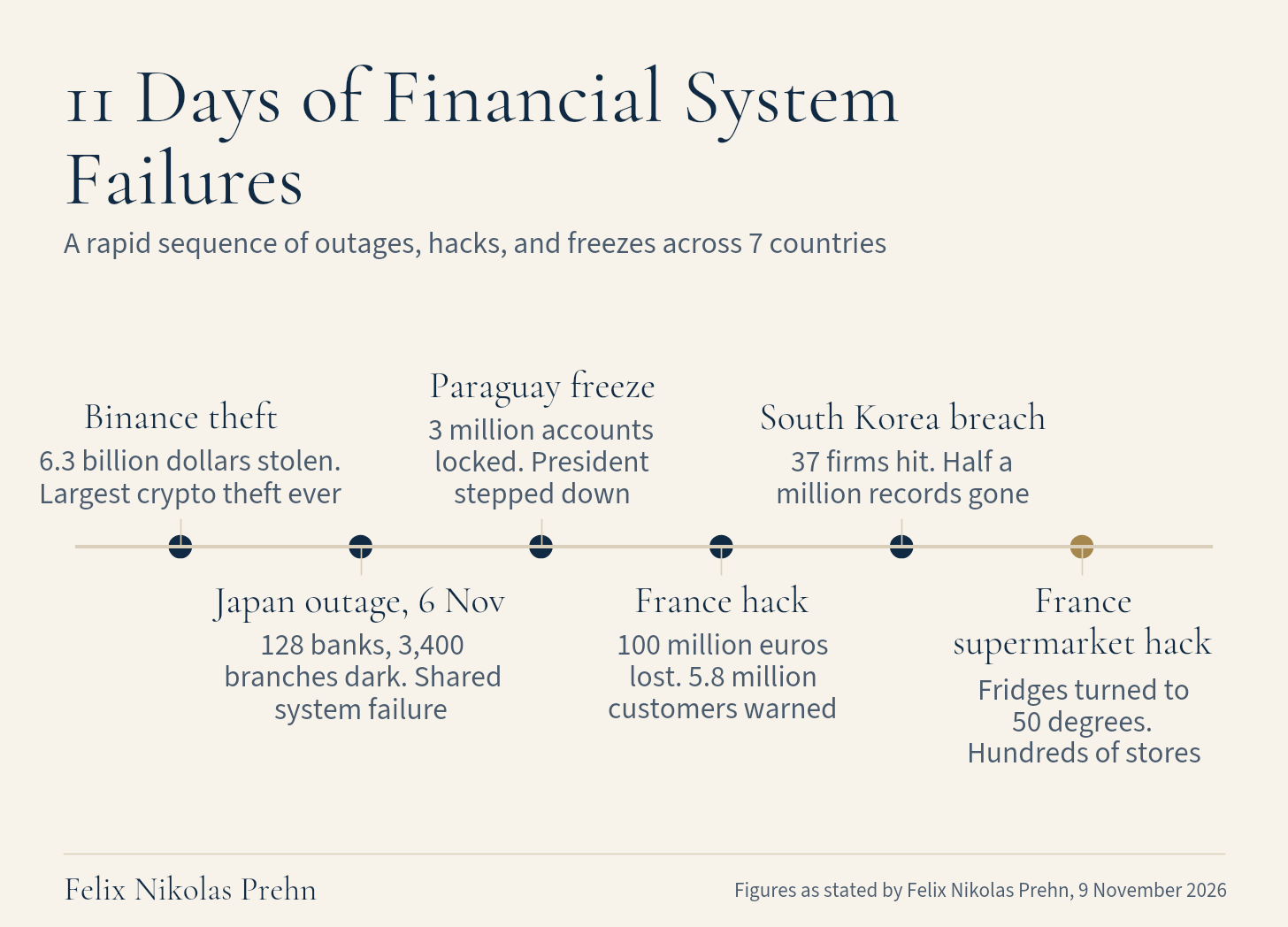
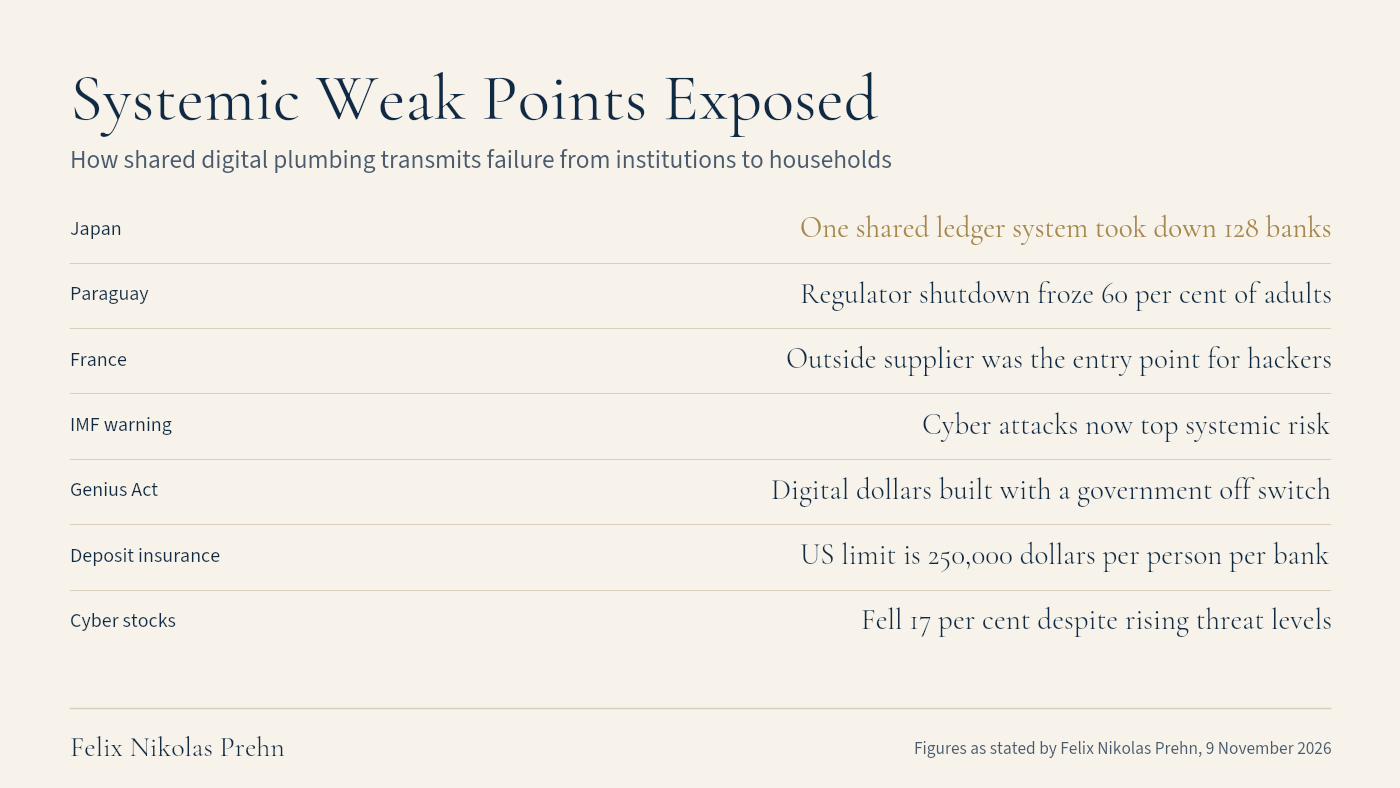
If you've got money in a bank account, what I'm about to show you could save you from a very, very bad day and it could make you money as well. In the last 11 days, one country after another lost control of its own money. Paraguay, almost 3 million people were locked out of their own accounts. About six and 10 adults, that is in the whole country. In Japan, 128 banks went dark in a single afternoon.
3,400 branches cash machines just debt. France, one of the biggest banks, was robbed of around 100 million euros through a hack. Almost 6 million customers were warned they could be a victim of the fraud. In South Korea, 37 financial firms were hit. Almost half a million records gone.
And the biggest crypto exchange on Earth lost $6.3 billion, the largest theft in history. This all happens in just 11 days in seven different countries and most of it didn't reach your evening news. But picture yourself at the supermarket till with a full trolley for a moment. Winston would be trying to steal your vegetables uh and your card gets declined and you can see your balance on your phone but you can't touch a penny off it. That's what those people woke up to millions of them.
And you might be thinking ah it won't happen to my bank. Well, that's exactly what every one of them thought the week before it got frozen. And the people in charge of the world's money are now rehearsing for the day, all the banks go down at the same time. And the strangest part is what happened to the companies who are paid to stop all of this. The biggest names in the business watch their shares drop about 17 per cent in just a week, which makes absolutely no sense.
I mean, if things make absolutely no sense, there's usually an opportunity. So, here's what we're going to do. We're not going to panic. No, we're going to learn how to protect your own money and we're going to have a plan and I'll pull up the names of the exact stocks who should actually benefit from this. So, stick with me and I'll walk you through all of it.
If you're wondering who the heck I am, my name is Felix Nicholas Pin. I'm a former economist. Actually, I'm still an economist, but I'm a former investment banker. I'm also the founder of the PIN Institute. We publish research on how the markets actually function and teach that, too.
And I take no sponsorships, no endorsements ever. So Winston and I here can say whatever you want. And he's of course the brains behind it. He's worked very hard on this. So he had to lie down.
Now, a lot's happened in just these 11 days. And I've put all of that into one free report from you. the full list of what happened, the sources, the checklist to keep access to your own money when the bank goes down, plus the companies and the funds that we rate highly with the dates to watch for all of those. You can download all of that for free at felix.org/lockout. And you are um you are special because most people think about this when their card stops working. Well, you're thinking a little bit ahead, which I love you for.
So, let's walk through this and really understand this.
Japan first because it shows the problem better than anywhere. In Japan, there are small local banks called Shinken banks. They're sort of your old-fashioned high street savings bank, the one that you know your grandparents used, that sort of thing. There are hundreds of them and they share one single computer system behind the scenes. And that system is the master ledger, the big book that knows how much money is in every single account in every one of those banks.
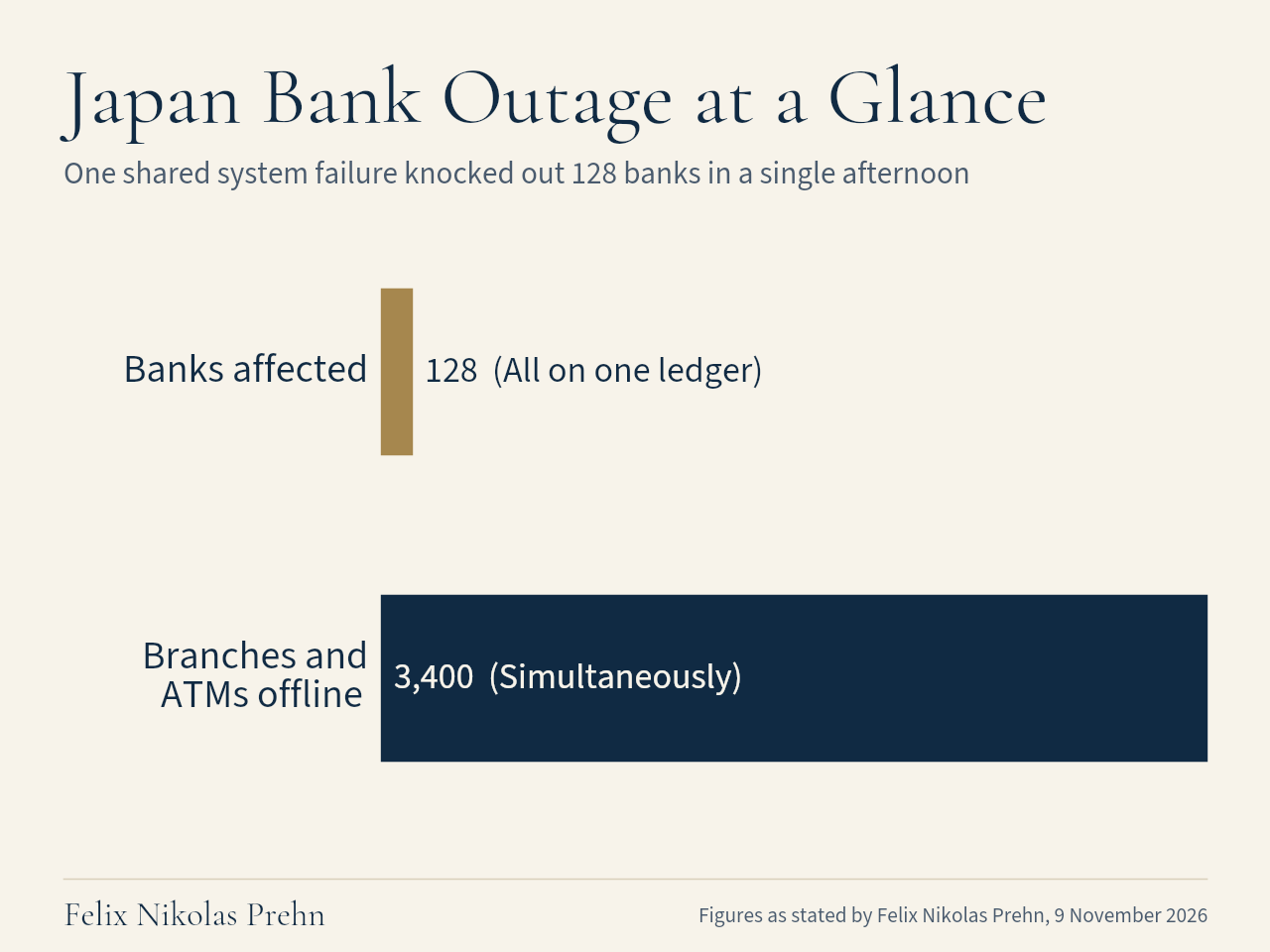
Well, on 6th of November, that system failed. A piece of communication equipment broke allegedly and in one afternoon all of those 128 banks just went dark at the same time. Cash machines didn't work. Counters couldn't help you. The app stopped, transfers stopped, and the officials were clear, well, no one's been hacked.
It's the official story. Now, one piece of kit apparently broke and millions of people couldn't reach their own money. So, what's the lesson? When a lot of banks show the same plumbing, one folds, it doesn't just hit the one bank, it hits all of them at once. Now, you might be thinking, I don't bank at Japan, Felix.
So, why does this matter to me?
Well, stay with me because the same week on the other side of the world, people lost their money in a completely different way. In Paraguay, there was a bank called Weno. It had nothing clever and nothing high-tech going on for it. It had simply lend far too much money to companies connected to its owners, which is against the rules for a very good reason. So, the central bank stepped in and shut it down.
Now the moment they did, three million customers were frozen out. The cards, the accounts, the apps, the cash machines were all dead. And that is 60 per cent of the entire country locked out overnight. Now the government guarantees pay people back eventually, but only up to a limit. And for a lot of savers, that limit was a small fraction of what they actually had.
So we had riots in the street, right? We had looting, we had all sorts. And eventually the president stepped down off the whole country. So what do we have here? We have Japan plumbing broke.
Paraguay, a regulator shut the door on a bank.
Different causes, same results for you, the person banking. The money was there on paper, but you couldn't touch it. And people don't like to plan for this because it's uncomfortable. So your money can be 100 per cent safe on paper and still be out of reach on the one day the rent is due or you know the bill comes in or you got to pay the wages for your staff. So before I walk you through the rest of these 11 days and what we can learn from it and the opportunities I want to show you one other thing that I think is actually connected to this because the people in in Japan and Paraguay did nothing wrong.
They trust the system. And that is the same unquestionable faith most people have in another number. They never stop to check. The idea that money in the market in the stock market just grows by about 10 per cent a year forever like clockwork. Who thinks that?
Do you think the market goes up about 10 per cent a year? Put put 10 per cent in the in the comments down below. Let's see it. And I want to show you something that you will not forget.
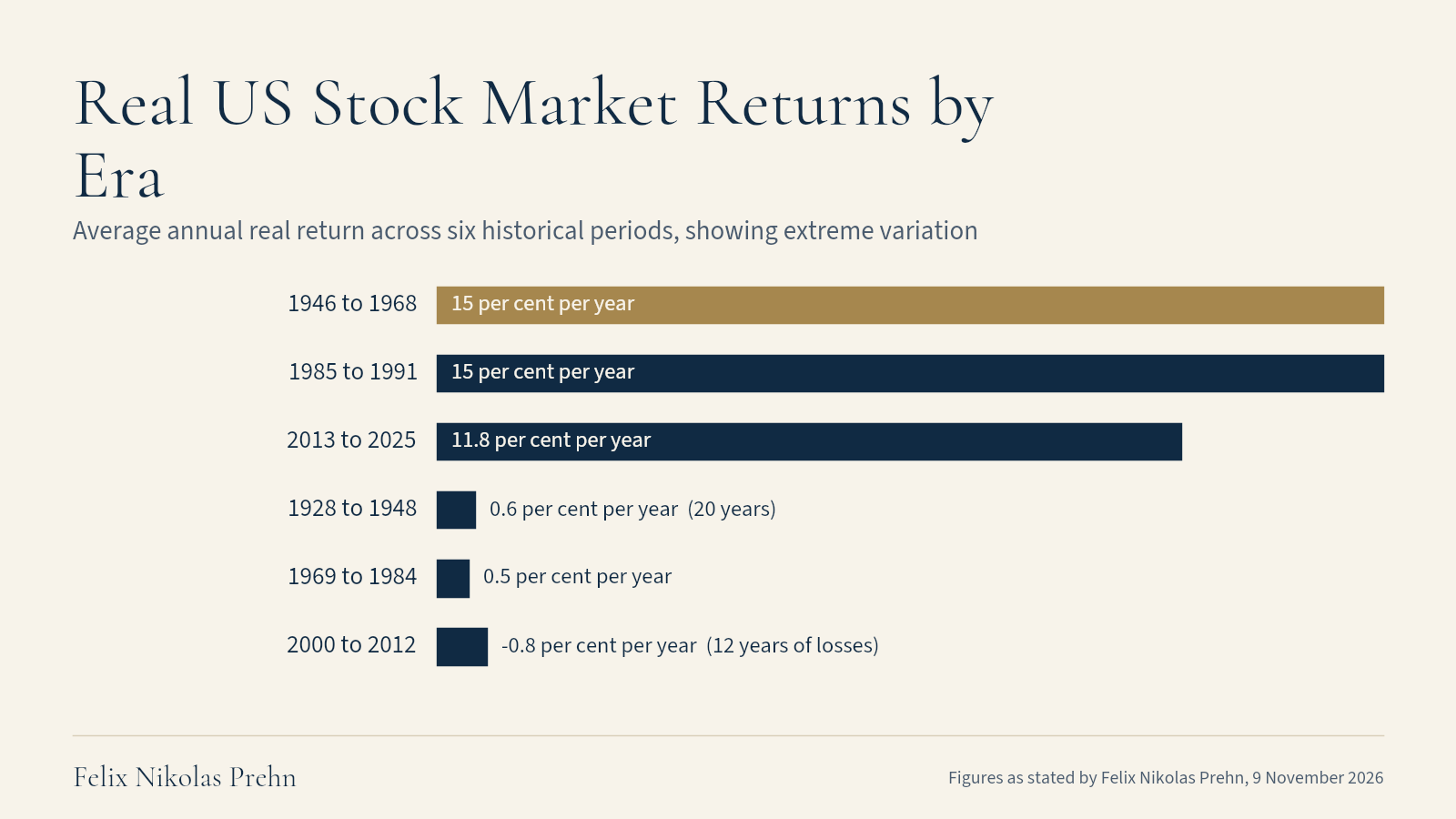
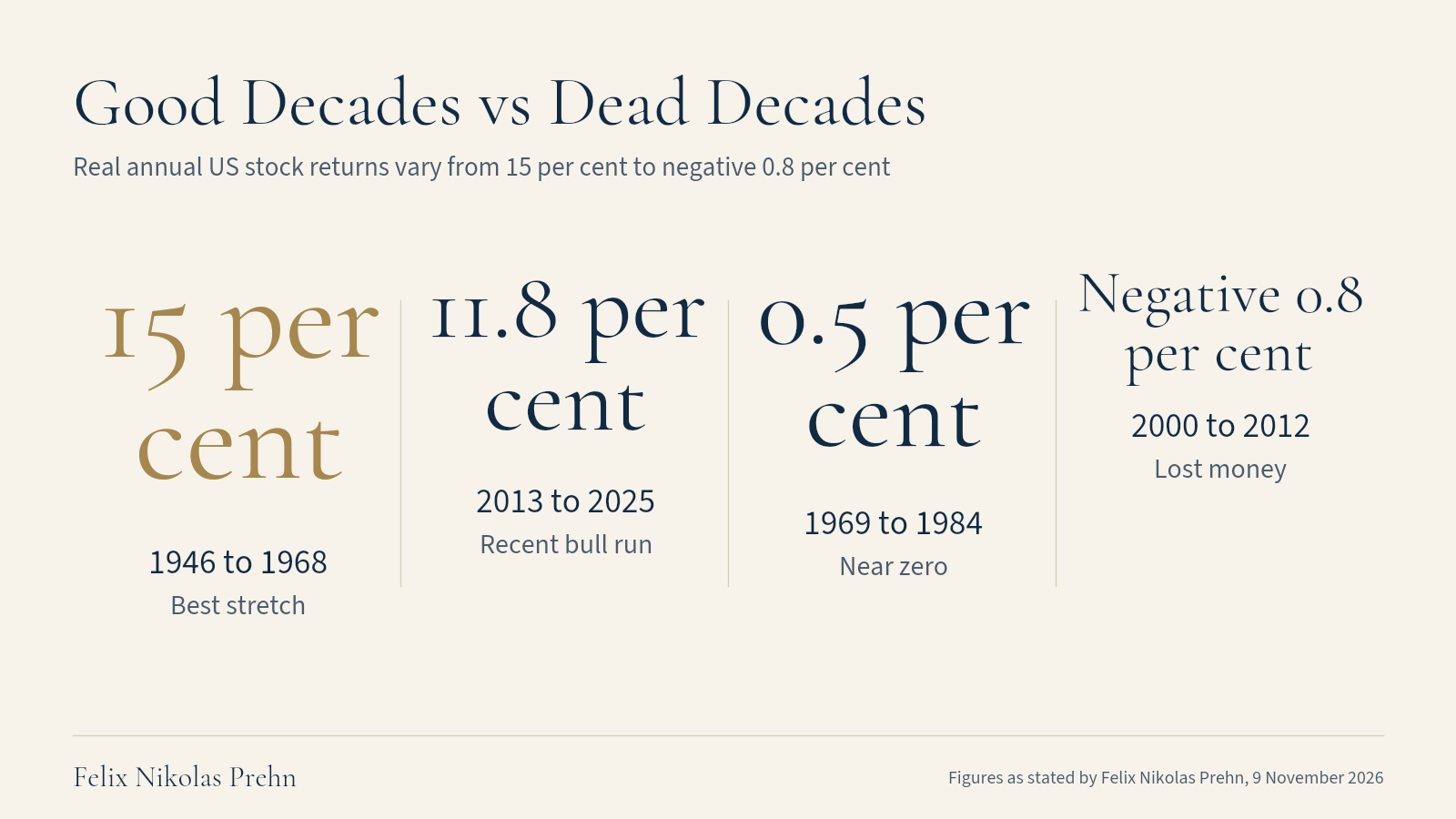
On the screen here is the real return of the American stock market broken into into chunks of history taking into account inflation. And the chunks could not be more different. There are long beautiful stretches where the market makes lots of money. 46 to 1968, 1985 to 1991 we made 15 per cent on average. 2013 to 2025 we made 11.8 per cent on average.
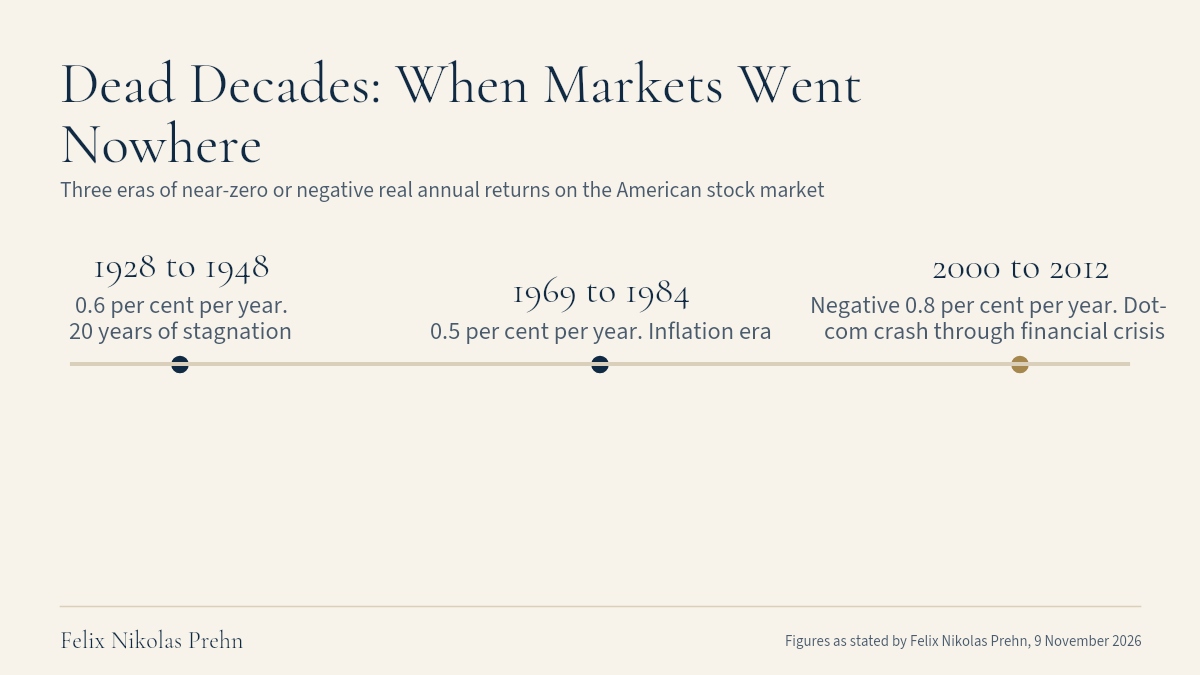
And then there are other stretches and those are not the ones people talk about. 1928 to 1948 the market went up 0.6 per cent a year. 20 years that is. Okay. It's a long time ago, right?
Everyone's dead. 1969 to 1984, it only went up 0.5 per cent a year for every one of those years on average. But a bit more recently, 2000 to 2012, the market declined by 0.8 per cent a year. So for 12 years you didn't make 10 per cent a year. No, you actually lost money every year.
So the honest question therefore is not what the market returns. It's which decade you are currently standing in. If you'd retired at the wrong moment, your so-called 10 per cent a year was basically zero for the next 15 years and no amount of hoping fixed it. So, if you're like 50, 55, 60, or even younger today and you have plans to retire, well, you're only going to get one or two more of these stretches in your investing life. So, which one are you at the beginning of right now?
Not a rhetorical question. It is honestly the single most important thing for your money and almost nobody can answer it because knowing how to answer it is actually a skill. And you know, you didn't get any financial education, right? which is probably why you're watching this because you appreciate the scandal of that. So, if you want to be ready for whatever the next 10 years throws at you, which could be 0 per cent returns or it could be 15 per cent returns, yet you still want to be able to retire. Well, you're going to have to do a little bit better than buy and hold and buy the index because it could give you 0 per cent.
Does that surprise you? This chart here, take a screenshot of it. Write surprise in the comments if it surprises you. And I'm going to spend with those of you who are willing to learn how to benefit from these periods, right? The dead periods because a lot of people made a lot of money in those periods, but not your average investor, not your average saver.
So, if you want to move beyond average, I'd like to spend two hours with you this coming Saturday. And it's a live seminar we've never run before. It's called Ready for Anything. And I'll walk you through the whole plan, how to protect your money first, how to position for a terrible market and also for a good market and how you can actually tell the difference because you can grow your money through a flat decade. Yes, you could just sit there and survive and sort of be miserable.
But wouldn't you rather know how to make money in that period? Well, it's free and it's life and though there is no replay. So if you want to learn this, learn the skills, then show up for yourself on the day. Go to how topreprepare.org um and write prepared in the comments down below to show me that you and to show yourself and everybody else that you want to be prepared for this and and we're going to have some fun together. Here's the link.
How to prepare.org. It's down below in the descriptions. It's also pinned to the first comment. Just click on that, register, grab yourself a seat, and u I look forward to seeing a few thousand of you there.
Now, let's get back to this panic. How how bad did this get? Well, honestly, it's worse than most people realise because the 11 days I mentioned at the start were pretty relentless. So, let me run you through those 11 days quickly because there's a pattern there that is more important than every single one of these stories on its own. It started with the biggest one.
The largest crypto exchange in the world, Binance, u was robbed of $6.3 billion. $6.3 billion. This is the biggest crypto theft we ever had. The American authorities blamed North Korea for it, but you know, who the hell knows? And now, to Binance's credit, it covered its users and used its own profits for that. So basically shareholders bailed out the crypto depositors, right?
Because it isn't Binance's money, it's the shareholders money. So then we move on to France and uh one of its biggest banks Mutualia which is a strange name. It was hit through an outside company it worked with and lost about hundred million euros. And the bank then went on to warn 5.8 million customers that the criminals now had enough information to come after its 5.8 million customers with fake calls, fake messages, all that stuff. So the theft was step one. the the scamming is going to continue.
And then we move on to Taiwan a few days earlier. Actually, another bank had money drained out of hundreds of customers account again through a supplier system rather than the bank's own front door. We had South Korea. The regulators there said 37 financial firms had been hit in a matter of weeks. The Korean crypto exchange just froze everything.
Deposits, withdrawals, trading, everything, right? And they never told people when they got their money back. So you now understand this isn't just about one bank and crypto. No, we go to France again. Criminals broke into the system that runs supermarket fridges and turned them up towards 50° Celsius.
So they try to spoil the food of hundreds of stores. So step back for a second because this is where all of this gets useful. First look at who actually lost money. In most of these cases, it was the institution. The customers were actually made whole.
But the customers lost was access. The app was down, the withdrawals were frozen, the transfers were suspended. So your money existed in sort of, you know, never neverland, but you couldn't use it. And that's the real risk here. Far more than losing it forever.
And second, look at how they got in. Again and again, it wasn't the bank's own front door. There was an outside supplier, a shared system, some tech thing somewhere. And that was the weak point. It was the plumbing, the bits you never see, you never check. and the IMF, the International Monetary Fund Fund, you know, the people who make uh, you know, impoverished nations richer and look after the little saver.
You know, you know those guys, right? They're lovely. They're sending us all Christmas cards and donate to like the fluffy bunny charity. You know those guys, right? The lovely IMF.
Well, they published a report and for the first time the top of its risk list is cyber attacks for the whole financial system, not just one unlucky bank. Because you see, everybody depends on the same digital plumbing. A tiny handful of tech suppliers sit underneath all of it. And attackers now have AI. It makes it faster to hack things apparently. to the head of the INF, Cristina Georgiva, who apparently grew up behind the Iron Curtain, said something that kind of stuck with me.
She warned that if people stop trusting their banks, they go back to keeping cash and shoe boxes under the bed. The head of the Bank of England has said much the same thing. and the finance chiefs of the richest seven countries in the world have agreed to run a drill, a rehearsal of an AI attack on the banking system to see if it holds up.
Now, governments tend not to rehearse this stuff because they think it'll never happen. They rehearse it because they think it's possible. But there is one little bit of background that I want to be frank with you about because I covered this on this channel when this law was first passed earlier. Was it this year, late last year? I can't remember.
It's a new law for digital dollars and it's called the Genius Act. I'm not telling you anything. It's new year. It's a it's a it's a law that's been around for a while, passed last year, but the rules actually switch on on January about 70 days from now, January 18th to be precise. And buried in those re rules is a detail worth knowing.
The companies that issue these digital dollars must be able to freeze them to switch them off on a government order. So the money of the future is being built with an off switch inside. So the people who run the system are rehearsing in private for the day it goes down. And the message to the public is everything is fine.
You know, keep walking. And when those things don't match, well, again, don't panic. Prepare. So, here's exactly how I do it. This is what I actually do myself and none of it is complicated or expensive or requires anything really.
Just five steps. Might want to write them down. Step one, keep a cash buffer you can reach without any bank at all. Um, I would generally say keep at least a month of essential spending somewhere in cash that is relatively safe. Um, maybe not all at home.
Maybe put it somewhere else where it is less obvious. Maybe you could do two weeks, but I wouldn't really let it drop below that. And this isn't an investment, right? It's going to lose money because inflation will eat it away. But it's enough to keep the lights on and the food on in the going on in the house if the banks go off for a while, right?
So, if your bank goes dark on a Friday night, that buffer is the difference between well, it's a little inconvenience and bloody hell, what do we do about this? And then step two, have a second bank. And this is the important bit. Make sure it runs on a different system from your main one. So not a you know side bank.
Remember Japan 128 banks went offline together. So two accounts at two banks that use the same supplier again give you no backup and keep enough in that second bank to again keep the lights on for a little while. Step three, check your deposit insurance. That's the government's guarantee that pays you back if your bank fails. In America, it's up to $250,000 per person, per bank, per type of account.
Britain and the European Union have their own limits. Spent a couple of minutes online finding that out. Talk to AI about it. Right. The the Paraguayans found out the hard way that the guarantee had a ceiling and a lot of them were above it.
Not good. Step four, keep a paper copy of the things you would need if your phone and your apps stop working. your bank's real phone numbers, your account details, couple of emergency contacts, somewhere safe on paper. I know it sounds old-fashioned, but imagine your phone runs out, stops working, Android's down, there's no power, right? And then step five, and again, this one costs nothing. after any big hack makes the news, this human wave of scams is coming straight after that because that's what the French bank warned about because these guys steal personal information that they can then use to ring you with and say, "Hey, uh, give us that little number on the back of your card, you know, something like that." And then there's an old rule I live by. For every disaster, there is a win buried in there somewhere as an opportunity.
And if you're calm enough to look for it, you'll find one. So, let me show you what I think is the win. I'm not a financial adviser. I haven't got a crystal ball, but you would think that during the biggest wave of hacking on record, the companies that sell protection against hacking would be booming, right? Well, the exact opposite happened in the same week all of this broke out.
The biggest names in cyber security, companies like Palo Alto, Crowd Strike, saw their shares fall about 17 per cent each. Why did they fall? Not because anyone stopped needing them. It was two things. And neither is about demand.
One of their rivals reported that its growth was slowing down. The whole sector got sort of tart with the same brush and it happened in the middle of a wider sell of tech stock after you know American elections. The shares were also just fairly expensive to begin with price to perfection. So they had a long way to fall. But I can tell you banks and governments are about to spend more on security after this 11 days not less.
So the market tends to overreact in both directions. And it almost always does that to a scare. Give you an example. Japan's banks when the day they went dark, the big banks in Japan fell about 6 per cent. And you know, everyone's like, "Japan's banks are collapsing." No, they weren't.
The fall was about interest rates and nervousness after elections. Um, so don't trade the headline. The headline's almost always wrong. So, let me show you where I see the opportunity here. If you go into the wind snap, if you want to follow along, there's a free link down below to a to a to to a to to a a 30-day trial for that.
Um, it's called funds, right? And actually, I've just tidied this up a little bit. I hope you like it. You just click on cyber security here. Can you see that cyber security?
We cover a lot of themes as you can tell. And you got to scroll down a little bit. And then you see the highest rated funds. My rating doesn't mean you should buy it. Uh you can also filter this to like US or you know to Europe or you know UK or wherever you live in the world.
Um but let's just stay on on the US for a moment. And there are three funds here that I would look at that have the lowest fees right here at the top. You can hit the compare button if you want to see. Ah and there you can see we have a bug which I will which I will uh kill straight after this. So by the time you you pull this up this is actually going to work.
I played around with this quite a bit yesterday. So, um, in in in theory, you'll be able to see exactly how these funds compare, but you can see this is a live piece of software in in action. Um, but here you can see, you know, one of them, and and for each one, it'll show you exactly what they own, where they're based, what the major stocks are, and what the price is, and so on. Uh, and also check if there's a near identical lower fee fund that exists, and and and it'll it'll it'll find them for you, which I think is pretty pretty useful. So there is a slightly cheaper fund which is called ISCG.
Um let's have a look at that. Okay, that's a little bit not as targeted though in terms of cyber security as what we're looking for. So that would be the first one. Look at just index funds. But if you want to look at actual stocks again, just go back into the app here so I can show you the data.
Uh, you want to look at filters here, cyber security filter, and you have a couple of stocks here, FT&T, uh, Quersless, Octa, they're sort of the top of that of that list in terms of rating. And then you got a bunch of others that have a lot more dodgy um, financials like terrible profits, for example, like Palo Alto here or Crowd Strike, you know, not particularly good in terms of profit trends here and and so on. And again, let me be brave and see if I can if I can compare these. Compare top 10. Let's see that that works.
Yeah, brilliant. So, you can click your way through it and you see basically all the core data. If you want to know more, you can go into the individual stock as well. and it'll tell you pretty much everything you might ever want to know about it, including when you know the the insiders sold, when key people like the president sold and bought um and all the data, revenue, growth, all every bit of financial that you might ever want to know.
So, that's what I would look at and I would calmly look for the opportunity, but I also wouldn't just randomly buy these. Um, I would look at carefully not to be in the stocks that have terrible scores because more risky, more dangerous. And instead, I would look for the moment, the opportunity when the money actually starts pouring back into these stocks. And again, that's something we're going to cover more on on Saturday if you join me there live because at the moment, these funds have sold off quite a bit. And there is a risk here that, you know, they're going to keep going lower and lower.
So, we don't want to do that. We want to wait for this to actually start moving up to see some confirmation that the Wall Street money is actually buying this again. But from a story point of view, it makes a lot of sense to me. Um, so I am looking at this as actively on my watch list and I might do something about it in the next couple of days or the next couple of weeks depending on when the money pours back into it. If you want a slightly safer play, you can just look at the funds which are covered, you know, at the top here.
And some of you might be thinking, oh, this isn't going to happen. It'll be temporary and all that. No, I love your optimism. I always like to be prepared for all outcomes and the same story is on on the on the stock market side is really the same. It's like it could be brilliant or it could be really really terrible.
So why don't we learn how to make the terrible good because so we can be good in the terrible time. Imagine how wonderful the brilliant times can be. So in all seriousness, what happened after the big crashes like 2000?
Well, 12 years of no no returns. So, if you need to live off that portfolio, if you're planning on spending that money at some point, well, what happens if it stops going up? You are spending it, it goes down and down and down and down. So, the whole like financial planning for for retirement just falls apart unless you know what to actually do about that. And that's what we're going to cover on Saturday because I think it's the most important lesson of the year.
And my hope is that you got some value out of this, that it inspires you to come and learn some more with us. So join us at how topreprepare.org uh down below. Tickets are completely free. We'll go for about two hours live. And yes, it might be a little early, a little bit late for you depending on where you are in the world.
It'll work for most time zones like the US, North America, Europe, and so on, Asia. Um, and it's just the only way we can reach the majority of people. So if you're slightly on the fringes where the majority of people live, I'm sorry about that. you got to stay up a little bit later. Um, and I'd be doing the same thing. For me, this is 10 p.m. at night where I am at the moment.
If you were in New York, it's 9:00 a.m. in the morning. If you were in London, I think it's probably 2 p.m. in the afternoon or something. It's a little easier for you. But think about how much time and effort you put into bringing in the money and how badly you want to actually benefit from your hard work of life. And there are things outside of our control that make this old mantra of ah the market will just go up 10 per cent a year everything will be fine.
That's not actually how it works. I know that's the story we've been told. So we keep our money in these index funds so they can keep collecting fees you know and I I'm always wonderful being invested and there is great benefit in index funds but just blindly relying on it without understanding it is I think very very dangerous. And I think where we are right now in terms of AI valuations and everything else the risk is significant that we could be heading into another period where there will be you know bag returns for 10 years for most people and I say for most people because unfortunately most people haven't got any financial education. So let's come and change that on on Saturday.
I see you there and I wish you all the best. Right now, I think we're going through some sort of weird phase transition. And normally when you get bad economic news or you get bad jobs data that people are going to fly to safety into the bond.