Transcript
Goldman Sachs just sent their 2027 gold research report here is in its full glory out to its institutional clients. Not to you, of course, not to me. But of course, Winston here has got friends in high places, so we got our hands on it. And they're saying gold's going to go to 5,600. But before you celebrate, think about this.
The Fed is about to raise rates, which historically crushes gold. We're seeing that right now. So, both can't be right. We can't have higher interest rates and higher gold. Or can we?
Well, they're talking about it is 2022 again, literally. And I want to walk you through the 2022 setup. It's the last time we had the exact same circumstances we have right now. Because this here, Goldman Sachs, who know a thing or two about gold, like Winston there, they're not some gold bug, not some chap selling you gold on the internet shouting at you, it's going to go to a million dollars. No, it's a report for institutional clients of Goldman Sachs, the pension funds, the sovereign wealth funds, the people who actually move billions of dollars around.
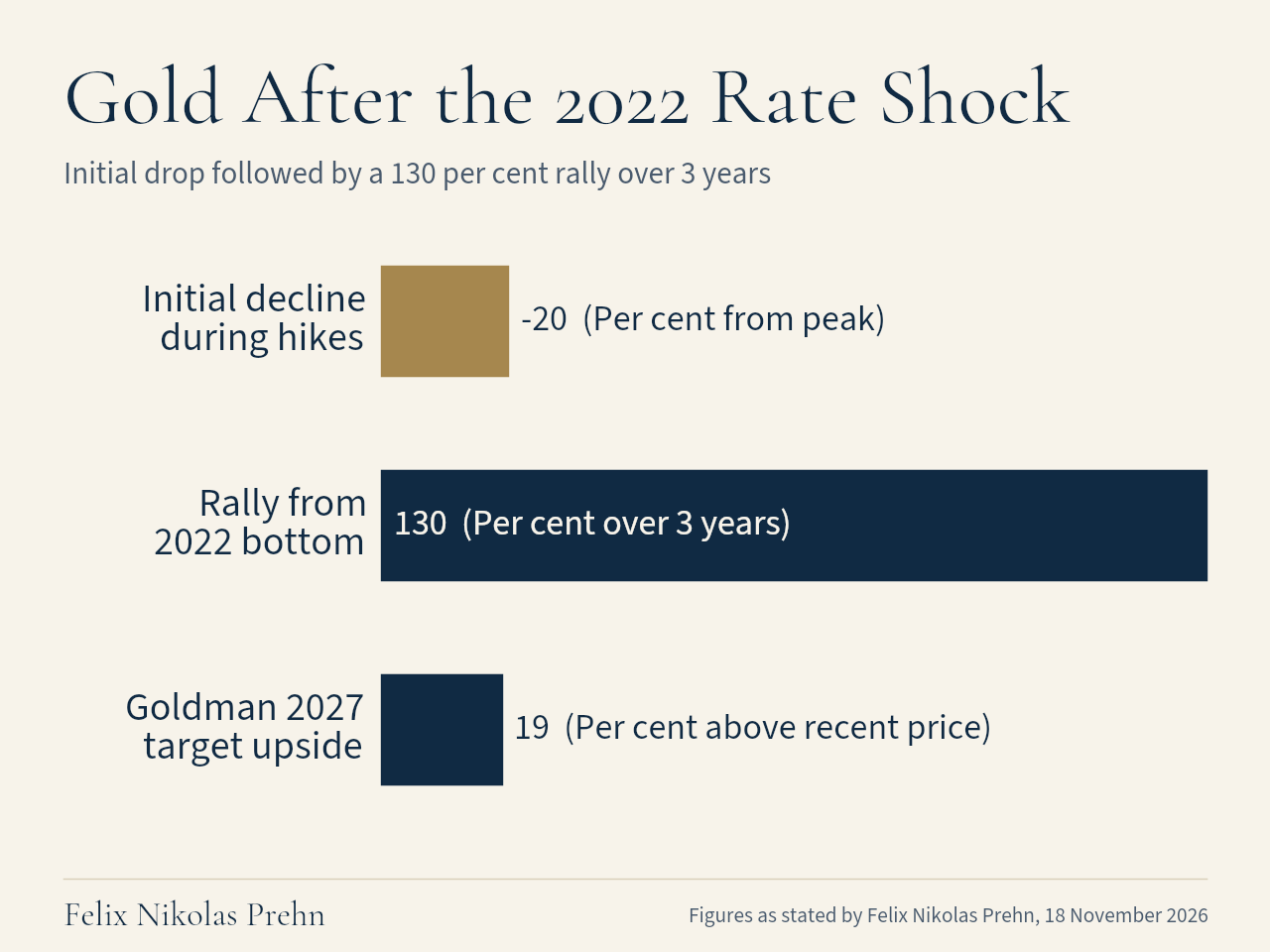
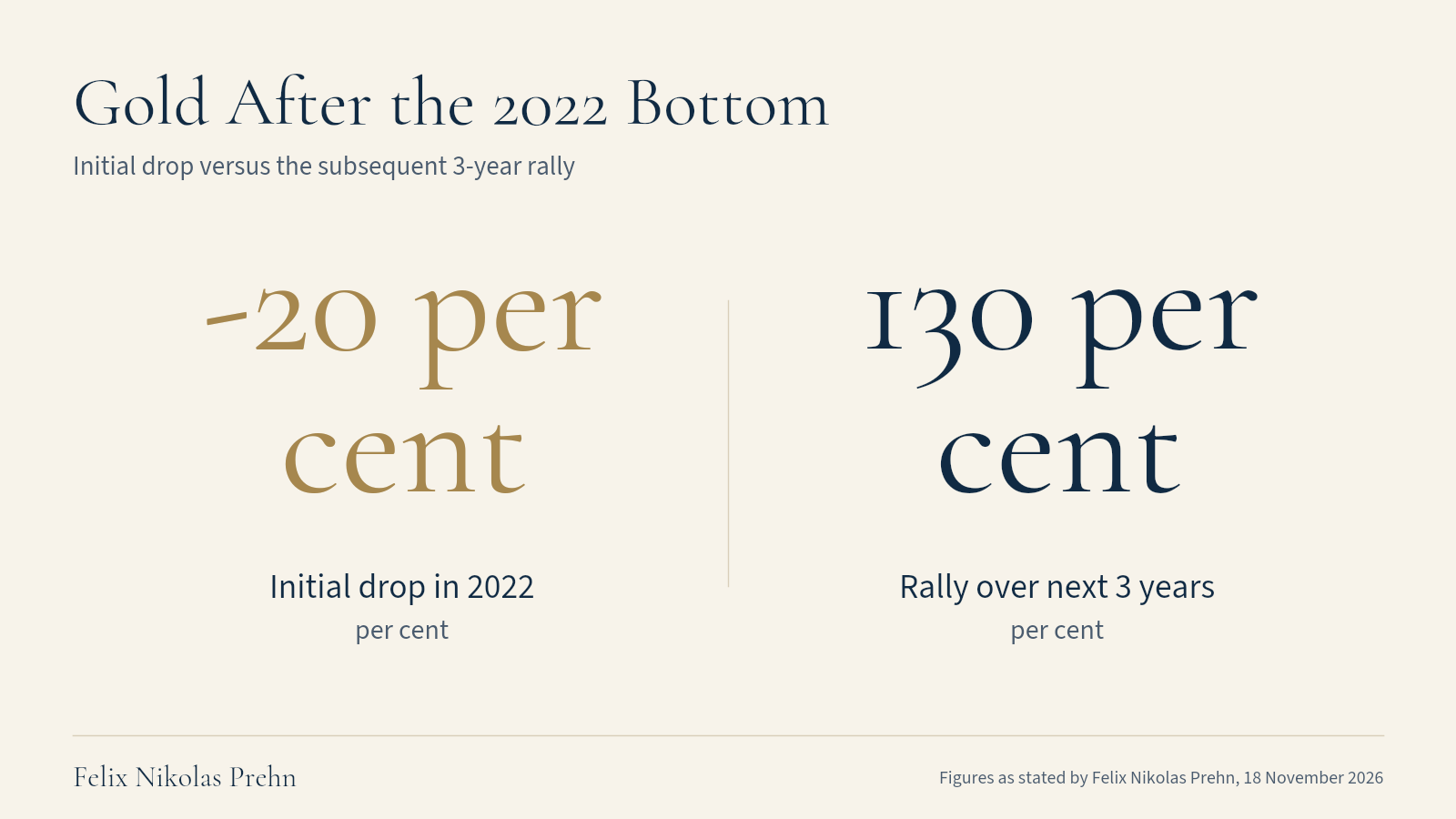
And the setup we're walking into right now is a near copy of what we saw in 2022. And it matters to you because in 2022, gold did something that wiped out a lot of ordinary investors because it fell. It fell very very hard for most of the year while the Fed was raising rates and millions of people looked at that falling chart and decided gold is phenito. It's over. So they sold at the bottom and then it went up 130 per cent of the next three years.
So they sold the exact thing they should have been buying because they didn't understand the machine underneath it all. So in the next few minutes, I want to show you the one key number this Goldman report has that tells you who's really buying gold, whether they can't stop, what it means for your money. I want to walk you through every important chart from this report. And if you're new here, you're wondering who the heck is this guy. My name is Felix Nicholas Pin.
I'm an economist former investment bankup, founder of the PIN Institute. We publish research. We tell people how the market really works. Zero sponsorships, zero endorsements ever, not even for gold. And that of course down here is is is Winston who does all the, you know, the gold research around here.
Get it? Goldman gold research. Uh anyway, so um I'm going to put all the key stuff here, all the numbers, the charts, and so on from the Goldman report into a free report. You can download at felix.org/ /goldoutlook. Um, it's just free so that you have a better understanding of what's going on here.
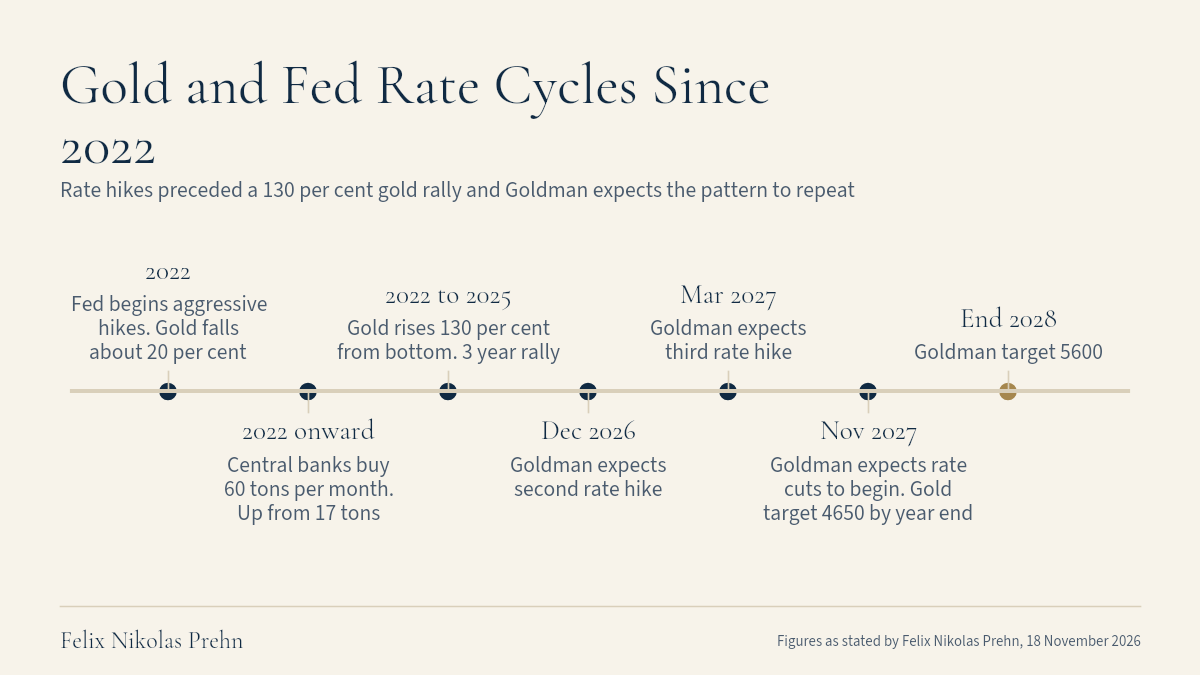
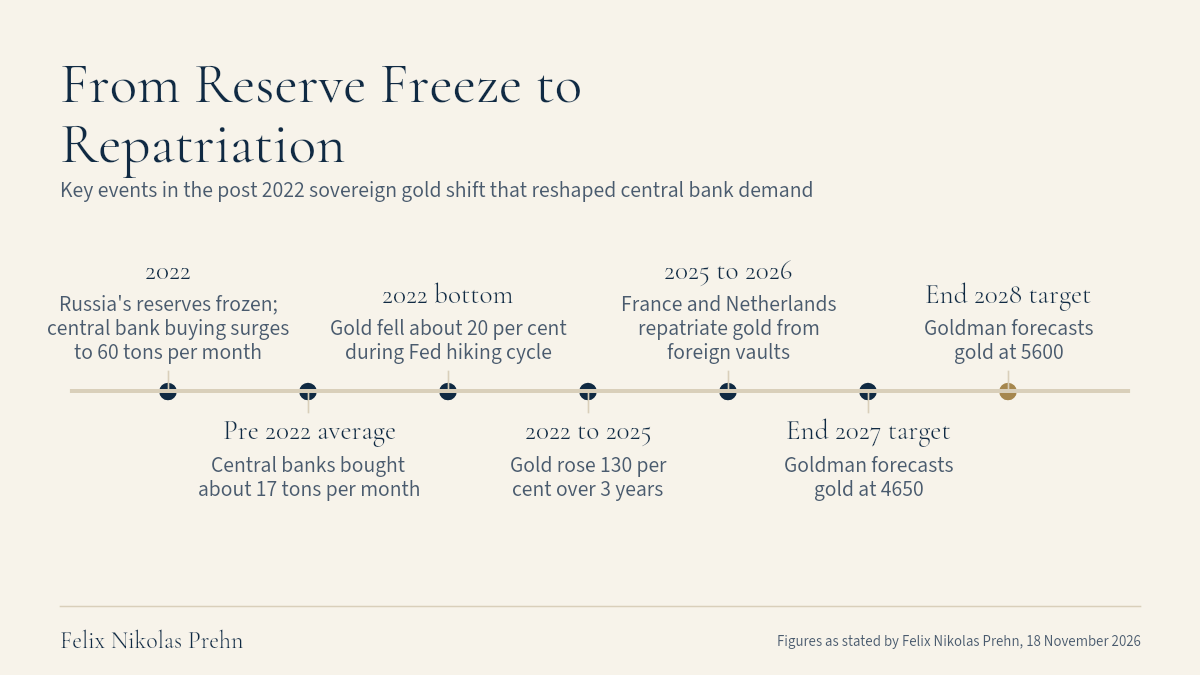
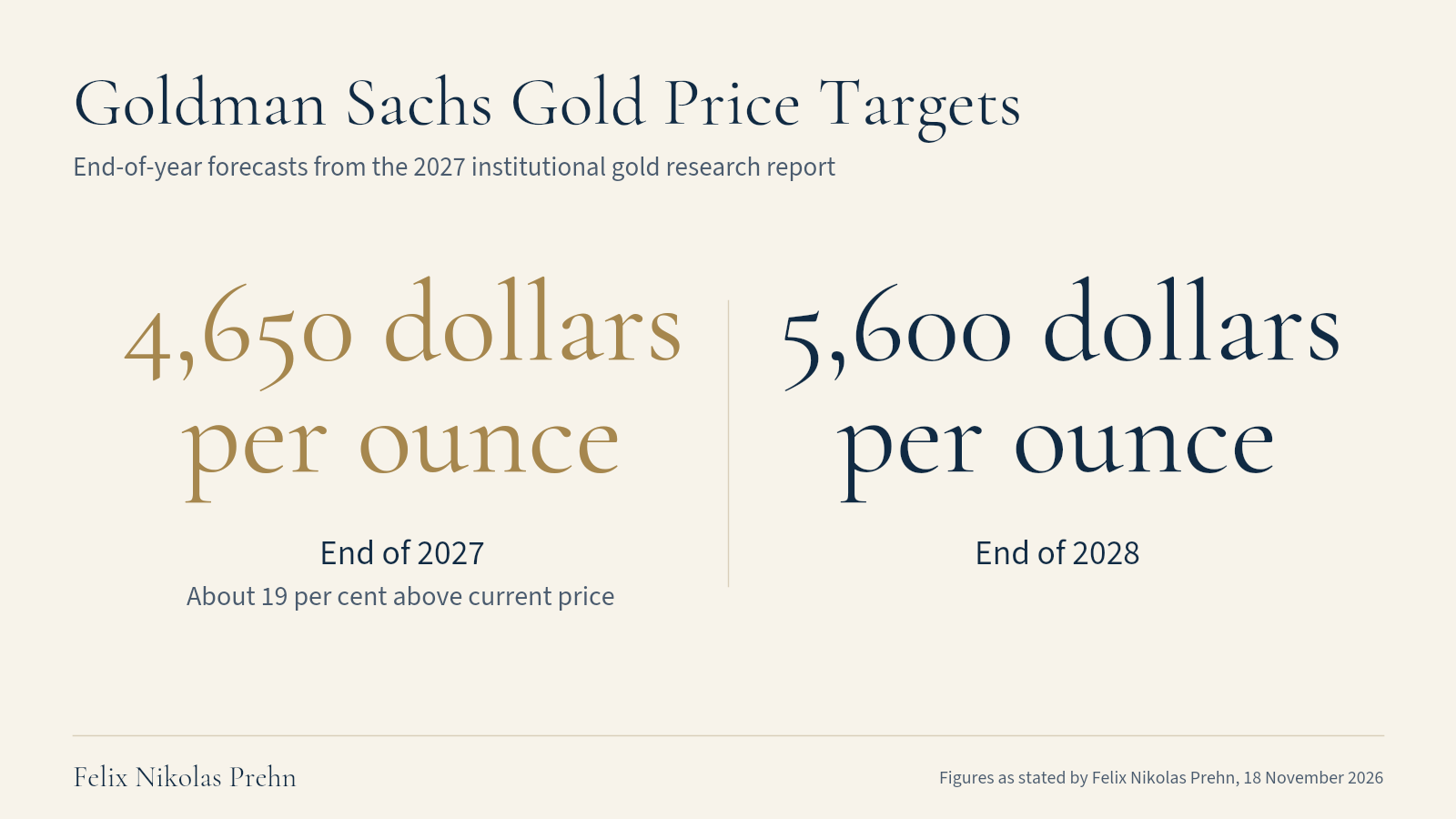
It's really our mission here. Um, but if you want to go deeper, stay with me for a few minutes. Goldman's forecast is this, and this is why not just reading the headline is so important. Goldman's forecast is that gold is going to go a little lower than it is right now. and that by the end of 2027 we'll be at 4,650, but that by the end of 2028 we'll be at 5,600. And they explain it.
They don't just pick these numbers randomly out. But even the 4,650 is about 19 per cent above where gold is trading as I'm recording this. The second number, of course, the 5,600 is the one you want to think about. But even by the end of next year, they're saying plus 19 per cent, which is pretty freaking good if you ask me. But I also know because I've also read the other Goldman Sachs reports which tell you that they think the Fed is going to raise interest rates.
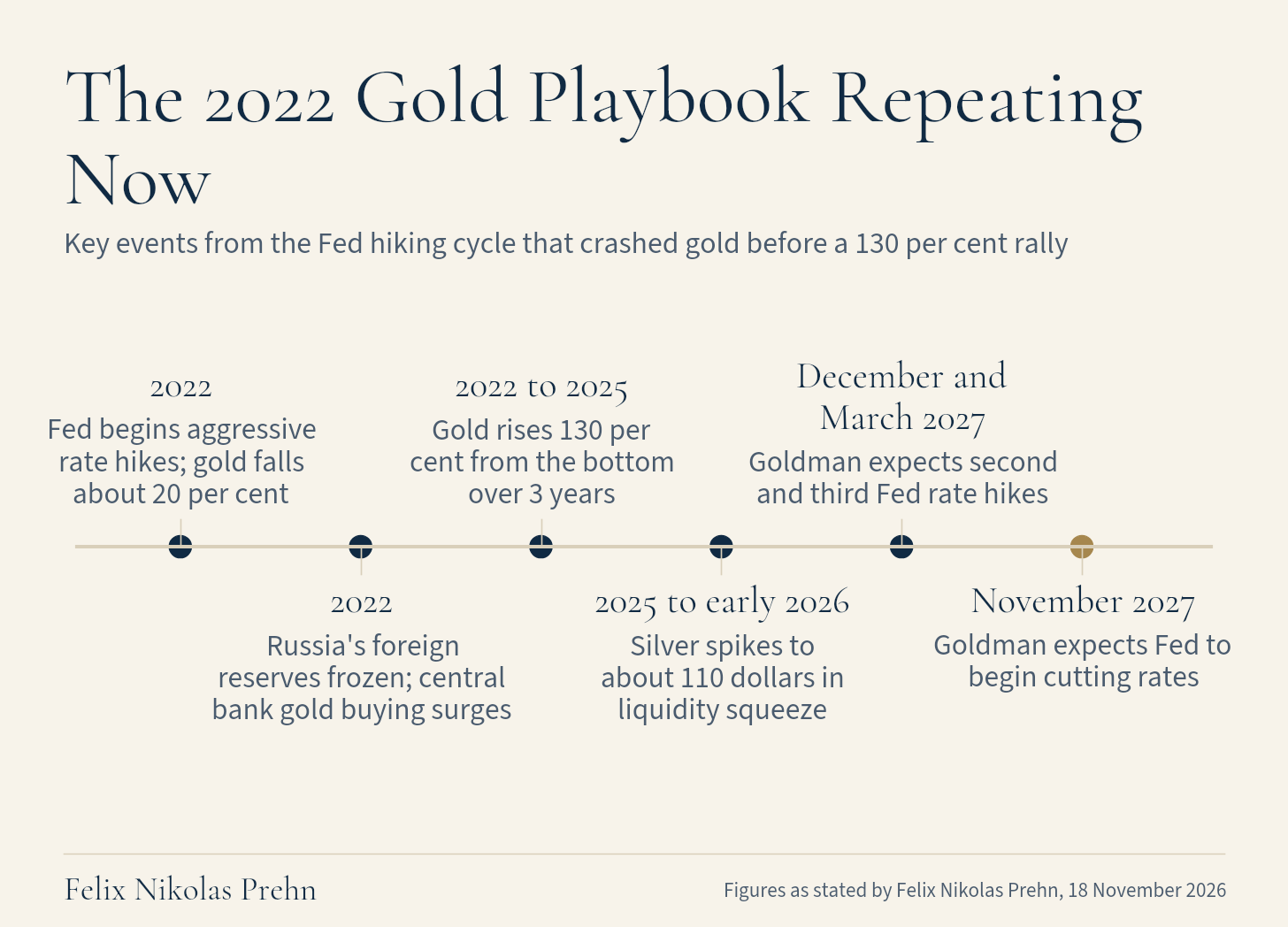
We're going to get a second rate hike in December and a third one in March 2027.
That's what they're saying. And and we've all been told, we all been taught, especially if you're sort of over, you know, say 40 years old, that um rising interest rates are bad for gold, right? Bad interest rates. Why? Very simple.
Well, actually, not that simple. Let me walk you through it. You get higher rates. That leads to a higher dollar USD. And that means that for foreign buggers like me, it is now more expensive to buy gold because gold is denominated in dollars.
Yes. So therefore you get a lower gold price because a lot of the world's demand is from, you know, foreign buckers like me. That's the textbook. So how does Goldman square those two things? How do you forecast gold going up and central banks raising interest rates at the same time when that breaks all the rules?
Well, that's the puzzle of this report. And it's the same puzzle that's tripped everybody up in 2022. Let me take you back to 2022 in our little time machine because this is the heart of it.
In 2022, it's on the screen here. We make maybe make this a little bit bigger. This is the start of 2022. The Fed started one of the most aggressive rate hiking cycles in modern history. And gold, which is the the dark blue chart on here, it it tanked, which is exactly what you'd expect it to do.
Fell about minus 20 per cent initially. So, a lot of regular Joe investors did the human thing. They panicked.
They sold. And who bought central banks? The central banks of the world bought that entire dip steadily accumulating while retail investors were being shaken out by their own higher interest rates. Interesting, isn't it? And then what happened?
Well, then we got, look at this blue chart here. Over the next three years, we got the most glorious bull run in gold we've had in a very long time. So, if you saw the the bottom, you're kicking yourself. you're like just really frustrated and a really miserable guy who's lost his hair and Goldman is now sitting here thinking and looking at the data saying it's 2022 again right it's there on black and white if you can see it on the on the thing so the Fed is hiking we're getting higher rates gold is going down which is what you would expect right retail is getting oh dear it's all over I should probably sell this at least quite a bit of it and the big structural buyer, the central bank. Well, they're still there. And I know if you're holding gold right now, you're in pain, right?
You're watching it chop around, going down and down and down, and you don't know if this is 2022 again or if this is something worse. If you own stocks, these rate hikes are about to split your portfolio into two halves. By the way, that's another thing we're going to discuss on Saturday. And I'll show you that in a moment. But if you're sitting in cash feeling safe, well, you're definitely losing money.
That's actually worse than sitting in anything else. Most things at least. So, the problem isn't that you lack information or prices. You're actually drowning in information. Don't you feel like you're drowning in news and information?
The problem is you don't have a framework that tells you what to actually do about it. And that's what the rest of the video is going to give you. But for those of you who want to go even deeper and actually serious, are you actually serious about gold or actually any investment? This works for tech stocks, gold, anything. Understanding the structure of the market now, understanding what Goldman is telling his clients and why the setup looks like 2022 and understanding the structure and actually repositioning your own portfolio.
Well, those are again two things. So, I can make you understand the structure today. I can't in the next 10 minutes teach you what to do about it because that'll take me about two hours. But I will and I'll do it for you for free because I want you to understand what happens when the Fed pivots into the hiking and then back into the cutting. Which stocks actually do well in which cycle?
Which ones bleed out? How do you tell the difference between a company that was built to well survive expensive money, which is where we're heading, and which one was just built for the free money era, which is the last 10, 12, 15 years, which is just over and isn't coming back. So, if you think we're just going to go back to plain old normal because everyone's always bought the freaking dip, well, that's not going to happen. And the simple reason for that is that money is now more expensive. We've gone through zero interest rates or near zero interest rates for a very long time.
That isn't coming back anytime soon for the simple reason that well, plenty of that to go through on Saturday. I call it the 2027 plan. So, we're going to sit down together. I'm going to walk you through the exact tests, run through exactly how you can apply this to your holdings, the sectors, the hiking cycles, all of it, and then rebuild your portfolio around what's actually happening there. And we're going to do that live.
We're going to do that for free. We will not give you a replay because I know people don't watch them. It's a waste of life. People just think that they're going to do it, but they never actually do it. So new.
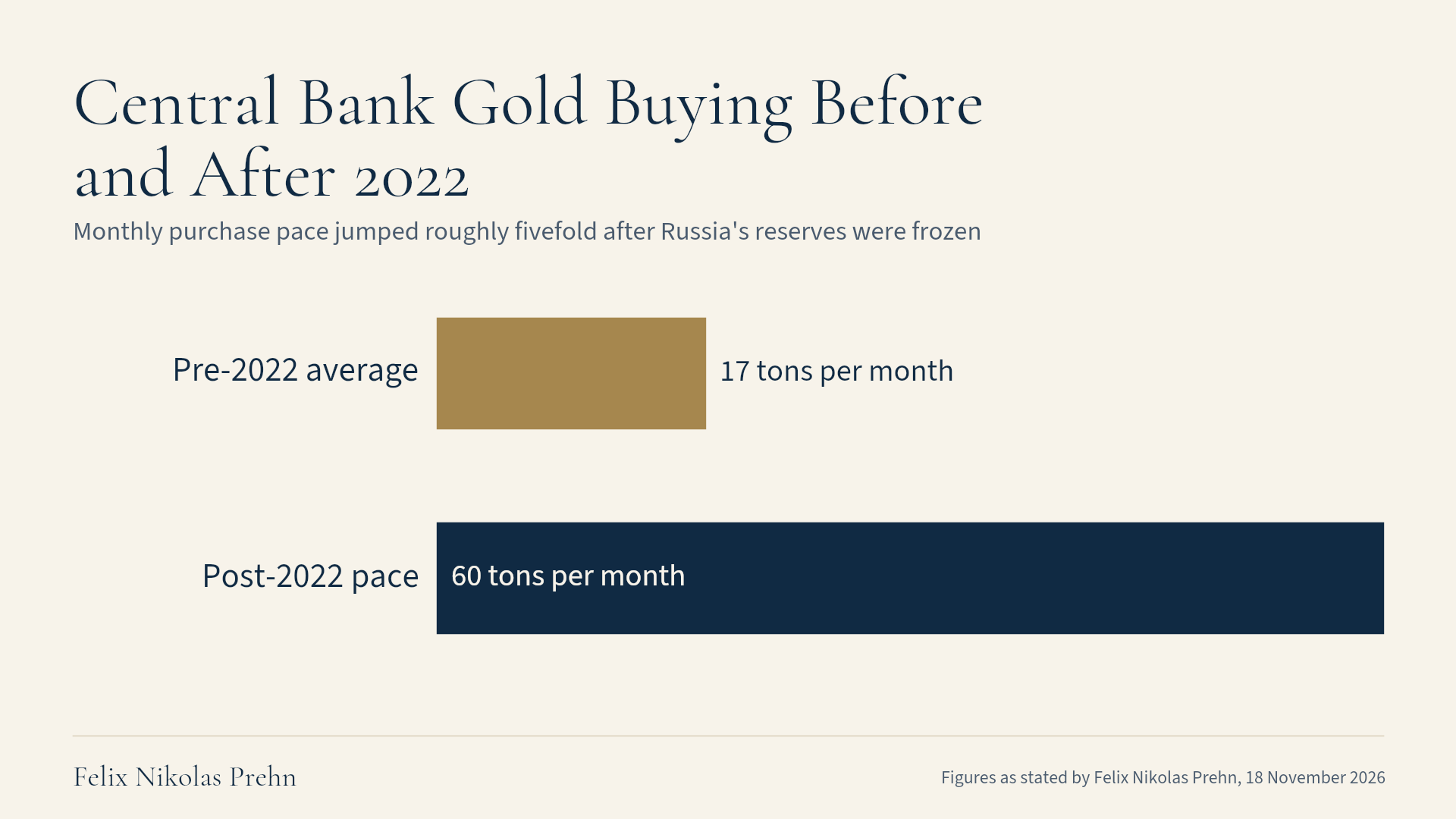
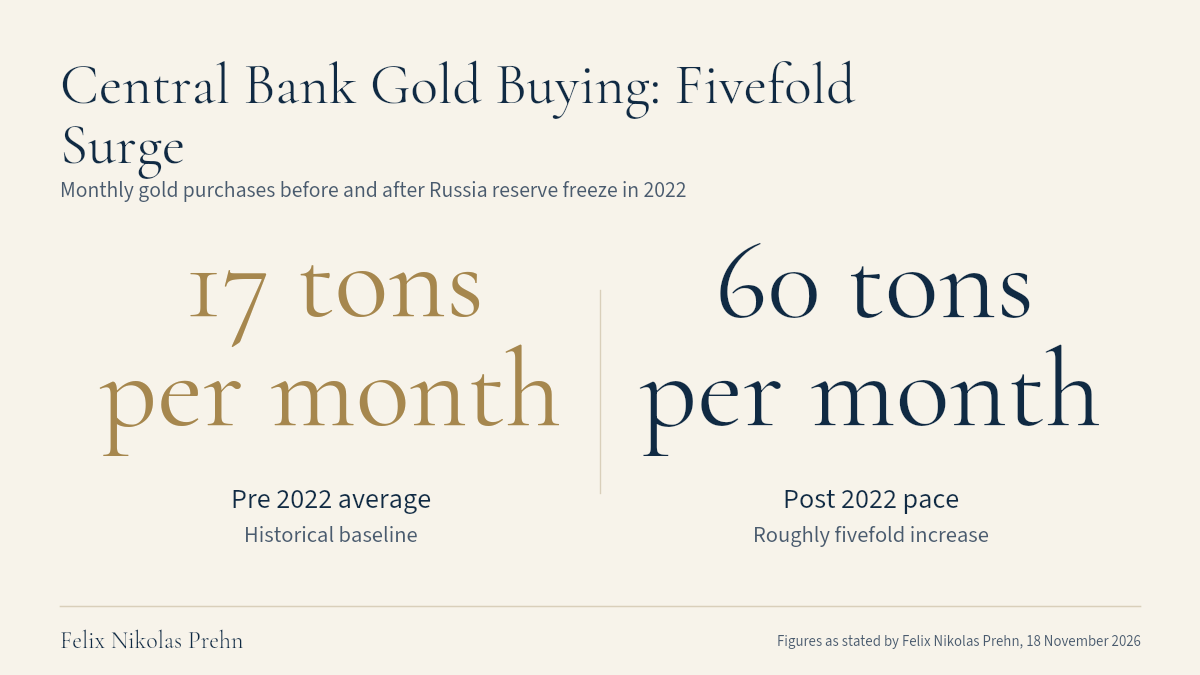
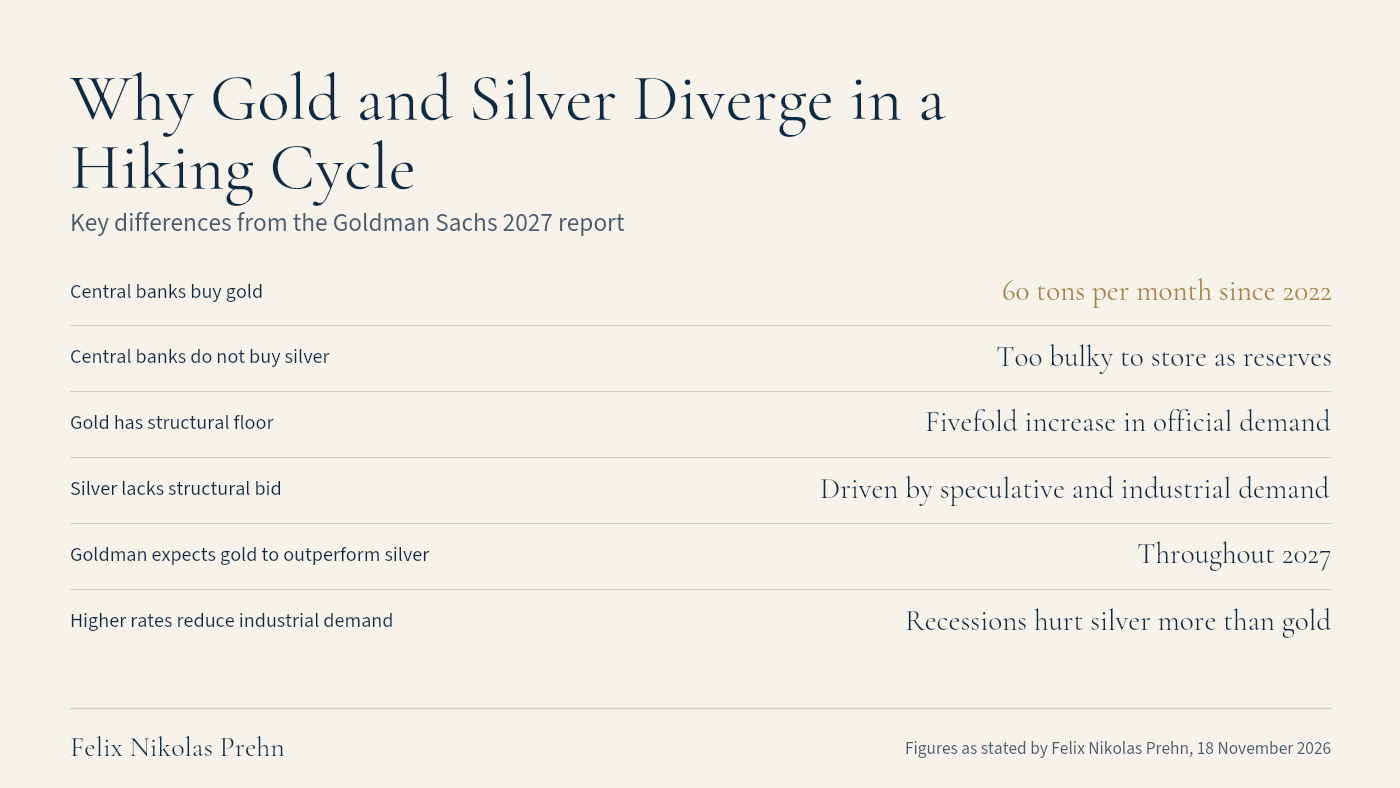
If you're going to show up for yourself, if you want to make your 2027 plan now before the big rate hike coming, before people really realise what's going on out there, then join me at 2027 plan.org. Uh just write plan in the comments. Uh and you just commit to yourself that you're going to show up. And I want to go back to the number that I promised you, which is central banks are buying gold at a pace of about officially about 60 tons per month.
And they've been doing that now since 2022. Before 2022, the average was about 17 tons 17. So we've gone from 17 to 60, which is about fivefold increase in amount of gold that these lovely people are buying because they are wonderful people, aren't they? They really only care about our great benefit. Uh and and 2022 is of course the moment when Russia's foreign reserves were frozen.
So you have a major country who woke up and was like their money that was parked in dollars and in euros and western banks it was just switched off just like that.
And then every other central bank on earth looked at that and said, "Ah, could that happen to me? Oh dear. What are we going to do about it?" Well, what can we hold? We can hold stocks. They can switch those off.
We can hold crypto. They can switch those off. You can hold stable coins. They have off switches as required by law. What can we actually hold?
Diamonds. Well, there too many of them. People can make them. Gold, right? So, you can put in your own vault.
It doesn't depend on anybody else's permission. And since that day, central banks have been buying gold at five times the rate that they've historically done it. And the report makes a very important distinction here, which is that this is not speculative money. This is not some lunatic trader on the Comx who's gonna make a profit this week and then sell it all and then short it and then flip around and take a load of cocaine. Did I say that?
I didn't say that. They don't do that. No, no, no. They are all um organic living juice slurping vegans of the KX. Lovely people.
Uh so um I wouldn't, you know, bismerge the great name of the most wonderful institution and its its traders in the world. I think I dug myself out. Yeah. So, the point being, these guys don't sell on a dip. They just keep buying.
In fact, they're buying more. And this little chart here shows you that that line down there, which I'm putting on here in blue, that was the pre2022 average, right? The red line, can we get a red pen? Sort of red. That red line there is the average of the last 12 months.
So you can see just how enormous the difference is between 2022 average and and post 2022 average. So things have fundamentally structurally changed in the gold market. And then there is a bit in the report which of course most people will skip over but I think it's the real signal. I think it's the really interesting bit and it's that France and the Netherlands have been moving their gold.
Not buying or selling, but moving it. Repet repatriating being the fancy word. Bringing it home out of foreign evil vaults into their own. And what does that mean? Well, the developed world is no longer arguing about whether, you know, should we own gold.
No, it's looking at where to store it and who do they trust to hold it. And these are allied nations. They're pulling their gold out of each other's vaults. Something therefore has shifted in the plumbing of the global financial system. The trust that hold the old system together is cracking somewhat.
And gold is the thing everyone's reaching for. When what? Trust breaks down. You don't trust people. Don't trust the bank.
You don't trust the government. Don't trust other governments. Don't trust the exchanges. What do you do? Well, you stick it under your own vault.
Right now, of course, you're now thinking, well, if this is true, there's this massive structural demand for gold. Why does the price keep falling for, you know? Well, this is the most important thing to understand because getting it wrong is what makes people sell near the bottom. I'm not telling you it's the bottom. I haven't got a crystal ball, right, for bottoms.
And I'm also not a financial adviser. I don't give you advice. I don't tell you what to buy or sell. I just want to give you some information that the loveies on Wall Street are getting. So, you're getting it, too.
So, I've already told you the first reason why higher rates bring gold down, but there's a second reason. Higher rates also mean that certain really boring things pay you money.
Bonds pay more. Yeah. And cash pays more. Your savings account pays more. Gold, on the other hand, pays how much?
Yeah. Nada, right? N zero. You actually have to pay to store it. So when rates go higher, the cost of holding gold gets greater because gold pays you zero.
Whereas bonds now pay you more. Cash even pays you more. It's in the savings account. So why do you want to hold gold and get zero when you can get like 5 per cent maybe 6 per cent maybe even more just holding government bonds which are the safest thing in the world right just keep repeating that and Goldman actually has a model on this and they call it something really fancy macro policy hedge demand for gold here as it is on the on on the screen and it makes them sound very fancy took about 15 minutes to try and figure out what the heck this chart was about.
Um but basically they track through the demand for call options on gold. You buy call options if you think something's going to go up. And their forecast is that this hedge demand declines back towards historical average as rates rise in what they call the basement concerns fade. What the heck did I just say precisely? Well, in plain English, as rates go up, the insurance or rather the demand for insurance on gold, which is what the institutions buy, it goes down.
The desire to hold insurance goes down. And that's the headwind. That's the force that's pushing gold down in the near term. But here's the thing, that is also exactly what happened in 2022. The paper price fell because of these rate mechanics while the physical buyer underneath the central bank kept accumulating.
And you can see this here is 2022. This was the spike in insurance buying essentially for gold, right? So it spiked to here. Well, right now we're there. So we're actually at higher levels than we were in 2022 when gold was at the bottom and then we had these crazy spikes here because of the the wall.
So, in the short term, rates win. In the long term, the structural bid won in 2022 in every Alverine I've looked at in history. And of course, the other thing feeding into this is what I call a liquidity crisis.
Imagine you're a chic and you're sitting in your gold bathtub with your gold bath taps and your gold coins slashing around you because you watch too much Disney growing up. and you look at your daily cash flow and it suddenly says zero and you're like, I'm sorry, there must be a mistake. It is usually gazillions, trillions, some random number that is so big that I keep buying things and nobody notices and it's now zero. And then someone comes and hands you a bill for the country's power, the country's education, the country's welfare, the country's defence. for some strange reason, you need to buy all these drones and air missile defence things. And you're going, "Well, I don't want to sell my gold bathtub, but I do have a whole vault of gold bars. I could sell those.
No one's really going to notice because I don't even tell anybody in the world how many gold bars I have. I could just sell some. I get some cash in and I can tidis over this little tough patch, which is precisely what gold's built for, right? It is built for those tough patches." And some of the world at present, some of the richest part of the world in present who have a lot of gold are sitting in that spot where you know the something's hit the fan. But maybe you're still thinking, but hang on, hang on, hang on.
In every crisis, gold goes up. It doesn't actually. What happens? Well, you start with a little cuddly war. Cuddly war seems to always involve oil for some strange reason.
You know, somehow our peacekeeping efforts are particularly focused on oil rich countries. So the price of oil goes up, therefore the co inflation goes up and then inflation goes up. What happens? Well, interest rates go up and therefore bonds pay more, which is what we just discussed. And therefore, people sell gold and buy bonds because they're so exciting.
Now, you with me on that? Now, you might be thinking, okay, I don't really care that much about gold.
It's my silver I'm worried about because I know a lot of you in silver as well. So, let me deal with silver because the two are not the same, not the same trade. And again, our lovely Goldman friends make that very, very clear. Here it is. Uh, but I'm going to explain it to you.
Don't worry. So, silver's had an extraordinary one in 2025 and early 2026. uh something like we call a liquidity squeeze has given us this beautiful spike went up to like $110, right? Enormous move. A lot of people are now sitting there expecting a repeat. Now Goldman is saying a repeat is unlikely while interest rates are going up.
And the reason for that comes straight back to that what number I gave you earlier. Gold gets bought by central bankers. Silver does not. Central banks buy gold for their reserves. They do not buy silver.
It's just too large. It's a pain in the neck to store. So when rates rise and the speculative fast money demand cools off, gold has that structural demand flow. Simple. Silver simply doesn't have that.
And that's why Goldman expects gold to outperform silver throughout 2027. That doesn't mean run out and sell all your silver and buy gold, right? Just saying you're telling you what Goldman's saying. means understand that gold and silver behave very very differently in this exact same regime reset and don't treat them as the same bet. And that brings me to the practical part. How do you actually tell whether silver or gold is cheap or expensive against each other?
So here's a chart here called the gold silver price ratio. We actually track that chart live um in the Winston app for those of you who are who are who are in that um in metals here. There it is. this little fuzzy chart here and it's showing you this increase. What What does that mean? When the line climbs, silver is falling behind gold, which usually means people are nervous.
This is what's going on. People are nervous on silver. I think they might get a lot more nervous on silver than you think. And yes, there is an industrial demand for it. But the second thing that higher interest rates do is they tend to cause recessions and therefore industrial demand tends to decline.
But it's also not that dramatic because if you look at this chart here again, the the bit in red there was the silver squeeze of this year. So silver got more got cheap got more expensive going down and now as it's recovered it's gotten cheaper and it's actually sitting at sort of the longer term average. So I also don't think that silver is particularly overpriced here. I just think it's going to be a lot more volatile in the short term. And I think I could be wrong on that, but just like Goldman's, I think the bet the bigger money is going to be making is likely gold.
So let's let's bring the whole thing together here. So this really lands for you. Let me just summarise this. So we've got first we've got 60 tons per month of central bank gold by five times increase from pre202.
So no matter what the Fed does over the next 12 months, no matter how many times they hike, there is this bio sort of last resort under gold that didn't exist before. Doesn't mean it can't go down further, but it does mean there is a a continued demand for it. And therefore, when the Fed eventually turns and starts cutting, which Goldman is expecting in November 2027, quite a long way away, right? But in gold terms, it's like the blink of an eye. At that point, the paper price might catch up with the physical reality, which is why Goldman's putting that price target out of 5,600.
Again, I'm not promising you a price here as it's just Goldman's number. Do with it as you wish. So, the hikes are the near-term headwind. The central banks are the long-term support. So, you, my friend, now understand the structure better than 99.9 per cent of people out there, which is very, very cool.
But if you actually want to turn this into a plan, I'm not just talking about gold and silver. We're going to talk about all all of the market and portfolio planning for 2027, then go and register. It's completely free at 2027plan.org. Link is in the description and the comment down below. And if you got something out of this, do me one favor.
Share this video with one other person who might need to hear it. Put it on your socials. put it somewhere where people actually benefit from this because too much of the stuff out there is just fear-mongering. Um people trying to sell you something which is understandable. We live in capitalism. I totally get that.
But um if you actually want to learn how the institutional money does this, which is how I learned this like my mentors are all guys who worked on Wall Street and hedge funds and you know market makers for the metal exchanges and so on. And I want to share as much as I can share of that with you in the sort of 90 minutes or two hours we have together on Saturday. So come and join me 2027plan.org and look forward to seeing you there. >> Right now I think we're going through some sort of weird phase transition. And normally when you get bad economic news or you get bad jobs data that people are going to fly to safety into the bond.