Transcript
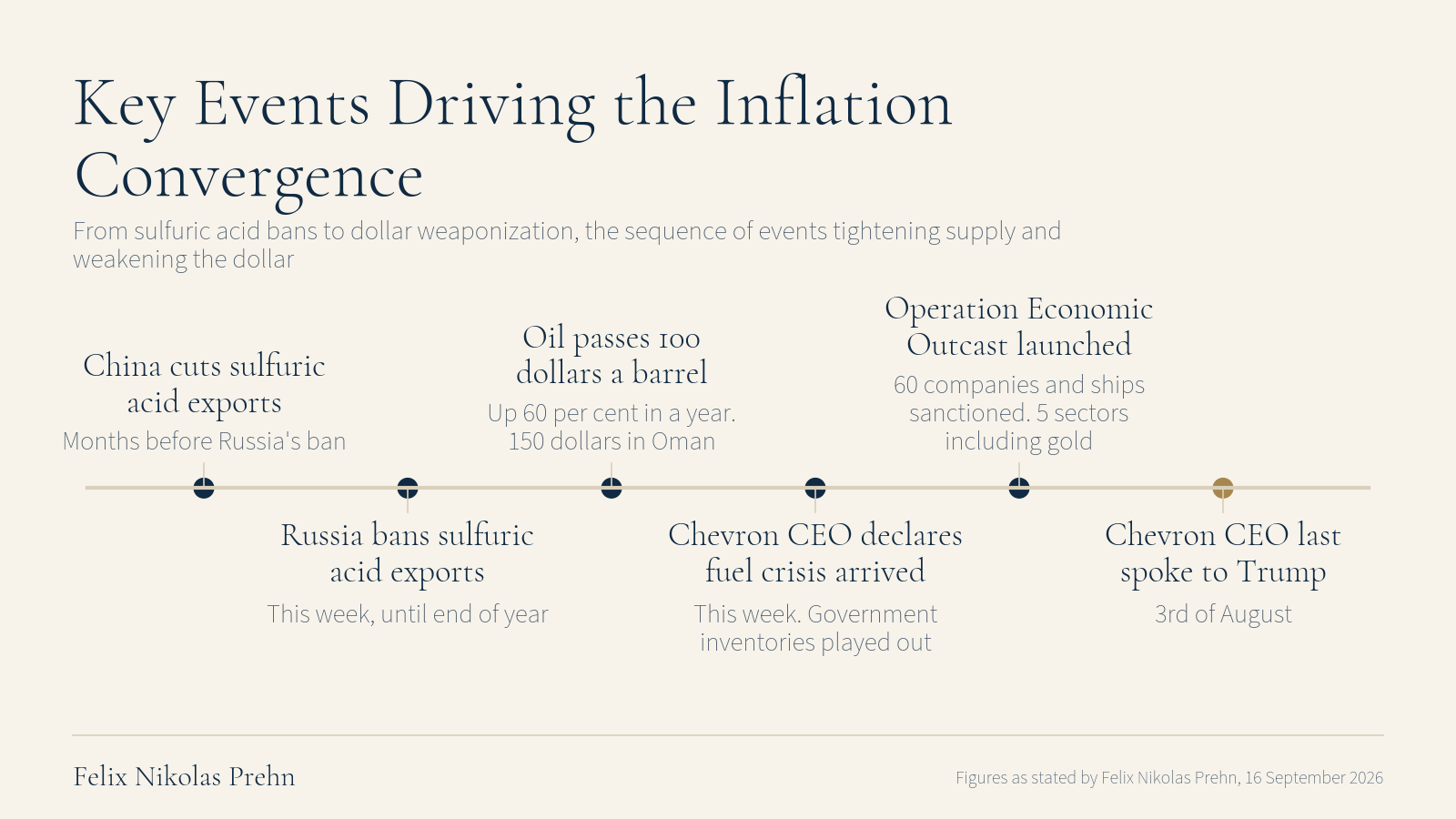
Russia have just banned exports of a chemical you've probably never heard of, yet it might be the single most important thing that happened to your money this week. The chemical is called suloric acid. And I know it sounds boring until you find out it is the key ingredient you absolutely have to have to make fertilizer. And China already cut their exports months ago. So the two biggest suppliers on the planet have walked away from the table within a couple of months of each other.
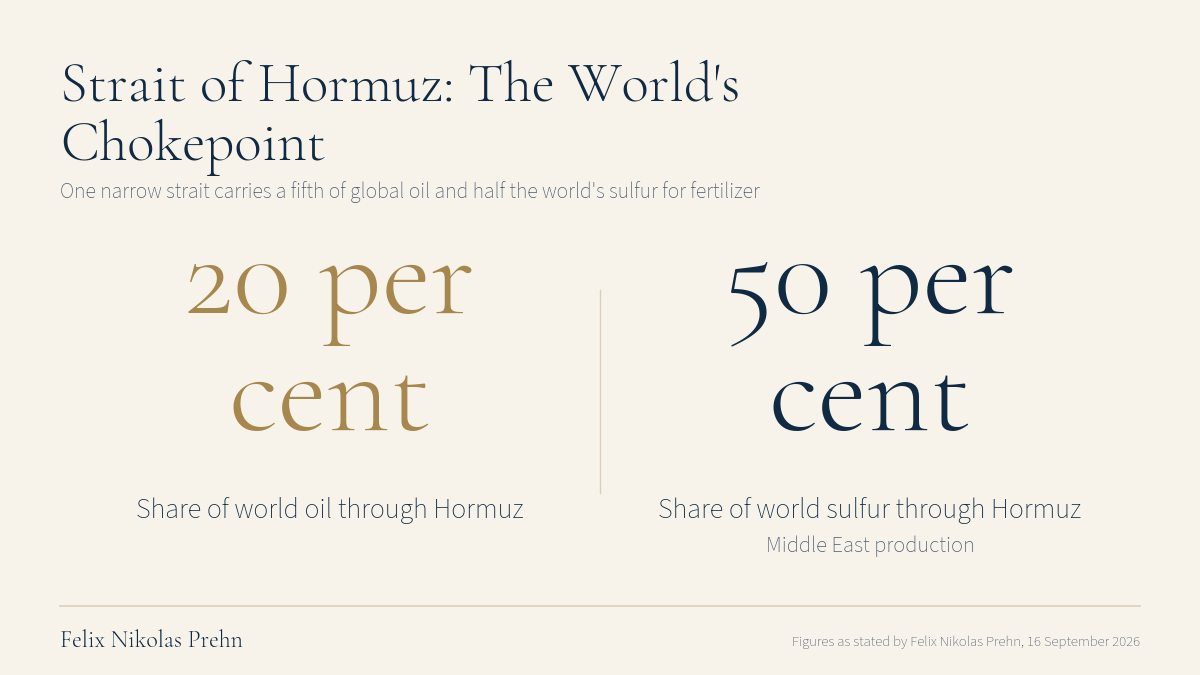
But the part that should actually worry you what Winston just told me where the stuff comes from. You see the other half of the world's sulfur, the raw material full sulfuric acid comes from one region, the Middle East. And it all flows through one narrow straight. Yes, you guessed it is. The same one that carries 20 per cent of the world's oil.
Half of the sulfur of the world comes through there. It's the straight of Hermoose. And right now, yeah, it's not looking so happy, right? My name is Felix Breen. I used to invest in banker.
This is Winston here. He's feeling a little bit better which we're very happy about. And we started teaching regular people about six, seven years ago the stuff that Wall Street would rather keep to itself.
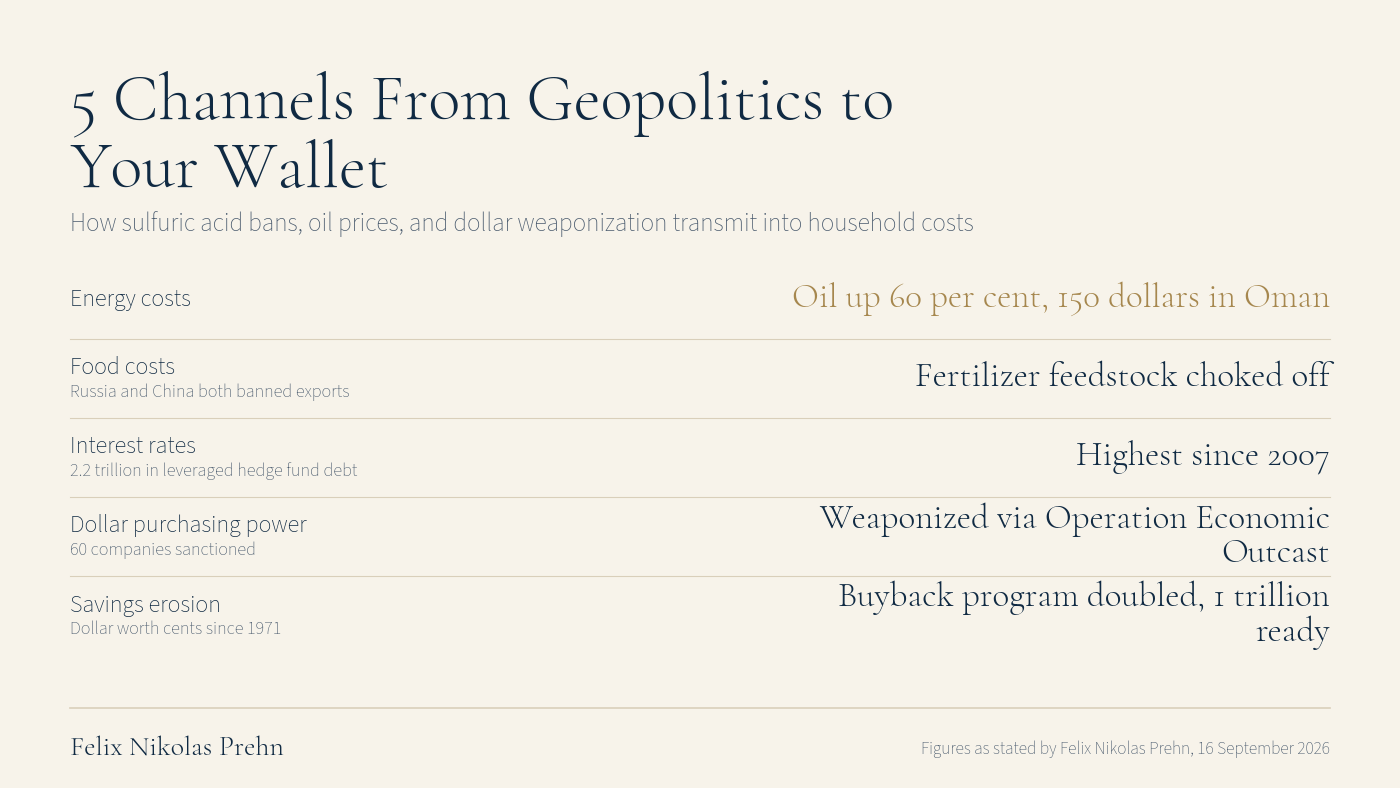
And we've taught about 25,000 people since none of this is ever sponsored. None of this is ever endorsed by anybody, which is how I like it. And when I just saw the sulfuric acid bound this week, and then I look at where oil is trading well over $100 a barrel, up 60 per cent from a year ago, and then I read what Chevron's own CEO just said about the fuel crisis. And then on top of that, I saw what hedge funds are doing with 2.2 trillion of US government debt. And I couldn't really stop thinking about it.
So I think no one's really putting this together. And that's really what I like to do for you. So people are not talking about this double whammy when it lands and it's about to land. The news shows you another, you know, random headline, another Fed meeting and you know all of that. But the people who move trillions around for a living, the central banks, the commodity desk, they're looking at a very, very different picture.
They see oil at above $100 and climbing.
It's $150 in Oman right now. They see the straight of Hammoose carrying a fifth of the world's oil and half the fertilizer feed stock. and they see Chevron's boss saying out loud that the buffers are gone. And they see hedge funds on this massive pile of US government debt that they will dump the second things get choppy. And let me tell you what, no one's really connecting. When oil goes above 100, everything that moves gets more expensive.
Transport, manufacturing, plastics, the lot. I mean fertilizer gets choked off because the acid can't get made food gets dera in fact there is less food very very simply so we got oil up less food so higher food prices at the same time and that's the whammy so people see the petrol prices jump right and their shopping climb you know their shopping bill climb 30 40 per cent. What do they do? Well they panic they feel bad. So what do governments do?
Governments hand up money to calm them down.
Right? you saw the $5,000 thing if you wait for for for Trump, right? Um, and this isn't political. I you know, they all they're all basically uh fairly similar. They're all trying to get elected. But what we're seeing is these other countries, they're seeing what I'm telling you, too.
And they're starting to move their savings out of the dollar and moving into something governments can't freeze or print or switch off. So my goal is stick around for a few minutes and by the end you're going to understand exactly what these people know that most don't and you're going to have a plan what to do about it before any of this turns up you know on the evening news. Anybody still watch the evening news? So there's going to be a lot of stuff here that we're covering today while I'm cuddling this lovely little ear of his. So Winston has um written the whole thing up for you in plain English.
You know what happened, why it matters and and everything else and you can download that the link down below in the description. He's got a bit of spot of pancreatitis unfortunately but he's uh he's recovering well which is which is the good thing. He's feeling much much better today. So thank you guys for all the kind messages those of you who had heard about it.
Uh first now so we need to understand this sulfuric acid crisis even though no one's talking about it. So what actually happened this week that really nobody realised Russia banned sororic acid exports until the end of the year. And you probably are still thinking, "Who cares? Boring ass chemical." Well, you're not alone. Um, I'd never really thought about it much, but I was with somebody very smart uh the last week and he was talking about it and then it hit my my my news item and I realised this is rather a big deal.
Sulfuric acid is the one chemical you must have to process copper, nickel, uranium, and yes, fertilizer. Without it, literally, you cannot make fertilizer that feeds 8 billion people. It isn't optional. It isn't easily replaced. It's the backbone of modern farming.
I'm not a huge fan of modern farming, but you know, this is what what we've got. Um, and I know you don't think about it. So, China has stopped exports.
Russia has because they realise there is a shortage. So the key realization is, and I learned this from a very clever chap last week, that the vast bulk of safhoric acid production is offline because it's in the Middle East. Only Canada has some left, but not enough. Australia closed most of their smelters and now stupidly rely on imports, which have now stopped. So the Middle East produces half of the world's sulfur.
It's what you need to produce sulfuric acid is what you need to produce fertilizer. And it nearly all of it leaves the region, the Middle East through, you've guessed it, the straight of Hammoose, that tiny little gap, you know, that uh is is is is part of this war. So, everyone's talking about oil, right? And I woke up this morning and says, you know, oil jumps 4 per cent after hookie strikes and so on. That's why I got my news from from our own Winston up because I hate the news.
I think the news is in terribly negative and depressing. Uh, but what we do instead is we write a personal newspaper for your stocks only and only the stuff you need to know, nothing else. So, it takes me like a minute to read, see exactly what's going on with each of my tickers for the day and why. And I find that incredibly useful. If you want to check that out, link down below uh for a for a full month trial.
Like literally just for a month. You don't like it, you just cancel it. No questions asked. So the double whammy is yes, everyone's talking about oil, but no one's talking about fertilizer because it's a little bit too complicated for mainstream media, but oil is up 60 per cent in a year. So lorries, ships, planes, they all burn diesel essentially or some sort of fuel, right?
So your Amazon parcel costs are going to be more. Your groceries will be more because everything gets transported that that way. Everything is plastically packaged. Your cosmetics, your medicines, your synthetic fabrics, yes, your Lululemons, all that. It's all oil, right? the tarmac on your road, it's all oil.
So, you might be feeling it when you fill up your car, but you haven't seen the second part of this yet, which is going to be a lot lot worse. And then I said the second part is the fertilizer crisis. Fertilizer prices about to move in a way that could make 2020 look gentle. There's less fertilizer available or no available means what? Your food yields drop because of the stupid way of farming.
Prices go up. Prices go up means people get frightened. Then they get angry and then, you know, governments don't really have a choice. So, what do they do? They subsidize because they print money because food shortages food shortages is one thing that brings governments down.
They know that they will always always choose the printing press over a food riot. And if you look at what Chevron CEO just said and you think that guy knows what he's talking about, he literally went on record this week and he said the fuel crisis that the oil executives have warned about has officially arrived. His words were that the mechanism which is used to soften prices and you know deal with the supply shock have been played out. There are not enough government inventories left to keep the prices low. He also mentioned he hasn't spoken to Trump since the 3rd of August.
So when Trump went after him on you know his truth social for not giving the administration um credit on and and demanded oil companies bring prices down. So, you've got the boss of one of the largest oil companies on Earth telling you the crisis isn't coming sometime soon. It's actually here. And all of this is landing on something even bigger. Right at the same time as we have the asset ban and the oil squeeze, the US government launched something it's calling operation economic outcast.
The Treasury Secretary described this, and I'm not kidding you, as an economic D-Day. They sanctioned 60 companies and ships went after five sectors including gold and told the world that any country caught helping Iran gets removed from the dollar system. Now you might think that's a brilliant idea because you know you don't love the ayat dollar. I mean you know who am I to criticise the infallible but in plain English they're turning the dollar into a weapon. You play by rules or we cut you off from the money the implanet runs on.
Now put yourself in another country's shoes. Maybe you're not the um infallible Ayatollah, but you are one of the sort of neighboringish countries, right? So you're watching oil at 100 bars but plus you're watching no more fertilizers.
You're watching Washington weaponize the dollar against sort of a neighborish. Whether you like them or not doesn't matter and a thought creeps in. What if we're next? What if they decide we're on the wrong side of this and they cut us off too? So that's the moment you start shifting your money out of dollars and that's the moment you start buying gold.
And I'm not 100 per cent a gold buck. I have most of my money in stocks and in index funds and I always want to be very clear now. You want to be diversified. You don't want to be 100 per cent in anything. That's crazy thing to do.
And I'm also not a financial adviser. You got to come to your own conclusions. I'm just sharing my my research here on the macro that's happening in the world right now. But the moment these guys start building a payment system that doesn't touch America, well, that's exactly what they're already doing, right? And that's where the professionals, the skilled money, the people running the billions are joining the dots that most people never see because headlines are pretty dafted.
They're looking at the oil, so inflation is coming through energy. Fertilizer crisis is here, so inflation is coming through food. Weaponized dollar, so foreign buyers are getting nervous about holding the dollar and its dollar debt. Hedge funds are sitting on the most hedge funds are sitting on the biggest pile of US debt they've ever had, 2.2 trillion. And I can tell you that's going to be leveraged to the hilt because that's what hedge funds do.
And the skilled money looks at all of that and they think one thing, inflation's coming, dollar demand softening and the volatility, the ups and downs are going to spike like heck. And that's the setup for money printing.
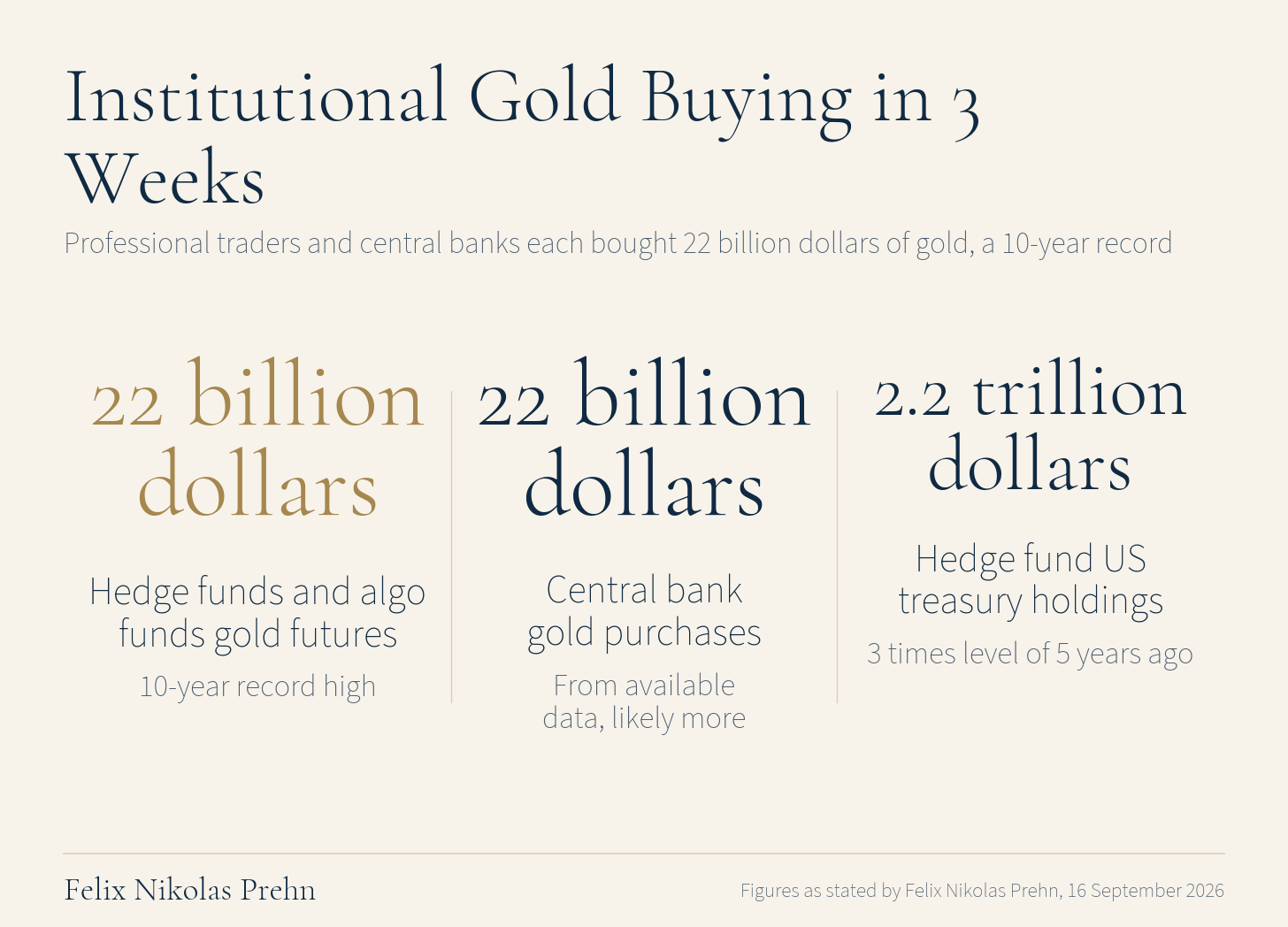
And when you know printing is on the way and it's already on the way but it's going to get bigger. You do two things. You buy hard assets that can't be printed and you got to have anything that quietly loses value when the printing press starts which is exactly what we're watching happen. Central banks bought 22 billion dollars of gold in the last three weeks from the data that's available. It's probably more.
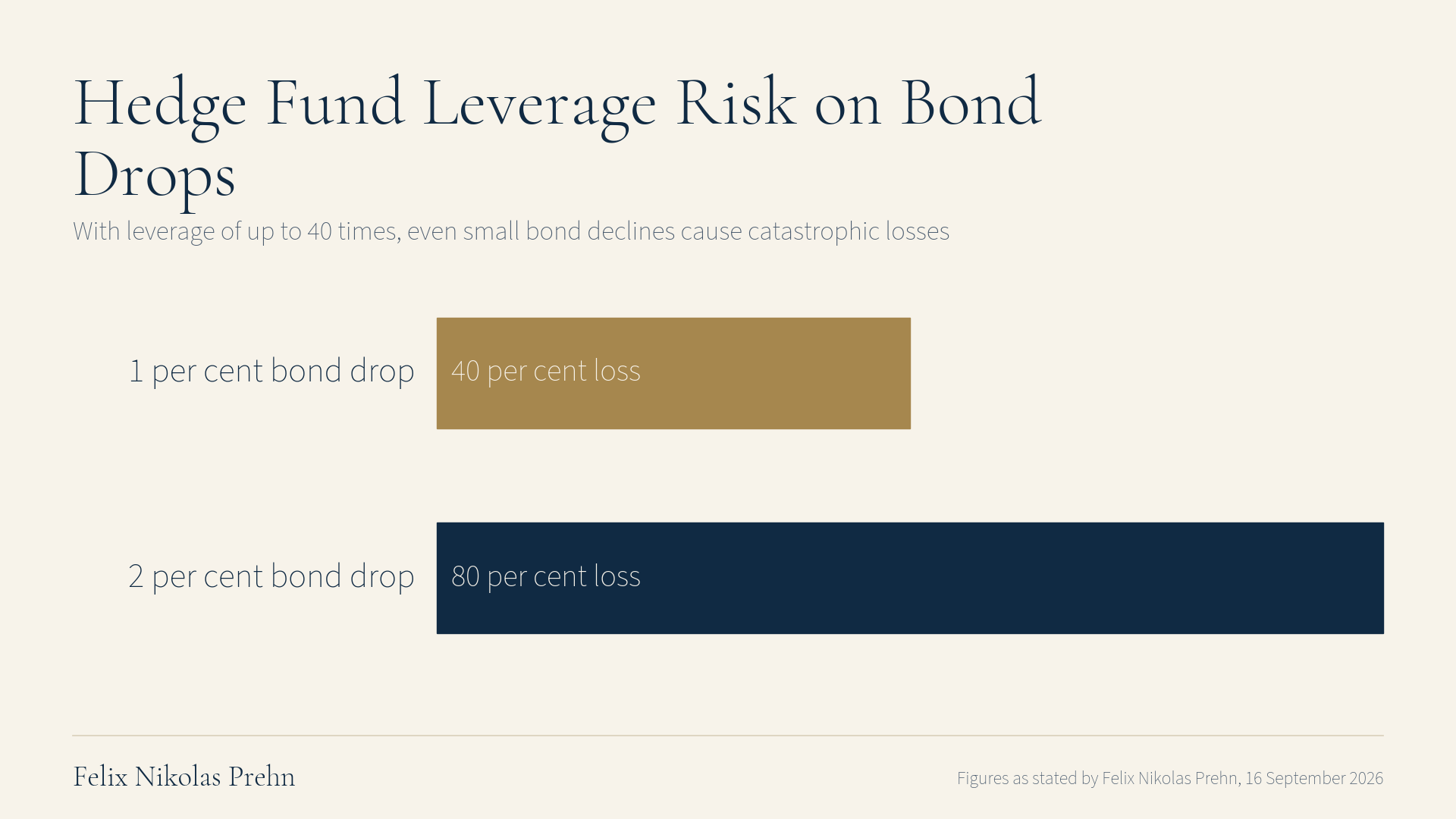
Wall Street desks see silver at $90 in the next three months and these hedge funds are going to sell off a lot of that 2.2 2 trillion government debt. The instant things get wobbly because they're not buying it because they love the country. They're just there for the money, right? And think about hedge funds. They're leveraged, highly leveraged.
They could be leveraged as much as 40 times. So think about a 1 per cent drop in the value of those bonds. They lose 40 per cent of their money. 2 per cent drop, they lose 80 per cent of their money. So, you can bet that these guys are going to move out of that as soon as they come down a little bit.
Right now, what does it mean when bonds get sold off? Why the heck would you care? You don't own that many bonds or any bonds. Interest rates go up. Why should you care about that?
Well, it's your mortgage. It's your car loan. It's your credit card statement. You know, hopefully you pay that off every month. But it's also every piece of investment in America, every factory, every data centre, everything is financed and everybody's interest rates are going to go up.
All the small and medium enterprises in the US, all those companies that employ most of the people, they have loans, credit facilities from their local bank. And those loans and those percentages that they pay, the interest rate is flexible. It is going to go up. And what does that do? It creates a recession.
Now, I get what you're thinking, right? Okay, I hear you fertilizer, dollar weaponization, central banks, buying gold, hedge funds, blah. Yeah, I get it. But what do I actually do about any of it? What do I do like tomorrow morning?
And that's actually the right question to be asking because we've taught 25,000 plus people over the last seven years. The one thing I learned from this is most people take an information like this, they're not along, they agree it matters, and then they do absolutely nothing about it. Nada. Zilch. Why?
Not because they're lazy, because they don't Well, they do care. It's because turning information into a plan, an actual plan you can follow is is the hard part, right? And nobody really shows you how to do it because we've got bag of financial education. So, I've tried handing people a PDF before. I literally thought about writing out a whole plan and giving it to you.
But I know what happened. You download it, you skim it for about 90 seconds, and then it goes into one of these f folders on your phone or on your desktop where, you know, another 2,689 PDFs are are resting for eternity, and you never open it again because life happens to get busy. So, I'm not going to do that this time. What I'd like to do instead is sit down with you properly. I'm going to do this this weekend, and I'll walk you through the whole lot.
It take me about 90 minutes or so to do it right. And I'll show you what the institutions are up to and why and how you can see it. I'm showing you what I'm doing with my own money for the rest of 2026, like the next 90 days or a bit more than that. The actual moves, the timing, and all of it. And most importantly, how you put together your own plan for the next 90 days.
And I'm not saying panic. I'm just saying carefully make a plan. Don't copy my plan because my situation isn't your situation and vice versa. But help you start to build your plan around where you are, what your money is, your life is right now. Because that's the whole point of this.
It isn't a hot tip that works for three days or doesn't blows up. It's getting you aware enough and skilled enough that you can genuinely protect yourself from what's come. And there'll be people who in, you know, 12 months, 18 months, um, they will read about this in the paper and there'll be the people who actually learned this um, and took advantage of it and hopefully thrived. And that's really the goal. So, there's a link down below in the description.
It is 100 per cent free. The link is 90dayplaybook.com. If you're going to be part of the people who will hopefully thrive with us, um, write thrive in the comments. I'd love to see it. There's no catch.
I'm not here to scare you or panic you. I want you to be skilled enough, prepared enough that you can thrive through what's coming instead of just, you know, scraping through it, which is unfortunately what most people will do. So, it's completely free the session. Um, so let me show you act two. And again, people are not talking about it.
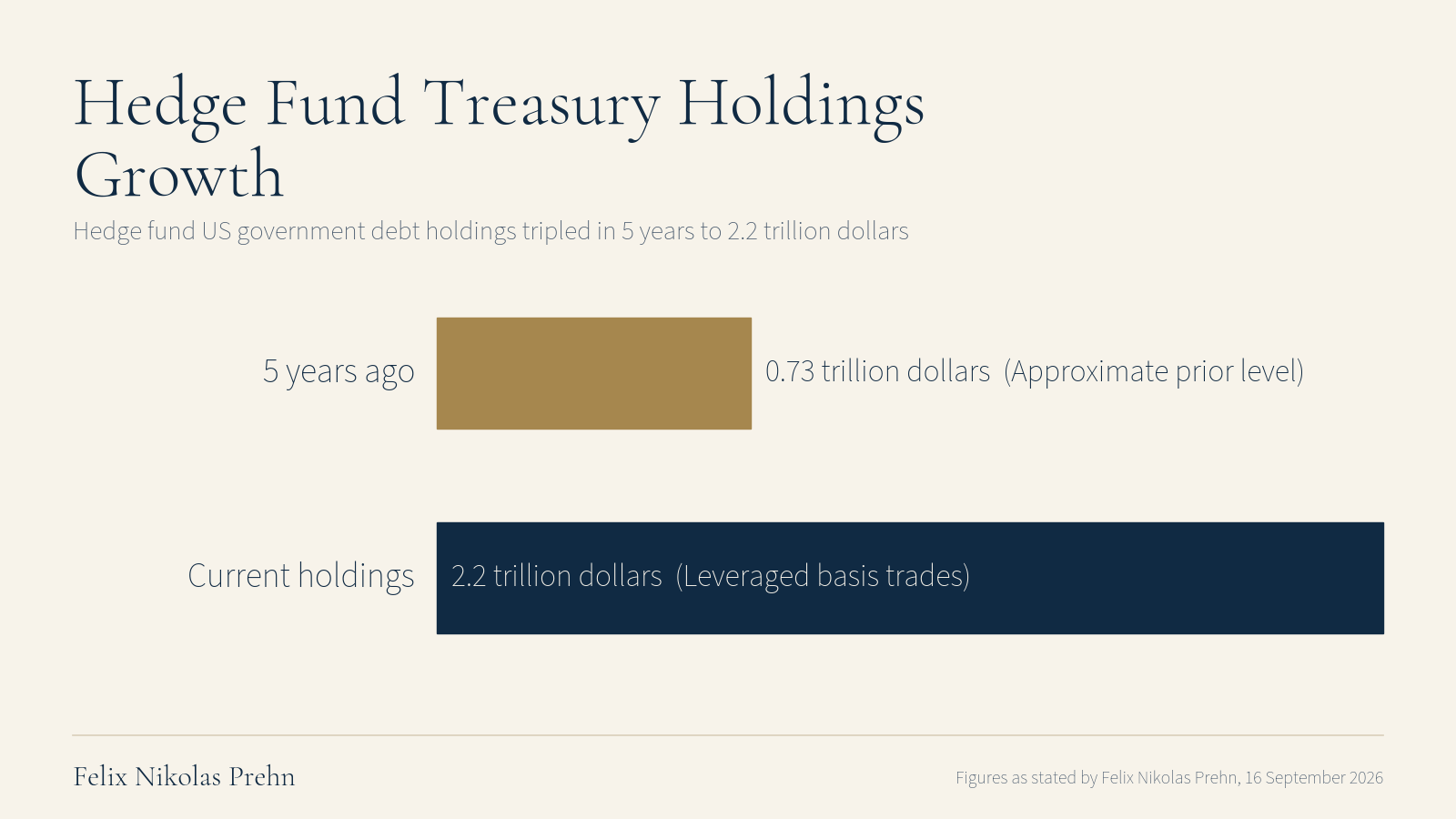
And it should be front page news. Hedge funds hold 2.2 trillion of treasures. It's three times what they held just five years ago is a is a is is a chart of it.
And it matters because hedge funds are not buy and hold people. No, they haven't gotten that sort of indoctrination. They're not your pension funds. They sit on it for 30 years. They're leveraged.
They move fast. And when volatility spikes, as they call it, they will sell all of them at once. And the way they hold these makes it worse. Most of that 2.2 trillion sits inside something called a leveraged basis trade. And in in simple English, a fund buys the bond, sells the futures contract against it, and then borrows heavily to pocket the tiny gap between the two prices.
And I know that sounds mad, and people don't really understand it, but it's a sliver of a profit on each trade. But if you borrow 20 or 30 times over or even more, that sliver turns into real money. The trouble is, it only works when the market is calm. the market the moment the market is not calm the moment those two prices move against them they have to unwind the whole thing immediately and unwinding means selling government bonds into a market that's not full of buyers so it's a bit like a margin call the leverage amplifies everything and the real question is what happens when the margin call forces the funds these funds to dump into a very thin market that's the nightmare that the treasury is is is worried about you got 2.2 2 trillion of fast borrowed money pulled on top of a market that's already stretched pretty thin. Long-term rates are the highest they've been since 2007. Remember what happened in 2008?
You know what happens? The economy can go on for ages and can all look wonderful. Even though there are all these problems everywhere. Why? Because if interest rates are low, it sort of covers the whole thing up.
It's like a rug you roll out of above, you know, the stain. But when interest rates go up, everything gets more expensive and the cracks become visible. Well, all you need now is a little bit more what we call the volatility. It's like up and down and it's going to come because you got the fertilizer crisis building and energy crisis building, inflation, the dollar weaponized and so on. And these funds will then dump.
And when they dump, interest rates spike. Yields is what they call them, but it's basically the long-term interest rate. And when these interest rates spike, everything rolls over with it. Shares fall, bonds fall. Why?
Because if I can get 6 per cent risk-free by holding Uncle Sam's debt, people think, well, why would I hold a risky stock, right? Why would I hold gold that doesn't pay me anything? So, everything gets hit. And it's important to understand that. Now, gold is something people buy when they expect inflation.
But initially, when interest rates go up, you'd expect it to get hit. Same story that happens when a war starts, right? People are like, "The war started in the Middle East of the year." Why did gold crash? Well, because it happened every single time a war started anywhere. Because oil was involved.
Oil causes inflation. Inflation causes higher interest rates, which means you can get more risk-free money from the US government by buying their debt. That's the that's the whole thing of it. Now, if you're thinking, "Well, the Fed's going to bail us out." Well, those guys are trapped. Literally, if these interest rates go up, the government interest bill becomes completely unpayable.
If they step in and buy the bonds to force interest rates back down, they're printing money and that means they're causing inflation. They're doing the latter at the moment. They're stuck between protecting the bond market and protecting the dollar. And history tells you very, very clearfully that they make the painful decision to do what? They protect the bond market, which means you pay for it.
Because money printing is not good for most people. It makes your savings worthless. It makes your salary worth less. So, who's it good for? Asset prices.
Yes. Who has all the assets? The wealthiest, right? Go figure. The world isn't fair.
And again, I'm not forecasting something. The buyback's already doubled. It's already live. Um, so the firepower is there, the plans there, they're prepared, they're seeing exactly what I'm watching, what I'm telling you about, and they know we're going to need to step in bigger and bolder. And that's why they got a trillion dollars sitting in their checking account.
Now there's a gold chart on the screen here and we've come out a little bit above the trend. We've had this sort of little consolidation period here. We come out a little bit of the trend and now now went off. Now did I buy this breakout? I did not.
Again, I show you more about that on on um on the weekend. The last breakout we had, the proper one we had in 2025, I did buy and it was very profitable, but it was a much much better setup than the one we're having right now. So, I can see the professional money is waiting for these interest rates to go up and they think it's going to hit gold and then they're probably going to buy. Again, I've got a crystal ball, but they are not really buying right now. And again, it's important to understand a little bit the timing with this because we don't want to time it perfectly.
It's impossible. But understanding why you're buying something when it's falling, it's kind of important, right? Then you have a silver. Few words on that. So, silver is the one that I I want you to pay attention to.
Silver has this pattern.
Um, it's gone sideways here for quite a long period of time. And that drives people around the bend. It sits dead for ages, does nothing. It looks finished. And then it moves after gold moves.
And when it goes, it usually moves much harder than gold. And the reason is simple. The silver market is tiny next to gold. And it's it's it's basically um controlled by a bunch of lunatic traders. So when the money starts pouring in, there aren't enough sellers to circuit up and and and and the price has to find a way to, you know, jump up.
And that's why silver moves so violently in both directions. Now, we've got one trading desk placing a call option, which is a bet that it's going to go up. And they placed it at $90 within 30 months, which would be a monster move from where we are right now, right? 50 per cent up. And again, I'm not saying that's going to happen.
I'm just saying you some of the skilled money is putting real bets with real size behind them at much much higher levels. Now, am I buying tons of silver here? No, because I haven't seen the breakout yet. I haven't seen the volume pour in yet. And I like to be a little bit late rather than too early because too early can be, you know, maybe it never ever happens.
So, who's doing all the buying? It's not retail. No, it's not the Reddit lunatics. Over the last three weeks, professional traders, hedge funds, Algo funds bought 22 billion dollars worth of gold futures, 10-year record high, the most gold hoovered up in a short window in a decade. And then you get the central banks on top.
So nearly every reserve manager on Earth is looking at buying gold. Exception is Russia. They're selling because they got some wars to fund. I know some of you are thinking, "Fine, I hear you, but I'm a bit scared. So I'll just sit this one out.
I'll wait until all of this blows over. And and look, I'm not a financial adviser. It's your call. I'm not telling you what to buy or sell. But that feeling, the one that says cash is safe, is a trap.
Let me show you why. Since 1971, when the dollar came off the gold standard, the government simply simply started printing more dollars, right? It's the easy way to get elected to fund whatever people wanted to keep everyone feeling good.
And since then, the dollar has lost almost all of its value. A $1 1971 is worth a couple of cents today. Literally a couple of cents. And that's using the government's own inflation figures which are made up. So in reality, it's way worse.
So it's a fraction of a cent in by by my metrics. Now they don't say we're printing money. They say it's a treasury buyback. It's quantitive easing. It is some sort of a liquidity support.
Some sort of thing that people don't understand. But you saw it. I mean, you saw literally after CO, right? Hotel rooms I used to pay $200 for. I'm now paying $2,000 for.
Did the hotels get better? Nope. Did they add anything? Nope. It was money printing, turning up the price, and the asset rich got a lot richer, and now they're paying 10 times for the same thing.
And they've already announced it. There is a trillion dollars set in a Treasury account ready to go. They doubled the government's buyback programme, read money printing. They weaponized the dollars to make foreign countries wary of holding American debt. and more dollars are going to be created. Fewer countries want to hold them.
That's the textbook recipe for inflation. So, you're sitting in cash while they're print. You're basically standing in the rain going, I shouldn't be getting wet, but you are. Except in the rain, you notice it. With this stuff, it happens relatively gradually.
You don't really feel it very much. But you work this out early. Guess what? You can actually thrive here. So, what do the what what does the skilled money do with this?
Skilled money owns real businesses that throw off real cash of pricing power. That's stocks, right? Or they own stuff that can't be printed, gold and silver typically. And obviously there's some other things one can invest in. So in six months from now and 12 months from now and 18 months from now, two kind of two kinds of people.
The ones who work this out while prices are where they are and then they're the ones who waited for the confirmation for the headlines which come way after it happened. And this happens in every cycle in every crash and every reset.
The people who got hurt the worst are never the ones who saw it coming. It's the ones who wanted to be careful and cautious and were waiting for stuff. So they did nothing. They were hoping it was going to get better magically. So my hope is that that's no longer you.
You just watched the whole thing. Congratulations. Very few people do that. And you know what's happening with sulfuric acid and fertilizers. You know the dollar is being weaponized.
You know the hedge funds are doing crazy stuff with treasury bonds and you know that central banks are doing something interesting with gold. So take the next step, make a plan. If you want to see how I'm doing it, come and join me this weekend at 90dayplaybook.org. Links down below in the description. It is completely free.
And I was going to run you through the historical parallel, but we did that in a previous video. So you can look at that. But essentially the only way out of debt that anybody has ever solved that the US has done since you know after the world war is more inflation and inflation is a quiet tax on the people who are not ready for it. Go and get ready. I hope to see you on the weekend all the >> right now.
I think we're going through some sort of weird phase transition. And normally when you get bad economic news or you get bad jobs data that people are going to fly to safety into the bond.