Transcript
Three of the most senior traders at the most important and powerful investment bank on Wall Street, Goldman Sachs, just went on camera and said something that should worry anyone with a pension or a 401k. They said this, "The Fed are much more passenger than driver." And think about that for a second. The one institution whose entire job it is to set the price of money, the Federal Reserve, the most powerful financial body on the planet, is according to the people who actually trade against it every single day, no longer steering. So, who's the one steering? Well, someone else literally grabbed the wheel of the American economy this year.
And it isn't the president, it isn't Congress, and it's not the Fed. Now, if you've watched me for a while, you're already bracing for another money printing story. But this is not what this is. This is newer and this is honestly worse because no one's connected it to their own savings and income yet. My name is Felix Prin.
I apologise for the squinting. It's pretty bright here, but I think this is very important. I wanted to get this out for you guys. And I used to be investment banker. And before I walked away to teach regular people how the market really works, the stuff that Wall Street would rather keep to itself, I learned quite a lot about this from my mentors.
And if you're wondering whether, you know, there is a gold plug in here or something for a mine or something there isn't. I never take money from anyone. None of this is ever sponsored. None of this ever political. And I like it that way because I can just tell you what I think and what I see.
And you can obviously do with it as you like. I'm not a financial adviser. But what I was reading late last night and I thought about whether people really need to know this and I was like, "Yeah, people really need to know this." In the same week that these three Goldman Sachs traders admitted that the Fed had lost the wheel, a different desk at the same bank, which is their metals desk, quietly told their clients that gold isn't done yet and that the recent drop what they called an elongated pause and that new record highs are still coming. It's the bank saying it, not me. Right.
Same bank, same week. So, one desk says the F Fed is now a passenger, no longer in charge of the economy. And the other says buy gold on the dips. So, what do they know that we don't know? Well, by the end of this video, give me a few minutes, you will know know it, too.
And I hope this isn't going to be too much of a ramble because I'm, you know, sitting in the sunshine. But most people just hear the word Fed and they switch off, right? Because it's just boring. um and they think about I don't know the bill for the most expensive building project in human history or something uh or or they they think you know the guys are printing all the money and they're crashing their retirement and all of that. But let me explain what's actually happening here in in plain English. And I'm going to walk you through quite a lot of data and numbers here as far as I can remember them.
But I'm also going to put it all together into a free report. It's plain English, no jargon. You can just read it. Take you about five or 10 minutes. So you could follow along with this video even if you'd like.
Uh there's a link down below to that at felixfriend.org/fed feed. Links in the description. Click on it. Uh you'll get it. You'll be better informed.
You get all my out of it. Explain it to somebody else and everything else. But let's go back to that Goldman Sachs quote because that really really matters. It wasn't some junior analyst. It was the three top crosset traders on their own show.
And the guy who's running this this conversation is a guy called Mark Wilson. He runs equity franchise sales. Sounds very exciting. Um there is a guy who is um I shan mentioned his name because I don't want to like you know get him trolled. Uh but I actually knew very well because we went to um the same university and talks about macro and there's another guy there who talks about European raid strategies.
But these actually are the people who moved the actual bond market. Not the commentators, but the people who actually moved the bond market. The guy I went to college with um actually school with. He was um yeah the smartest kid around. He was just irritatingly always getting 100 per cent in exams while not really doing very much.
And what was their message? Their message was very blunt. They said AI has stopped being just a stock market story. It is now a bond market story and a credit story. And I see you literally falling asleep as I'm telling you this.
But what does it mean in plain English? Why is it so important to build AI? The big technology companies, they call them the hyperscalers Microsoft Amazon Meta and all the rest. They need to build these data centres, right?
So far, nothing new. They need power plants to run them. They need chips to fill them. And all of that costs an amount of money that is genuinely hard to picture. Wilson, the top guy there at Goldman's, calls it, and I'm quoting, the most capital hungry investment cycle in history.
Now, these companies are rich, but they're not rich enough to pay for this out of their own pocket, out of their own profits. So, they're doing what everyone does when they need money that they don't have. They are borrowing it. They're selling bonds or lots of bonds. How much?
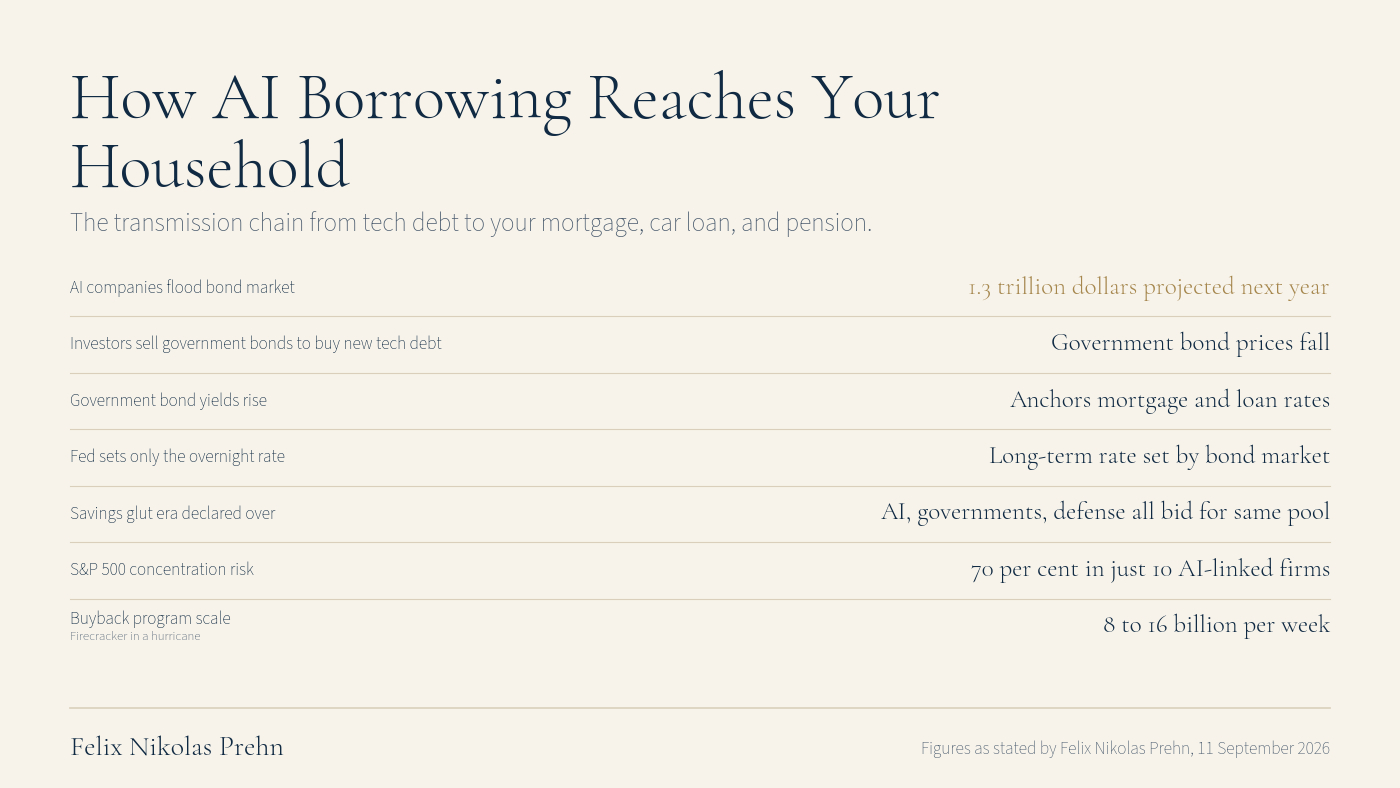
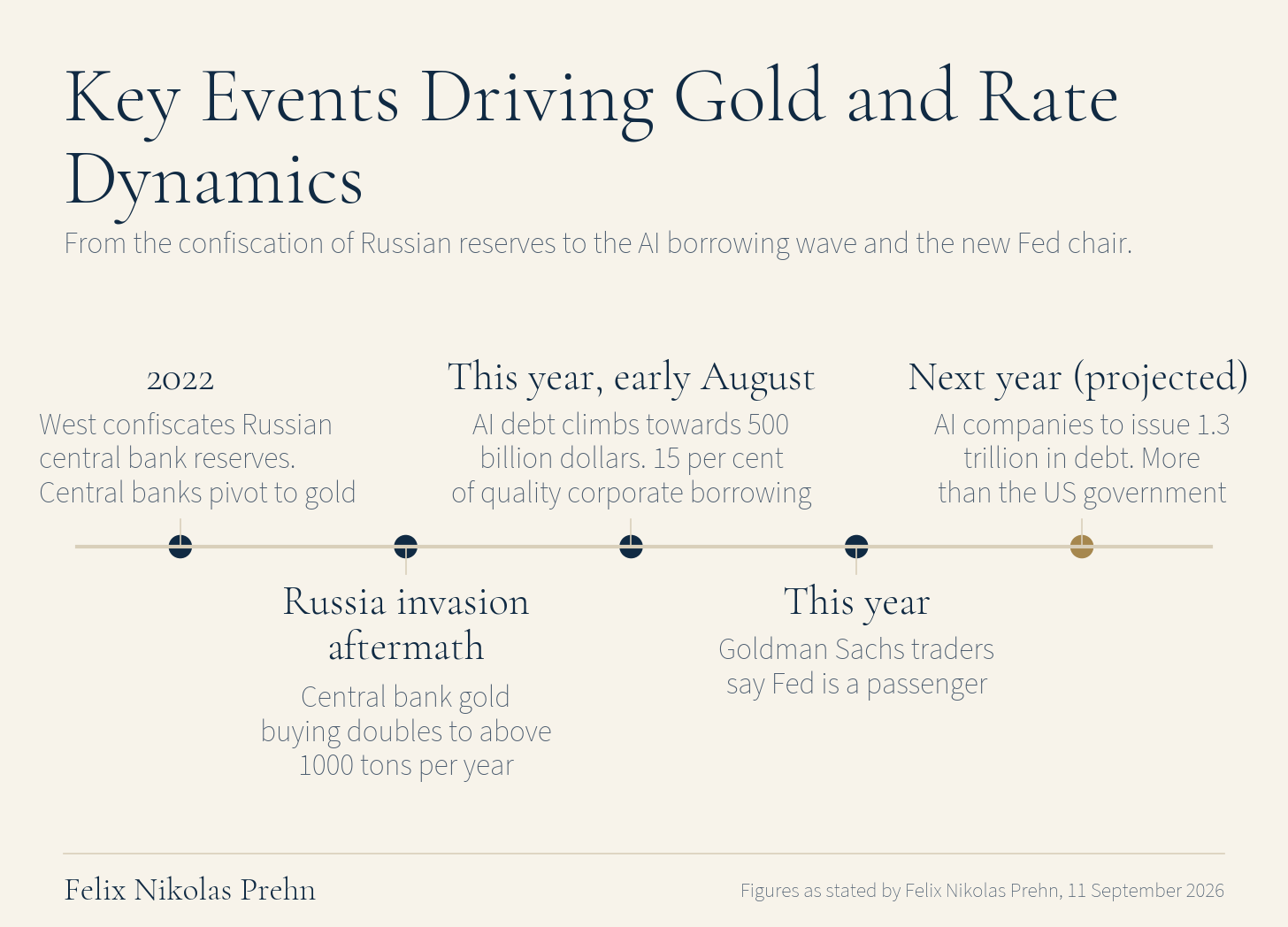
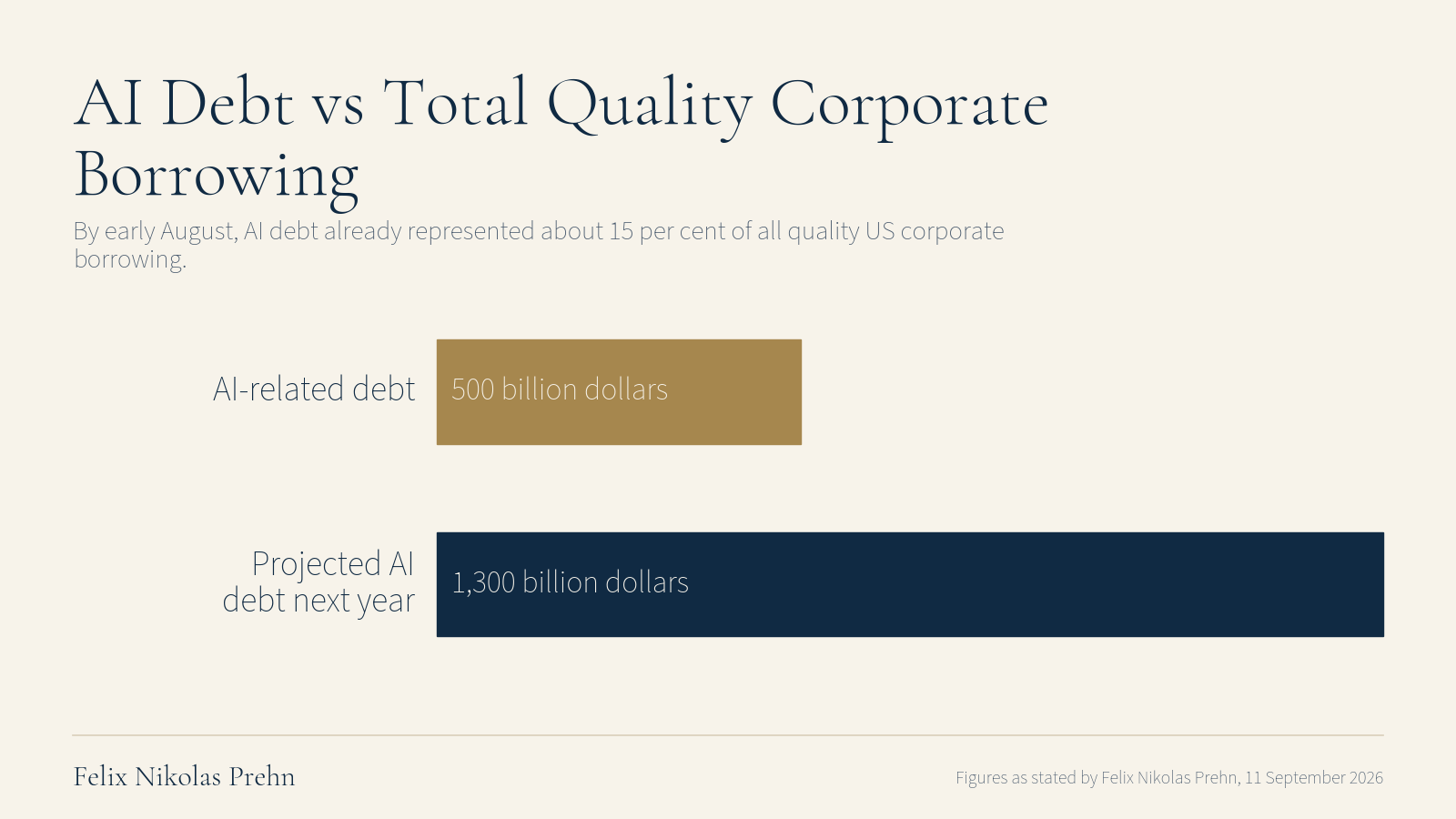
Well, by early August this year, AI debt is already climbed towards $500 billion. And that number is worth about 15 of all the quality corporate borrowing in America. So, it's just one investment theme and it's a fifth of the entire market. But that is literally just the warm-up. No one's quite figured out yet how to fund next year's build out of all these data centres and chips, but we're expecting it to be $1.3 trillion.
And again, I'm losing you on these random numbers. But let me give you the line from Goldman Sachs. They say next year this handful of tech companies is going to issue more debt than the United States government. They're not a country. They're not a government.
It's just a couple of handful of tech firms. It's about to become the biggest force in the bond market bigger than the United States government. And that's a pretty tough one to beat because they are clearly the most irresponsible spenders on the planet.
Now the mechanism which is pretty the part one of this I wanted to get across is there is only so much savings in the world at any one moment. There's only so much money looking for a home in bonds. For decades we lived in what economists called a savings gut. There was just more money slushing around than there were places to put it. And Goldman just said that era is over.
Why is it over? Because everyone is reaching into the same pot at the same time. The AI companies need money for these data centres. Governments need money to fund enormous deficits and, you know, wars and all sorts of wonderful things. Um, defence obviously needs it, right?
Uh, defence war. Um, rebuilding factories at home needs it. They're all bidding literally for the same amount of savings at the same time. And when tech companies flop the market with this all this new debt, investors have to find the cash somewhere. So, what do they do?
Well, they sell what they already own. government bonds, mortgage bonds, the safe stuff to buy the new stuff that gives you more exciting returns. Now, the problem with that is when people sell the government bonds, the interest rates on those government bonds go up because the government has to pay higher interest to attract buyers. That's just how the bond market works. And I know it sounds terribly dull, but it's actually what runs your portfolio. So, when the price falls, the yield, as they call it, the interest rate goes up.
And that rate is the anchor for everything in your life. And that's what I want to get this across.
Your mortgage, your car loans, the credit card, the interest on the government, you know, debt, therefore your taxes and everything else. So this is where the Fed comes in, or rather where it doesn't. You see, the Fed sets interest rates. Everyone's obsessed with that, but they set something that's called an overnight rate. It's a very short-term interest rate, but the rate that actually matters for you and your mortgage and your portfolio performance and your retirement and everything else is the long-term rate.
And that's set by the lunatics and the bond market. And right now, that tug of war is being pulled by a trillion dollar borrowing wave the Fed didn't create and can't switch off. It's the lunatics running the hyperscalers. And that's what Goldman Sachs is talking about. The Fed is a passenger.
It can tap the brakes a little if it wants to, but it is not the one with the foot on the gas. So, the AI buildout is the one actually running the ship. And it gets worse. Goldman points out that this whole boom is implicitly inflationary.
Um, and that was my old school friend who said that. Now, the economy is demanding the payoff from AI. So, the cheaper, faster, better future before that payoff has actually shown up. You're getting all the spending now, all the borrowing now, all the strain on capital now and the productivity that is supposed to make it worth it is somewhere out there in the through Gaussy in the future. So spending today hopefully results tomorrow and that gap is causing inflation and it's going to lift the interest rate for the whole system up before we get any of those gains.
Now you might be thinking shorty the government can fix this, right? Isn't isn't Besson going to, you know, um fix it with his buybacks of bonds? Well, what one Wall Street trader described those buybacks, this government buyback programme of Bessins this week as a firecracker in a hurricane. It's symbolic. It's nice messaging, but it is nowhere near big enough against what matters because we've got 1.3 trillion in debt coming next year just from AI, right?
So him spending 8 billion or 16 billion a week on something on buying his own debt is basically irrelevant.
It's symbolic at this point. So you put the whole thing together, what actually happens here? The single most powerful financial institution on the planet has by admission of the people who really understand this market lost control. And the thing that took control is a borrowing spree so large it'll out borrow the US government. So the question for you that matters is and for your money.
Well, when the Fed loses the control, where does the smart money go? What does the smart money do with that? And let me answer that with a bit of history because this is a pattern. It is not a guess. And the market is full of patterns.
That's how we generally make better decisions in it. Money is loyal to one thing, trust. When people trust that the currency and the people managing it will hold the line, they're happy to sit in cash and in bonds. The moment they suspect nobody is really steering it, that the printing, the borrowing, and the inflation are running on out autopilot, they start to look for a place to hide that no central banker can touch.
There really only a few places. The oldest one, the one that's worked across every empire 5,000 years, um is is of course gold, right? And then there is the slightly more um you know mad cousin silver, which is just more volatile, a little bit more late, and it's a little harder to manage. But why does it point at gold and silver? Well, if the long-term interest rate is now being set by an unstoppable wall of AI borrowing and now borrowing is, as Goldman says, inflationary, then holding cash becomes a guaranteed leak, right?
So, your money still loses value as prices climb and therefore, you know, you get poorer. Holding government bonds isn't a safe haven it used to be because the very flood of new debt is what's pushing their value around and making them less reliable. So the big patient money, the money that thinks in decades, not days, starts moving from one form of wealth that has no counterparty. So the patient money, the money that thinks in decades, not days, starts moving into the one form of wealth that has no counterparty. No CEO, no board, no Fed can't be issued by anybody, right?
Because you can't print gold. Which is why we're seeing all this gold buy. But there's a second deeper reason, and this one connects both to well to actually to both Goldman stories in a in a single kind of picture. Remember this all sits on top of a world where trust in government paper is already cracking. The reason those AI companies can out borrow the treasury, the US government is that the treasury itself is drowning in debt.
Deficits are enormous. The interest bill is enormous. And it's not just in America, right? The same thing is showing up across Europe, Japan, everywhere. And when a government owes more than could can comfortably pay, it really has only a few exit points.
And every single one of them, well, is actually good for gold. can inflate the debt away which cheapens the currency. It's good for gold. Can hold interest rates down on purpose while it runs hotter inflation which cheapens the currency which again is good for gold. So every road leads in the same direction. A slow cheapening dollar and rising prices for things you cannot print.
So this isn't some doom prophecy. You know, I'm sitting in a pretty happy place here. Life is good. It's just patterns. It's just history.
It's happened every single time. Again, not a financial adviser. then run out and put all your money into gold. That will be irresponsible. But the second half of the story is what I thought was actually the most exciting and interesting part here because the metal desk at Goldman Sachs work on numbers, not on sort of, you know, vibes, how we're feeling today. And they've given us some of the most specific concrete figures I've seen a bank put on a table in years and they will explain why even a small shift in money can move this market a lot.
Let me show you those numbers in a moment. But first, I need to talk to you about the one thing that turns all of this from an interesting video, something you play in the background to an actual plan for you. So, understanding why gold is rising is interesting, right? It's lovely. Um, it's however not the same as being ready.
Knowing the Fed lost the wheel doesn't tell you what's going to be happening to your 41k on Monday and what you should do about it. And almost nobody has actually looked at this next part. The money you think is your safe money, your index fund, right? your 401k, your pension, your Roth is sitting right on top. The exact thing that's driving all of this because when you own the S&P 500, you think you own 500 companies. You really have 70 per cent of your money get sitting on just 10 of these AI lunatic companies, right?
So the guys who going to borrow $1.3 trillion next year, um, you know, insanely outspending the treasury, they are the most expensive, most crowded names on the planet. And they literally are your safe, allegedly safe index fund. And we don't have to take it from me. Look at the most, you know, trusted investors out there. Warren Buffett, uh, you know, they sold their index fund and and and and just listen to the the biggest traders on Wall Street.
Uh, they're all warning about a drop. They're all saying we're too concentrated. They're all saying the same thing, but people don't know what to do about it. So, I want to know make sure you know what to do about it. So, I'm going to run a free live training on exactly this.
I want you there. Uh, and it's going to be called index fund, the index fund trap. Why the S&P 500 is lying to you. And you can get yourself a free seed for this at index.com. It's completely free.
There's no um no catch. Uh, just sign up for it and you got to show up because we don't do replays because people don't watch them. It's only helpful if you're there. If you're in the room, you can ask questions. You're part of the the energy of learning and and thriving, which is really what the point is here.
So, show up for yourself and if you are, write thrive in the comments down below so I know you're going to be there. And then let's get into the into the metals part here. And there's a guy to listen to and he's called Tony Kim and he runs the global metals trading at Goldman Sachs. Again, the most important invest bank on the world. Just call them and ask them.
They'll tell you that. And when someone in that seat talks about gold, well, their jobs on the line here. So, his clients been hammering him obviously with one question like you all are. Um, gold peaked in January. it's sitting what 20 per cent below it or something like that. Um was that the top?
And his answer was this. This isn't the end of the bull market. It's an elongated pause and then this quote ultimately the bull trend will resume and new highs are going to be in the future. So why this pause? He pointed to two shocks landing at the same time.
The first is the new Fed share. The nomination and confirmation of Cavan Walsh means the market is still trying to figure out how do how it'll actually behave with this new guy in charge who's just not telling us very much. And uncertainty is what makes the money hesitate to act. And the second is Iran. The US Iran conflict and the disruption around the whole moose thing oil and so on fertilizers everything else didn't just hit oil.
It hit energy, food, metals all at once. and it scrambled the normal flow of reserves that usually leaks into gold buying. So in in in simple terms, some of the usual buyers, they got distracted. Some of them had to sell because they weren't selling any oils. They needed money.
So the price took a bit of a breather. And here is the flow that didn't disappear. And it it's really the one that matters, central banks. And this is where Kim gave the the single most important set of numbers in this whole story. So it's a get these numbers clear for you.
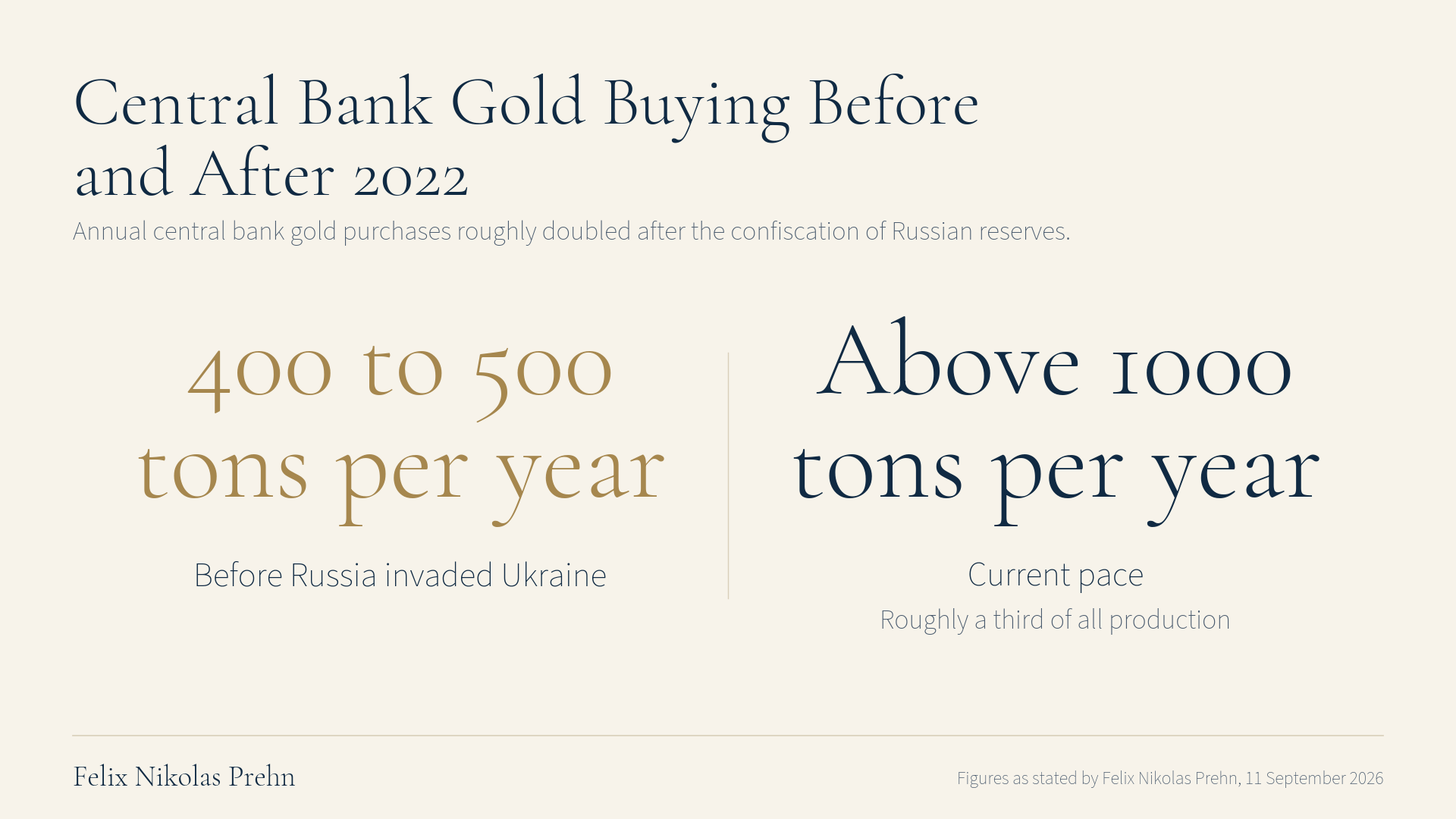
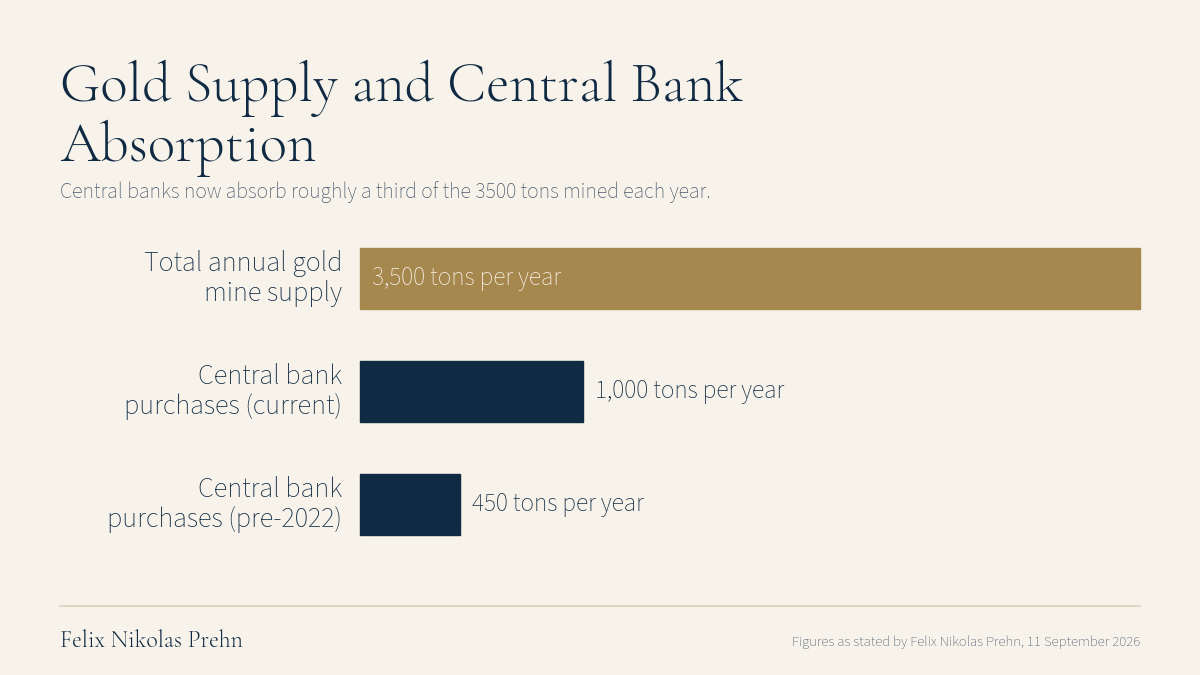
The world mines about three and a half thousand tons of gold a year. Three and a half thousand. That's the supply. Everything, every ring, every bar, every coin, every ounce backing every gold fund on Earth comes out of three and a half thousand tons of new gold. Now before Russia invaded Ukraine, central banks, national bolts, bought about 400 to 500 tons a year of that.
Nice slice, but pretty boring. Now it's well above a thousand tons a year. So they've literally doubled how much they're buying and they're now buying a third basically of all production and they're burying that in volts. They're leaving it there. It doesn't hit the market.
So the maths on where that leaves us is is is this. If the vaults are swallowing up a third of all the new gold and they're not letting not letting go, right? the bit that's left for everyone else, all the jewellery, all the coins, all the investment funds, you know, all the stuff that we're stacking, well, it got smaller. And Kim's conclusion is that the key that unlocks the whole thing is this. Uh, and then the quotas, and hopefully you got this right, he says, you don't need as much investment capital to drive metals materially higher. Because when the supply available to normal buyers is thinner, it doesn't take a flood of new money to move prices. is it just takes a trickle of your money.
So even if a modest wave of regular investors decide they want to buy some gold, they're all fighting over the smaller remaining pile and the price can jump far more than the amount of money would suggest. Now is this going to change? No, because central banks learned a lesson in 2022 and Russia invaded Ukraine. The West effectively confiscated Russian central bank reserves. the dollars it thought were safe that were sitting in, you know, New York and London and European banks and so on. And that money is now gone.
And every central banker in the world paid attention. It's like, ah, we're not going to do that anymore. We're going to hold our wealth at home in our basement where we can touch it and no one else can get to it. So, they started selling the paper money and um started buying gold. You can hear that racket.
I apologise. Sounds like a generator or something. the power cuts out here sometimes. So, what I'm saying to you is that this is a permanent state of affairs. Central banks are not going to go back, sell their gold, and buy US debt again.
No, they're going to stay with this plan because it's the only sensible thing to do. Now, there's another bit here. Some people are expecting an interest rate rise. Uh I'm actually not one of them, but if you think like the majority of the market that interest rates are going to go up, that's normally bad for gold. Why? because you can get a higher interest by holding a boring piece of paper than gold gug because gold pays you no interest.
But the Goldman guy thinks that the rule higher interest rate lower gold is broken. And the reason he does for that is that the higher rates are actually coming about because we're scared of government finances. And then people are scared about government finances, they buy gold. So the more governments openly meddle in their own currencies and bond markets, which is exactly what we're saying, um, and and and the Goldman guy says it like this. Anytime you see official policy intervention, people tend to buy gold.
Now, a few words on silver because I know a lot of you here for, you know, the the wilder gold cousin.
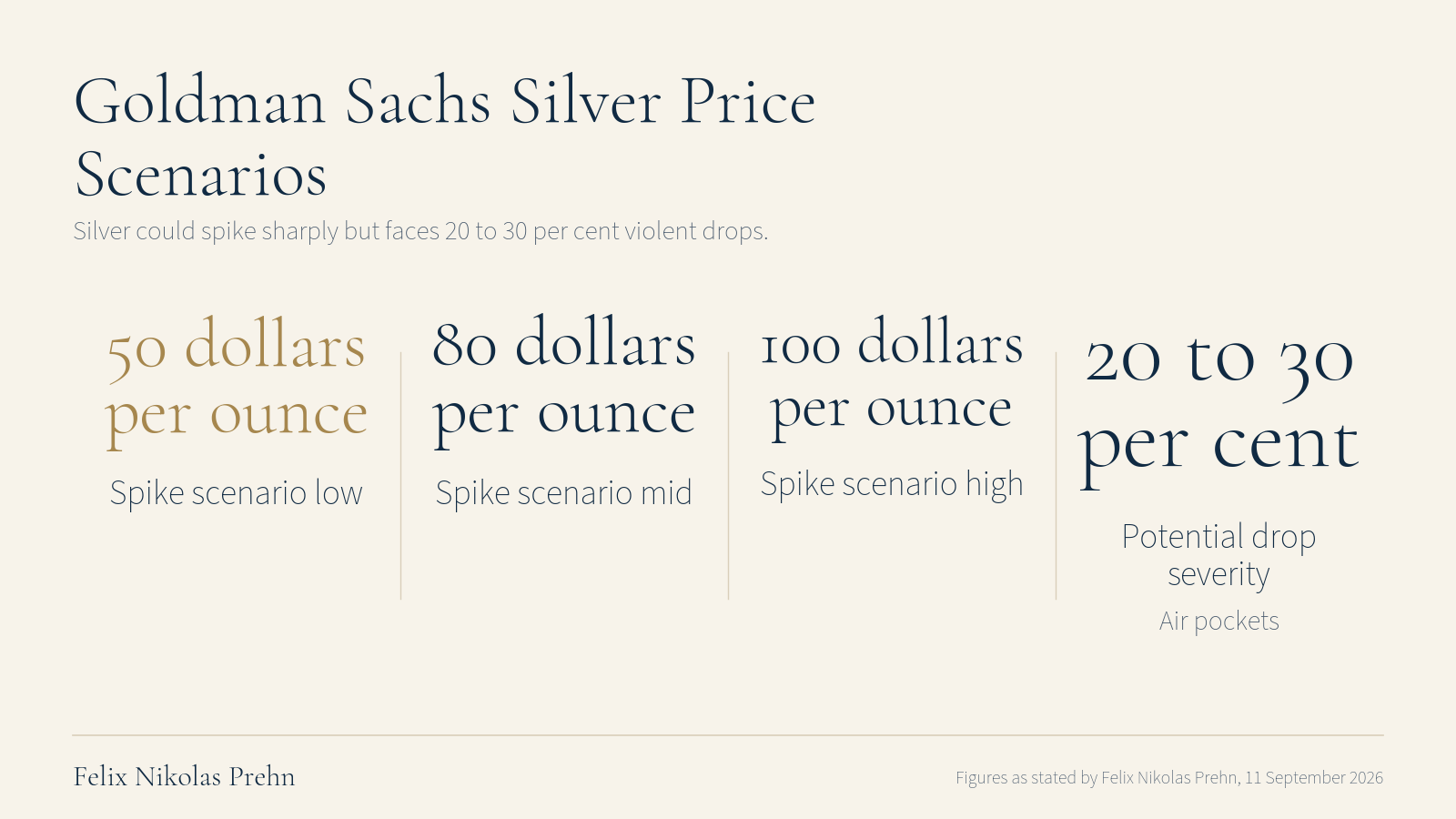
Um, Goldman's take on that is silver is a warning label wrapped around an opportunity. Silver is a much smaller market than gold, but half of all the silver demand is industrial. goes into solar panels, electronics, and so on. And that leaves only about 20 per cent of the market that's actually investment amount. And that very thin slice is what actually sets the price. So when investors pile in, you get these massive spikes, right?
You go from 50 to 80 to even $100. And and and and that's basically the price level that that that Goldman is giving us. That's per ounce. Um and it just depends on how many of those buyers show up at the same time. But he also warned and I completely agree with you that there are these 20 30 per cent air pockets, these violent drops that happen because it's a trader market.
So potentially bigger upside, yes, but you need much much stronger stomach lining to deal with these drops, right? And that's why the central banks buy gold. They don't buy silver. So gold has got that steady permanent demand flow underneath it. Silver has the most lunatic traders in the world. and and therefore, you know, you you kind of are betting on that.
You're you're a trader if you if you're massively into silver um at least if you have a shortage time period. So, what's the actual trade? Well, let me give you the exact words of Goldman Sachs. And they said, "Look, we're still bullish on gold. Um they think $4,000 is sort of a flaw under the price.
Again, it's not a promise. It's not my number. It's his." And and his advice to his clients is scale into gold on the dips. Anything that's closer to the 4,000 level, um buy it. And I'm not telling you to do that by anyway.
I would never give give it financial advice like that. Um, and it depends on your horizon, right? Gold has a cost. You pay a premium. There's downsides to it.
You got to store it. You got to insure it. All that kind of stuff. If you go into index funds, well, you pay your fee there. You don't actually own the thing.
And, you know, all that kind of stuff. But this is Goldman's view, but isn't mine. It's not a promise. It's a forecast. And, you know, everyone gets forecasts wrong all the time.
But if you put this together, the Fed's losing control of interest rates and the and the economy. AI borrowing wave is actually in charge. And then the other desk at Goldman says by gold of the dips because the central banks are just putting a price flow on the whole thing. You put them all together. Well, I think it's a message and I think it's an important message.
It's not a panic and dump everything into gold bars on Monday message, but it is the foundation of understanding what's actually going on out there right now. Um, and I think that's important and hopefully that's going to help you make better decisions, which is always what my goal is for you guys, that you have more information, uh, better data. You start to see the patterns, you start to look at it more like a an institutional investor would.
And, and the one thing I'd warn you about is doing nothing is going to be dangerous. The most dangerous, the most risky. Sitting in cash is 100 per cent guaranteed to lose your money in my humble opinion. Um, as is your salary, by the way. sadly, right? The the the the the salary is going to shrink.
It's going to shrink. So, how do you how do you win against that setup? The the people with all the money are going to do tremendously well. The people who living paycheck to paycheck are going to struggle unless they do something about it. Uh but the people who are the skilled money, and that's Wall Street, yes, but that can also be you.
They can protect themselves from this. I believe they can actually thrive in this situation because a lot of people came out of the last money printing scenario you know postco really really well but most people did not because they didn't see it coming they didn't understand my hope is that uh these 20 minutes here we spent together I've given you some insight in how you can be better prepared you want to go deeper into that join me live at um I think is it what is it index.com anyway the link's down below in the description join me live I'll teach you for almost two hours um live. I'll answer all your questions exactly about how we set ourselves up with this, how we protect ourselves from the the sort of noise of the news and and rather focus on making better decisions, recognizing the patterns and thriving for you and your family. I wish you all the best. I'm going to go and find myself a coconut and um hope to see you soon.
Right now, I think we're going through some sort of weird phase transition. And normally when you get bad economic news or you get bad jobs data that people are going to fly to safety into the bond.