Transcript
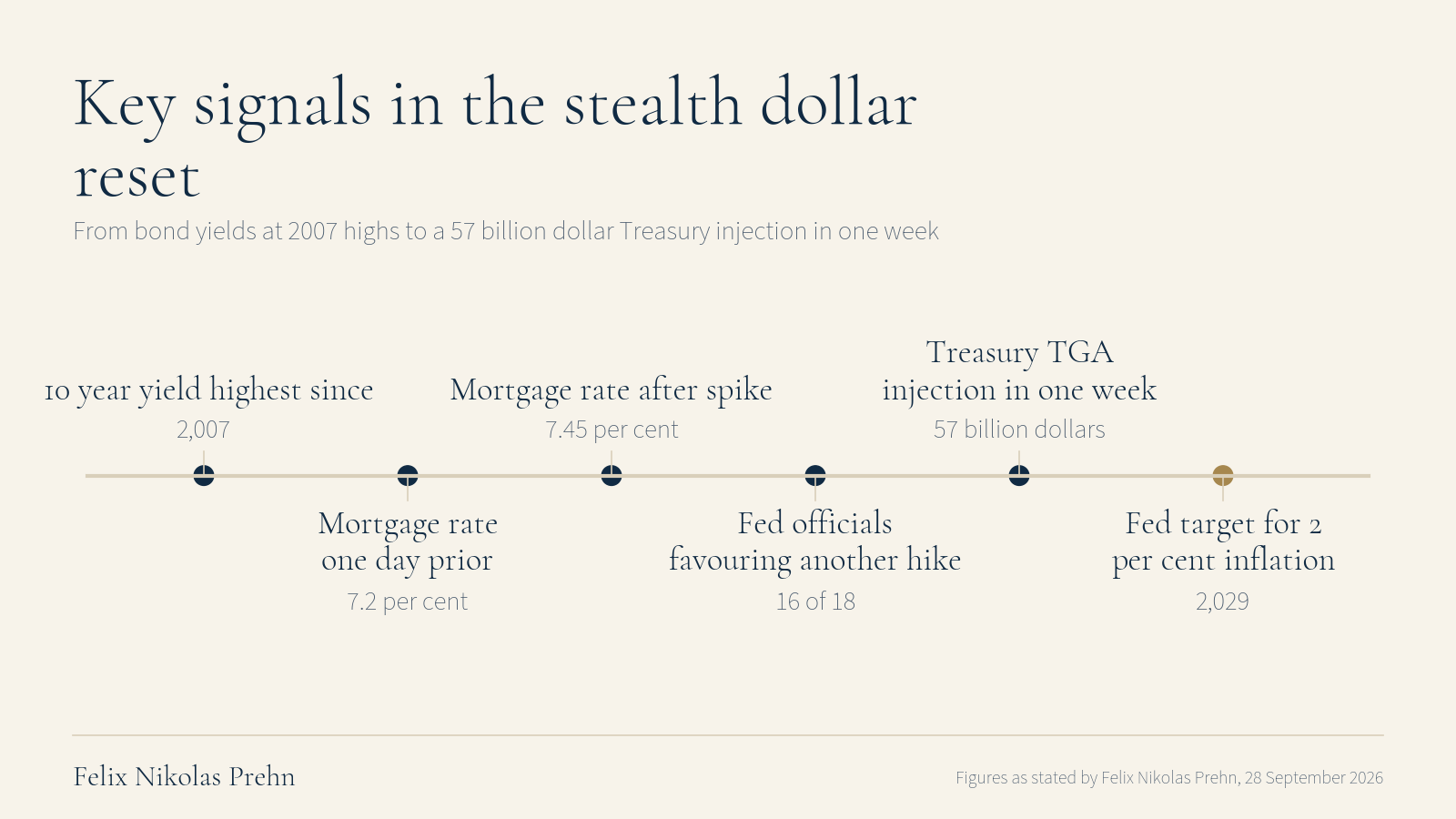
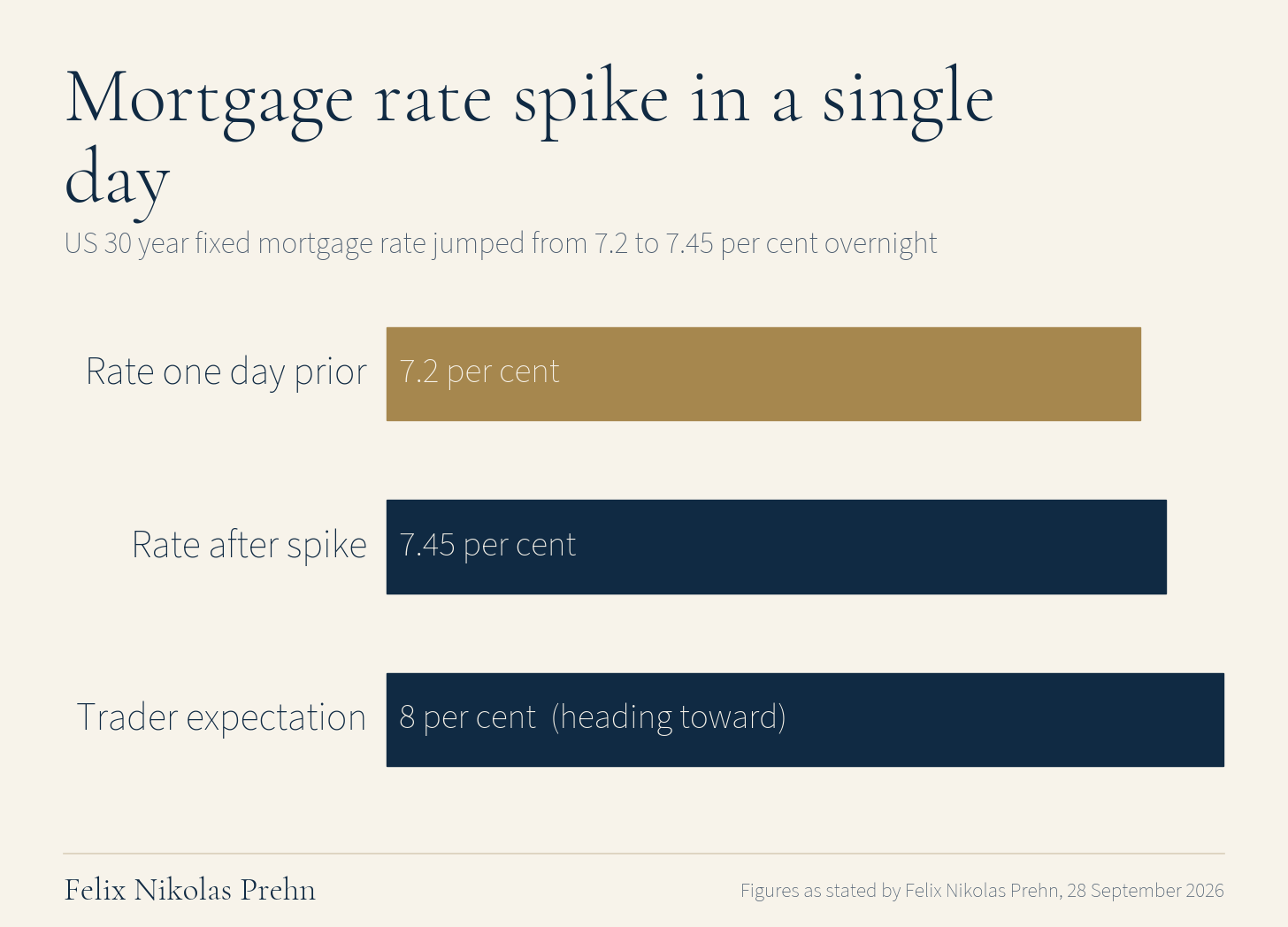
Mortgage rates in America just jumped to 7.45 per cent. And a day before they were 7.2 per cent. So it's a huge jump in just one night. And people who trade this stuff for a living I've spoken to say 8 per cent is coming next. And that's happening at the same time that the people in charge tell you they've got inflation under control. which is odd if you think about it for a second because if they are under control, why are they working on a way to make the inflation numbers smaller without a single price in the shop coming down?
So, I'll show you exactly how they're doing that cuz I was just reading about it and I'm literally sitting here on the the tarmac and someone's going to say Felix is in a fake plane. Um, no, no, it's it's it's actually a real one. It's funny, isn't it? Someone said the other day about my hotel room as well. Um, but this is public information.
It's just people don't know where to look. People don't look for it. And people don't seem to be joining the dots. And by people, I mean mainstream media. So, I apologise.
This sounds going to be a bit crappy, might be a bit wobbly and all of that, but I think it's that important that I'm willing to do this off the cuff here for you and put together three things that really, really matter. And I think if you put them together, you'll see why they're so important for your portfolio and your decisions coming up. So, one of the best known billionaire investors in America has just said publicly that the medicine might now be feeding the disease. What do I mean by that? Well, if he's right, every move that the Fed's making from here to fix this inflation problem is actually making it worse.
So your mortgage, your pension, the cash stinger bank account, your portfolio, every one of them gets measured against a number and that number is well being remeaged to be something different. So the question is, do they know something you don't? And I would wager that they do and I want to make sure that you know what they know so you're just as well informed they make better decisions. If you're wondering who I am, I'm Felix Nicholas Breen. I'm an economist, I'm a former investment banker.
I'm also the founder of the uh the Pren Institute where we publish uh research on financial markets and you know provide instructions and so on. Zero sponsorships on this, zero endorsements ever and that way I can say whatever the heck I want as we're literally just taking off there which is quite lovely and rather dramatic, probably a little noisy. I'm sorry about that. But I will also spend the rest of this flight sitting down and actually writing this out for you uh to make sure all the numbers and so on really land for you. And you can download that at felixfriends.org/dollarreset.
So that's why we're going to put link will be down below in the the description. So read it alongside or read it read it afterwards. Um, and look, the fact that you're actually watching this and you're putting up with this bumpiness and the terrible light and the crappy audio, um, means you're actually kind of special because, you know, we talk about mortgage maths and and bonds and stuff that puts most people to sleep, but most people will find out about what's happening here in a year or two from a headline that's will say, oh, the great scandal of 2026, but they learn about it in 2028, and by that point, it's too late. So well done for finding out about this right now. So let's just start with the the simple stuff, the your mortgage, right?
Most people assume that the Fed sets mortgage rates, but it doesn't. Um a a say a 30-year fixed mortgage in America follows the government bond rates. So it's the amount of money America pays to borrow for 10 years.
And when investors demand more to lend to the government, the banks will demand more from you buying a house. And that 10-year interest rate is just gone to the highest level since 2007. And I don't to remind you that a little thing happened in 2008 called the global financial crisis. So the increase in the mortgage costs for people who are buying homes now um comes from the bond market. So it's all the investors in the world, the smart ones, and they decide what you pay for your mortgage.
And then on top of that, the Fed came out and they raised the interest rate. And we seem to be expecting one more interest rate. That's what 16 out of 18 Fed numpties, sorry, officials penciled in. So think about who actually is going to feel that. Anybody who's looking to buy a home.
In fact, anybody's looking to sell a home because you have to find a buyer. You're going to find, you know, a fourth the mortgage rate or got cash. So borrowing gets deer and that typically means people spend less and prices calm down. bit the billionaire hedge fund manager I was alluding to a chap called Bill Aman he's a pretty big deal just ask him Italian and um he's just put out a note and he said what happens if the economic textbook is wrong this time and his argument goes like this raising rates is supposed to work by cutting demand people in businesses borrow less so they buy less so prices come off but what if the biggest buyers in the economy right now don't care about money costs.
You see the race to build super intelligent AI has in his words a near in infinite return on investment. Actually he said ROI you know bankers. So if you think the price is that big you're not going to stop buying chips and power stations and building data centres because the loan went up by a quarter of a percentage point. You just keep buying. So the demand the Fed is trying to cool well it doesn't cool.
It doesn't care what it costs. And the numbers actually back up Bill Aman. Companies are expected to sell somewhere between, you know, around about $500 billion of new debt this year just to pay for AI. This just AI built and that's borrowing on a scale that just doesn't care. The rates go up.
And then he says, look, interest is embedded in everything. And think about the lorry that moved your food to the supermarket.
He was bought on finance, right? The warehouse it came from was built with a loan. The supermarket carries his stock on credit. The builder putting up new homes in your town is paying interest on every brick until the house sells. So when the Fed makes money dearer, all of those costs go up and they get passed on to you and you pay more.
So you get a loop. The Fed raises the prices. Sorry, rather the Fed raises the rates to fight prices. Business costs go up so prices go up. So the Fed raises again because inflation's gone up.
So Aman's basically saying, I think, this is a quote, "I think the Fed might have just made a mistake. Am I right or am I wrong?" And I actually think he's right. He's a very smart man, but I actually think on this one, it makes a lot of sense. You see, in the past when we raised interest rates, it does cool stuff down. It cools down the economy.
But that only works if you have a demand problem. So like too much money chasing too few goods like after the pandemic, right?
This one here looks very different. This is about shortages. Shortages of homes, shortages of power, shortages of chips. And you don't fix a shortage by making it more expensive to build the thing that's short, right? Shortages of diesel, shortages of uh fertilizer, all those things, right?
You're not going to stop eating. Trucks are not going to stop rolling. So, picture the Fed standing in a in a corridor here, and there are two doors in that corridor. Door one is keep raising rates. And if Aman is right, you feed the loop you're trying to break because more inflation.
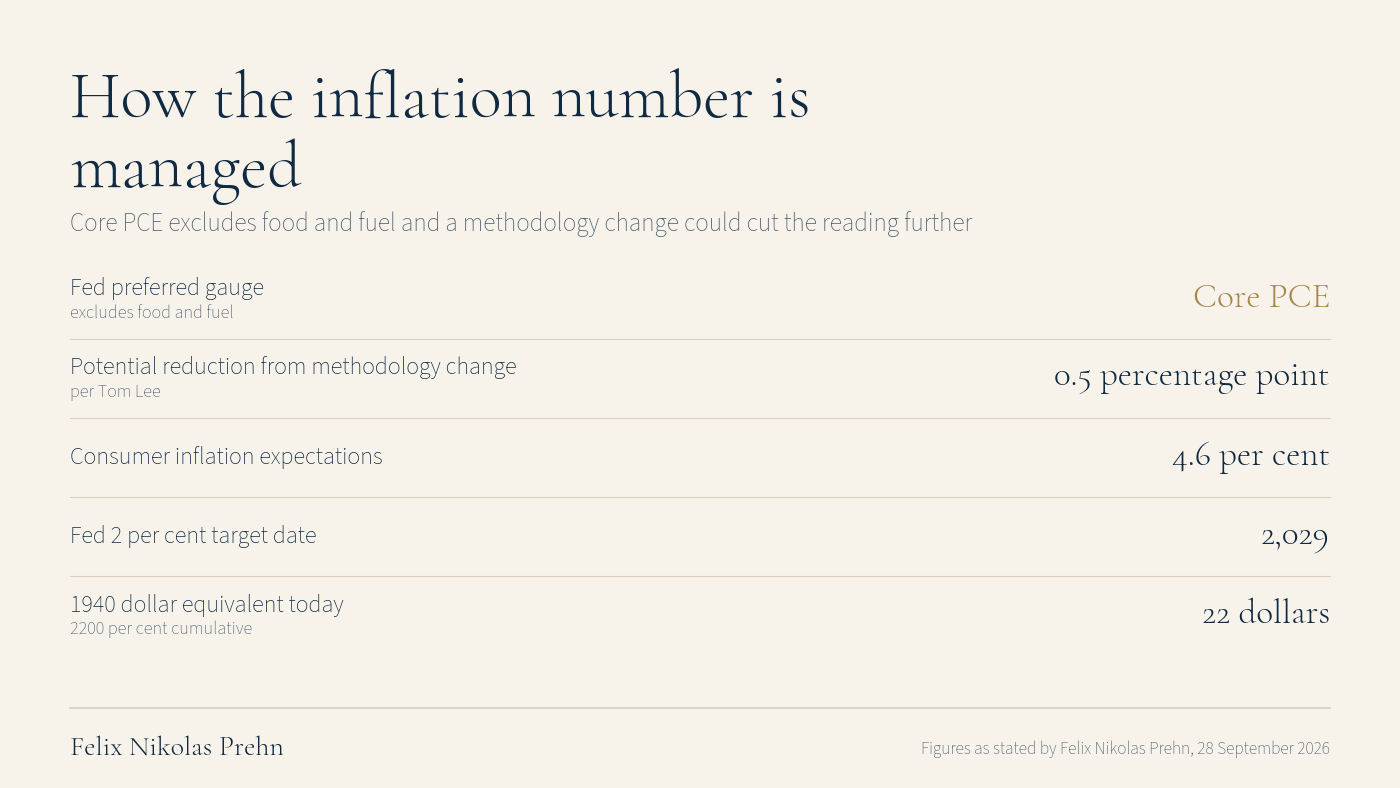
And then as door two, where you stop raising the rates and inflation runs hotter than you wanted to. So either way, the person sitting in cash or in bonds or saving or being just a bit scared about the market and therefore not investing is on the wrong side of what's happening. Even the Fed admits inflation isn't going to come back down to 2 per cent till 2029, which is sort of like never ever, right? Consumers expect inflation to be 4.6 per cent. So what do most smart people do?
Well, most smart people have been told just buy an index fund, right? Tuck it away, don't look at it, just buy it. And that worked really, really beautifully when rates were low and falling year after year. It's a lot more problematic when rates and prices are climbing together. So that's honestly the problem.
What do you actually do about it? Let me give you something practical. Investing used to be like you plant an oak tree, you pick up something solid, you plant it in your account, you walk away, you come back 20 years later and you got a beautiful oak tree giving you shade. And for our parents generation, that actually worked pretty well because rates were coming down for decades. But that strategy that built your parents' retirement, I just don't think it'll build yours because the system's changed.
Money is moving faster than ever. All right. The traders are moving faster than ever. I don't know a single guy on Wall Street or on a hedge fund who's a buy and hold guy or a value guy. Just just they just died out.
They're going with the hawk or the arc. Um, so what do the skilled money guys do? Because that's what they are. They're not smarter than you. Don't call them smart money. is skilled, right?
Well, they follow the money. They watch where the big institutions are moving their cash and then they move with it. So, they don't fall in love with a stock or a position for life. And my hope is that we can teach you that strategy because I've been using that for years and I know plenty of people who've been using it for decades. And if you're willing and you open-minded, write open in the comments down below.
And I will then teach you this live and for free for about 2 hours this coming Saturday. And I call it why buy and hold is dead and what Wall Street does instead. And we're going to do that together live. Not quite sure where I'll be on Saturday, but I'll make sure I'm awake. So it'll work for you time zone wise if you're in the US or in the UK or in Europe, pretty much everywhere Asia.
Um, and if you're thinking, "Oh, it sounds complicated." Well, relax. It can be done with index funds. It's actually very simple and I'll walk you through it and you can ask me questions live which is a bit better than you know this format here on on the plane. So get yourself a free seat buying.net. There's a link down below in the description to sign up for it.
And if you ask for replay no sorry if we don't do them they don't work. So write open the comments and let me know you're coming. But let me come back to the number that the government's rewriting and it's literally stranger than anything I've read in a long time.
The Fed, you see, has a favourite inflation measure, and you don't really read it about in the news because it's really boring. It's called PCE, and and there is a core version of it where they remove food and fuel because apparently we don't need it. Is the number that the Fed actually steers by, which is just weird, isn't it? The inflation measure they steer by excludes food and fuel. Uh, try living without food and fuel for a week.
See what happens. Um, but that's the number they look at when they raise or cut interest rates. and they're changing how they are calculating it. I know it sounds pretty specific and and all that, but there's a chap on Wall Street called Tom Lee and and and he's a very well-known sort of strategist. He's kind of a permable and he thinks it could knock off half a percentage point of inflation just from the method change. So, no price in America has to fall.
No shop has to sell something cheaper. Your weekly shop costs can still go through the roof. Your car insurance and all that. Um, but the number just comes out just a just a little bit lower basically. And good old Tom says it's extremely bullish for stocks.
And I think weirdly he might be right in the short term because the numbers going to go lower. People won't understand why and they're going to go, you know, bananas with it. But think about what it means. The Fed raises rates because inflation is too high. Now they are massaging the number that they watch to tell whether it's like it's like taking a thermometer and it says um you know you got a 38°ree fever Celsius or the weather some Fahrenheit apologies.
Um and you think well I could take the fever down and you know do something about it or I could just scratch out the 38 on the thermometer and make it 36 or whatever right 37. Um so that's kind of mad, isn't it? That's kind of crazy. That's literally what the government is doing. So, we're fighting inflation by adjusting how we calculate it.
Weird, eh? And and and it's kind of funny. It's kind of sad at the same time. Governments have done this for a long time. And and they'll justify it.
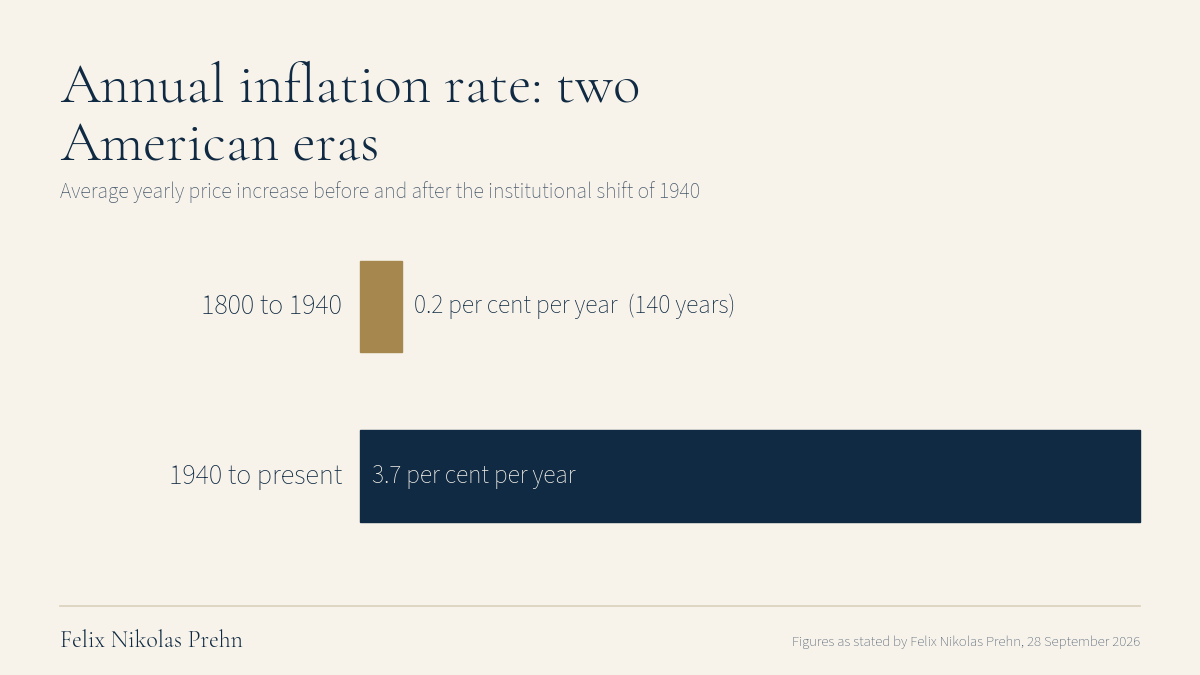
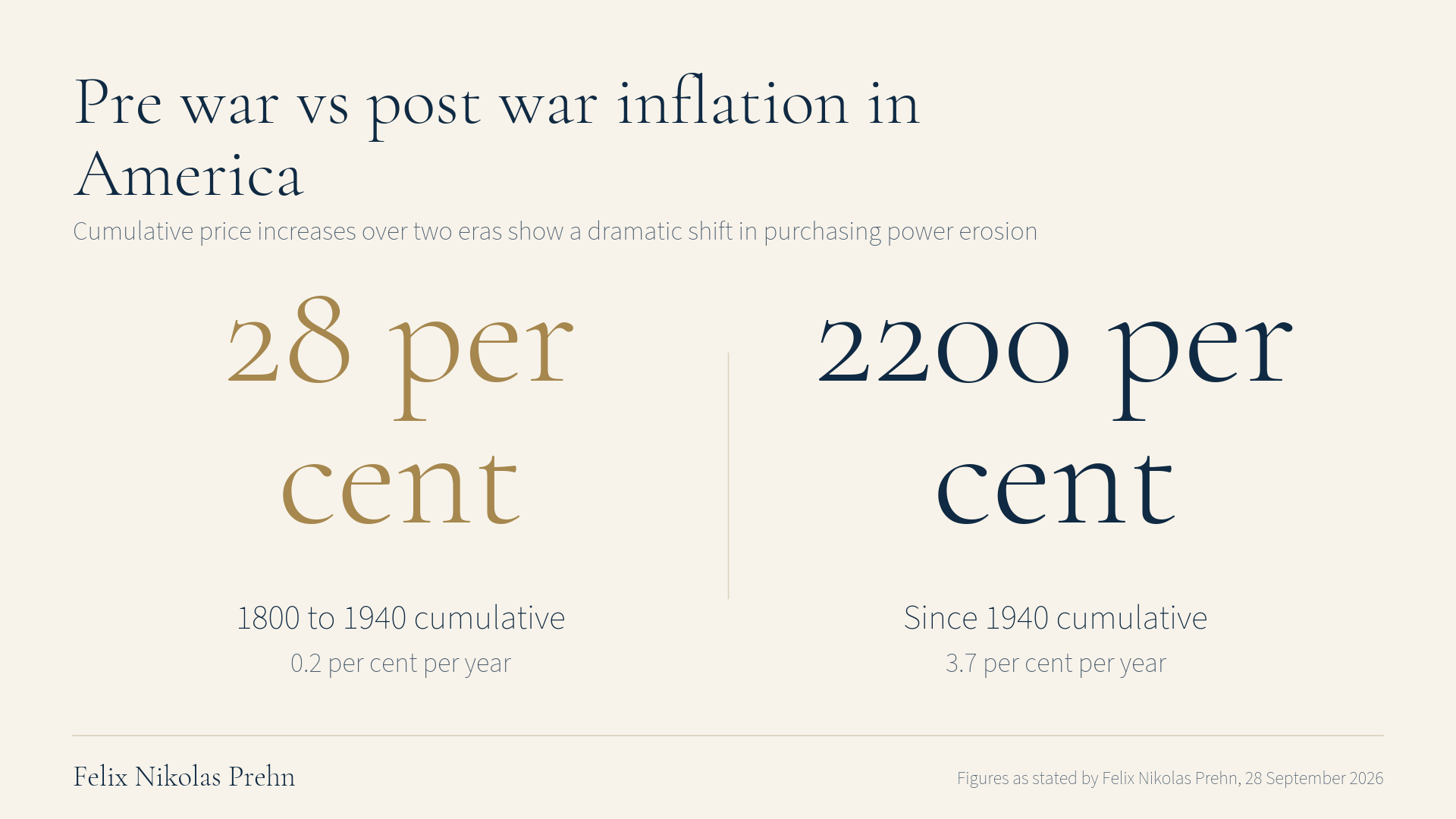
They say, "Oh, spending habits has changed or new products came in the basket or whatever." and and and you know no matter what the government number is have a look at this number here from 1800 to 1940 prices in America rose about 0.2 per cent a year 0.2 per cent 22 per cent a year for 140 years over so over 140 years that is 28 per cent in total. So your great great grandparents or something they could basically put their money in a drawer and they'd basically rough buy them roughly the same thing a few decades later.
But since 1940 inflation has averaged 3.7 per cent a year which is 2,200 per cent inflation since 1940. So something that cost a dollar in 1940 costs $22 now. So when you look at these numbers, 0.2 per cent before the war, 3.7 per cent since the war, sounds like a tiny number, right? But the difference is huge. It's 28 per cent versus 2,200 per cent.
And it's a quiet transfer from savers to borrowers. And the biggest borrower on earth is who? You guessed it right. It's the US government. So let me just teach you the plan here.
And and it's kind of the one I called, you know, unthinkable in the silly title here, but people don't announce it like this. But here is what it actually is. First, a government with a debt this size cannot afford high interest rates for long. The interest bill will just get bigger and bigger.
Second, you have the Fed that just raise rates and it may do it again, which makes the interest worse. And then third, the measure, the indicator the Fed uses to decide whether rates should go up or down is being well, you know, recalibrated would be the polite way for putting it. And maybe you can think of a better way put in the comments. So you put those together and you get your path out, right? So you let it prices run a little higher.
You report them a little lower. You just, you know, fudge it a bit and you lose the lower reading to lower your rates. And that way your interest rate costs go down. And that way the debt shrinks a little bit every year. But at the same time, the dollar also buys a little bit less every year.
And that's all it is. That is the reset. It won't be a great big bang or a new currency or a stable coin or something on a Monday morning. No, it's just a gap between the official number and your actual bills. So the official number says, "Oh, things are coming down, but your actual costs are doing the opposite." Now, most people trust government numbers.
So the retiree whose pension has, you know, his index inflation linked or something, they think they're doing the right thing. People are sitting at cash. They think they're being careful. They think they're doing the right thing because they're trusting the numbers. So what do we watch out for here?
We don't watch the Fed. You watch the Treasury's bank account. The Treasury has a bank account called TGA, and it's the government's current account, and it's at the Fed where they just print the money.
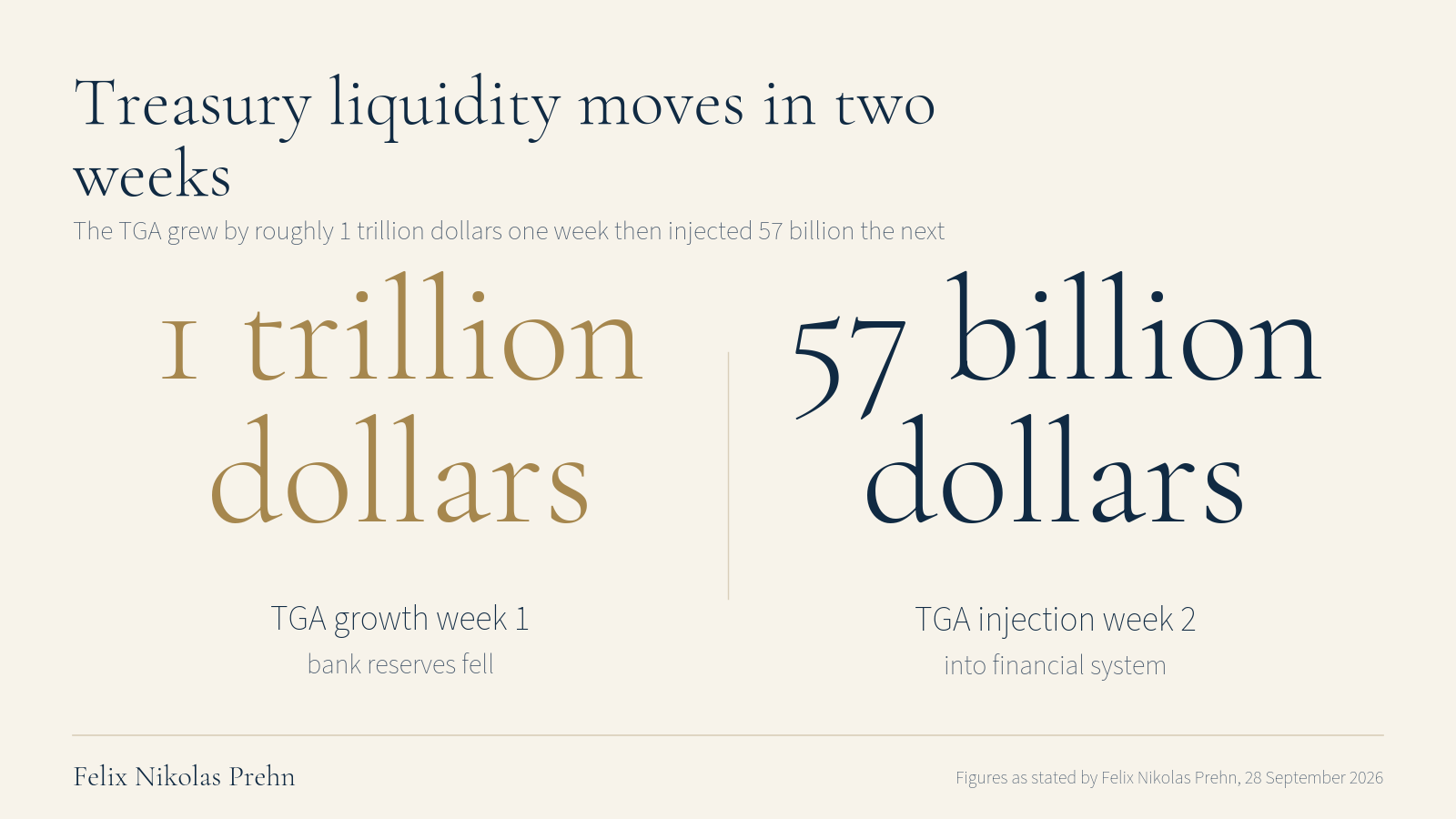
And last week, the Treasury used that money to inject 57 billion into the financial system in just a week. And that money flows into the banks. And there's no talk about it. I couldn't even find a press release on it. The Fed isn't involved on it.
And the week before, well, week before it smelt about a trillion dollars and bank reserves fell. There's a small bank in the US just collapsed, by the way. So when the government doesn't pump money into the banking system, the money tends to flow into the government's coffers and therefore money leaves the liquidity. And what that's really telling you is that the treasury bessent is becoming the central bank. And it gets even weirder and I appreciate this is a little technical but at the New York's Fed conference just officials discussed the idea of treasury lending its spare cash into the overnight lending market.
Now in plain English that means the government would take its own cash pile and push it into the plumbing that banks use to fund themselves. And it means that the Fed doesn't have to do it. So why would you want to do this? And and I know it's a little complicated. The Feds just raised rates and told the world, "We're going to be tough on inflation." And so they can't as well turn around and say, "Well, we're going to print money." They are doing it, of course, but they're not telling you about it because it looks ridiculous.
But you see, the government, the Treasury can, and they can do it through this account that nobody have heard of, but now you have, the TGA account.
So the Fed looks tough on inflation, but the Treasury, the government keeps the system afloat. And the headline will just say rates are going up. Inflation's going down. Right? So they say the tough thing, they do the soft thing somewhere less visible.
They tell you inflation is being fought. Well, well, inflation is actually going up. So what do we do about it? Well, there's hard assets.
There's gold, right? Tends to do well, but it's not right now. When wars get worse, gold tends to underperform. When oil prices go up, gold tends to underperform. When interest rates go up, gold tends to underperform, at least for a period.
But the people I know you're benefiting from this, the buggers running the f the funds, the hedge funds and so on, they're not even buying gold. They can see it. Just look at the gold charts. If you know what to look for, you can see the institutions aren't really buying it. So, they are just floating around.
They're making money. They're trading, but they're moving away from the inflation risk. They're moving away from the AI risk. And if your game, if you're open to it, I'll teach you that structure, that system this coming weekend on Saturday at the free seminar we're going to run, why buy and hold is dead in 2026 and Wall Street does instead. And there is no catch.
There's nothing you got to do. You just got to sign up. You got to show up, take some notes. Um, and and and I will actually teach you and I enjoy that tremendously because I think everybody deserves to understand this. I think everybody deserves to know the rules that money actually is run by and I think everybody deserves to understand how relatively simple it is.
So grab yourself a free seat buying.net links down below and graduate from buy and hold to hopefully buy and grow which is really what the what the what the goal is here. And if you know someone who's a bit scared by what's happening or is sitting in cash or is waiting for the dip or whatever, just send them that link or send them this video and hopefully we can help them before this structure, this system does what it's meant to do, which is move your money into the government's money. It's a tax. It just isn't announced. It isn't on your tax bill, and it's going to hurt, unfortunately, a lot of people.
So, I hope, and I know that was a little unstructured. I hope it was still somewhat useful. Uh, we're now properly in the air, although it is rather cloudy, so not much to see. And I will enjoy a little snack, maybe have a nap, and I wish you all the best. Take care. >> Right now, I think we're going through some sort of weird phase transition.
And normally when you get bad economic news or you get bad jobs data that people are going to fly to safety into the bond.