Four companies, Microsoft, Amazon, Alphabet, and Meta, are spending a combined 650 billion dollars on artificial intelligence. More than 600 of that total is going to AI infrastructure this year. The figure exceeds Sweden's entire GDP.
The distribution of that spending may be the single largest factor in American growth for the rest of this decade. Big tech AI capital expenditure is one pillar.
Concentrated consumer spending by the wealthiest households is another. A belief that the government will step in if markets buckle is the third.
AI spending comes from only four companies. The necessary consumption comes from one tenth of households. Market confidence rests on a single assumption about policy intervention.
The AI spending tsunami
Goldman Sachs compares the current AI investment boom to the 1990s telecom spending wave. In the 1990s, vast sums poured into fibre optic cable and network infrastructure.
No one yet knows how much of that spending will prove useful. If a rival spends on AI and a firm does not, the laggard risks obsolescence.
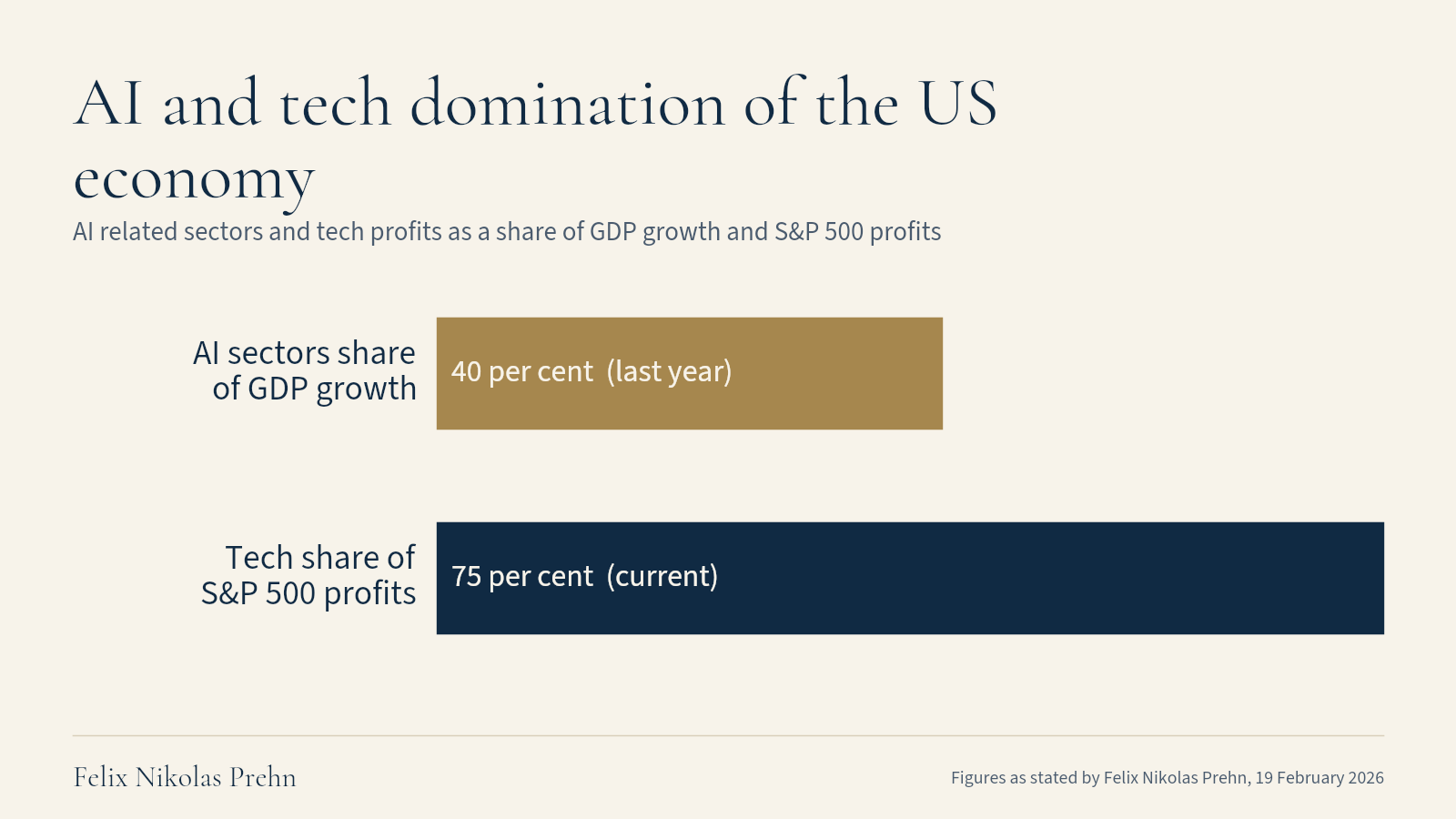
In Felix's view, competitive pressure is driving overspending. The returns may not justify the outlay, though AI related sectors accounted for about 40 per cent of GDP growth last year.
Felix's analysis shows tech now generates 75 per cent of all S&P 500 profits, and the economy has not crashed in part because these companies have enormous cash flow. They are borrowing on top of it to spend still more. The result is a flood of corporate capital into the American economy.
A semiconductor firm selling chips to the big four thrives. A software company that AI might replace faces a shrinking valuation.
AI concentration and market fragility
JP Morgan data shows the long semiconductor, short software trade has returned 35 per cent so far this year. The trade is simple in concept: buy chip makers and sell short their counterparts in enterprise applications. The return reflects a market pricing semiconductors for continued dominance and software firms for decline.
Felix argues that AI spending is concentrated in a few companies. The concentration splits the market. The gap between chip makers and enterprise application companies has widened sharply.
A semiconductor company supplying the big four sees booming demand. A firm whose product AI can replicate sees its valuation collapse. Semiconductor and software sectors have reached historical extremes.
The tariff drag on households
Felix calculates that the average American household is paying an extra 1300 dollars per year because of tariffs. The burden falls on imported goods, raising prices on products that households buy routinely.
Consumer sentiment has deteriorated. Headlines confirm that tariff costs remain a subject of active debate among policymakers and economists.
The 1300 dollar figure reduces disposable income for most households. The wealthiest tenth continue to increase their outlays.
The wealth driven consumer
As Felix puts it, the top 10 per cent of American households drive half of all consumer spending. The share is a record.
Household outlays account for more than two thirds of the entire US economy. If the wealthiest tenth spend more, GDP rises even if everyone else spends less.
Outlays by the top 10 per cent rise about 10 per cent a year. Lower and middle income households spend less year on year.
Stock prices and home values rise, and asset holders feel richer and spend more. The wealth effect feeds directly into GDP figures.
Felix argues that the government is bullish on 2026. The top 10 per cent have portfolios up and home values have climbed.
They received generous tax cuts and record tax refunds. Lower and middle income households are spending less, but aggregate GDP does not reflect their decline because the wealthiest tenth compensates.
When asset prices rise, the holders of those assets benefit disproportionately. When markets fall, the same group absorbs the losses, but policy tends to intervene before the pain becomes severe.
The political backstop
Felix argues that a belief has taken root on Wall Street: the current administration has a back off button. Approval ratings tend to track market performance. A sharp decline drags political support down.
The administration therefore faces built in pressure to adjust policy before damage becomes permanent.
Felix points to a recent episode. In 2025, tariffs went up and the market sold off. A 90 day pause followed.
The S&P 500 posted the biggest daily gains since 2008. Investors treated the reversal as confirmation that a floor exists, that if conditions deteriorate far enough, policy will bend. The expectation of a policy floor now functions as psychological support for the market.
AI adoption and the obsolescence fear
Firms with paid AI subscriptions grew to about half of all companies. Adoption grew about 90 per cent from a year earlier.
Investors panicked about AI disrupting everything. Software firms might become obsolete.
Banks might need fewer employees. Freight brokerages could be automated, and fear triggered broad selling that pushed many stocks down.
JP Morgan believes many of those prices are wrong. JP Morgan created a basket of stocks it considers mispriced and insulated from AI disruption. The list went only to large institutional customers.
In cybersecurity, JP Morgan's list includes CrowdStrike, Palo Alto, Okta, Zscaler and SentinelOne. AI generates more data and more attack surfaces. It also makes attacking easier, so firms need bigger defences.
The list also includes Datadog, ServiceNow, HubSpot and Microsoft. JP Morgan sees the last of those as insulated because it sells AI tools to everyone: cloud computing, its OpenAI partnership and Copilot.
In financials, JP Morgan favours Bank of New York Mellon, Nasdaq Inc, Moody's, S&P Global and MSCI. AI increases the demand for data. Credit ratings and indices remain necessary regardless of the technology used to produce them.
Contrarian bets and the road ahead
CH Robinson Worldwide is a freight brokerage company. As Felix notes, the stock dropped 25 per cent in a single day on fears that AI could automate the matching of shipments to carriers. JP Morgan has an overweight rating on it.
A new Fed chair is expected and is anticipated to lower interest rates. Felix maintains a bullish outlook on the American economy for the year.
In his view, lower rates and record tax refunds support growth. More than 600 billion dollars in AI spending by four companies makes a contraction unlikely.
Microsoft, Amazon, Alphabet and Meta account for the bulk of AI capital expenditure. The top 10 per cent of households drive half of consumer spending. AI related sectors accounted for about 40 per cent of GDP growth last year. Consumer spending is more than two thirds of the entire US economy. A slowdown in either would change the arithmetic behind GDP.