
In Felix's view, the US government signalled a backstop for the AI industry. The Federal Reserve talked down inflation. The CME raised the cost of holding precious metals futures.
All three arrived in close succession. All three changed the rules of the game before the headlines caught up.
The Biggest Single Day Jump in US Stock History
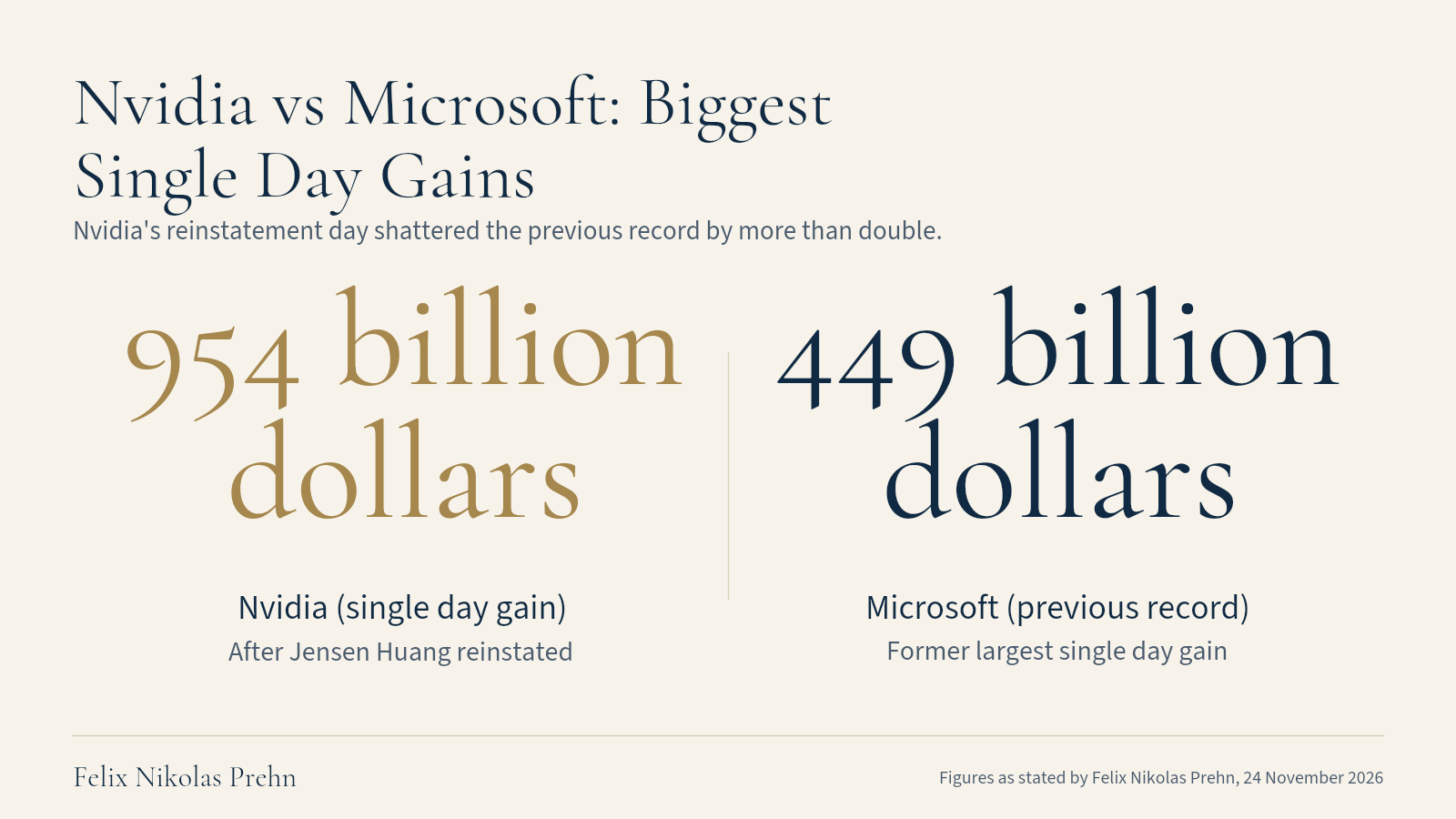
Nvidia gained 954 billion dollars in value in a single day after Jensen Huang was reinstated as board director. The gain is the largest one-day jump any American stock has ever recorded. The previous record belonged to Microsoft, at about 449 billion dollars, making Nvidia's move more than double that figure.
The stock rose about 31 per cent in a single session. Revenue and product lines had not changed. A personnel decision drove the move.
Why the Board Brought Jensen Huang Back
Most of the board's wealth was in Nvidia stock. About 30 per cent of it had disappeared.
Huang's return reversed the decline overnight. The 31 per cent single-day rise more than recovered the loss.
The board did not reinstate Huang because of a strategic review or a shift in product direction. Huang was the one person whose return could recover their capital.
The Government as AI Backstop
Evercore, a Wall Street research firm, described the US government as the implicit backstop of the AI industrial complex. The firm called it AI's first bailout. Evercore specified that the rescue targeted the architecture supporting a trillion-dollar buildout, rather than any single balance sheet.
A backstop is a promise to catch an industry before it hits the ground. In Felix's view, the government has decided AI infrastructure cannot be allowed to fail.
Market forces alone will not determine its fate. Headlines have not confirmed an official government announcement. Pressure on AI firms to secure institutional backing has been widely reported.
The stock price of a company operating under a government backstop stops being a measure of quality. Nvidia's 954 billion dollar gain followed a personnel decision, while revenue and product lines were identical the day before.
The same logic that deemed banks "too big to fail" has reached the AI sector. If Washington will bail companies in or out, the price signal breaks. Nvidia's valuation then tracks policy rather than earnings.
The 3 Trillion Dollar Whiplash
About 3 trillion dollars moved over Wednesday, Thursday, and Friday combined before the Monday rebound. The sequence was sharp: a steep fall over 3 days, then a record-breaking recovery on Monday.
Revenue did not change between Friday and Monday. The 954 billion dollar gain tracked a board decision and a government signal.
A 3 trillion dollar drawdown followed by a recovery of that scale in 1 day resembles a policy response. The price moved because a board changed its mind and a government signalled support.
The Fed Signals Lower Inflation Ahead
Fed governor Williams stated that 2027 will be a year of lower inflation. He attributed recent price rises to unusual factors and indicated the Federal Reserve had worked to bring inflation down. The phrase shifts responsibility away from monetary policy.
Oil and energy prices respond to geopolitics, not to interest rate decisions. Rate increases do not change what is happening in the Middle East. The Fed is backpedalling on further hikes by framing recent inflation as temporary and externally driven.
Recent headlines on Williams's stance have been mixed. Some reports suggest no urgency for further hikes.
Others indicate more increases remain possible. The overall signal, however, points toward rates going sideways or beginning to fall.
When the Fed talks inflation down and rates flatten or fall, money stays cheaper for longer. Asset prices stay higher. The Fed's language functions as a policy tool, deployed when the system needs prices to hold.
Gold and Silver Under Pressure: CME Margins, Turkey, and the Dollar
The CME, the exchange where most precious metals futures trade, raised gold margin deposits from 5 to 6 per cent. Silver requirements went from 8 to 9.9 per cent. The CME justified the increases as a normal review of market volatility to provide adequate collateral coverage.
A margin is the deposit a trader puts down to control a larger position with borrowed money. When an exchange raises that threshold, every holder of an open bet must find more cash.
Holders who cannot top up are automatically sold out. Forced selling pushes prices down regardless of the case for the metal.
The CME has done the same before. Late last year and early this year, the exchange raised silver margins several times.
The hikes came within a few weeks of one another. The price fell sharply after each increase.
A similar sequence of margin hikes pushed down precious metals prices in 2011.
Gold is priced in dollars. When the dollar rises, foreign buyers must convert their currencies into dollars.
Gold becomes more expensive for them. Gold usually falls when the dollar rises.
If the Fed softens its stance and cuts rates, the dollar would likely come down. At present, the dollar is appreciating.
Turkey has a currency that is down something like 99 per cent due to mass inflation. To support the lira, Turkey has been selling gold.
Turkey's central bank has signalled it may use gold reserves to shore up its foreign exchange position. Each sale adds supply to a market where margin hikes are already forcing leveraged holders out.
Three forces are pushing gold and silver prices lower in the short run. A rising dollar raises costs for foreign buyers.
Higher CME margins force leveraged holders out. Turkey is selling gold to support the lira.
What Comes Next: Senate Testimony and Institutional Positioning
Jensen Huang is to testify publicly before the Senate Banking Committee on December 3rd. The hearing is confirmed by multiple outlets, though the topics have not been disclosed in detail.
Goldman Sachs sent its 2027 gold research report to institutional clients. The report went to large holders, not to the broader market.
Goldman sent the report while the CME was raising margins and Williams was talking inflation down. The timing of that distribution coincided with the margin hikes and Williams's comments.
Each of these shifts arrived within days of the others. The government backstop kept AI valuations from falling further.
The Fed's language held rate expectations low. The CME's margin hikes pressured precious metals lower.
AI stock prices recovered after a personnel decision and a government signal while revenue had not changed. The Fed attributed inflation to external causes, and rate expectations stayed low.
Margin hikes forced leveraged holders out of gold and silver. A firm dollar raised costs for foreign buyers. Turkey's central bank added selling pressure by offloading reserves to prop up the lira.
Felix argues that the financial system adjusts its own rules to preserve itself. The backstop, the inflation language, and the margin hikes arrived within days of one another.
Each change favoured financial asset prices and penalised holders of physical gold. The margin hikes preceded the drop in gold. Williams's comments arrived before markets repriced the path of interest rates. Goldman's 2027 report reached institutional clients before any public coverage.