
The price of borrowing is returning to where it was before 15 years of near-zero interest rates suppressed it. Credit feeds into mortgages, pensions, share prices and government budgets.
A repricing in credit feeds through to bonds, stocks and commodities. For years, yields (the interest a bond pays) were below the level the economy warranted. Yields have now corrected.
The adjustment is already visible in government auctions, corporate bond markets, stock market breadth and commodity flows. Each section below traces a different channel through which the same force, the normalisation of borrowing costs, is working.
The Highest Borrowing Cost This Century
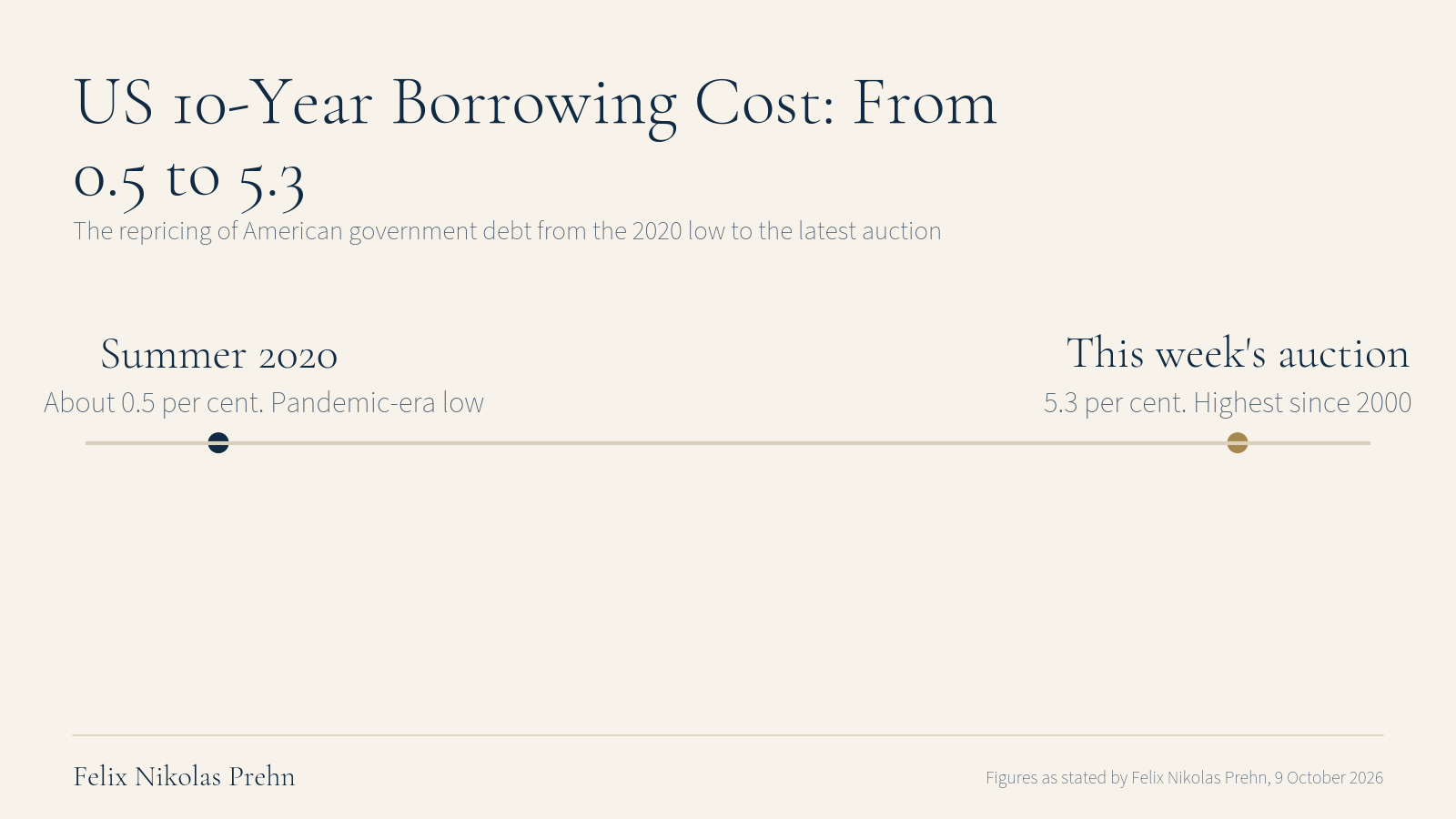
At this week's auction America sold 39 billion dollars of 10-year debt notes at 5.3 per cent. The Wall Street Journal called it the highest borrowing cost since 2000. The 30-year rate touched 5.66 per cent, a level not seen since 2002.
In the summer of 2020 the 10-year rate was about half a per cent. The annual cost of each new dollar borrowed has risen tenfold.
Every government bond issued at those pandemic-era rates will eventually mature. When it does, the Treasury must replace it at today's rate.
A bond financed at 1 per cent must roll over at 5 per cent. A rollover replaces old debt at today's rate. The interest charge on that slice of debt multiplies by 5.
The Debt Spiral
US government debt is 40 trillion dollars. In 2020 the figure was 23. Federal debt grew by 74 per cent in roughly 6 years.
M2, the broad measure of money circulating in the economy, is up 51 per cent since the pandemic. The Federal Reserve's balance sheet rose from $4 to about $9 and remains close to $7, all in the trillions. Consumer prices are officially up almost 30 per cent since 2020.
A government facing a growing interest bill can cut spending or raise taxes. It can also print money and have the central bank buy its debt, which erodes the currency's purchasing power. The scale of money creation since 2020 suggests the printing path is already well under way.
AI Concentration Risk
JP Morgan reports that AI stocks now make up 49 per cent of the S&P 500. At the start of 2023 the figure was 26 per cent. In Felix's view, AI stocks account for 70 per cent of all stock market gains this year.
A market where half the index weight and 70 per cent of the returns come from a single theme is fragile. 3 of the 4 corporate bonds discussed later in this piece, Oracle, SpaceX and Meta, are tied directly to AI infrastructure spending.
The stock index looks calm. Corporate bond prices tied to AI infrastructure are falling sharply.
The Hidden Bear Market
Morgan Stanley reports that 89 per cent of Russell 3000 stocks are down more than 10 per cent from their peak since June. The index is the broadest measure of the American stock market.
More than half are down 20 per cent. And 7 per cent have fallen more than half.
Felix argues that the index looks fairly calm because a handful of AI giants are propping it up while most stocks are falling. A 20 per cent fall is the textbook definition of a bear market. More than half the Russell 3000 qualifies.
Four Bond Charts That Tell the Story
Bonds have moved before stocks when credit conditions changed in recent cycles. 4 recent examples illustrate the pattern.
Oracle borrowed heavily to build data centres for the AI boom. One Oracle bond paying 6.7 per cent interest was issued at 100 cents on the dollar.
It now trades at 82 cents, which means the effective yield (the return a buyer gets at today's price) is above 8 per cent. The cost of insuring Oracle's debt against default rose from about 60 a year ago to 244. Insurance on the same company is roughly 4 times more expensive than it was 12 months ago.
SpaceX sold a bond paying almost 7 per cent interest just weeks ago at 100 cents. It now trades at 85 cents, an all-time low. SpaceX's bond lost 15 per cent of its face value in weeks.
The bond financing Meta's Hyperion data centre traded at 110 cents a year ago. It is now at 91 cents.
Meta's shares have held up better than its bond. In Felix's view, bonds are pricing something that stocks have not yet absorbed.
Paramount's debt has moved in the same direction. In Felix's view, the cost of insuring the company's debt against default has returned to the level last seen during the 2008 financial crisis.
Stress in Paramount's debt has also been reported in headlines following a large financing deal. Felix argues the cost of insuring the company's debt against default has returned to levels last seen during the 2008 financial crisis.
The Silver Flush
Felix argues that 1.6 billion dollars left the silver market in one week, dumped by institutional money. Felix argues the selloff says more about positioning than about silver itself.
The selloff has three drivers.
The dollar remains a drag on silver.
Speculative positioning has taken a hit. Trend-following programmes (computer-driven strategies the industry calls CTAs) are also selling.
Two of those 3 reasons are mechanical. Nobody in that chain changed their view on silver. They ran out of room for their speculation.
Borrowed money explains why the selling snowballs. A trader borrows 10 times their own capital to buy silver.
Suppose silver drops 5 per cent. Half the trader's own capital is wiped out in that move.
The broker demands more cash. If the trader cannot provide it, the broker sells the position. Each forced sale pushes the price down further, triggering the next margin call in sequence.
Felix argues that once the borrowed-money traders and trend funds exit, the remaining holders are those who want the metal. Fewer sellers remain to sell into any subsequent rally.
Flushes of this kind tend to come before money printing, not after. US Treasury yields are at multi-decade highs and credit stress is spreading through corporate bond markets.
Gold and silver are priced in dollars. Each metal exists in a fixed quantity, but the number of dollars keeps growing.
Historically, gold and silver have tended to be priced upward when money supply expands. The M2 money supply is up 51 per cent since the pandemic. If the Federal Reserve resumes large-scale purchases of government debt, the number of dollars grows further while the quantity of metal does not.
Long Bonds as a Contrarian Position
A 30-year government bond currently pays about 5.66 per cent, the highest in over 20 years. A buyer who keeps the bond to maturity locks in that income for 30 years from the US Treasury.
Bond prices and yields move in opposite directions. When interest rates fall, the prices of existing bonds rise.
Longer bonds move more in price for a given change in yield. If a 30-year yield drops 1 per cent, the bond price gains roughly 16 per cent.
Felix argues that if a credit crisis forces the Federal Reserve to intervene, the first action is usually to push down interest rates. The Fed buys government debt and bank assets, paying with newly created money.
Yields fall and bond prices rise as fresh cash enters the financial system. Long-dated bonds would benefit directly from such an intervention.
Long bonds carry risks in the other direction. Inflation could return with force, causing rates to stay high or go higher, and a new Federal Reserve chair could choose a different path. A long bond position loses roughly 16 per cent for every 1 per cent rise in yield, the same sensitivity that creates the upside.
Felix argues that the Federal Reserve will print again because the alternative is a credit collapse. When it does, each dollar will command less purchasing power. The supply of gold and silver stays fixed. A 30-year bond's price sensitivity to falling yields means it would capture a large share of any rate decline the Fed engineers.