
What a currency reset is
A currency reset rewrites the value of everything priced in the old money. A crash is visible and loud, over in days or weeks. A reset changes the terms underneath while the old system still appears to apply.
Every few generations the debts grow too large to ever be repaid in honest money. Governments and central banks rewrite them. The rewriting can be sudden or can stretch over decades.
Most wealth takes the form of a claim inside the system. Cash in the bank is a promise written in the old money.
So are ordinary savings and a pension locked away for years. Each exists as an entry on somebody else's computer. Entries can be altered or quietly written down.
Claims inside the system bear the cost of a reset. Real things outside the system are not rewritten in the same way.
Why the careful saver is most exposed
Wealth stored as a claim remains in the one place a reset can reach. Careful accumulation in the safest form available leaves wealth exposed to the full force of a reset.
Savers who followed the rules too closely left their money where a reset can find it. Soft language about fairness and stability accompanies the change, but the currency is being altered behind the reassurance.
Gold: the asset with no counterparty
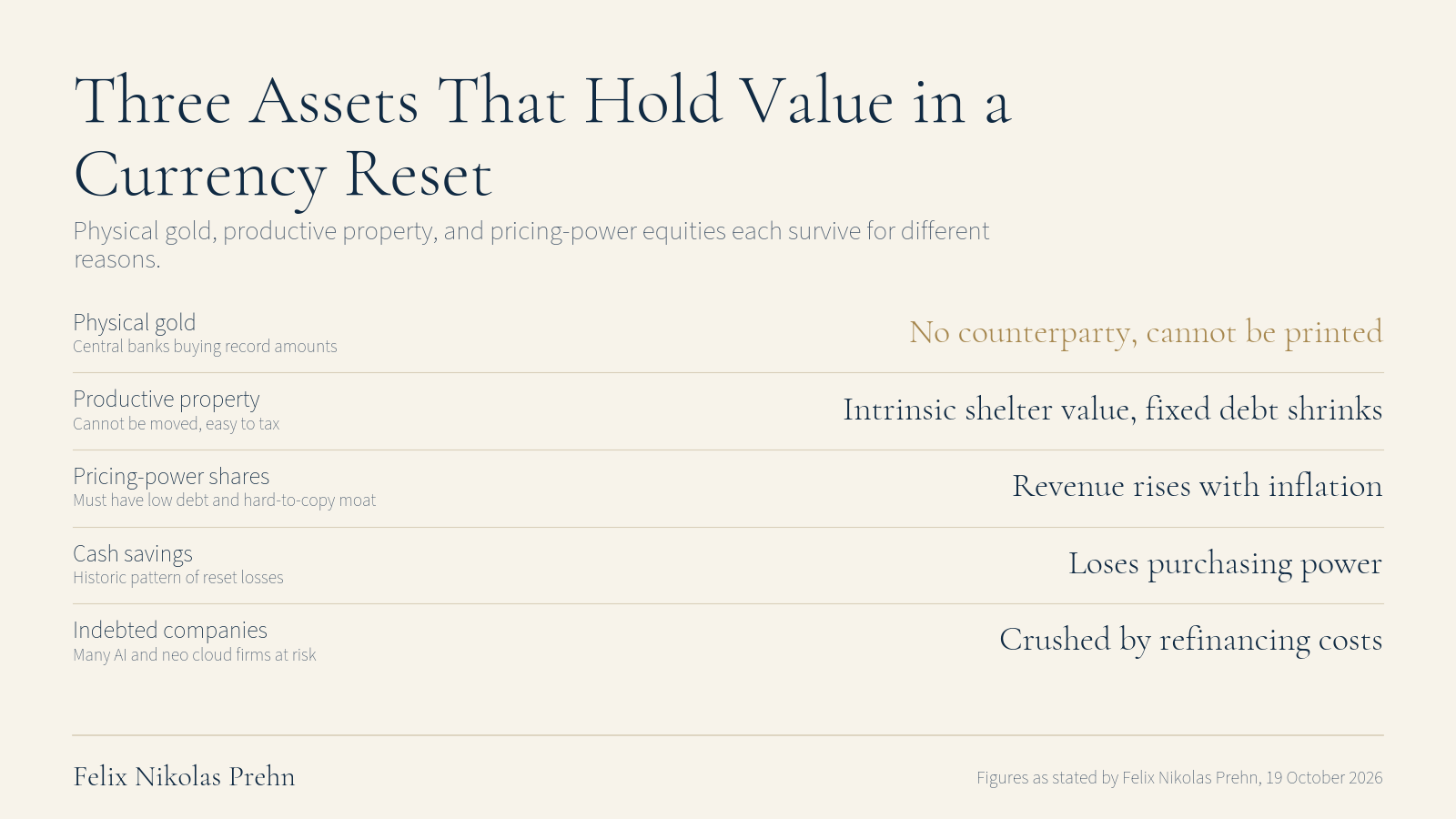
Gold does not sit on anyone's balance sheet. It carries no counterparty obligation and exists as no entry in any ledger.
It needs no conversion because it is not a claim on anything else.
Gold cannot be printed, copied or created by decree, and for that reason it survives a reset when cash does not. When the money supply is increased, more claims chase the same amount of real goods.
The result is higher prices and weaker purchasing power, meaning savings buy less with each round of printing.
The supply of gold cannot be diluted in the same way. New supply cannot be created quickly; it must be mined at great cost and effort. Gold's scarcity is a geological fact, slow and costly to change.
Central banks, the very institutions that print money, are buying record amounts of gold. The data runs through July of this year, with August and September figures still to come. Multiple sources confirm the trend, with China and Poland among the largest buyers, as these institutions hedge against their own product.
The metal and its paper equivalent are different instruments. The physical metal is the commodity, not a claim written on it.
Paper versions are claims layered on top of it, entries saying the holder is owed some quantity.
Paper claims on gold exceed the metal in the vaults. Paper gold is one more piece of the system. It can be inflated like any other promise.
In Felix's view, the amount of gold left in the vaults is declining, meaning paper promises are backed by less and less metal. While physical metal retains its value through a reset, the paper version carries the same counterparty risk as any other promise.
Gold is not without short-term price risk. Felix suggests the Middle East is probably selling quite a lot of the metal right now, and in his view, those disposals explain why the price is soft. Geopolitical pressures and a firm dollar add further weight.
The structural argument is unchanged by short-term moves. Over the span of a reset, gold retains value because nobody can conjure more of it quickly. No central bank can override that geological constraint.
Property: real but reachable
Property is shelter, and demand for a roof persists under any currency. Everyone needs a home and a workspace. Property provides a service that persists regardless of which currency is in use.
Property has two weaknesses gold does not: it cannot be moved and it is very easy to tax. A house cannot be carried out of the country in a pocket. The government always knows where it is and who owns it.
The more productive and self-sufficient a property is, the more resilient it proves through a crisis. Land that can grow food keeps functioning when the wider system falters. Its own power generation adds further independence.
A reliable water source removes another dependency. An urban office tower dependent on external logistics has no such resilience.
Residential property has higher real need than office space. Everyone can live without an office.
Most property is bought with a large loan. The buyer has two things at once: the real asset and a debt written in the old money.
When the currency is devalued, a fixed debt denominated in the old money shrinks in real terms. The borrower repays it in money that buys less than it did when lent.
The real asset keeps its value while the debt shrinks. Fixed-rate debt on productive land is one of the few positions where devaluation works in the owner's favour.
Shares: the surprise survivor
A share is part ownership of an actual business with physical buildings, a brand and customers. Revenue arrives daily from buyers paying for goods and services. When money loses value, businesses do not all behave the same way.
The factor that separates survivors from casualties is pricing power. A business that can raise its prices as fast as money loses value turns inflation into higher revenue. Its costs go up, but its revenues increase commensurately because it can charge more without losing its customers.
Three questions identify a resilient business. The first is whether it can raise prices without losing customers. The second asks if it owns something genuinely hard to replicate.
The third is whether it carries heavy debt. A durable brand or a product close to a necessity gives a company pricing power. Companies that survive a reset gain competitive ground, partly because weaker rivals did not make it.
The losers: cash and indebted companies
Cash in ordinary savings will lose purchasing power based on the historic pattern. The erosion begins slowly, with each unit of currency buying a little less.
Heavily indebted businesses with no pricing power face a different kind of destruction. A company that borrowed at low rates must refinance at a much higher cost once those loans mature. A good product alone cannot offset the burden of refinancing at far higher rates.
In Felix's view, a lot of the AI and neo-cloud space fits this description. Felix argues that the story was exciting only when borrowing costs were low. Rates have risen and remain high for bonds, loans and every other form of corporate debt.
Many borrowed when rates were near zero and would not function if forced to refinance at far higher cost.
CoreWeave offers a recent illustration. Its stock was down 25 per cent and insiders had sold 3.3 billion dollars since its IPO. The bond market has shown concern.
Diversification and the single cause
No single asset class is safe from short-term disruption. Gold prices can be volatile, depending on buying and selling pressures. Property can be taxed, and individual companies can fail.
Diversification in unrelated industries is the only structural defence against any one position turning hostile. A reset rewrites promises inside the system. Cash, bonds, paper gold and pensions denominated in the old money are all claims of that kind.
Gold carries no counterparty obligation and appears on no institutional ledger.
Productive property and low-debt companies with pricing power pass inflation through to revenue.
Physical gold cannot be printed or diluted. Productive, self-sufficient property provides shelter regardless of which currency is in use.
Businesses with genuine pricing power and low debt convert the very force that destroys savings into higher income. Each category carries its own risks. Gold prices can swing sharply in the short term.
Land can be taxed, and any single firm may fail. Capital split between unrelated industries limits the damage when any one holding loses value. Gold, productive property and low-debt businesses with pricing power are not entries on somebody else's ledger. None of the three depends on a government's promise to honour a number on a screen.