Distribution, the Programmable Dollar, and Gold
Distribution in the opening bell
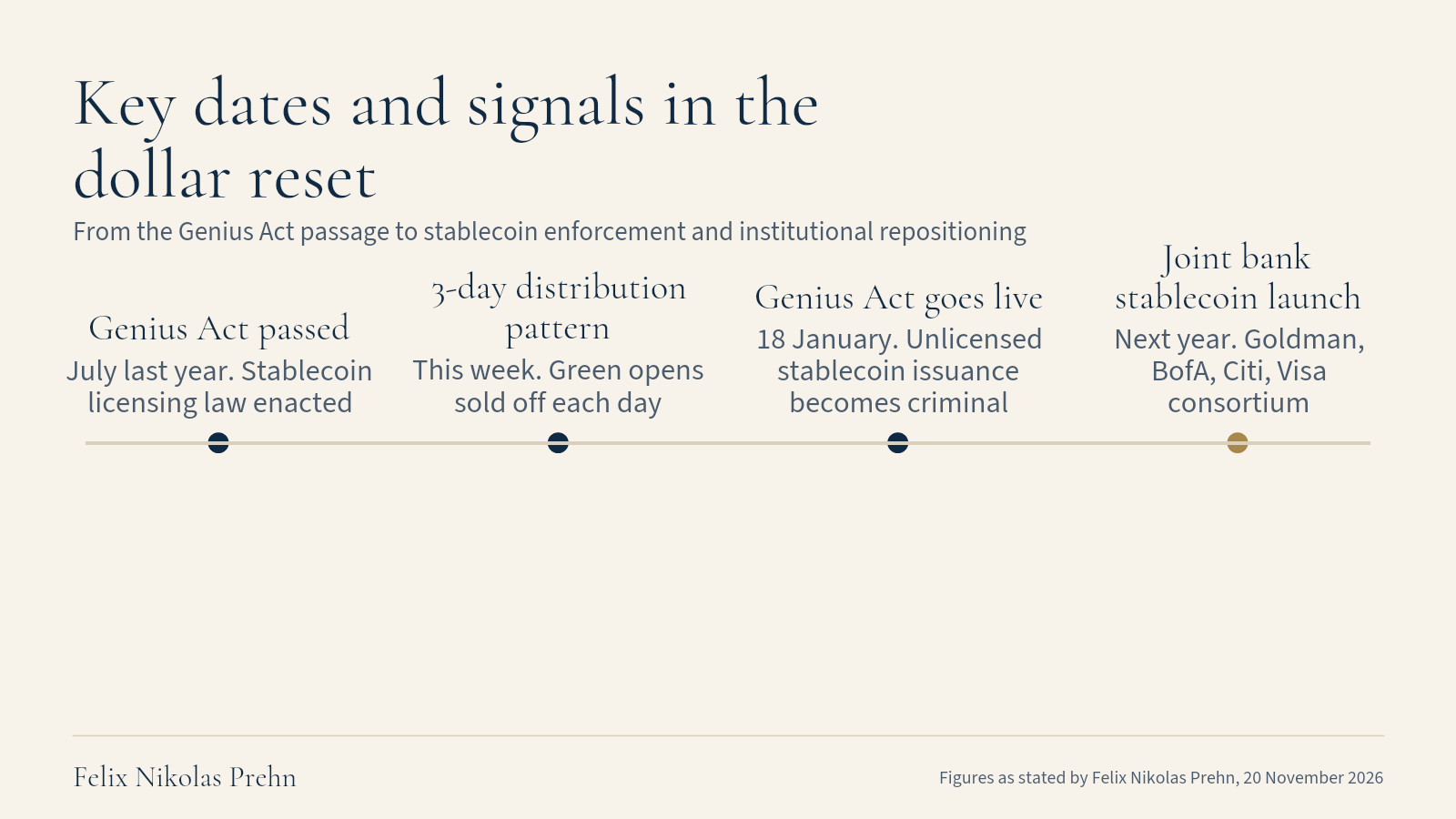
For 3 consecutive days the market opened green in the morning and sold off by the closing bell. Prices rise at the open, attract buying, then fall through the afternoon.
Wall Street calls the pattern distribution. Large institutions cannot sell billions of dollars of stock in a single block without crashing the price.
So they feed shares out in slices, selling into the strongest buying of the day. Morning sessions carry the heaviest buying because sentiment is highest at the open.
A single day of green-to-red price action can be dismissed. Three consecutive days suggest institutional selling. The same distribution pattern appeared in 2008 and just before the top in 2020.
What distribution means in a late cycle
Distribution marks a transfer of ownership from large funds to smaller buyers. The funds sell gradually. The smaller buyers absorb the stock at prices the funds have chosen.
The "buy-the-dip" habit may no longer apply in the present market. For the past 10 years, buying every decline produced gains. Conditions have changed since the long bull run of the past decade.
The dot-com crash produced rallies of 10, 15, and 20 per cent while the market fell 78 per cent overall. Each bounce looks like a buying opportunity. It traps those conditioned by a decade of quick recoveries.
The Genius Act and the 18th of January
In July last year America passed the Genius Act. On 18 January 2027, the law will take effect. After that date, issuing a dollar stablecoin in America without a proper federal or state licence becomes a criminal offence.
A stablecoin is a digital dollar pegged one to one to the dollar and backed by US debt. One token always equals one dollar. The backing consists of government obligations.
Goldman Sachs, Bank of America, Citibank, and Visa are among the institutions forming a consortium to launch a joint dollar-pegged stablecoin next year.
The programmable dollar and what it enables
A programmable dollar can be watched, tracked, frozen, and switched off from the outside. Governments have already frozen bank accounts over protests and politics using the existing, older system. Russia's foreign reserves were frozen under Western sanctions.
Central banks are buying gold at the fastest pace in 2 years
Central banks purchased more than 300 tons of gold officially in the last 3 months. Central bank gold purchases are 40 per cent more than the year before already. The pace is the fastest in 2 years.
Central banks can create dollars from nothing. China has been among the largest buyers, according to industry data.
Gold, silver, and the signals in the charts
Gold has fallen below its 200-day moving line (the mean closing price over the past 200 trading days) for the first time in a long stretch. The gap between the current price and the average is wide.
Last year's consolidation zone was about 3,400. Gold has been falling toward that level. A return to 3,400 would erase the entire move above last year's range.
The gold-to-silver ratio (how many ounces of silver one ounce of gold buys) is stretched very wide. When the ratio climbs, silver is falling behind gold, which signals nervousness. Some trading desks are still betting on 90 dollar silver through large options positions.
Two forces are pushing gold and silver lower in the short term. Paper markets and their traders profit from declines. And sellers under pressure, countries that need cash, are liquidating reserves.
The dollar's long decline and what comes next
Since 1971 the cash dollar has lost 97 per cent of its purchasing power. A 1971 dollar is now worth 3 cents. The erosion has been continuous for more than 50 years.
About a trillion dollars is expected to come out of the Treasury's main account into the economy through buybacks that function as stimulus. Big banks forecast the dollar will be about 5 per cent weaker next year. A weaker dollar is, in general terms, supportive of gold and silver prices, though it does not guarantee a rise.
In Felix's view, Iran may be liquidating gold, as sanctions have constrained its oil exports.
Gulf states face the same constraint: they cannot export at their usual volume and are short of revenue.
Felix argues Turkey has been selling gold to buy oil to keep the lights on. US sanctions continue to pressure Iranian trade, and Turkey has been managing its energy imports under strain.
The distribution visible in stock markets over the past 3 days matches the sequence that preceded the 2008 decline and the 2020 top. Central banks are accumulating gold at a pace 40 per cent above the prior year.
On 18 January the Genius Act takes effect. Goldman Sachs, Bank of America, Citibank, and Visa plan to launch a joint programmable stablecoin.
Central banks, meanwhile, purchased more than 300 tons of gold in 3 months. A stablecoin issued under the new law carries no such immunity. The issuer, or the government behind it, retains the power to freeze it.