
The Federal Reserve meets on 16 September 2026 to set interest rates. The president has made the decision a political event. He told the Fed to lower rates.
He threatened to halt trade with countries against which America runs a deficit. He has described high rates as a "very unfair disadvantage" and urged the central bank's governors to be "patriots".
Presidential pressure on the Fed coincides with gold repatriation by central banks.
Major sovereign holders are selling US government debt. A consortium of banks is building a private digital dollar.
Felix argues the events are connected.
The September 16th Ultimatum
The Fed, America's central bank, sets the interest rate at which the government borrows. Almost every other rate in the economy follows from it. On 16 September 2026 it will decide whether to raise, hold or cut.
The president has demanded a cut. He called high interest costs a very unfair disadvantage. He told the Fed to cut or he would stop trading with deficit countries.
The dollar's credibility depends on the separation between the officials who print money and the politicians who spend it. The Fed is supposed to say no when the White House leans on it. The separation between printer and spender is a large part of why the dollar has been trusted for 80 years.
Felix argues that open presidential pressure on the Fed changes behaviour. Foreign holders buy gold, trim their US treasury positions and build new instruments they control.
Gold Is Leaving American Vaults
For 80 years, countries stored their gold reserves in the vaults beneath the Federal Reserve Bank of New York. America was the safest, most trustworthy custodian on the planet. Several countries have begun to reverse that arrangement.
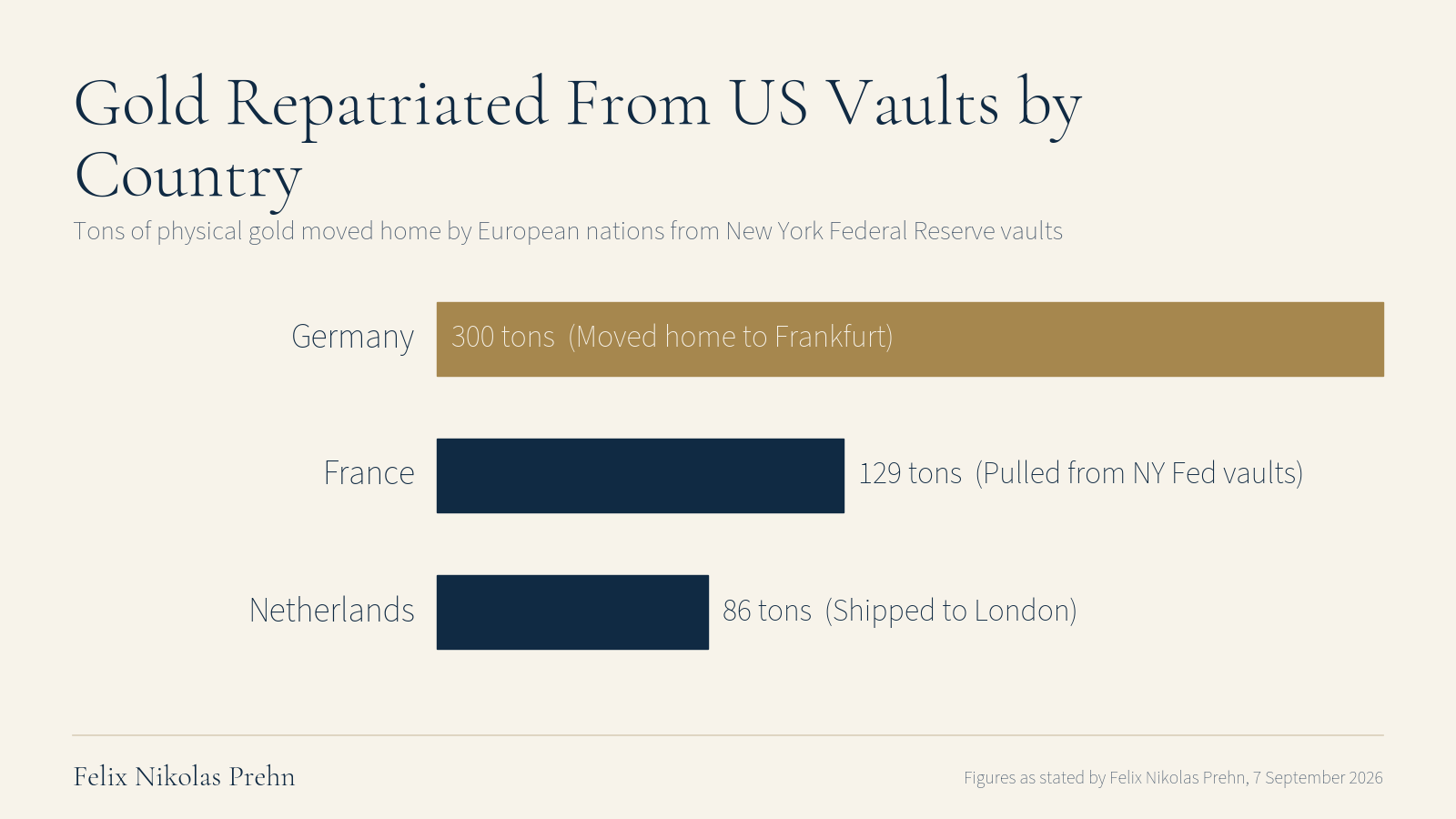
The Netherlands pulled 86 tons of its gold out of North America and shipped it to London. France finished removing 129 tons from the New York Fed's vaults. Germany moved about 300 tons home from New York.
Central bankers offer technical explanations: liquidity management, crisis readiness, trading standards. European headlines frame the moves as a response to geopolitical unrest. In Felix's view, countries want their reserves on home soil, beyond the reach of a foreign government.
The 1971 Precedent
The Netherlands asked to convert 250 million dollars it held into physical gold in 1971. Under the Bretton Woods System, the dollar was backed by bullion. Foreign governments could swap their currency holdings for metal.
Paul Volcker, then a young American official, was sent to Amsterdam to beg the Dutch not to convert. The Dutch refused.
In August 1971, President Nixon went on television. He ended the dollar's convertibility into bullion permanently, closing the window forever.
Too many countries were showing up to convert their dollars into gold. America did not have enough to honour the promises.
The Nixon Shock severed the last link to metal. The dollar since then is backed by nothing but a promise and a money printer.
The decade that followed was the great inflation of the 1970s. Prices roughly doubled, and the purchasing power of savings evaporated.
Felix describes the period as what a monetary reset feels like. Before the 1971 reset, countries demanded their gold back from America, and the same pattern of repatriation is visible today.
The Biggest Buyer Steps Back
The American government borrows by selling securities called treasuries (a treasury is a promise to repay the holder with interest). Since the Second World War, foreign governments and institutions have lined up to buy them.
Constant, reliable demand kept America's borrowing cheap. Mortgage rates stayed low as a result. Car loans and credit card rates were kept lower than they would otherwise have been by the same mechanism.
Norway runs the biggest sovereign wealth fund on the planet, valued at 2.3 trillion dollars. Norway formally proposed cutting its government debt holdings and slashing about 80 billion dollars of US treasuries. The proposal has not been finalised.
If fewer lenders want to finance the United States, the government must offer a higher interest rate to attract them. When America's rate rises, mortgage payments follow.
The interest bill on the national debt rises, and so does the cost of building infrastructure and data centres. Every large purchase in the economy is financed at a rate linked to the government's borrowing cost.
Felix argues the list of reliable buyers is thinning. Japan, the Gulf States and Norway have all stepped back. Felix argues the shrinking buyer list feeds through to mortgage costs and credit card charges.
The Digital Dollar Is Being Built
On 1 September 2026, 21 of the largest financial institutions announced a joint venture. The product is a US dollar stablecoin, a digital dollar pegged one to one against the currency. The launch is planned for 2027, and the group includes Goldman Sachs, Citi, Bank of America and UBS.
JP Morgan is not joining that group and is building its own digital dollar infrastructure. A law called the Genius Act lays out the rules for the stablecoin. A euro version is being planned to follow.
The Index Fund Illusion
The S&P 500 is treated as the default safe allocation, a portfolio of 500 American companies. Yet 40 per cent of the index is composed of just 10 stocks.
The same 10 drove 72 per cent of all S&P 500 gains this year. An index fund marketed as 500 stocks delivers nearly three quarters of its returns from 10 names.
All 10 are AI companies, the most expensive, most crowded, most dollar-dependent names on the planet, at valuations never seen before. Commentary in the financial press has described the S&P 500 as little more than a technology fund. When 72 per cent of returns come from 10 names, a label of diversified is hard to justify.
Japan Was the First Crack
A Japan-related event wiped about a trillion dollars off Wall Street in 40 minutes. The United States spent a fortune propping up the Japanese currency, and that briefly cracked a giant hidden trade. Authorities in Washington and Tokyo have confirmed joint intervention in the yen for the first time in decades.
Felix argues each move reflects one cause: confidence in the wall between the Fed and the White House is eroding. When a president publicly pressures the central bank, the credibility of its independence weakens. Felix argues eroding confidence links all three: Norway's proposed treasury cuts, European gold repatriation and the private digital dollar.
If that separation breaks, the government pays more to borrow. Lenders price political interference into the rate they demand.
Government bonds, mortgage-backed securities and foreign dollar reserves are all priced on the assumption that the Fed can refuse the White House. The S&P 500 concentrates 40 per cent of its weight in 10 dollar-dependent companies trading at valuations never seen before.
A fracture in the currency system would reprice those 10 names before anything else in the index.
Gold is leaving American vaults. Norway proposed cutting 80 billion dollars of treasuries.
The Dutch moved 86 tons to London. France removed 129 tons from New York. Germany brought about 300 tons home.
Twenty-one of the largest financial institutions began building a private digital dollar.
The president told the Fed to cut rates or face a trade halt.
In 1971, countries pulled their gold and the system broke within months. Felix argues the repatriation pattern mirrors 1971. The sums involved today are larger. The instruments now include digital tokens as well as physical metal. The Fed meeting on 16 September 2026 will show how much of that wall still stands. The speed of repricing follows from the answer.