
The Admission
The president told Time magazine that inflation at certain levels will pay off the national debt very rapidly, a point he repeated.
Time magazine pointed out that the national debt had grown around 11 trillion dollars in the 5 years he has been in office. His response did not dispute the figure. He moved straight to the remedy.
He then stated there are other means to deal with the debt. He refused to name them.
The refusal to name the tool suggests the cost falls on someone other than the government. He made the admission on the record, to a journalist, without qualification.
The president described inflation as a deliberate delivery mechanism. Debt shrinks in real terms when the currency it is written in loses purchasing power. The statement to Time magazine said so plainly.
A Decade of Signals
The same position has appeared on the record for close to 10 years.
In a 2016 CNBC interview the president said America could buy back its own bonds at a discount if interest rates went up. He later told interviewers the same point more plainly. He said a country never has to default because it prints the money.
He also told the Washington Post he could wipe out what was then a 19 trillion dollar debt over about 8 years. The debt has since doubled. The same claim has survived a decade and a doubling of the obligation.
The Treasury Confirms
Treasury Secretary Scott Bessent said there is nothing magic about 40 trillion and that the country can grow its way out of it. He offered no detail on how growth alone would close a gap of that size.
Growth sufficient to outrun a 40 trillion dollar debt would require real expansion well above recent trends.
Bessent did not promise spending cuts. He offered no tax increases.
No balanced budget appeared in the statement. He promised that the number would become smaller relative to the economy. The only way that arithmetic works without fiscal pain is if the unit of measurement, the dollar, shrinks faster than the debt compounds.
The president's statement to Time magazine described precisely that arithmetic.
Financial Repression Defined
Financial repression means the government keeps the interest rates it pays below the rate of inflation.
Say prices rise at 9 per cent and the government pays only 4 per cent on its debt.
The 5 per cent gap transfers wealth each year from the saver to the borrower. No bank statement records the transfer.
The loss builds in the gap between interest earned and prices paid.
A 2011 Bank for International Settlements study found the method at work after the Second World War.
It wiped out debt worth 2 to 3 per cent of GDP every year in America and Britain. The post-war debt was enormous.
Governments of that era inflated the debt away while holding rates down. Savers covered the bill as inflation ate through the real value of their holdings.
Tax rises large enough to close the gap would lose the next election. Cuts on that scale carry the same electoral penalty. A sovereign default would wreck the global financial order built on Treasury debt. Repression through the rate gap is the only option that does not end a political career or wreck the system.
The Compounding Problem
The interest on the US national debt is now over a trillion dollars a year. Old cheap loans from the zero interest rate era are rolling over at today's higher rates, and each rollover adds to the annual cost. The 10 year Treasury yield, the interest rate paid on a decade of borrowing, is at its highest level since 2019.
Financial repression only works when the government borrows at a rate below inflation.
At present, the government is paying more to borrow than prices are rising. The debt is growing in real terms.
Every month that rates remain above inflation, the compounding works against the Treasury rather than for it. The arithmetic worsens with each refinancing cycle, as cheap legacy borrowing is replaced by more expensive new debt.
The president is publicly demanding interest rates of 1 per cent or less.
At 1 per cent, the Treasury would borrow well below any plausible inflation rate, and the debt would erode in real terms. The debt can only erode in real terms if rates fall well below inflation and remain there.
The longer they stay high, the larger the bill becomes, and the more aggressive the eventual suppression must be.
North America has 1700 zombie stocks, companies that cannot service their debt and are burning cash, with 77 in the UK and 34 in Germany. Such firms survive only while borrowing costs remain low enough to cover interest.
The Cost to Workers and Savers
The Prehn Institute hours of work index measures the labour time required to buy a basket of stocks, gold and housing.
In 2000 that index stood at 100. It now stands at 341.
The index has gone up 20 per cent in the last year alone. The cost of gold in labour terms has moved in the same direction.
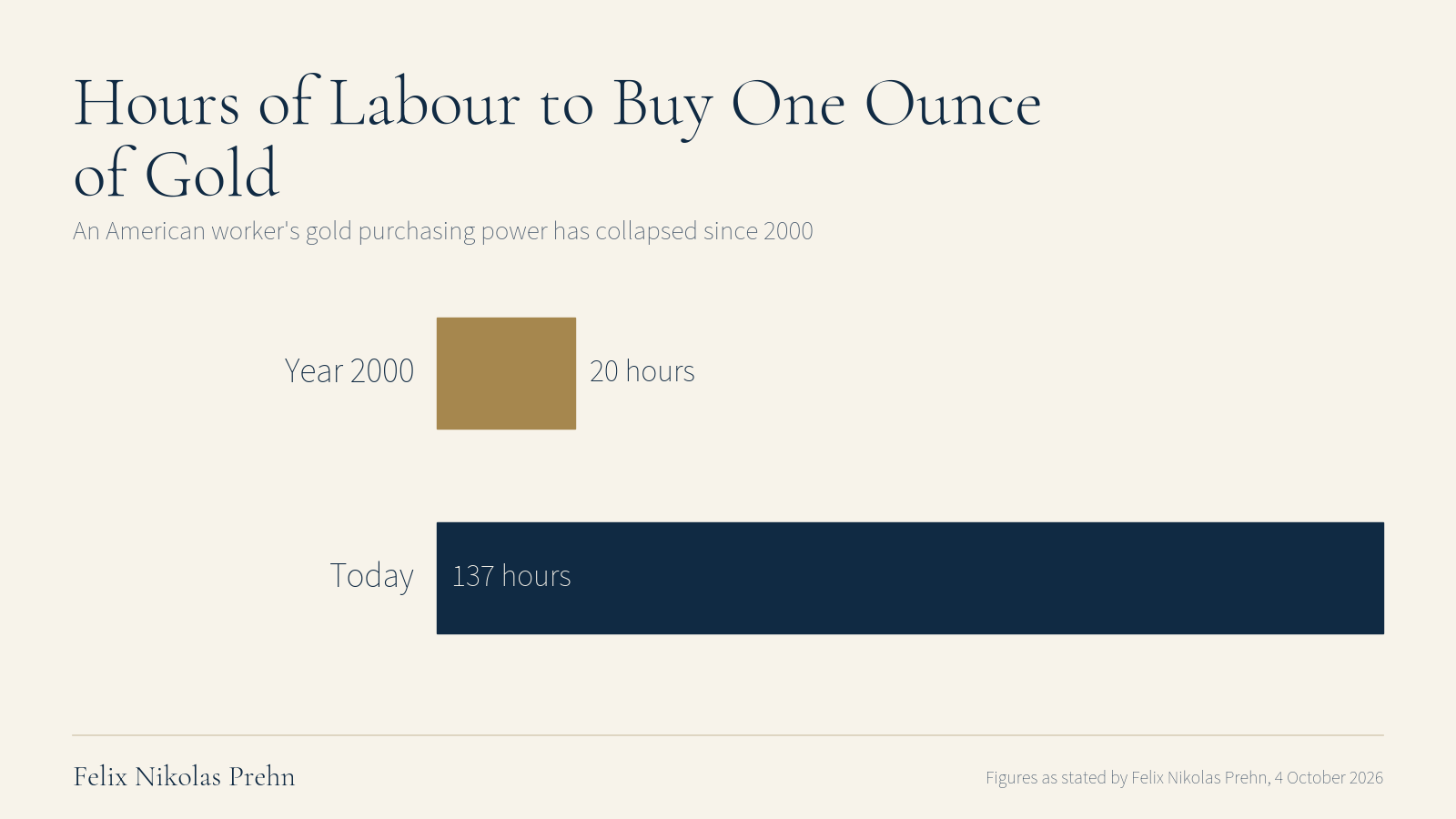
In 2000 an ounce of gold cost an American worker about 20 hours of labor. Today one ounce costs 137 hours of labor.
The dollar that hour earns has lost value. The gap between 20 and 137 labour hours is a direct measure of currency debasement over a generation.
House prices have moved in the same direction. A median family house now costs the best part of 6 and a half years of a typical person's entire income before tax. A generation ago that figure was a fraction of the current level.
Nominal pay has risen since 2000. The goods it must buy have risen far faster in labour terms.
A K-shaped economy describes the widening gap where the top 1 per cent own more of total net worth while the bottom 50 per cent own less.
When the currency is debased, asset prices rise in nominal terms. Property, shares and gold are priced in dollars, and the dollars are being made smaller. Workers and savers whose wealth consists of wages and cash fall behind. Inflation erodes the purchasing power of wages and cash savings year after year.
Workers without hard assets take on debt to maintain their economic position. Sustained inflation widens the K with every passing year, and financial repression is the mechanism that delivers it.
The Dollar's Fading Privilege
America can borrow so much so cheaply because the whole world has dollars, trusts them and settles trade in them. Financial repression spends that privilege. If a government deliberately pays less than inflation to those who hold its currency, the rational response is to move capital elsewhere.
The dollar share of world reserves has been drifting down for years as central banks add gold and trim dollar holdings. The decline has been gradual, a slow voluntary sacrifice of the privilege that lets America borrow cheaply. The architects of the policy appear willing to bear that cost because honest repayment is politically impossible.
The post-war precedent worked because governments held the rate gap steady for decades. A weaker dollar and higher inflation can shrink the debt burden, as post-war Britain showed. But if the policy appears erratic, if confidence breaks instead of fading, the result is capital flight and a larger debt, not a smaller one.
Financial repression requires no legislation. It operates through the gap between rates and inflation.
The president has said so on the record, to Time magazine and to the Washington Post. The Treasury Secretary has framed 40 trillion dollars as a number to be outgrown rather than repaid.
The BIS documented the mechanism. Post-war Britain and America tested it.
The same apparatus is being assembled again in plain sight. Wages, savings accounts and fixed-income instruments lose real value year after year for as long as the repression runs. At present, the gap between rates and inflation determines whether the transfer flows from saver to government or the reverse.