
Gold fell sharply in March. Several central banks, scrambling for US dollars after the Iran war began, liquidated gold reserves.
Gold hit almost 5600 dollars an ounce during its run in 2024 and 2025. China, India, Turkey and Poland all added to reserves.
Gold then fell over 1000 dollars, a 15 per cent drop in March alone.
An ongoing conflict involving Iran disrupted shipping through the Strait of Hormuz. Reports on the degree of disruption remain contradictory.
Oil prices surged, and gold, the asset bought as insurance against exactly such disorder, declined sharply. The explanation is mechanical, and Turkey is the clearest case.
Turkey's forced liquidation
Turkey had been one of the largest gold buyers of the last 10 years. Ankara bought specifically to reduce dependence on the US dollar.
Felix argues the Iran war forced a complete reversal of Turkey's gold policy.
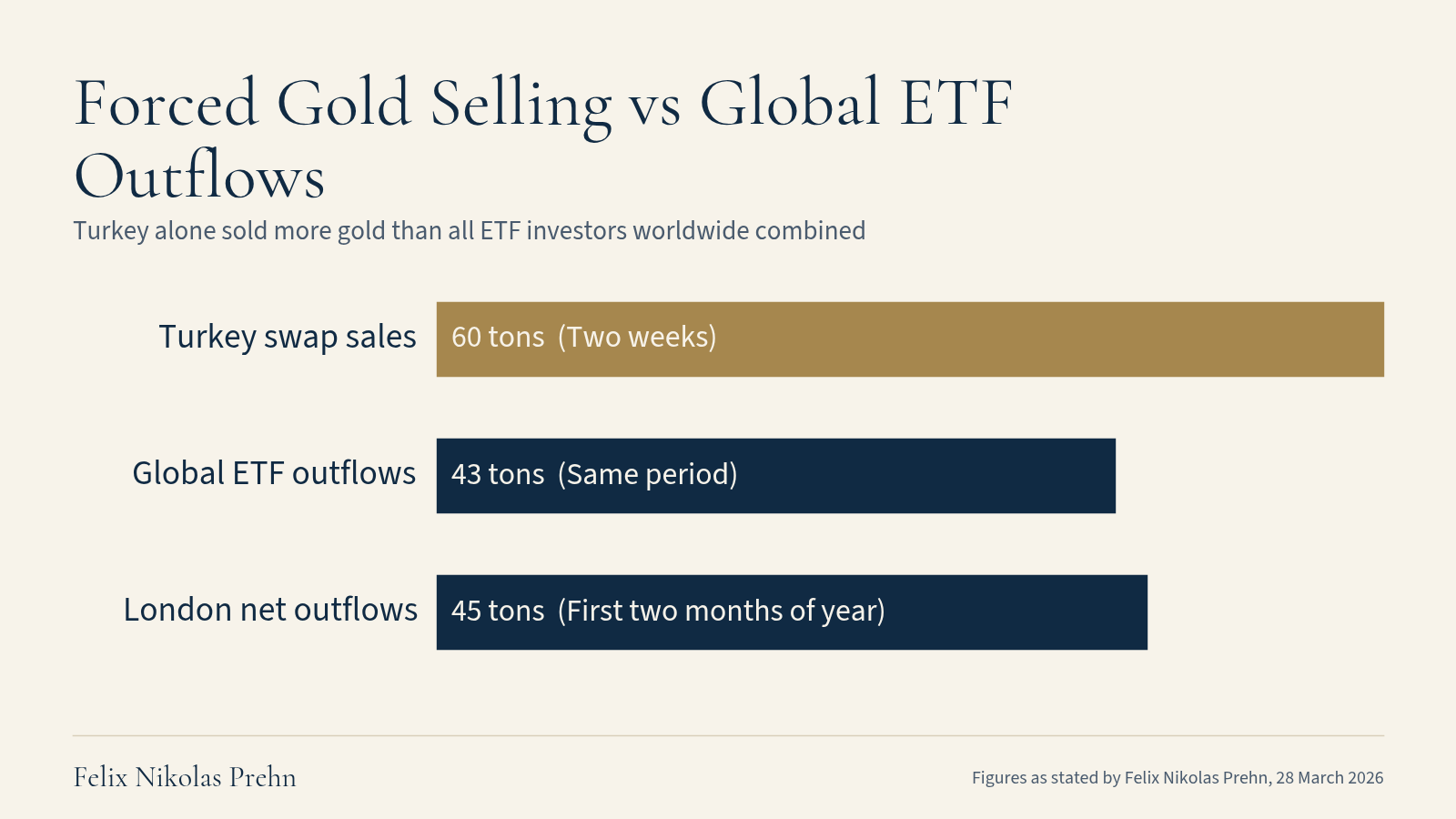
Turkey's central bank liquidated about 58 tons of gold in 2 weeks through a gold-for-foreign-exchange swap agreement. Gold is handed over for dollars, with a nominal right to repurchase later. The 60 tons represented about 10 per cent of Turkey's entire gold stockpile.
Turkey has about 30 billion dollars worth of gold at the Bank of England in London. The swap could be executed without physically moving bars. The mechanism is a form of collateralised lending for sovereign states.
The scale of that selling dwarfed every other source of supply. Global gold ETF (exchange-traded fund, a pooled investment vehicle) outflows totalled about 43 tons. Turkey alone created more selling pressure than every ETF investor on earth combined.
When that much metal hits the London bullion market, the price falls.
Turkey had spent a decade accumulating gold to escape dollar dependence. The war made Ankara desperately need the very currency it had been trying to avoid.
The energy import trap
Turkey imports 90 per cent of its oil and energy and 98 per cent of its gas. It produces almost no energy domestically.
When oil prices rose, the cost of energy imports surged. Every barrel must be paid for in dollars. A 10 dollar increase in oil prices costs Turkey an extra 4 to 5 billion dollars a year.
Countries in that position face 3 difficult options. They can let their currency crash.
They can burn through existing dollar reserves.
Or they can sell gold for dollars.
Turkey chose the third option.
India has become a net gold seller since January for the first time in many years. In Felix's view, the same oil shock compels energy importers to burn dollar reserves. Some are selling gold.
Gulf states and the dollar peg
Gulf states operate a different mechanism but arrive at the same forced sale. Saudi Arabia has pegged its currency at 3.75 to the US dollar. The UAE, Qatar, Bahrain and Oman maintain similar pegs.
The system works because oil is sold in dollars. Revenue flows in, the central bank accumulates dollars, and the peg is maintained.
In normal conditions, dollar inflows from oil exceed outflows for imports, wages and trade. The surplus keeps reserves high enough to defend the peg.
Felix argues the Iran war reduced the primary source of dollar inflows. With the Strait of Hormuz disrupted, oil export revenues fell, while dollar outflows accelerated.
About 80 per cent of Gulf states' food is imported by ship, and military spending rose.
Expatriates left. Investors pulled capital out, and companies moved money offshore.
All of those outflows require dollars.
When reserves drain below the level needed to defend the peg, the peg breaks. A broken peg would trigger a collapsing currency and runaway inflation.
No Gulf government can afford to break the peg. Dollar reserves can be spent to buy time.
Reports on whether oil flows through the Strait have normalised remain contradictory. The remaining choice is to convert gold into dollars and support the peg.
In Felix's view, Gulf states are selling gold collateral to meet dollar obligations. The mechanism resembles a margin call on a pledged asset. In each case, gold is the asset being sold, and the obligation is the currency peg.
Net London gold outflows reached 45 tons in the first 2 months of the year.
Felix reads the figure as evidence that Gulf sovereign wealth funds are selling. Gulf funds do not report gold holdings to the IMF.
They can sell through ETFs, futures contracts and London accounts without public disclosure.
Russia's gold export restriction
Russia occupies a different corner of the gold market. The G7 banned Russian gold imports in 2022.
The LBMA (London Bullion Market Association, the body setting the global gold trading standard) expelled Russia the same year. Excluded from the LBMA, Russia has been building an alternative payment system and a separate gold exchange.
Russia sold 30 billion dollars worth of gold last year on an ongoing basis. Felix argues Russia made it illegal to export gold bars larger than 100 grams, about 15000 dollars. The restriction takes effect in April 2026.
The restriction has two primary consequences.
Before the cutoff, Russian gold holders have an incentive to liquidate and move assets abroad. Anyone with a kilogram bar faces a deadline to export it. Pre-deadline selling adds supply to the international market and puts downward pressure on prices.
After the cutoff, Russian gold is removed from world circulation, reducing global supply. When China restricted exports of silver, the metal's price rose.
Russia's gold export restriction also serves a strategic purpose. Felix argues the ban removes demand from the US dollar. A parallel financial system, he adds, undermines paper money long term.
The buyers have stepped back
Gold prices are set at the margin, where the final buyer meets the nearest seller. Sellers have multiplied in Asia, Europe and the Middle East. On the other side of the trade, official buyers have withdrawn.
China, the largest state buyer, purchased 27 tons of gold in 2025 and then paused acquisitions in the fourth quarter. Felix argues the pause removed the dominant source of state demand. It came during the heaviest selling, leaving the market without its anchor buyer.
In Felix's view, Poland is discussing monetising about 550 tons of gold worth 13 billion dollars for defence spending. India has become a net gold seller since January.
Energy importers are liquidating gold to pay oil bills. Dollar-peg countries are selling to defend their currencies.
Russia sold 30 billion dollars worth of gold last year. China, India, Turkey and Poland sustained the bull market. Each of the four has either paused purchases, begun selling, or is considering monetising reserves.
The short-term pressure and the long-term case
A commodity strategist at TD Securities stated the Iran war's economic shock will likely dent demand for gold from central banks. Some banks will cut purchases. Others will be forced to sell reserves to meet dollar obligations.
A war raised the price of oil. Costlier energy raised the demand for dollars. Countries that had been accumulating gold were compelled to sell it.
The war also pushes up US bond yields (the interest rate paid on federal debt). Higher yields make gold less attractive short term.
US government debt pays around 5 per cent. Gold pays no interest. At 5 per cent, US government debt offers a yield that gold cannot match.
Felix argues the long-term picture is unchanged.
He expects Washington to cut rates and print more money. The deficit, in his view, will compel artificially low yields.
All of that would weaken the dollar over time. Russia's construction of a parallel financial system reduces global dollar demand.
Energy importers like Turkey and India are liquidating gold to cover surging oil bills. Gulf states, Felix argues, are converting reserves into dollars to stop their currency pegs from breaking. Russia sold 30 billion dollars of gold last year, and Poland is weighing the sale of 550 tons to finance defence.
Central banks caught between collapsing revenues and fixed dollar obligations are selling gold they would otherwise have kept.
Felix argues the liquidation has not stopped. New supply continues to reach the London market.
Until the war ends or oil flows normalise, downward pressure persists.
Felix argues the long-term case for gold rests on the same fiscal arithmetic that preceded the war. The US deficit has not shrunk. He expects Washington to print more money and suppress yields in due course.