
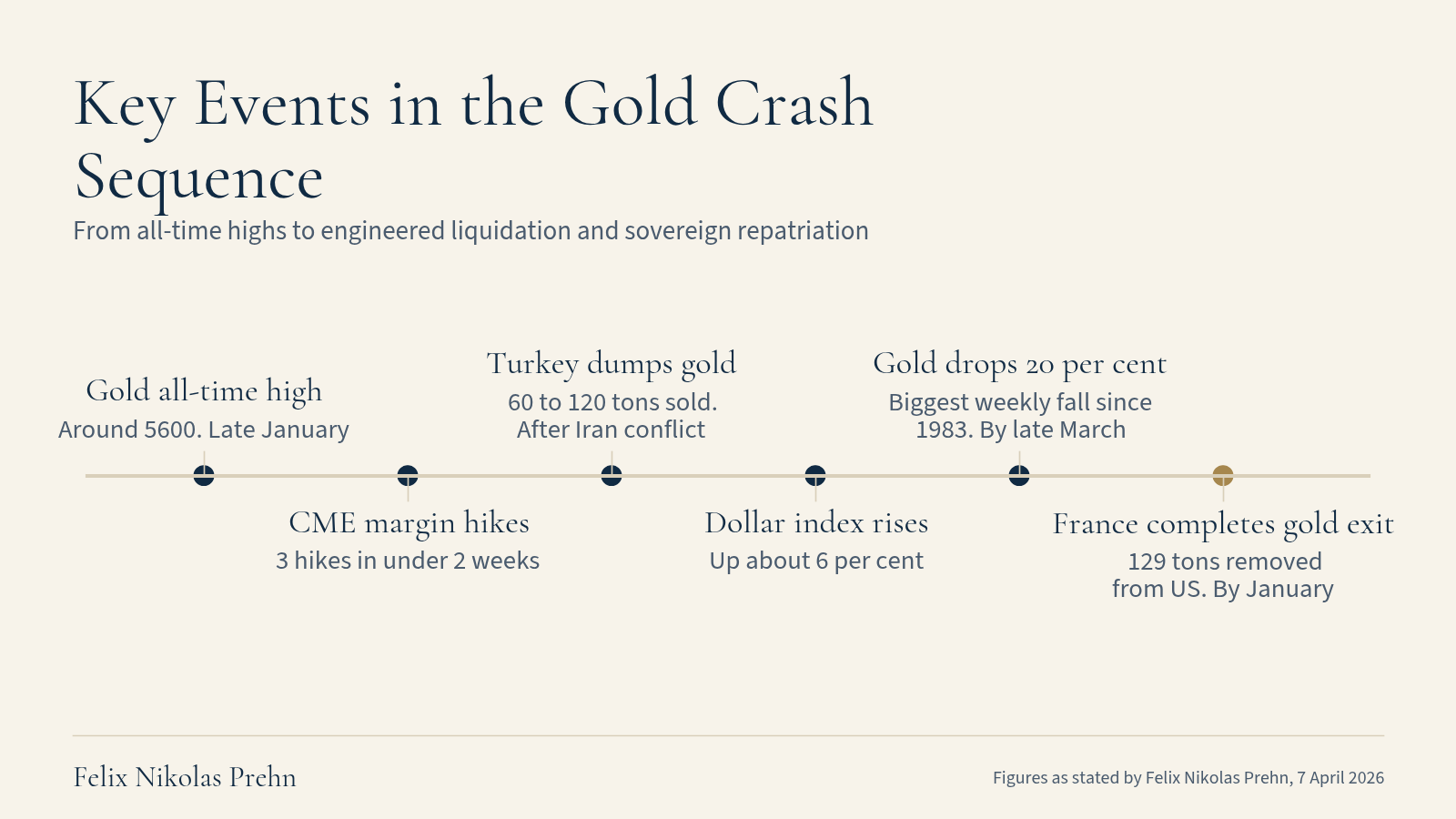
Gold hit an all-time high of around 5,600 dollars before falling roughly 20 per cent by late March. The weekly decline was the largest since 1983.
A war had broken out in the Middle East. Oil prices spiked past 110 dollars. Standard pricing logic says gold rises in that scenario.
Gold fell instead, despite every conventional signal pointing upward. The margin mechanics of the paper market explain the move.
The Margin Mechanics Behind the Collapse
CME Group, the company that runs the COMEX exchange where gold futures trade, changed how it calculates margin requirements. Margin is the cash deposit a trader must post to keep a position open.
CME switched from a fixed dollar margin to a percentage of contract value. The shift meant that as gold climbed, margin costs increased automatically, creating a built-in amplifier for a crash. CME then hiked margin requirements 3 times in less than 2 weeks.
Traders who were long gold could not meet the new margin calls, the demands for additional cash. Forced selling followed as those holding long positions liquidated to meet the new requirements.
Forced sales drove the price down further, with each drop triggering fresh margin calls which produced yet more liquidations.
The margin hikes did not hurt large banks. JP Morgan, Goldman Sachs and HSBC have balance sheets large enough that a margin hike is a rounding error.
Minor traders and mid-sized funds cannot post additional collateral on short notice. A sudden margin hike forces them to sell. The well-capitalised institutions then buy what the smaller players were forced to sell, at a discount.
The Dollar Feedback Loop
The dollar index, known as DXY, which measures the dollar's strength against other major currencies, rose about 6 per cent as the conflict started. A firmer dollar makes gold more expensive for anyone who does not earn dollars, and international demand drops as a consequence. The dollar's rise and gold's fall reinforced each other.
War drove up the oil price. Higher oil drove up inflation fears. Inflation fears kept Federal Reserve interest rates higher.
Higher rates meant more interest on American government debt. Foreign capital flowed into dollars to capture that yield, strengthening the dollar further and crushing gold.
Turkey's central bank dumped 60 tons of gold in just 2 weeks after the Iran conflict started. Some estimates put the figure as high as 120.
Felix argues the sale was the largest weekly drop in the country's gold reserves ever recorded. Energy import costs spiked after the conflict began, demand for dollars surged, and Turkey did not have enough.
Gold was the most liquid asset Turkey could sell. When a country sells 60 tons into the London gold market, that volume moves prices globally. Gulf states also began selling gold reserves to fund war-related spending and shore up their currencies.
Paper vs Physical: How COMEX Sets the Price
About 5 per cent of COMEX contracts result in physical gold changing hands. The remaining 95 per cent are paper bets on price direction.
The figure heard on the news is almost always the COMEX futures price, set by paper trading rather than by physical supply and demand.
The ratio of paper claims to physical gold on COMEX is 2.8. For every ounce of gold available, 2.8 ounces of paper claims exist. Registered inventory on the exchange, meaning metal ready for immediate delivery, has fallen about 25 per cent.
The futures price dropped. Withdrawals of physical metal from COMEX vaults picked up at the same time. Holders pulling real metal from COMEX vaults while the futures price drops are treating the bullion as worth more than the paper contract.
France's Gold Exit
France, the 4th largest gold holder on Earth with almost 2,500 tons, moved 129 of those out of the United States. The gold had been stored in New York since 1920.
France did not ship the metal home. The Banque de France sold it in New York and bought new gold on the European market, storing the replacement in Paris.
The official explanation from the Banque de France governor, François Villeroy de Galhau, was that the move was not politically motivated.
He said the metal in New York was old and non-standard. He said it was easier to buy new compliant bullion in Europe than to refine and ship the old bars.
Felix argues a more plausible reading is that France asked to get its gold back and the United States could not deliver it. The United States offered to wire the cash instead.
Paris accepted and bought new metal in Europe. France now stores its reserves in Paris.
Germany's Gold in New York
Germany stores about 1,236 tons of gold. About a third of that total remains at the Federal Reserve in New York.
A former Bundesbank economist went on the record saying that storing gold in the United States is risky given the current geopolitical situation. Germany's position mirrors the one France resolved by moving its reserves.
General de Gaulle demanded bullion for France's dollar reserves, as the convertibility rules then required. The outflow was so severe it led to the Nixon shock, the moment America left the gold standard.
France was the 4th largest gold holder then and remains so now. Germany stores about 1,236 tonnes and France almost 2,500.
The Eastern Accumulation: China and Central Banks
UBS sent a precious metals analyst team led by Joan Tees to China. The team reported that the majority, if not all, of their conversations signalled an upside bias to gold price expectations over the medium to longer term.
Chinese gold ETF inflows have been far more resilient than North American outflows suggest. In March, ETFs listed in the United States and Canada saw net redemptions while funds in mainland China held steady or grew.
China's financial regulators authorised 10 major insurance companies, including PICC and China Life, to invest up to 1 per cent of their assets in gold. The 1 per cent cap amounts to about 200 billion renminbi, equivalent to roughly 27 bn in dollar terms.
Central banks globally purchased 1,050 tons of gold last year. Buyers included Poland, Kazakhstan and Brazil.
Central banks do not want all their reserves in the United States. Felix argues they are diversifying because America weaponised the banking infrastructure and the global reserve currency against Russia.
The sanctions may have been justified on foreign policy grounds. The consequence for dollar-denominated reserve holdings is a separate matter, and central banks are acting on it.
What the Data Shows Next
In the past 3 years, when the smart money meter showed extreme heavy selling levels, the metal rose 19 per cent on average in the next 90 days. If the Iran conflict worsens and American interest rates keep climbing, a rising dollar will weigh on gold prices in the opposite direction.
Persistent inflation that keeps rates higher for longer would push institutions to sell gold and buy US Treasuries, the government bonds that carry a risk-free label.
A prolonged conflict could force Turkey and other Gulf states to sell even more gold. Additional gold sales would compound the margin-driven liquidation pressure from the initial crash.
The daily price, set largely by COMEX futures, remains subject to the paper market's margin mechanics and the short-term strength of the dollar.
Central banks purchased 1,050 tons last year, and China's newly authorised insurance programme alone could channel 27 billion dollars into the metal.
Paper markets remain exposed to margin-driven liquidation. Sovereign and institutional buyers keep accumulating physical metal. A rising dollar combined with further margin hikes would push the futures price lower. Central banks bought 1,050 tons last year. If that pace holds, physical demand will work against the paper market's downward pressure.