The event that started the gold bull market
In February 2022 the United States froze Russia's foreign reserves. The act turned the dollar from a neutral settlement currency into a coercive instrument. Every central bank with dollar reserves drew the same conclusion: Washington could do the same to them.
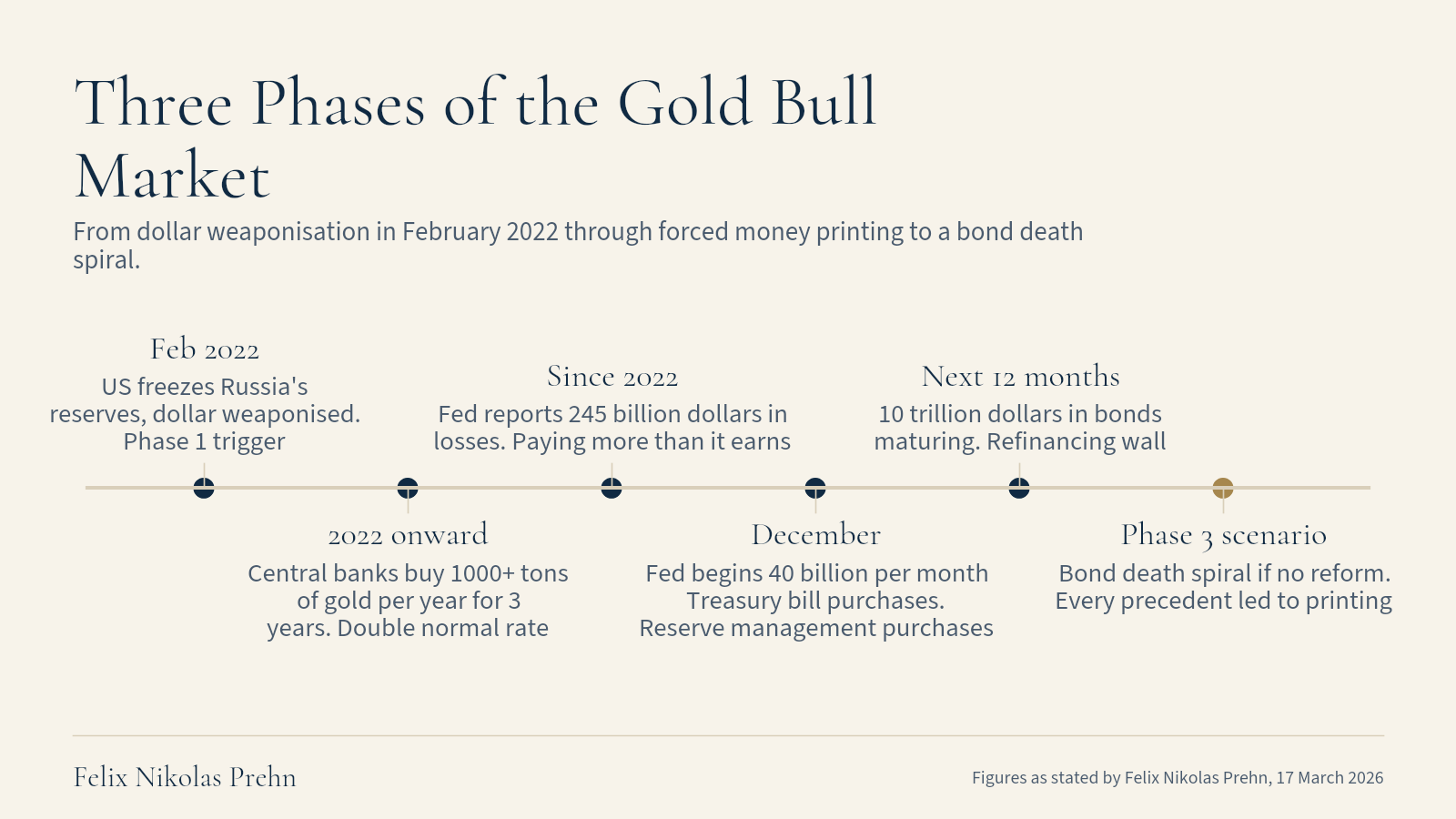
Central banks responded by buying gold at a pace not seen in decades. Over the following 3 years they bought more than 1000 tons of gold per year, roughly double the normal rate. China has been importing record volumes.
Two weeks after the sanctions, the Federal Reserve began raising interest rates. Gold dipped about 20 per cent in the months that followed.
Standard pricing models predicted it would stay down. Higher rates increase the opportunity cost of owning a non-yielding asset. Gold yielded nothing while cash parked at the Federal Reserve earned well over 4 per cent.
Gold climbed back and kept climbing. A metal that pays no interest rising through an aggressive rate cycle was an anomaly. The signal pointed to a class of buyer larger than any hedge fund: sovereign central banks, accumulating regardless of yield.
Gold is in the first of three phases of a bull market driven by central banks abandoning the dollar. The second phase will be triggered when the Federal Reserve is forced to print money. The third will arrive when government bond markets enter a self-reinforcing debt spiral.
Phase one: calm institutional repositioning
Phase 1 has so far proceeded without a financial crisis. Central banks are repositioning before a potential crisis, buying slowly, over years, to avoid moving the price against themselves. The 1000-ton annual pace, sustained for 3 consecutive years, fits the profile of large institutions building positions ahead of a shift they expect but cannot publicly announce.
Discussions around frozen Russian assets remain unresolved, with Europe and the United States disagreeing on how to treat them. The Kremlin has called the use of profits from those assets 'theft'.
The Fed's impossible maths
Felix argues the Federal Reserve has reported about 245 billion dollars in losses since 2022.
The Fed pays interest on bank reserves. Banks park cash at the Fed and receive well over 4 per cent.
The government debt the Fed purchased during the pandemic pays much less than 4 per cent. The Fed pays out more than it earns.
When the Fed describes the resulting shortfall as a "deferred asset," it means the losses are real but the accounting rules allow the institution to continue operating. The institution's income has turned negative. Remittances to the Treasury have stopped.
In December, as Felix puts it, the Fed announced it would purchase 40 billion dollars in Treasury bills per month, labelling them reserve management purchases.
The label "reserve management" describes purchases that, in practice, create dollars to buy bonds the market will not absorb at current prices.
The next Fed chair's contradictory mandate
Kevin Warsh has been sworn in as Fed chair. He has stated that price stability is his priority.
Felix argues Warsh wants two things: lower interest rates and a smaller Fed balance sheet. Lower rates help borrowers and reduce the government's financing cost.
A smaller balance sheet means less central bank intervention in bond markets. In isolation, each goal sounds responsible.
In Felix's view, the two goals are contradictory. He argues that about 10 trillion dollars in bonds are maturing over the coming 12 months and need to be refinanced. A smaller balance sheet means the Fed stops buying government debt.
Without the Fed as a buyer, placing 10 trillion dollars of new bonds would push yields higher. Felix argues the two goals are incompatible given the volume of maturing debt ahead.
Felix argues that every Fed chair begins with principles and abandons them when a crisis arrives. Jerome Powell, while still a Fed governor, warned that markets would always demand more stimulus and that it would never be enough. Felix contends the same pattern will repeat with Warsh.
Warsh will print money against his stated wishes, since no Fed chair in history has chosen to let the financial system collapse.
The bond death spiral and the trillion-dollar interest bill
The United States government's interest bill is set to exceed 1 trillion dollars this year. The full sum services debt already issued.
Inflation pushes interest rates up. Higher rates swell the government's interest payments, widening the deficit. The Treasury must issue more bonds, and the added supply pushes rates higher still.
Argentina, Brazil, Turkey, Mexico, Russia and the United States in the 1970s all faced this position. Each time the central bank bought the unwanted debt.
In each case the currency fell and gold rose. Felix argues there is no exception to this pattern in the historical record.
As more of the existing debt stock rolls over at higher rates, the interest bill compounds.
The Federal Reserve can let the bond market clear at rates the government cannot afford. Or it can buy the bonds itself and accept inflation.
Felix argues the second option is chosen every time.
Private equity as the crisis catalyst
Felix argues that private equity firms are sitting on just under 4 trillion dollars in unsold inventory, with buyers unavailable at the valuations the funds require. Zombie funds, those older than 10 years that still cannot sell their portfolio companies, have reached 440 billion dollars in assets, in Felix's estimation. A forced liquidation would transmit stress to the banking system, and Felix identifies this as the most likely source of the crisis that forces the Fed's hand.
In his view, phase two begins when bond investors recognise the Fed must absorb the entire government debt supply.
Japan's central bank has already taken that step. Once the market concludes the central bank has no exit, gold reprices sharply higher.
Oil shocks, miner margins, and the capital that hasn't arrived
Every major oil shock in the past 50 years has been followed by a surge in gold. The 1973 OPEC embargo preceded an 89 per cent rise in gold within 12 months. After the 1979 Iranian revolution, gold gained 276 per cent in 1 year.
Oil shocks have historically led to gold increases of between 15 and 100 per cent within 3 to 12 months. Iran has raised threats to tankers in the Strait of Hormuz, and passage costs have climbed.
Felix argues oil could compress the timeline for gold's move. He notes that all oil from the Gulf of America passes through the Caribbean and suggests that region may become the next pressure point.
Gold mining companies display a mathematical property that amplifies gold's move. A miner with production costs of 1900 dollars per ounce earns 100 dollars of profit when gold trades at 2000 dollars.
At 3000 dollars, the same miner earns 1100 dollars per ounce. A 50 per cent rise in the gold price produces an 11-fold expansion in profit per ounce.
Current miner valuations do not reflect that relationship between gold prices and operating margins.
Shares outstanding in the gold miners ETF have declined by 20 per cent. The junior miner ETF has seen nearly 22 per cent of its shares redeemed.
GDXJ shares outstanding are down about a third. A falling share count indicates net capital outflows.
Miner valuations have not adjusted to the shift in central bank reserve behaviour since February 2022. Miners are posting record profits, yet capital continues to leave. Shares outstanding in the main gold miners ETF have declined by 20 per cent. The potential for an 11-fold margin expansion at a gold price of 3000 dollars per ounce has not been reflected in share prices.