
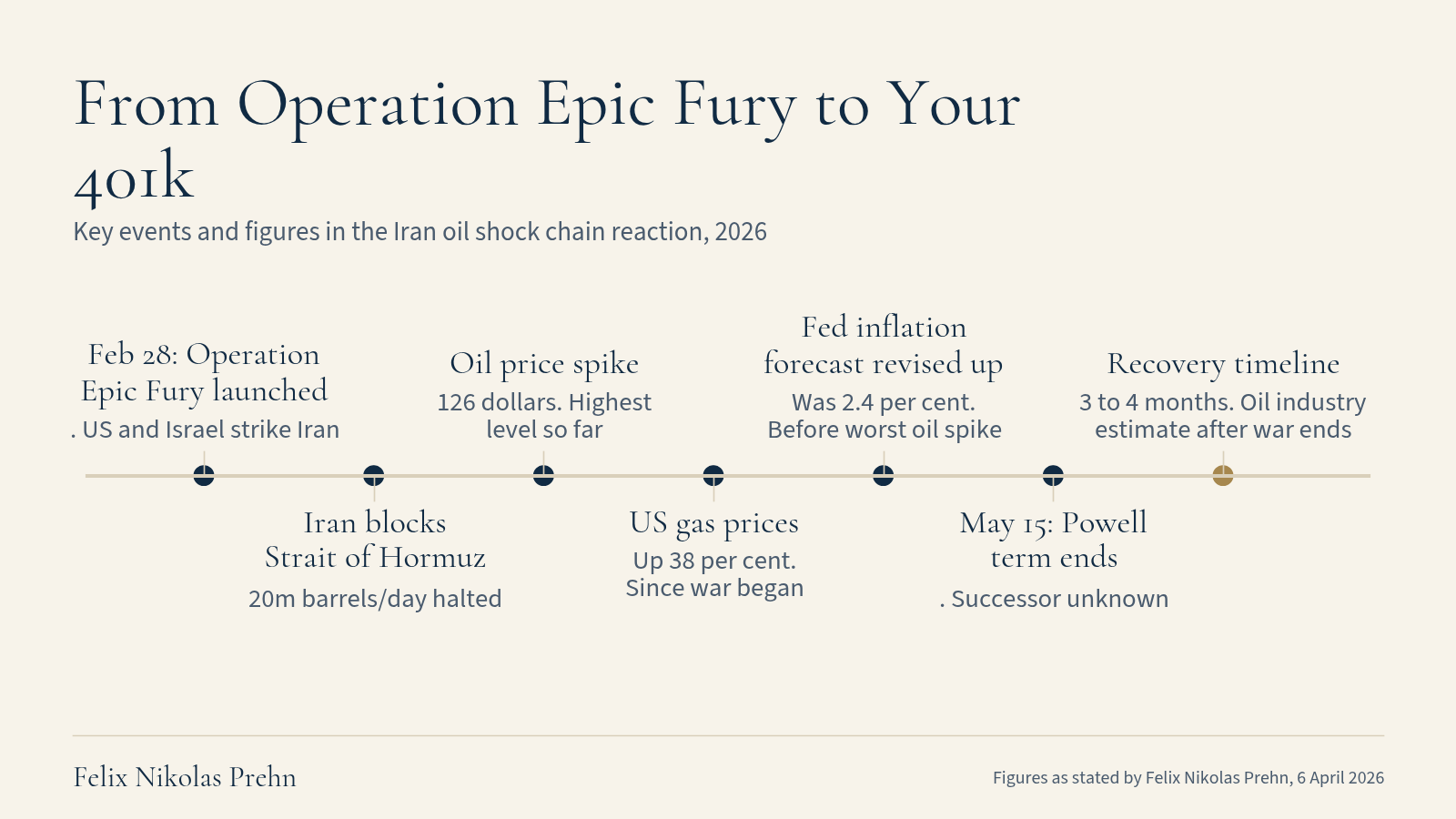
On 28 February the United States and Israel launched Operation Epic Fury against Iran. Iran responded by blocking the Strait of Hormuz. The consequences run far beyond the price of crude.
The initial oil shock creates inflation. A rate cut from the Federal Reserve would worsen inflation. A rate rise would increase the cost of government borrowing.
Governments take on fresh debt to subsidise the harm, and the new issuance compounds the cost. Retirement savings lose value on two fronts: bonds decline as rates rise, and stocks drop when capital is diverted to government debt.
Operation Epic Fury and the Strait of Hormuz
About 20 million barrels of oil pass through the Strait of Hormuz on a good day. One in 5 seaborne cargoes of crude passes through it. Iran's blockade removed that flow from global supply.
The strait is a narrow strip of water between Iran and the Arabian Peninsula. No alternative route can absorb 20 million barrels a day at short notice. When Iran closed the passage, the supply shock was immediate.
Iran has considered a ceasefire, and some progress toward reopening the strait has been reported. Yet the oil industry says it will take 3 to 4 months to return to normal or near-normal production once the war ends. A ceasefire would not restore supply overnight.
The Oil Price Shock
In Felix's view, oil prices reached a high of 126 dollars during the crisis. Petrol prices in the United States are up about 38 per cent since the war began.
Oil powers the lorries that deliver goods. When oil goes up, delivery costs go up, and the price of everything that arrives by road rises with it. Oil generates power in many parts of the world, so electricity bills climb too.
Inflation Beyond the Gas Pump
The region around the Strait of Hormuz produces 30 per cent of all fertiliser. Fertiliser is made from oil. A blockade of the strait cuts off fertiliser shipments alongside crude, and food prices rise as a result.
The conflict has created a fertiliser squeeze, threatening future harvests. The Federal Reserve's preferred inflation measure had forecast 2.4 per cent for this year before the war revised it upward. The war and the oil spike broke the disinflationary trend.
The 29 Trillion Dollar Debt Wall
Felix argues that governments around the world need to borrow 29 trillion dollars in 2026 alone, double what was borrowed just 10 years ago. The United States government owes more than 38 thousand billion dollars.
Much of it was originally issued at interest rates of around 1 to 2 per cent. A rollover (old debt replaced at today's rate) reprices that cheap borrowing at roughly 5 per cent. The interest cost is 5 times higher.
The Federal Reserve is therefore constrained. A rate cut would make inflation worse.
A rate rise makes government borrowing costlier, pushes up mortgage rates, slows hiring and drags the economy toward recession.
The Squeeze on Retirement Portfolios
When interest rates go up, bond prices go down. Target date funds keep 30 to 40 per cent of their money in bonds, and the bond portion is losing value as rates remain high.
Stocks are affected through a separate mechanism. Government borrowing sucks up capital, so less money is available for companies to borrow.
Reduced access to capital slows business growth and hurts profits.
Higher interest rates also push up mortgage costs. Mortgage costs discourage home purchases.
Consumer spending contracts as a result. Company revenue falls when buyers pull back.
Contributions to 401(k) plans in the United States dropped from 9.2 per cent to about 8.9 per cent. Workers need the money now, to pay for petrol, food and electricity. Meanwhile 20 per cent of employees took a loan from their own 401(k) last year, the highest number ever recorded.
The Flawed Government Fix and Who Benefits
Governments respond to the crisis by borrowing money at roughly 5 per cent interest and using it to pay subsidies that lower energy costs. Subsidy payments go to oil companies, and the resulting profits flow to shareholders. The top 10 per cent of people own 93 per cent of all stock, according to a Federal Reserve figure.
The borrowing itself creates a self-reinforcing loop. Governments must sell more debt, and to convince buyers they must offer higher interest rates.
Higher interest rates depress the economy, prompting treasuries to stimulate with more subsidies financed by fresh debt. Each round of issuance enlarges the debt.
Larger obligations force the government to offer higher yields, and the next batch of financing costs more still.
After COVID, stimulus cheques, business loans and wage subsidies caused government debt to explode. Inflation hit levels not seen in 40 years.
Higher refinancing costs and the need for subsidy feed each other in a loop that does not break when the strait reopens. Bonds lose value as rates rise. Stocks fall when government borrowing diverts capital from companies.
Subsidy profits flow to the top 10 per cent, who own 93 per cent of all stock. The oil industry says full production is 3 to 4 months away even after a ceasefire.
Oil prices remain high for every month the strait stays closed. Inflation stays above forecast as a result.
Fed Chair Jerome Powell's term ends on 15 May. His successor will take office while, in Felix's view, governments worldwide need to borrow 29 trillion dollars in 2026.
The Federal Reserve's preferred inflation measure had forecast 2.4 per cent for this year before the war pushed it higher. Inflation will exceed the 2.4 per cent figure for as long as the strait stays shut. The oil industry says full recovery will take 3 to 4 months after any ceasefire. The disruption to fertiliser and oil supply will continue to push food and energy costs higher during those months. The debt issued to finance subsidies in the interim will compound at roughly 5 per cent, and no reopening of the strait retires those obligations.