
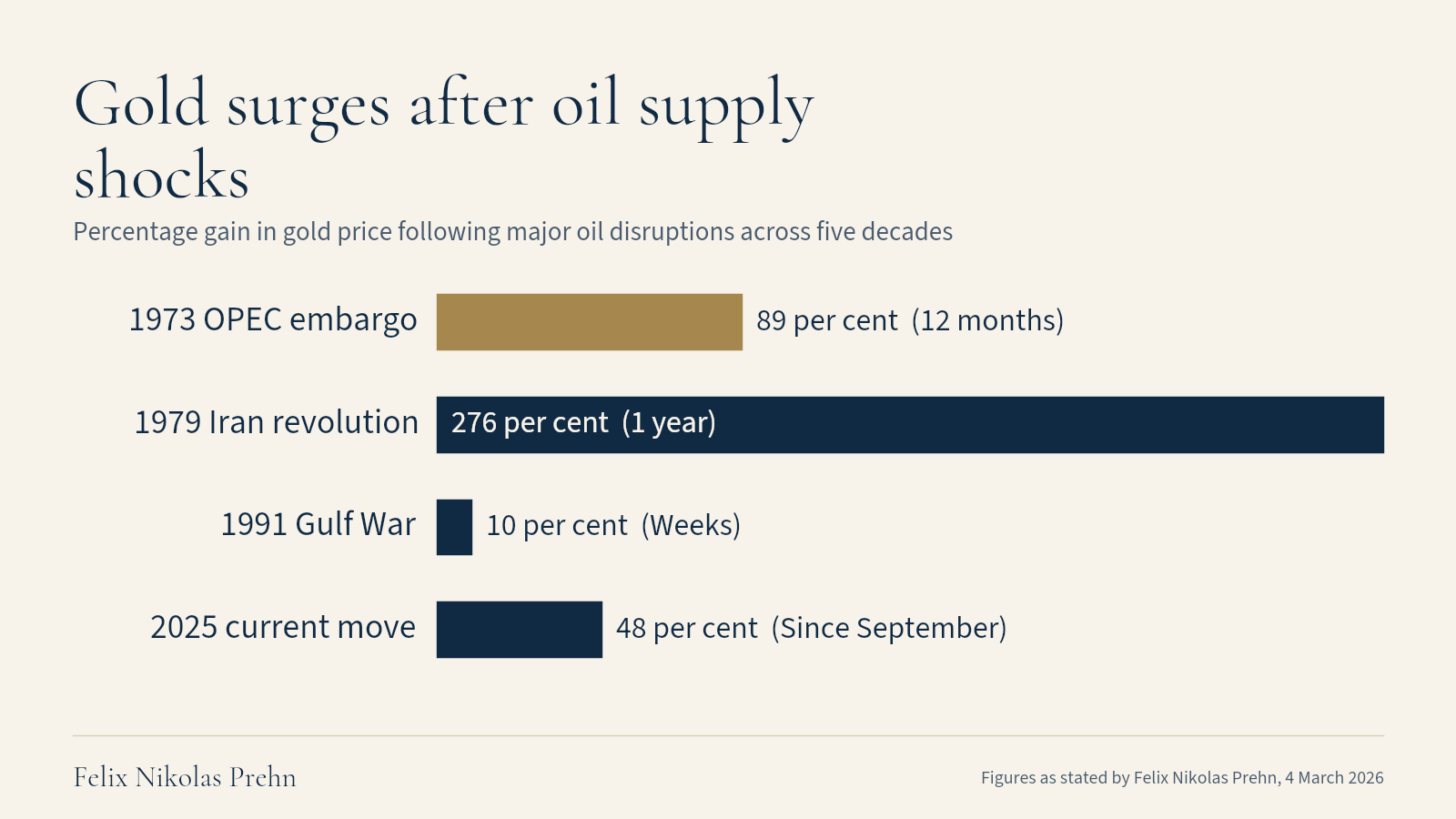
The price of gold has risen 48 per cent since its breakout around September 2025. Gold miners have risen 140 per cent over the same stretch. The same mechanism has driven gold higher after every oil supply disruption for half a century.
Oil as the decisive factor in modern warfare
Fuel supply has decided the outcome of modern wars. The Second World War offers 3 clear cases.
Rommel's Afrika Korps reached El Alamein and stalled because he ran out of fuel.
Allied bombers then destroyed Germany's fuel plants in a systematic campaign. German aviation fuel production fell from 180,000 tons a month to 11,000 by 1945. Germany was still producing aircraft but had no fuel to fly them.
Japan attacked Pearl Harbor because the United States had cut off Japanese oil imports. Tokyo then invaded Southeast Asia for fuel, targeting Indonesia in particular. Once those supply lines were severed, the empire collapsed.
After 1945, oil disruptions began to move the price of gold in commodity markets.
The 1973 embargo and gold's first modern surge
In 1973, OPEC weaponised oil against the West. The cartel cut oil supplies by 5 per cent per month. American oil prices rose from 3 dollars to 5 dollars.
Gold responded to the supply cut. It went from 97 dollars to 183 dollars in 12 months, a rise of 89 per cent.
The 1973 embargo was the first modern case of an oil cut producing a gold surge. Later oil shocks produced gold surges of varying magnitude.
The 1979 Iran parallel
The 1979 Iran revolution produced a more severe oil supply shock and a far greater gold move. Felix Nikolas Prehn calculates that gold went from 226 dollars to 850 dollars in one year, a rise of 276 per cent. Silver outperformed gold 3 to 1 during the same period.
The magnitude of any future move, however, is likely to be smaller. The United States is the largest oil exporter in the world. Its production can offset oil shocks in a way that was impossible in 1979.
Gulf War, Ukraine, and the recurring pattern
The 1991 Gulf War produced a 140 per cent spike in oil. Gold jumped 10 per cent in weeks.
Energy stocks rose 34 per cent over the following 18 months as a result of the supply disruptions.
The Ukraine war pushed gold through 2,000 dollars in 2022.
Every oil supply shock has produced a gold surge. The range is 15 to 90 per cent within 3 to 12 months.
The current disruption: Hormuz, COMEX, and central banks
20 per cent of global oil flows through the Strait of Hormuz. Any disruption to that traffic would affect a fifth of global crude supply.
In Felix Nikolas Prehn's view, Lloyd's of London cancelled war coverage for oil tankers in the region. The American government then stepped in to insure shipping lines.
The COMEX silver stress index is at high. The index measures metal reserves at the exchange relative to paper claims.
Demand for deliverable metal is outstripping paper supply. Felix Nikolas Prehn argues that COMEX is losing control, more so on silver than on gold.
Silver has a supply deficit. Industrial demand drives the gap, including military uses in missiles, aircraft and naval vessels.
Central banks are buying record amounts of gold. The World Gold Council confirms that purchases have remained near record highs.
Cuba as the next flashpoint
Cuba is 90 miles from Florida and lies on a Caribbean shipping lane. Every tanker entering the Gulf of Mexico passes near Cuban waters.
Cuba gets most of its oil from Venezuela. The deal exchanges cheap crude for Cuban doctors and general support. Washington restricted those oil exports, cutting off Cuba's main supply.
Cuba faces a fuel crisis and rolling blackouts, and the Cuban economy is collapsing under the strain. Cuba's electrical grid is reportedly failing, and American officials have seized fuel shipments linked to sanctions evasion.
Felix Nikolas Prehn argues that Cuba's proximity to American waters matters. Its position on a major shipping lane makes it a candidate for the next oil supply disruption.
Conclusion
Since 1973, every oil supply shock has been followed by a gold surge of 15 to 90 per cent within 3 to 12 months. Gold rose 89 per cent after the 1973 embargo. The 1979 Iran revolution produced a 276 per cent surge.
Flashpoints at the Strait of Hormuz and Cuba threaten oil supply. COMEX reserves are strained. Central banks are buying record amounts of gold.
American oil production can offset part of any shock. A repeat of the 276 per cent move of 1979 is unlikely. Gold is up 48 per cent since its breakout around September 2025. Prior oil shocks produced gold surges of 15 to 90 per cent, a band that extends above the current gain.