
The Riyadh Strike
A missile fired from Yemen struck Terminal 3 at King Khalid International Airport in Riyadh, killing 12 people and injuring 309. The New York Times called it the deadliest attack on a Gulf Arab state since the Yemen war began in February. An American citizen was among the dead.
Oil jumped more than 5 per cent on the day of the attack. Brent crude, the world benchmark, is at just over 100 dollars.
Higher oil prices reach the pump first. They raise the weekly shop next, then heating bills, then the value of financial assets priced in dollars. The last comparable rehearsal for an inflation and oil shock was 2022.
Interest rates fell for 40 years straight before the current era. A 40-year fall in rates made a buy-and-keep approach to investing look reliable.
Low oil supported that record. When crude surged in 2022 the strategy ceased to work for a spell.
Saudi Arabia Looks Beyond Washington
Saudi Arabia signed a defence pact with Turkey and Pakistan after the attack. Riyadh called Paris and Islamabad. Washington was not among the capitals Riyadh called.
The 1974 Petrodollar Bargain
The 1974 petrodollar deal required Saudi Arabia to price its oil in dollars and reinvest the proceeds into American assets. In return, America provided security. Oil and protection were bound together in a single arrangement.
Felix argues this agreement is why the dollar is used in roughly 90 per cent of all oil transactions. Any nation that needs oil, and almost all do, must first buy dollars before it can buy a single barrel.
The petrodollar system creates constant demand for dollars. Petrodollar demand supports the currency, the stock and bond markets, and America's ability to run large deficits.
If fewer countries need dollars to buy oil, the greenback loses a pillar. Assets priced in dollars and Washington's deficit capacity lose support in turn.
The deal was oil in exchange for security. If military cover now comes from Pakistan, Turkey, France and Britain, the incentive to keep Saudi money in America weakens.
The Financial Weight Behind the Peg
The Saudi riyal has been pegged to the dollar at the same fixed rate since 1986. For 40 years it has not moved a cent.
To keep the peg from breaking, the Saudi central bank must shadow the Federal Reserve's rate decisions. It has done so for four decades.
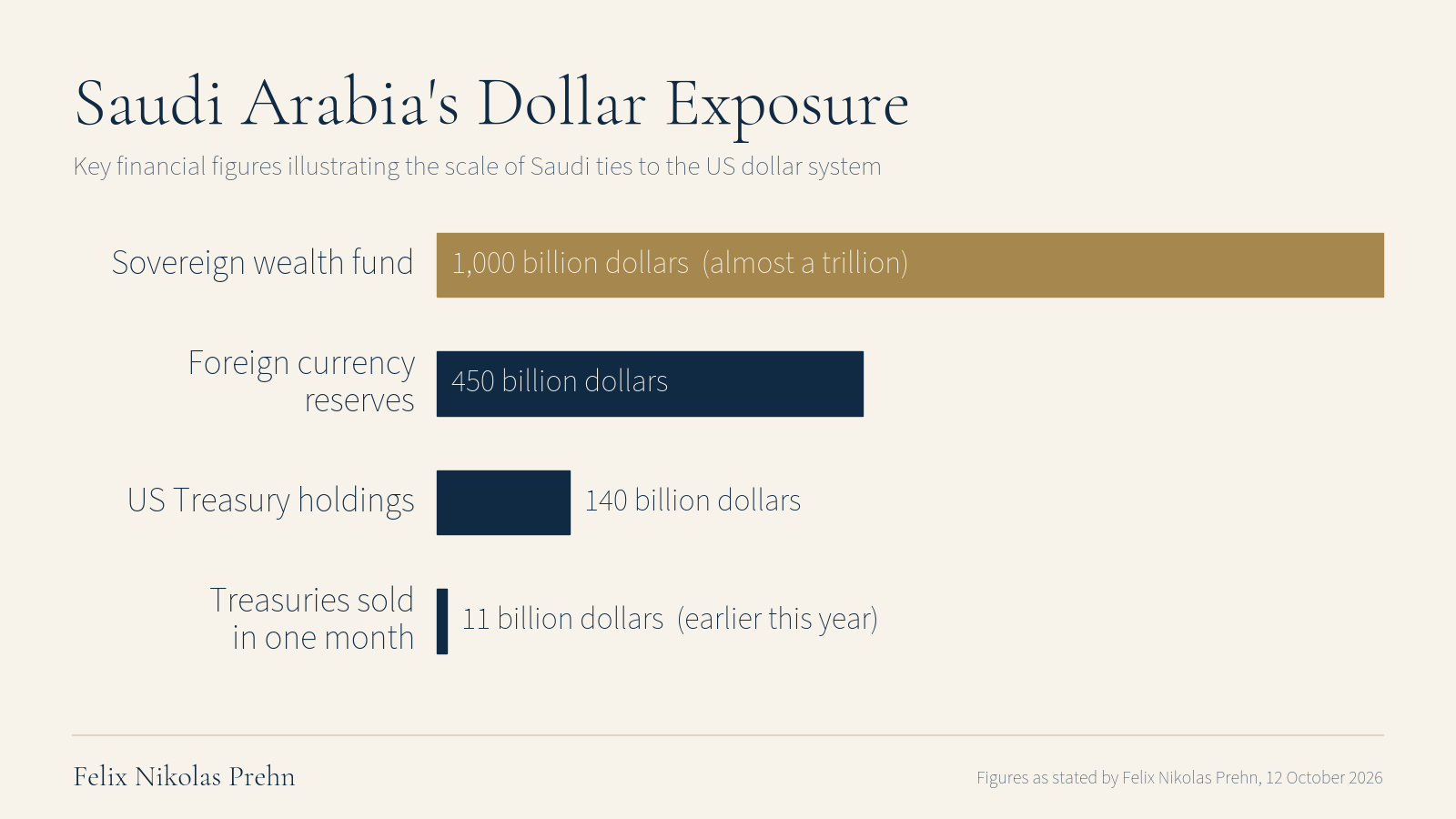
Saudi Arabia has about 450 billion dollars in foreign currency holdings and a sovereign wealth fund of almost a trillion dollars. For nearly 50 years, those reserves have been denominated largely in American assets.
A portion of those reserves is held in US Treasury bonds, debt instruments issued by Washington. Saudi Arabia has about 140 billion dollars of such securities.
In Felix's view, Saudi Arabia sold about 11 billion dollars of US Treasuries in a single month earlier this year. He attributes the sale to a need for funds from lower oil revenue and to diplomatic friction with the United States.
Oil Chokepoints and Shipping Costs
A quarter of the world's oil passes through the Strait of Hormuz. The waterway lies between the Arabian Peninsula and Iran.
The Strait has a backup route: the Red Sea. Houthi forces have been gaining ground along the Yemeni coast and have captured positions that let them threaten that backup route too.
Felix argues that when the main route and the diversion are under threat together, oil stops being priced on supply and demand. Oil begins to carry a fear premium that has little to do with barrels produced or consumed.
The cost of hiring a tanker to move oil out of the Gulf has risen to the highest level ever recorded. The figure is described as around a million dollars a day. Tanker captains are being paid 100,000 dollars a month in danger money.
The Side Door: Mbridge and Alternative Currencies
For 50 years, buying oil required dollars. Several central banks have built an alternative payment channel. Mbridge lets central banks pay each other directly in their own currencies.
The system bypasses the dollar entirely. 55 billion dollars have already gone through it.
Saudi Arabia took part in an Mbridge pilot. When the pilot was wrapped up, the Saudis stepped back out. Felix argues they presumably did not want to anger the United States.
Reports from September 2026 confirm the Saudi Central Bank withdrew from the project. The Mbridge infrastructure is built and has been tested by participants including Saudi Arabia.
Gold as the Signal
Gold had its worst quarter since 2013, falling more than 20 per cent from its high earlier this year. Central banks continued buying gold through the worst stretch for the metal in 13 years. Felix argues this accumulation of gold corresponds with central banks trimming their lending to the United States.
A price of 4,000 dollars and above is described as the level at which the bullion trend remains intact. Saudi Arabia has about 450 billion dollars in reserves and a sovereign wealth fund of almost a trillion dollars. Officially, its gold holdings have not climbed.
Felix argues that if Riyadh wants to avoid putting large fresh amounts of money into dollars, gold is the likely destination.
The 1974 deal was denominated in paper dollars, and gold sat outside it. Gold is a store of value that carries no counterparty risk from Washington.
Felix argues that when Saudi Arabia's gold reserves start to officially climb, a signal follows. The richest oil nation on earth would be saying its trust in the paper dollar has diminished.
Riyadh signed its post-attack defence pact with Turkey and Pakistan, not with Washington. The petrodollar bargain rests on a security guarantee. If America's pledge continues to erode, Saudi financial loyalty to the dollar is likely to soften in step. As that arrangement loosens, the global demand that supports the dollar, the country's asset markets and Washington's deficit capacity shrinks with it.