
Productivity and consumer confidence are falling together for the first time since 2008. Output per hour is declining despite 1.5 trillion dollars of AI spending. In response, central banks are buying gold at a record pace.
The Bank of America Signal
Bank of America's chief strategist Michael Hart published a chart tracking productivity and consumer sentiment. The two have moved together since 1978. When factories grow more efficient and technology makes goods cheaper, output per hour rises, and consumer sentiment has tracked the same path for nearly 50 years.
Productivity and consumer confidence have now fallen sharply at the same time. Hart's chart marks the first such simultaneous drop since 2008.
1.5 trillion dollars has been spent on AI, the largest technology investment boom in history. Bank of America states there is scant evidence yet of an economy-wide productivity gain.
Central Banks Are Hoarding Gold
Felix argues the productivity collapse is the reason central banks are hoarding gold. They know the AI miracle has not delivered yet. The gains may still arrive, but Bank of America's data says they have not done so yet.
Gold had dropped roughly 20 per cent from its highs. Central banks then bought a record amount in a single quarter, spending 40 billion dollars.
The buying appears to be opportunistic, as central banks wanted more gold and the price had fallen. The true figure may be higher, as not all countries disclose their purchases.
Conventional logic says rising interest rates should push institutions out of gold and into bonds. A 5 per cent government bond pays a return. Gold costs money to store.
Felix argues that logic has broken down. Institutions expect very high inflation.
The driver, in his view, is money printing and the government buying its own debt.
A survey of 76 central bank reserve managers found 89 per cent expect gold reserves to rise over the next 12 months.
Poland was a fairly ordinary gold holder. Felix describes Poland as probably the most aggressive known gold buyer in the world at present. When asked why, the head of Poland's central bank said they do not trust what is coming.
China is in its third year running as a massive net buyer. Singapore doubled its gold reserves.
Some countries did sell gold, and those sales contributed to the price decline. Turkey, several Middle Eastern states and Russia all sold, driven by war-related needs. They used gold for exactly what it was intended for: a reserve for difficult times.
What the Big Banks Are Targeting
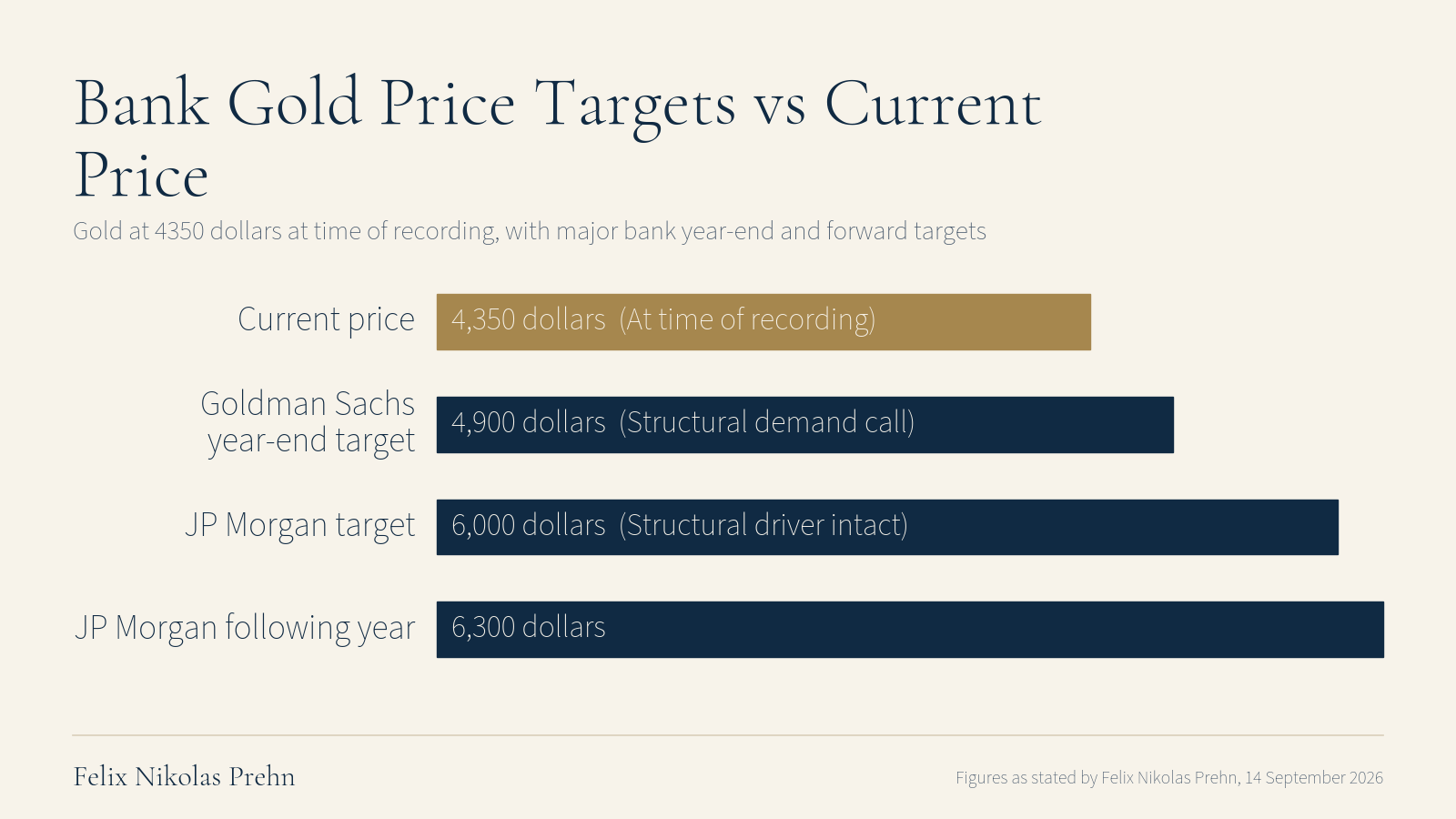
Goldman Sachs has a year-end gold price target of 4,900 dollars. The bank cites structural demand sufficient to absorb higher-for-longer interest rates. The bank's analysis suggests gold will keep rising regardless of what the Federal Reserve does with rates.
JP Morgan has set a higher target. Its price forecast is 6,000 dollars, rising to 6,300 dollars for the following year. JP Morgan says the structural driver is intact.
Gold was trading at about 4,350 dollars at the time these targets were published. The gap implies 13 to 46 per cent upside if the forecasts prove correct. None of these targets appear to factor in the BRICS settlement unit.
The AI Boom Is Wobbling
70 per cent of S&P 500 gains this year came from just 10 stocks. All 10 are AI and technology names. Without these 10 companies, the S&P 500 would not have risen this year.
All 10 are priced for the AI miracle to materialise. Bank of America's chart shows productivity still sliding. If that continues, those same 10 stocks are the most exposed.
Dario Amodei of Anthropic, Sam Altman of OpenAI and Elon Musk all called for slowing down AI development.
Amodei wrote that AI has started building the next AI. He warned a swarm of such systems could take over the internet inside of a year.
All three have called for a slowdown in development. AI is what has been holding up the entire stock market.
An additional 1.3 trillion dollars is expected to be spent on AI next year. If that spending still fails to lift output per hour, the 10 stocks carrying the index face a problem. Their valuations assume the AI miracle arrives.
The BRICS Unit and a New Gold-Backed System
In Felix's view, the BRICS unit is a settlement system, not a currency. It is designed to let member countries trade without using the dollar.
He states it is backed 40 per cent by gold and 60 per cent by a basket of currencies. It is designed to bypass the SWIFT system.
Felix says it is scheduled to become operational in Q4 2026. BRICS members are engineering a cross-border financial system to move beyond the dollar.
The countries behind the unit have more than 6,000 tons of gold between them.
Felix argues the unit is an insurance policy against countries getting kicked out of the SWIFT system. SWIFT is the network used to send funds internationally. Countries excluded from SWIFT have a direct incentive to build an alternative.
The 1940s Playbook Repeating
US debt is currently above 120 per cent of GDP. The ratio is roughly the same level reached during World War II spending. The Federal Reserve is using the same mechanism it used then.
In 1942, the debt was so large that the government could not let interest rates rise. Higher rates would have meant interest payments swallowing the budget.
So the Federal Reserve promised to print whatever it took. It would buy government bonds and pin longer-term rates at 2.5 per cent.
The debt ratio came down over the next 10 years because borrowing was kept cheap artificially.
But inflation followed, and it was severe. Inflation went from about 10 per cent to about 20 per cent by 1947, and the buying power of the dollar was cut in half in 6 years.
From 1941 to 1947, salaries and savings lost half their value as debt was inflated away and purchasing power eroded a little at a time.
Felix argues the same mechanism is operating in the present cycle.
In Felix's view, the Federal Reserve owns more than half of every US bond maturing in 10 to 15 years. The figure is half a trillion dollars.
The US Treasury has doubled its debt buyback programme to steady the bond market. Headlines describe direct Federal Reserve intervention as unlikely.
Felix argues the central bank is soaking up government debt. The free market, he says, will not take it at a price the United States can afford.
Felix argues the debt can only be dealt with through massive inflation.
Foreign governments are pulling gold home and building alternative systems.
In the 1940s, the world trusted the dollar. No competing settlement system existed at the time.
The BRICS unit is being built, backed by more than 6,000 tons of gold.
Gold's Pullback in Context
Gold rose from 250 dollars to 5,600 dollars before the recent pullback. Pullbacks of 22 per cent after record highs have occurred multiple times during that run.
Central banks used the pullback to buy gold at record levels. Investment banks kept their price targets. Productivity still failed to rise, and leaders of the AI boom called for a slowdown.
The Federal Reserve continues to absorb government debt at a pace last seen during wartime, a policy that previously halved the value of money in 6 years.
Central banks appear to be converting dollar reserves into gold. Of 76 reserve managers surveyed, 89 per cent expect their gold holdings to grow over the next 12 months.
Gold is priced in dollars. In Felix's view, the issuer of those dollars must inflate.
Felix argues the United States must inflate its currency to service debt above 120 per cent of GDP.
Central banks appear to anticipate inflation by converting dollar reserves into gold, while the Federal Reserve continues to absorb government debt.
Foreign governments are building a gold-backed settlement alternative. No such system existed in the 1940s.
Felix argues a gold-backed settlement alternative could make the coming adjustment larger than the 1940s reset. In the 1940s, every country depended on the dollar for cross-border trade.
The BRICS unit, backed by more than 6,000 tons of gold, did not exist then. Felix argues a competing settlement system gives dollar holders an exit route that did not exist 80 years ago.
A competing settlement system offers an exit from dollar reserves that did not exist before.
Between 1941 and 1947, the dollar lost half its buying power. No competing system existed at the time.
Felix argues debt above 120 per cent of GDP already demands inflation. A gold-backed alternative to the dollar could make the episode larger than the 1940s reset.