
The silver market is one of the most misunderstood commodity markets in existence. Popular predictions of an imminent COMEX collapse are built on misread data and obscure a more complex reality.
A legitimate long-term case for higher silver prices exists, based on its role as a consumable industrial commodity. Unlike gold, which is primarily a monetary and store-of-value asset, silver is destroyed in the manufacturing process.
It goes into solar panels, electric vehicles, 5G infrastructure, AI data centres, medical devices and missiles. Yet popular accounts predicting an imminent COMEX collapse are built on misread data. COMEX has intervened before and retains every tool it used then.
The COMEX vault reality
COMEX stores two categories of silver: registered and eligible. Bars in that category are actively offered for delivery. Eligible silver is metal stored in the same vaults but not currently listed for sale.
The distinction matters because most commentary ignores it. Registered silver stood at 117 million ounces last year. The registered figure has since dropped to about 70 million.
In Felix's view, the decline has been sharp and sustained. Eligible silver remains at about 250 million ounces, still in the vaults.
Owners of that metal can convert it to registered status with a few administrative steps.
Commentary that ignores 250 million ounces of eligible metal overstates the shortage. The drop in registered inventory signals intense demand for physical delivery, but the question of default depends on different factors.
Felix's COMEX silver stress index reads 95 out of 100. Paper claims on COMEX run at 7 times the silver available for delivery.
Coverage for physical settlement is only 13 per cent. A reading of 95 out of 100 is high, and it coexists with 250 million eligible ounces still in the vaults.
COMEX has never defaulted. It survived the Hunt brothers squeeze in the 1980s, the 2011 run, the 2020 crash and the 2021 tightening. Every time commentators declared the end had arrived, COMEX found a way out.
The 350 to 1 myth
The most widely cited figure in silver commentary is the claim that 350 paper ounces exist for every physical ounce. The number comes from dividing the total notional value of every derivative, including futures, options and swaps, by the deliverable metal in COMEX vaults.
Felix argues the figure is meaningless. Most futures contracts are closed before delivery.
Most options expire worthless. Most swaps settle in dollars.
The 350 to 1 ratio treats every contract as a physical delivery demand and so describes nothing real.
The ratio of paper claims to deliverable metal on COMEX is about 7 times. A healthy market would run at 3 or 4 times, making the current figure roughly double the norm. A ratio of 7 differs from 350 by two orders of magnitude.
The Shanghai premium in context
Silver on the Shanghai Gold Exchange trades at a premium of about 19 per cent over Western prices, according to Felix's tracking. The usual gap runs at 3 or 4 per cent. The gap has drawn attention from market watchers globally, and some commentators treat it as proof that Western prices are suppressed.
Felix argues the premium tells a different story. It reflects how much harder silver is to obtain in China than in the West.
China imposes capital controls, money and metals cannot move freely in or out of the country, and import licences are restricted. Domestic demand is high because China manufactures solar panels, electric vehicles, chips and other industrial goods that require silver.
Physical metal is moving east, and global supply is under pressure. The premium does not prove that Western prices must rise to match.
Jane Street and the market maker misunderstanding
Jane Street has about 20 million shares of the SLV ETF. Commentators have treated the position as proof that the smartest trading firm in the world is betting on the metal to rise. In Felix's view, the interpretation is backwards.
Jane Street is a market maker, a firm that profits from the spread between the bid and offer prices.
The firm earns from trading volume. Jane Street holds SLV shares because it needs inventory to make the market.
When a market maker's position grows large, the firm is usually hedged in the opposite direction. Jane Street might be long SLV and short the metal through futures or options. Its net exposure is probably zero.
The large holding tells observers something about trading volume and activity. It says nothing about where Jane Street expects the price to go.
The COMEX toolbox
A persistent belief exists that COMEX cannot stop a silver squeeze. COMEX has shown in every past episode that it will use its rule-making power to protect itself.
The first tool is margin hikes. In 2011, COMEX raised margins 5 times in 8 days, making it far more expensive to maintain positions in silver carried on borrowed money.
When traders must produce millions of dollars in cash overnight and cannot raise it, they are compelled to sell. The resulting liquidation crashes the price.
The second tool is cash settlement. COMEX contracts include the right to settle in cash instead of physical metal.
If every contract demanded delivery at once, something that has never happened, COMEX could pay dollars and deliver no silver. Cash settlement is written into the terms from the outset.
The third tool is rule changes. COMEX is owned by CME, a private company that can change its own rules and has done so before.
CME changed the rules during the Hunt brothers episode in the 1980s, and silver fell from 50 dollars to 10 dollars. CME can also halt trading entirely.
In Felix's view, CME would take any measure necessary, including halting trade, to prevent a default.
Historical precedents and industrial demand
In 1980, silver hit 50 dollars, the exchange changed the rules, and the price crashed to 10 dollars. In 2011, silver hit 50 dollars again and fell back to 40 dollars. In March 2020, silver dropped to 12 dollars during a liquidation event as credit tightened and risk assets sold off.
After each episode, the same claim circulated: that the next squeeze would succeed where the last had failed. Each time, the exchange or the broader market imposed discipline.
Felix argues the anticipated squeeze has failed to arrive for decades. The people who run these markets always find a way to manage it.
The industrial demand argument is the most plausible version of the bullish case. Silver consumption in solar panels, electric vehicles, 5G, AI data centres and military applications is real and growing.
Reports confirm silver's role in chip manufacturing and renewable energy, though some analysts have flagged a potential slowdown in Chinese solar demand. The long-term consumption trend supports a gradual price increase over years.
Industrial users do not buy silver on COMEX. They have long-term supply contracts with mining companies and refiners. Factory consumption alone will not force a COMEX delivery crisis.
Two constraints limit the case for silver at 200 dollars. If silver reached 200 dollars, every industrial user would direct its research department to find an alternative material.
At 50 dollars, the effort is not worthwhile. At 200 dollars, the cost of research would be small relative to the savings.
At 200 dollars, recycling would surge. Billions of ounces sit in landfills, old electronics and decommissioned solar panels. Recovery of silver from old circuit boards and panels would turn profitable at 200 dollars.
Probability matrix for silver
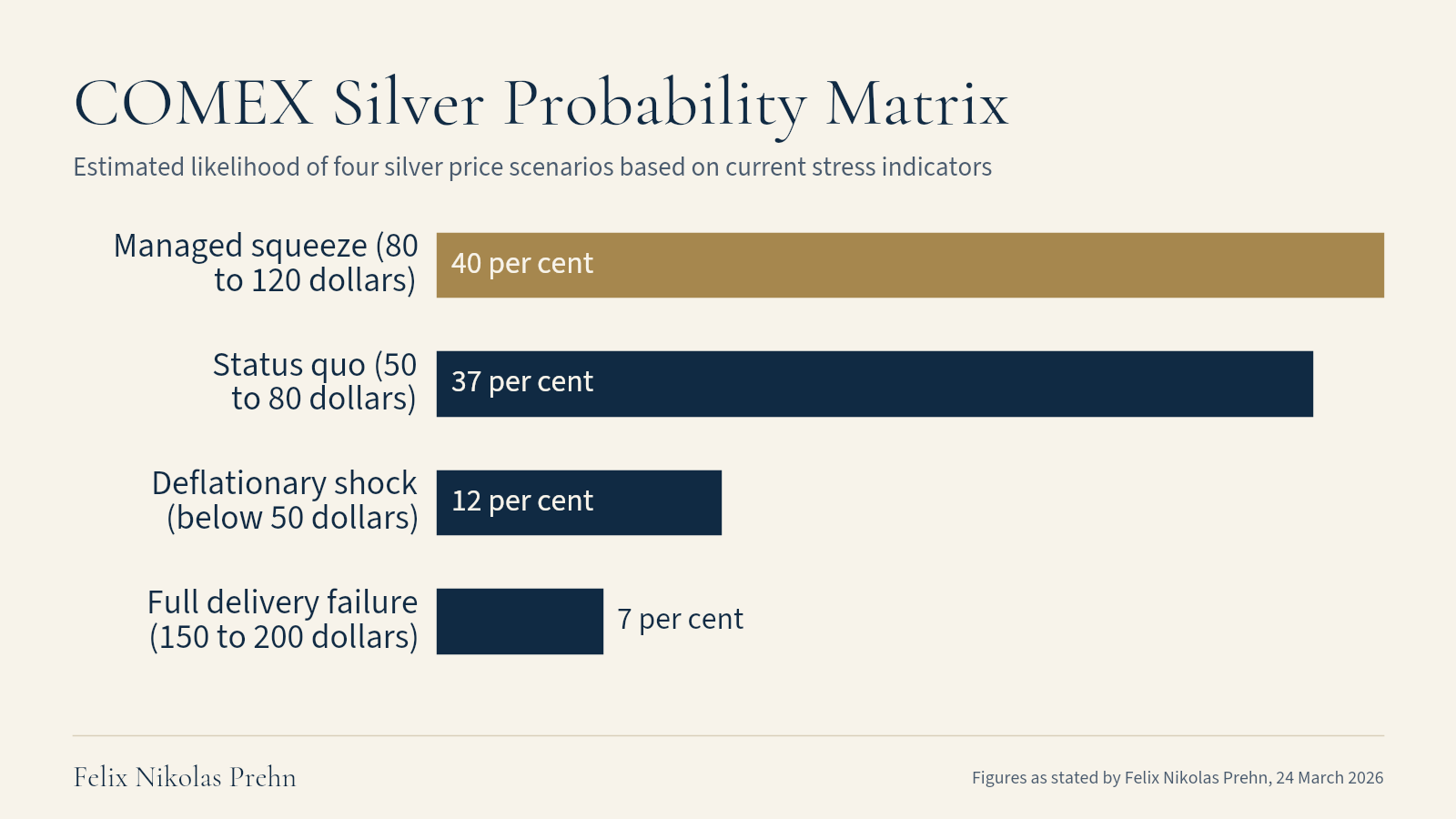
Felix assigns a 5 to 10 per cent probability to a full COMEX delivery failure. In that scenario, silver reaches 150 to 200 dollars and contracts cannot be honoured.
Felix argues the true odds are closer to zero. Every tool in the CME toolbox exists to prevent exactly that outcome.
A managed squeeze carries a probability of 30 to 50 per cent. Prices rise to 80 to 120 dollars before the exchange intervenes through cash settlements or emergency rule changes. The price overshoots, then corrects to a new, higher range.
The status quo, with silver trading between 50 and 80 dollars, carries a probability of 35 to 40 per cent.
A deflationary shock, in which a recession arrives and credit tightens, carries a probability of 10 to 15 per cent. Silver fell to 12 dollars in March 2020 despite a favourable long-term supply picture, caught in a broader liquidation event.
No single outcome commands a majority probability. COMEX has defeated every squeeze in its history, from the Hunt brothers in the 1980s to the 2021 tightening.
COMEX registered inventory has dropped to 70 million ounces and the stress index reads 95 out of 100. Industrial consumption continues to destroy supply.
Yet a delivery failure has been predicted for decades and has never occurred. COMEX retains margin hikes, cash settlement, rule changes and the ability to stop trading altogether. It hiked collateral requirements 5 times in 8 days in 2011. It changed rules during the Hunt brothers episode in the 1980s.