
On February 20th the Supreme Court ruled 6 to 3. The ruling struck down roughly half of all tariffs in place. Within hours, the White House imposed new ones under a different law.
The net result is a trade regime marginally lighter but far less predictable. The new tariffs expire in 150 days. Midterm elections will determine whether levies become permanent law.
The Ruling: What the Supreme Court Decided
On February 20th the Supreme Court struck down tariffs imposed under the International Emergency Economic Powers Act. IEEPA is a 1977 law originally designed for sanctions and freezing assets during emergencies.
The court ruled 6 to 3. Two of Trump's own appointees, Gorsuch and Barrett, joined the majority.
The constitution gives Congress the sole power to tax imports. Trump had used IEEPA, a law meant for freezing assets, to impose taxes on foreign goods. The court held that this was an improper application of the statute.
The majority applied the major questions doctrine. When a government action carries massive economic consequences, Congress must explicitly authorise it. A president cannot assume those powers by stretching an emergency statute beyond its original purpose.
Half the Tariffs Gone: Scale of the Decision
The ruling struck down roughly half of all tariffs that were in place.
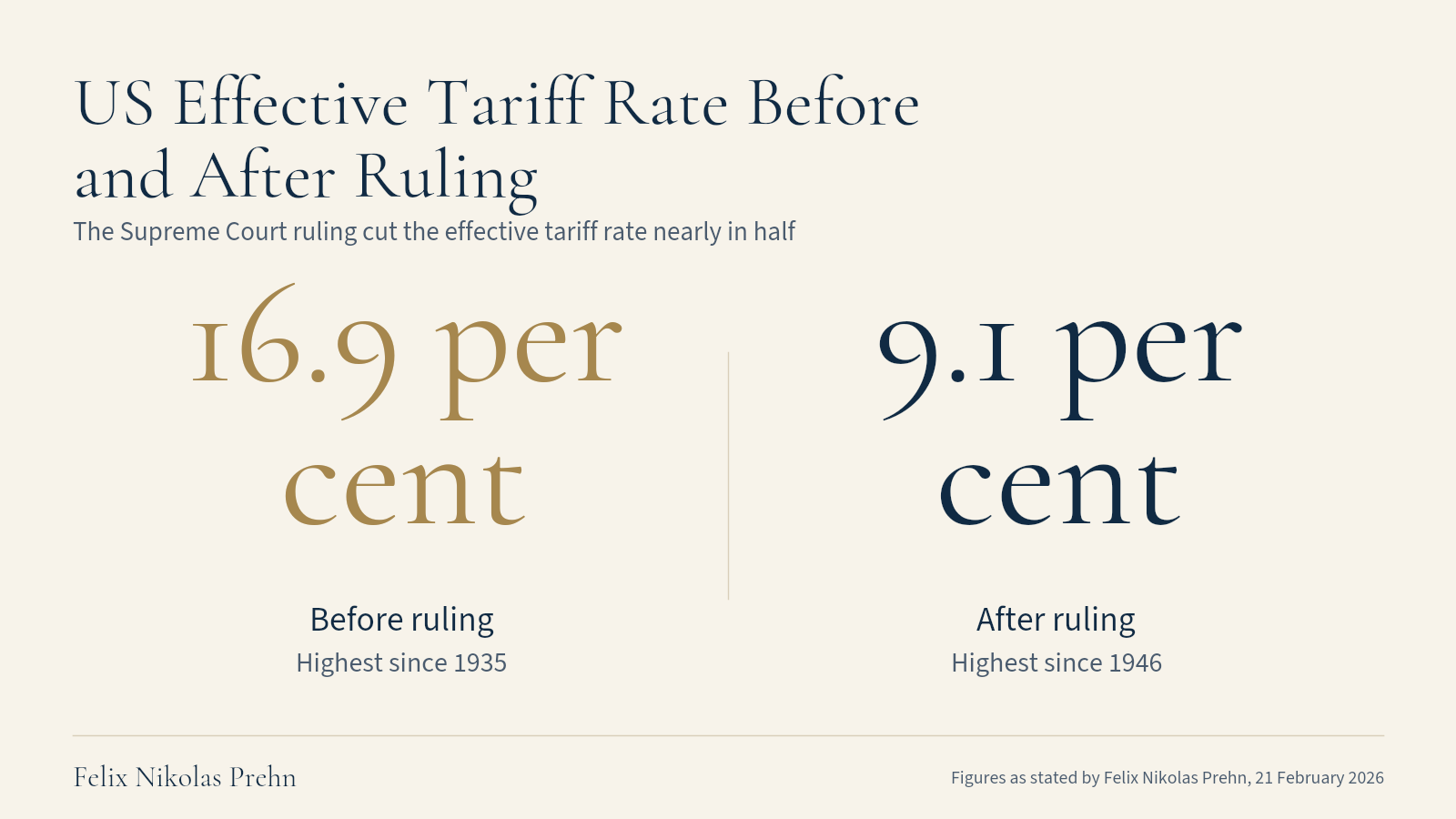
Before the decision, the United States effective tariff rate stood at 16.9 per cent, the highest since 1935.
After the ruling, the rate fell to 9.1 per cent, a level not seen since 1946. Markets reacted positively to the ruling, which functions as a tax cut.
The Refund Question and Corporate Response
The Wharton budget model estimates that 175 billion dollars in tariffs had already been collected under IEEPA authority. The court has since declared the legal basis for those collections invalid.
A federal court has since cleared the way for a class-action lawsuit. Companies that paid the tariffs are moving closer to refunds. Costco and other firms are preparing claims to recover those payments.
Trump's Immediate Countermove: Section 122
The administration responded within hours. A new 10 per cent global tariff was announced under Section 122 of the Trade Act of 1974.
Section 122 allows temporary tariffs up to 15 per cent for a maximum of 150 days. After that period, congressional approval is required.
Open-ended tariffs gave way to temporary levies capped at 150 days. The new measure is already facing legal challenges in trade court.
Congress must decide whether tariffs survive. The president's unilateral power over trade has been curtailed.
The New Tariff Map
The new 10 per cent rate lowered tariffs on most trading partners. Rates on European, Japanese and South Korean goods fell from 15 per cent to 10 per cent. Tariffs on goods from India fell from 18 to 10 per cent, and for Vietnam from 20 to 10 per cent.
China is the exception. China faces 35 per cent total tariffs.
The new 10 per cent tax applies on top of an existing 25 per cent levy. A different legal authority governs that layer. The IEEPA ruling did not touch that 25 per cent layer.
Steel and aluminium tariffs remain in place under a separate law. The ruling did not affect them. Levies on cars remain at about 15 per cent.
Where Tariff Rates Stand Now and What They Mean for Inflation
The effective tariff rate dropped from 16.9 per cent to 9.1 per cent. The White House then added 10 per cent under Section 122, partially offsetting the drop. The aggregate rate after the new levy depends on trade-weighted calculations.
The Yale Budget Lab estimates that every 1 per cent increase in tariffs produces about 0.1 per cent inflation. Goldman Sachs described the outcome as slightly fewer levies but materially more trade uncertainty. The removal of the struck-down tariffs reduces inflation pressure, which could allow the Federal Reserve to cut rates more aggressively.
Lower tariff rates ease inflation pressures. Growth stocks benefit from that relief. The market is cautiously optimistic on that basis.
Higher tariffs raise import prices and feed into inflation. Persistent inflation keeps interest rates higher for longer.
Higher rates in turn mean a stronger dollar, which makes American exports less competitive.
Weaker export performance widens the trade deficit, creating political pressure for more tariffs.
The effective tariff rate fell from 16.9 per cent to 9.1 per cent after the ruling. Section 122 tariffs and other authorities keep the mechanism partly intact.
Domestic producers who do not import much may not welcome the ruling. Their foreign competitors can now sell at lower prices.
Firms that import benefit because lower tariffs reduce their cost base. Reshoring firms, those helping manufacturers move production back to the United States, may lose an incentive. High tariffs had served as a reason to bring manufacturing back to the United States.
The Political Clock: Midterms and the 150-Day Countdown
The new Section 122 tariffs expire in 150 days. After that, Congress must vote to extend or replace them.
The midterm elections in November become far more consequential because of this timeline. Congress will have to approve tariffs to make them permanent.
A Republican sweep would mean tariffs are there to stay. Once Congress passes a law imposing taxes, the levies rarely disappear.
If Democrats win enough seats, no legislation will pass to make tariffs permanent. Rates will stay lower by default once the 150-day window expires.
The 150-day window creates a fixed point of uncertainty. Markets will price the approaching deadline well before it arrives.
Polls, congressional races and leadership statements will all feed into expectations about the tariffs' fate. Banks and trading desks welcome this kind of environment. More volatility produces more deal flow, which generates more commissions.
Congress faces a 150-day deadline. Legislators must write tariffs into permanent law or let them lapse before the window closes. The Supreme Court has made clear that the power to tax imports rests with the legislature, and lasting trade levies require explicit congressional approval. The midterm elections will reshape Congress. The new composition will determine whether the 9.1 per cent effective rate hardens into statute or lapses with Section 122.