
The Buyback No One Is Talking About
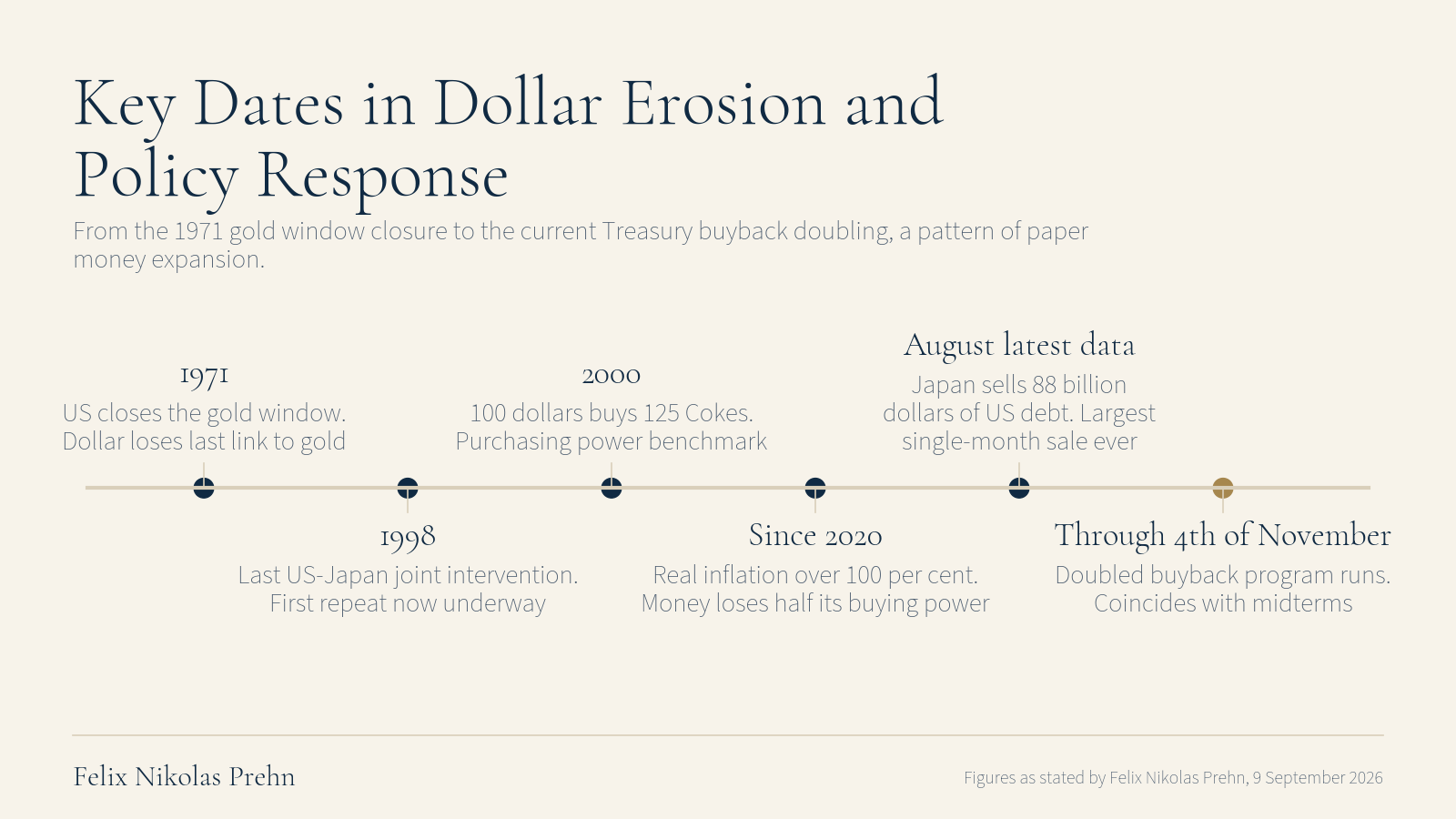
The US Treasury is doubling the amount of long-dated debt it buys back. The programme runs for two months through 4 November. The timing coincides with the midterm elections.
The government issues bonds. It then creates new money to buy them from the market.
Few buyers want US debt at current yields (the interest a bond pays). Because willing buyers are scarce, the Federal Reserve creates new money to fill the gap.
New money is created to buy the debt that nobody else wants. Higher interest rates would attract more buyers. The Treasury steps in as buyer of last resort instead.
The label "buyback" borrows from corporate finance, where a cash-rich company retires its own shares. A government buying its own bonds with freshly created money is a different operation.
Every fresh dollar dilutes the ones already in circulation, though the nominal figure in a bank account remains unchanged.
The purchasing power behind each unit falls by the proportion of new supply added.
Japan Walks Away
Japanese investors sold 88 billion dollars of US debt holdings in August. August's figure was the largest single-month selling of US debt Japan has ever done. For decades Japan has been the biggest loyal buyer of American debt on the planet.
70 per cent of Japan's reserves are held in US debt. When the largest foreign holder begins to sell at that pace, someone else must absorb the supply.
If no buyer appears, the price of that debt falls. Yields (the interest a bond pays) rise.
Felix argues that Japan is selling because it is defending its own currency. The coordinated intervention between the United States and Japan was the first such joint action since 1998. Geopolitical and monetary pressures on the yen have forced Tokyo to bring capital home.
American borrowing costs are linked to the yen carry trade. For years the world borrowed cheap yen and parked that money in US markets.
Cheap Japanese capital propped up American stocks and kept borrowing costs low. When Japan sells its US bonds to defend the yen, that money returns home.
Cheap yen capital no longer flows into American assets at the old pace. US interest rates come under upward pressure as a result.
Factories, infrastructure and industrial investment in the United States are all financed with borrowed money. The cost depends on the interest rate.
Felix argues that rising rates, if sustained, push the economy towards a severe recession. The buyer pool for US debt is shrinking because countries like Japan are pulling back.
The Hidden Inflation Tax
Real-world inflation since COVID has been well over 100 per cent. Money has lost roughly half its buying power in 5 years.
A concrete measure: 100 dollars in 2000 bought 125 bottles of Coke. Today the same 100 dollars buys 44. The comparison shows a 65 per cent drop in purchasing power over 24 years.
Since 1971 the dollar has lost about 93 per cent of its value on official government figures. A 1971 dollar is worth 7 cents today.
Measured against market prices, the loss is larger. Against them, a 1971 dollar is worth about a third of a cent.
Every new dollar is extracted from the value of dollars already held. A bank balance still reads the same figure.
The same nominal sum buys fewer goods than it did a year ago. Five years ago, the same sum purchased roughly twice as much.
Monetary expansion transfers wealth from those who have cash to those who borrow.
The Treasury's expanded buyback programme accelerates this process, injecting fresh money into the system.
The AI Debt Tsunami
72 per cent of S&P 500 gains this year came from just the top 10 names. All of them are AI stocks. An index fund marketed as 500 companies is, in practice, a concentrated bet on a single theme.
Big tech companies are borrowing about 700 billion dollars this year to build data centres. The figure rises to a trillion dollars next year. Corporate borrowing on this scale will land alongside the government's own bond issuance.
Corporate and sovereign borrowers are issuing debt into a shrinking pool of buyers. Countries like Japan are already retreating from that pool.
The only entity large enough to absorb the combined supply is the money printer. Corporate AI borrowing and government bonds compete for the same capital. When private buyers decline, the money printer must run faster.
The AI boom and money printing are, in Felix's view, one story. The buildout is financed by the same money printer that erodes savings. The cost arrives through currency depreciation.
The Bond Market Contradiction
The bond market expects interest rates to move up towards 4 per cent. At the start of the year the expectation was for rate cuts. The two trajectories have diverged sharply.
The government is printing money to buy its own debt, the loosest possible financial policy. At the same time the market prices in tighter conditions through higher rates.
The government prints money to suppress rates. Bond yields have moved in the opposite direction, towards 4 per cent.
Felix argues that this contradiction cannot hold indefinitely. If rates rise, the cost of servicing government debt climbs and the budget deteriorates further. If the printer runs faster to suppress rates, the currency weakens.
Gold Leaving America
The US gold window was shut in 1971. The temporary measure has now lasted 55 years.
Too many countries wanted their gold back. Washington severed the dollar's last link to gold rather than honour the claims.
The Netherlands, France and Germany have moved physical gold reserves home. Several European central banks have cited geopolitical considerations. The Dutch central bank moved its holdings from New York.
In Felix's view, gold has become one of the biggest single export items from the United States. Physical gold is leaving US vaults at record levels.
Gold cannot be printed or expanded through a Treasury refunding statement. Sovereign holders appear to be drawing a distinction between paper claims and physical reserves. Central banks do not ship metal home at considerable expense unless they doubt the paper alternative.