
Japan, Europe and America are all losing control of their borrowing costs at the same time.
One common explanation is that yields rise because economies are healthy. Yields are climbing in Japan, France and Italy, all countries with weakening output.
The cause is too much borrowing everywhere at once, and bond buyers no longer trust the governments that issued the paper. Felix argues gold fell recently. In Felix's view, central banks responded by expanding the supply of currency.
Japan's Bond Market
Japan's 30 year government bond yield has hit the highest level ever recorded. Japan carries the largest debt load of any major economy on Earth, about 260 per cent of its annual output. For decades, it got away with that by keeping interest rates at zero and buying its own debt.
The Bank of Japan became the buyer when no one else would have bonds at such low rates. The arrangement held for decades.
Bond buyers are withdrawing. Yields are climbing beyond the central bank's control.
Sovereign Debt in Europe
France's government bond selloff is spreading to Italy, Belgium and Greece. France is at the centre of it: borrowing too much, running a political system that cannot agree on a budget, with zero plan to close the gap.
A decade ago, during the Eurozone crisis, Germany was the safe haven. Capital fled southern Europe and was invested in German bonds.
German yields are rising too. The old safe haven no longer functions as one.
The contagion is not limited to smaller economies. France, Italy, Germany and Belgium are among the largest industrial nations in Europe, and all four bond markets are selling off together.
America's Interest Bill
US bond yields are the highest they have been since 2004. The interest the American government now pays on its debt is 1.25 trillion dollars a year, almost everything it spends on social security.
Mortgage applications in the United States just hit their lowest level since 1995. Credit is tightening at the consumer end while the government's own borrowing cost balloons. America faces the same pressure as Japan and Europe: too much debt repriced at higher rates.
Why Gold Dropped
Gold is up more than 60 per cent in a year. Silver is up still over 100 per cent. After gains of that size, almost everybody who wanted exposure already has it.
Gold is priced in dollars. When the market expects interest rates to stay higher for longer, the dollar strengthens. A rising dollar pushes the gold price down for everybody outside America.
A crowded trade compounds the decline. After gains of 60 per cent in a year, new buyers thin out and sellers dominate.
Paper gold markets add a mechanical dimension. Exchanges raise margin requirements, forcing leveraged traders to sell. Automatic stop losses then trigger further sales.
Each wave of liquidation causes the next round of margin calls. The paper gold price on screen can fall sharply while the physical metal remains unchanged. Funds sell gold first for cash in a liquidity crisis precisely because it is the most liquid asset anyone owns, and can be sold fastest.
The 1970s contain a clear example. Gold went from about 100 dollars to about 850 dollars.
In 1973 and 1974, while the stock market was collapsing, gold went flat and then fell. An 8 fold rise followed over the subsequent years.
In 2008, gold fell about 30 per cent in the panic. Once the printing started, it tripled over the next 3 years. Each time, central banks responded with new money and gold repriced against the currency that was suddenly worth less.
The Inflation Plan
Felix argues the broad supply of currency is growing at its fastest pace in 4 years, as every major central bank is quietly printing. Bond yields imply that buyers do not believe the official story about fiscal discipline.
The strategy has been stated in public. In 2016 the man who now sits in the White House said a country never has to default because it can just print money. The government quietly makes each dollar worth a little less so the debt shrinks against everything around it.
Economists call the mechanism financial repression. A government keeps interest rates below the inflation rate on purpose.
Though savings earn interest, the return paid is less than the rate of inflation.
Each year, the money in the account buys a little less than it did the year before. At about 5 per cent a year, the value of those savings is roughly halved in a decade.
American policy favours a weaker dollar. A weaker currency makes exports cheaper and reduces the debt in real terms. If the dollar falls too far, the rest of the world may lose confidence and start moving capital out of dollar assets.
The Erosion of Purchasing Power
At a devaluation rate of about 5 per cent a year, purchasing power is roughly halved in just 10 years.
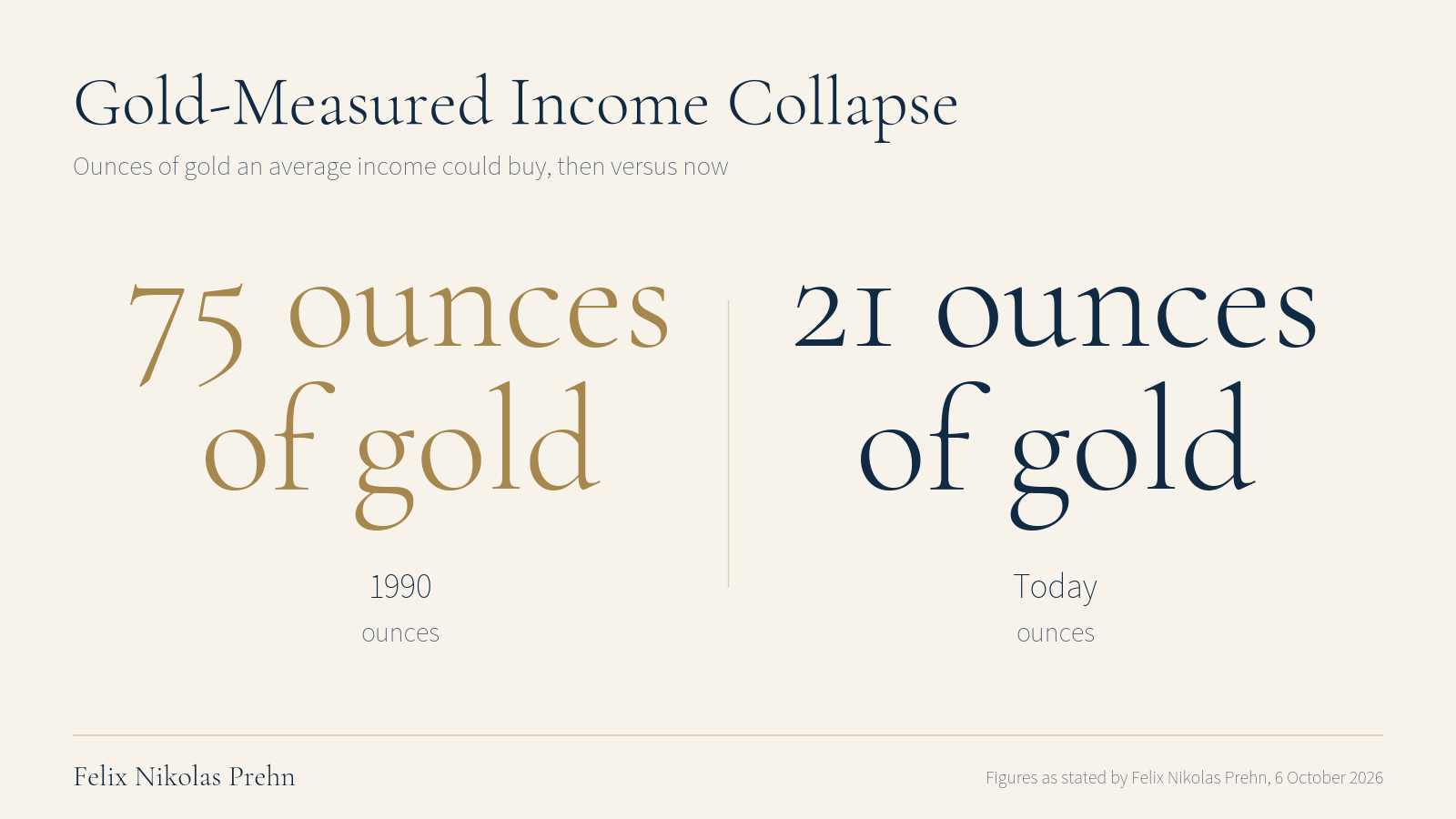
In 1990 an average income could buy 75 ounces of gold. Today the same income buys 21 ounces.
The same salary buys 21 ounces today instead of 75. Measured against gold, the loss is about 70 per cent in a single generation.
An index measuring prices in time counts how many hours of work a given basket of assets costs. With the year 2000 set at a baseline of 100, the same basket cost 341 hours of average work by August 2026. The cost of this basket of assets, measured in hours of work, has more than tripled in 26 years.
The Common Thread
Japan, France, Italy, Belgium, Greece and America are all selling off at the same time. Buyers no longer believe the borrowers can pay.
Japan kept rates at zero and bought its own bonds until buyers withdrew. France cannot agree on a budget and has no plan to close the gap.
America's 1.25 trillion dollar interest bill consumes almost as much as social security. Margin cascades on the paper gold market force leveraged holders to sell, repeating the sequence visible in 2008.
Governments borrowed too much for too long. Bond buyers no longer accept that the borrowers can service what they owe.
Financial repression is already underway. Purchasing power erodes slowly and deliberately, shrinking the debt in real terms without a formal default. At about 5 per cent annual devaluation, roughly half the value of savings disappears in a decade. Felix argues the broad supply of currency is expanding at its fastest pace in 4 years.