The worst month in 13 years
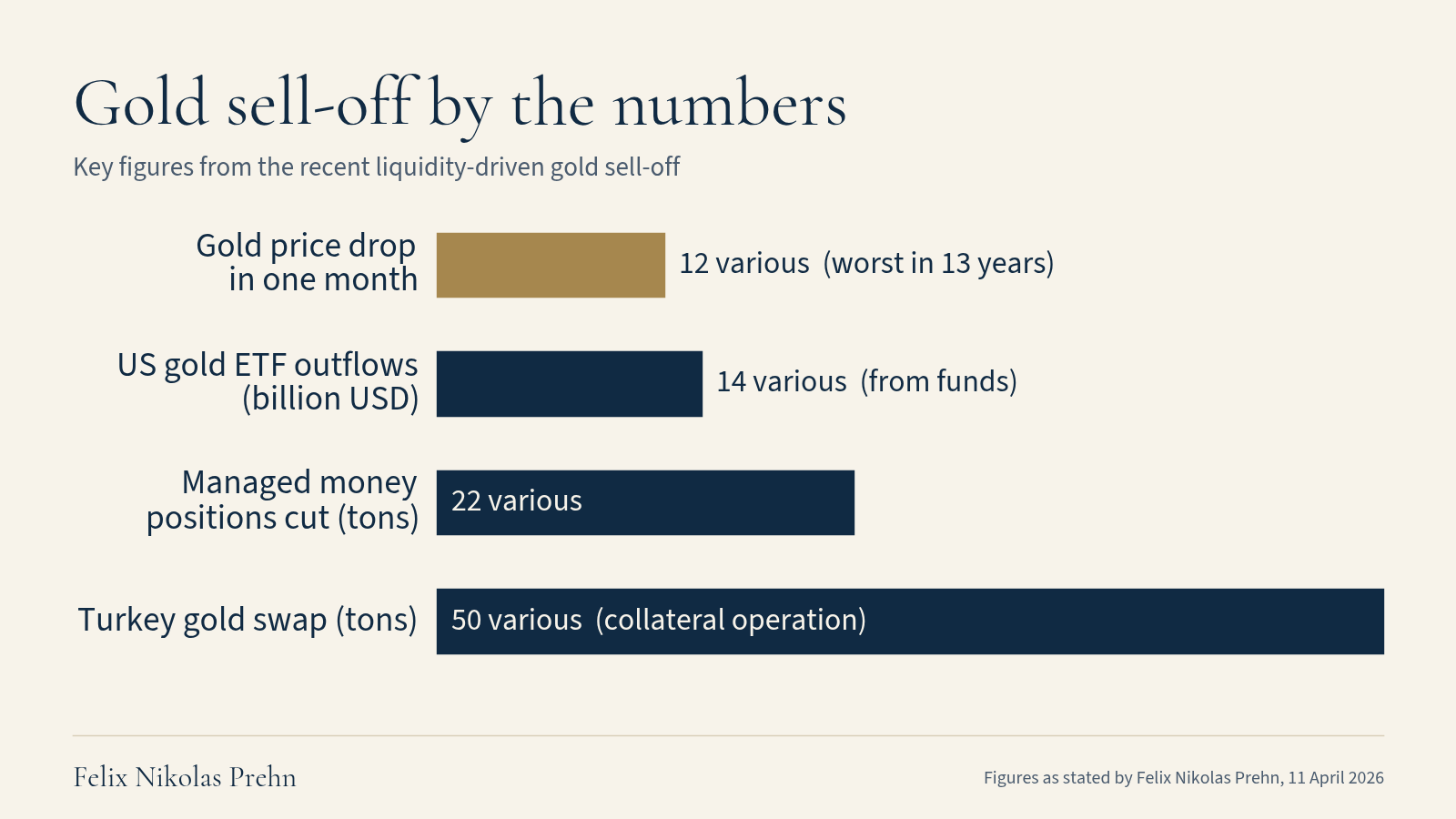
Gold dropped 12 per cent in a single period, its worst calendar month in 13 years. About 14 billion dollars flowed out of US gold ETFs from funds in a very short period. Managed money positions were slashed by about 22 tons.
The scale of the sell-off looked alarming in isolation. Yet the cause had little to do with a reassessment of gold's value. Felix argues the drop was driven by a liquidity squeeze, and the metal's investment case remained intact.
Liquidity squeeze, not a loss of faith
Hedge funds borrow to amplify their returns. Conservative operators may use 5 times their own money. Aggressive ones go as high as 40 times.
A 1 per cent market decline can therefore translate into a 40 per cent loss on the fund's own money. The Middle East conflict pushed oil prices higher. Stocks fell in response.
Hedge funds carrying borrowed positions faced losses and required immediate liquidity. In Felix's view, gold was sold first because it was liquid. Managers offloaded winners to cover losses elsewhere.
Turkey added to the selling pressure, though the picture is more complicated than a simple liquidation. Felix argues Turkey used about 50 tons of gold in a swap arrangement. It borrowed against the metal rather than disposing of it.
The country had done the same during COVID and after a 2023 earthquake. As the energy crisis hit Turkey's economy hard, it needed cash, and gold served as acceptable collateral.
Institutional positioning at extremes
The institutional positioning score for gold is 13 on a scale of 0 to 100. Zero means everyone is selling. A reading of 13 signals extreme pessimism among large holders.
Over the last 3 years, when the score fell between 0 and 20, gold rose on average 18 per cent over the following 90 days. Forced liquidation drove the positioning data. Sellers needed cash, and gold was the easiest source.
Central banks keep buying
Central banks are in their 15th straight month of gold buying. China is the largest buyer. China added 1.9 billion dollars in gold ETF inflows during the same period that hedge funds were liquidating.
The metal now accounts for 20 per cent of emerging market reserves, according to the World Gold Council. As Felix puts it, these central banks are buying more gold because they do not want to buy dollars. Central banks in Asia and parts of Europe have been repatriating gold holdings and reducing exposure to dollar-denominated assets.
Investment bank analysis
UBS identifies 4 reasons to be bullish on gold. They are stagflation risk, a weaker dollar, lower interest rates ahead and central bank buying.
The term describes rising prices combined with a slowing economy. Felix argues gold has historically performed well in such conditions. Capital flows toward assets that retain value when wages stagnate and costs climb.
A weaker dollar supports gold mechanically. The metal is priced in dollars.
When the currency falls, the quoted price of the metal rises. UBS cites a weaker dollar as one of its 4 reasons to be bullish.
Lower interest rates reduce the appeal of holding cash or government bonds. A yield (the interest a bond pays) of 5 per cent on US government debt may look attractive.
A yield of 1 or 2 per cent offers little reason to stay in bonds. When yields fall, capital migrates toward assets with the potential for price appreciation.
Goldman Sachs's top commodity analyst said the bank is constructive on gold even after the sell-off. The bank specifically cites Iran, oil, gas and food costs as inflation drivers supportive of gold. Oil, gas and food costs feed directly into higher consumer prices.
Higher inflation has tended to coincide with stronger gold prices. Middle East tensions have pushed oil to multi-month highs, and a CBO study has linked the conflict to inflationary pressure.
UBS's chief investment officer issued guidance stating stay bullish on gold. Energy supply disruptions from the Middle East conflict could take years to repair, not weeks or months.
New demand from China's insurance sector
China introduced a rule change allowing its insurance companies to allocate 1 per cent of their assets into gold. One per cent of assets looks modest as a ceiling. Chinese insurers, however, manage very large pools of policyholder money.
UBS notes that Chinese insurance companies have not yet fully allocated the permitted 1 per cent.
Felix argues the rule change opens a new channel of demand that has barely begun to flow.
China has been overhauling its insurance law to widen permitted investments. Gold appears to fall within that broader liberalisation.
Conclusion
Gold's 12 per cent fall was a technical event. Borrowed-up hedge funds liquidated positions to raise cash.
Central bank buying continued, and UBS and Goldman Sachs maintained bullish guidance throughout the sell-off. Institutional positioning fell to 13 out of 100.
Central banks kept buying for a 15th straight month. UBS and Goldman Sachs reiterated bullish guidance.
Persistent fiscal deficits and de-dollarisation by reserve managers continue. New demand from China's insurance sector has barely begun.
Felix argues the sell-off was a liquidity event, not a verdict on gold. Central banks added to reserves while the price was falling. UBS issued bullish guidance, and Goldman Sachs reiterated a constructive view. The structural forces behind gold, fiscal deficits, de-dollarisation and new Chinese insurance demand, remain in place regardless of a single month's forced selling.