The Widow Maker Wakes Up
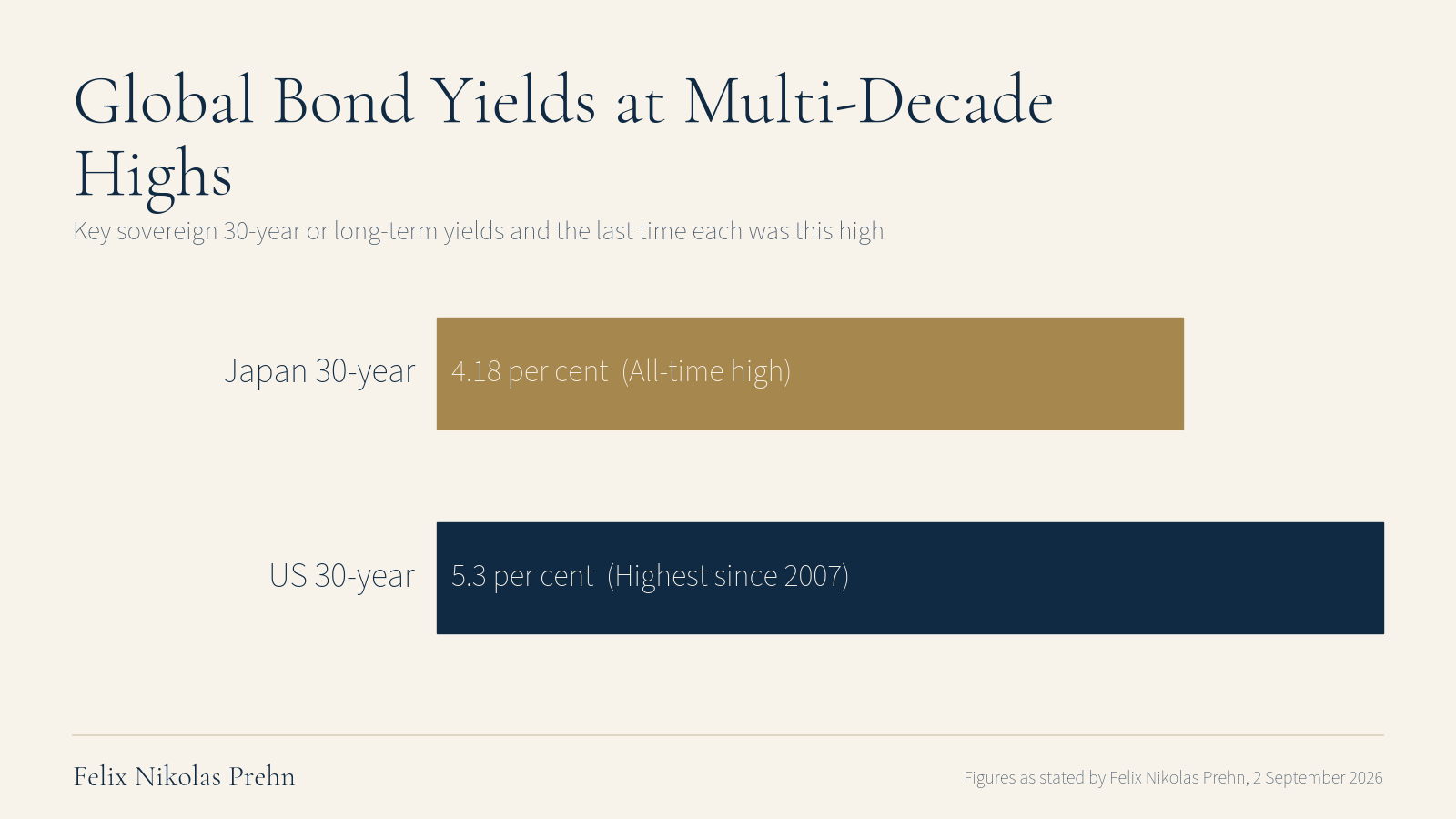
Japan's 30-year government bond yield jumped to 4.18 per cent, the highest level in its history. A bond yield is the interest rate a borrower pays to raise money for a fixed period. At 4.18 per cent on a 30-year bond, Japan pays more to borrow long term than ever before.
For 30 years, one trade destroyed every investor who attempted it. Japan's government debt is about 200 per cent of its entire economy, the worst ratio in the developed world.
Investors saw that figure and bet borrowing costs would spike. The trade wiped out every person who tried it. Wall Street nicknamed the trade the Widow Maker.
The Bank of Japan prevented the trade from paying off. It stepped in as the buyer of government debt by creating money out of thin air.
When no private buyer wanted the bonds, the central bank manufactured demand. Artificial demand kept yields low for 30 years.
The Japanese yen has steadily lost value as a consequence.
On the day the 30-year yield hit 4.18 per cent, the Widow Maker finally paid off. After 3 decades of artificial suppression, the yield broke through to a record.
Watch the video this article is based on: Felix Nikolas Prehn on Felix Prehn on Japan's Bond Crack and the Paper Gold Problem
https://www.youtube.com/watch?v=nNlvhJj86pw
Tokyo's Market Rout
Japan's stock market lost more than 200 billion dollars in a single day following the bond yield spike. The 30-year yield hit its record, and the stock market registered the loss immediately.
Felix argues that heavily indebted countries follow a predictable sequence. Debt piles up until the interest becomes unpayable.
The central bank then buys the debt with printed money and the currency loses value. Japan's debt is 200 per cent of GDP.
Its central bank printed money for decades. The yen has steadily weakened as a consequence.
The AI Bubble Borrows Into Rising Rates
Companies borrowing to build the AI boom have raised 410 billion dollars so far this year. The assumption behind that spending was that interest rates would fall.
Rates are instead climbing, with global bond yields at the highest level since 2000. Firms that raised 410 billion dollars expecting cheaper financing now face a higher cost than planned.
Cisco, Yahoo and AOL were considered the obvious winners of the internet around 2000. Two of those companies disappeared, and Cisco never recovered its peak valuation.
The NASDAQ crashed 78 per cent in 2000 and took 15 years to return to its starting point. The internet was a real technology, and the crash still wiped out 78 per cent of the NASDAQ's value.
A Global Bond Sell-Off
US 30-year yields just touched 5.3 per cent, a level not seen since 2007. The UK's borrowing cost hit the highest since 1998.
Australia's cost of government debt hit a 15-year high. The Financial Times called the simultaneous rise in yields in major economies a global bond sell-off.
Press coverage cites inflation fears and fiscal concerns as contributing factors.
The Dollar's Arithmetic
US government debt has reached 40 trillion dollars. In Felix's view, the interest cost now exceeds the US military budget.
The arithmetic that follows is circular. To pay the interest, the government borrows more.
Each new loan enlarges the debt. Each new dollar of debt adds to the interest bill, which in turn forces yet more borrowing.
Three exits exist from that loop. The first is to grow fast enough to shrink the debt as a share of the economy.
Felix argues that will not happen. The second is to stop paying, which would collapse the global financial system.
The third is quiet inflation and money printing. Inflation erodes the currency, and the debt shrinks in real terms as each dollar buys less.
Felix argues that governments will choose the third door. The evidence, in his view, is already visible.
Felix puts the world's money supply at 150 trillion dollars, an increase of 50 thousand billion since 2020. The expansion amounts to 50 per cent in under 5 years.
Felix argues the expansion came from central banks creating money to absorb government debt, not from economic growth.
The long-run effect of that process is measurable. A 1971 dollar is now worth 12 cents in purchasing power.
Since 1971, the year the dollar was separated from gold, it has lost 88 per cent of its value. The value was diluted, inflated away over 5 decades.
Gold Is Not Ready
Gold is the traditional refuge when currencies lose value. Felix argues that the gold market is not prepared for the demand that a dollar crisis would generate.
For every real gold bar in vaults, many paper claims exist. Paper claims of every kind reference the same finite stock of bars.
As long as few holders ask for delivery, the system functions. Felix argues that if Japan and the dollar follow this path, claimants will demand real bars at the same time.
The quantity of actual gold in vaults is far smaller than the paper claims written against it.
Many gold funds are not backed by metal at all. They track the gold price through futures, swaps and IOUs with no real metal behind them. A fund with "gold" in its name may contain no bars and carry no right of redemption.
The Rate Bet Shifts
Kevin Warsh spoke at Jackson Hole. In 3 days the market's bet on a rate hike jumped from 36 per cent to 70 per cent.
Warsh co-wrote a 2018 op-ed telling the Federal Reserve to hold off on raising rates. A move from 36 per cent to 70 per cent in 3 days reprices every interest-rate-sensitive asset.
Mortgages, corporate debt and government refinancing costs all adjust to the new probability.
Felix argues that the tough talk may be a credibility play. If a deal with Iran crushes oil prices, cheaper energy means reduced inflation.
The Fed would then have room to cut rates. The market would then rally to new highs.
The Pattern Across Borders
Central banks can buy bonds directly. Yields in Japan, America, the UK and Australia are all at multi-year or record highs simultaneously.
Bond prices reflect lenders' judgement on repayment. Lenders charge more when they expect inflation to erode what they receive back.
Japan's government debt remains about 200 per cent of GDP. The 30-year yield is at an all-time high.
The United States has 40 trillion dollars of debt. Its 30-year yield is 5.3 per cent.
America's debt ratio is lower than Japan's. Yields and borrowing costs are moving in the same direction. The UK and Australia are repricing at the same time.
Gold is the traditional store of value in such crises. Yet paper claims on gold may exceed the physical metal available.
Funds backed by futures and IOUs carry counterparty risk. Felix argues that a currency crisis would send holders rushing to convert paper claims into metal.
In Felix's view, the physical gold in vaults is far smaller than the paper written against it. A weaker dollar raises the incentive to demand delivery of real bars. If conversion requests arrive faster than vaults can settle them, some holders of paper claims will find no metal available.