Japan made an emergency move to hide 1 trillion dollars in losses on the balance sheets of its banks and insurers. The decision points to a pattern that extends far beyond Tokyo.
Japan's trillion dollar cover up
A Japanese government bond issued at 99.8 yen now trades at 38 yen, a 62 per cent loss of face value. Felix argues this is because the bond pays almost no interest, making it unattractive to investors. Losses of that scale threatened to bring down the entire Japanese financial system, where insurers would have gone bankrupt and banks would have collapsed.
Japan faced, as Felix puts it, a collapse that would have dwarfed any recent financial crisis. The response was an accounting rule change.
The Japanese Institute of Certified Public Accountants altered the rules so that banks and insurers no longer have to report bond losses. Bonds are now treated as held to maturity. Institutions can carry them at face value even when the market price is a fraction of par.
A bond worth 38 yen on the open market can appear on a balance sheet at 99.8 yen. Late 2026 headlines confirm the rule change. Life insurers will no longer record losses even if bond prices plunge.
The effect is to paper over 1 trillion dollars in real losses. The financial system continues to function on paper, but the bonds still trade at 38 yen.
The Silicon Valley Bank parallel
Silicon Valley Bank collapsed in 48 hours. The mechanism was the same one now at work in Japan.
The bank's bond portfolio fell in value, and it had to recognise those losses. The resulting hole destroyed confidence overnight.
Japan's version of the same problem is, in Felix's view, about 10 times larger. The difference is that Japan chose to change the accounting rules rather than let institutions fail. Silicon Valley Bank had no such option and was forced to recognise its losses in full.
Late 2026 reports note that rapid bond yield moves have preceded major financial blowups. The last sharp fall in Treasury yields coincided with the day Silicon Valley Bank collapsed.
The 20 trillion dollar carry trade
The carry trade works by borrowing money in Japan at very low interest rates and investing it in the United States. For years, cheap yen funded purchases of American stocks, bonds and other assets. The trade is profitable as long as Japanese rates remain low and returns in the United States hold up.
Felix argues that the Japan crisis is connected to a 20 trillion dollar carry trade that props up the American market. When Japan's system cracks, Japanese investors receive margin calls, demands from lenders to return borrowed money. To meet those calls, they sell American assets.
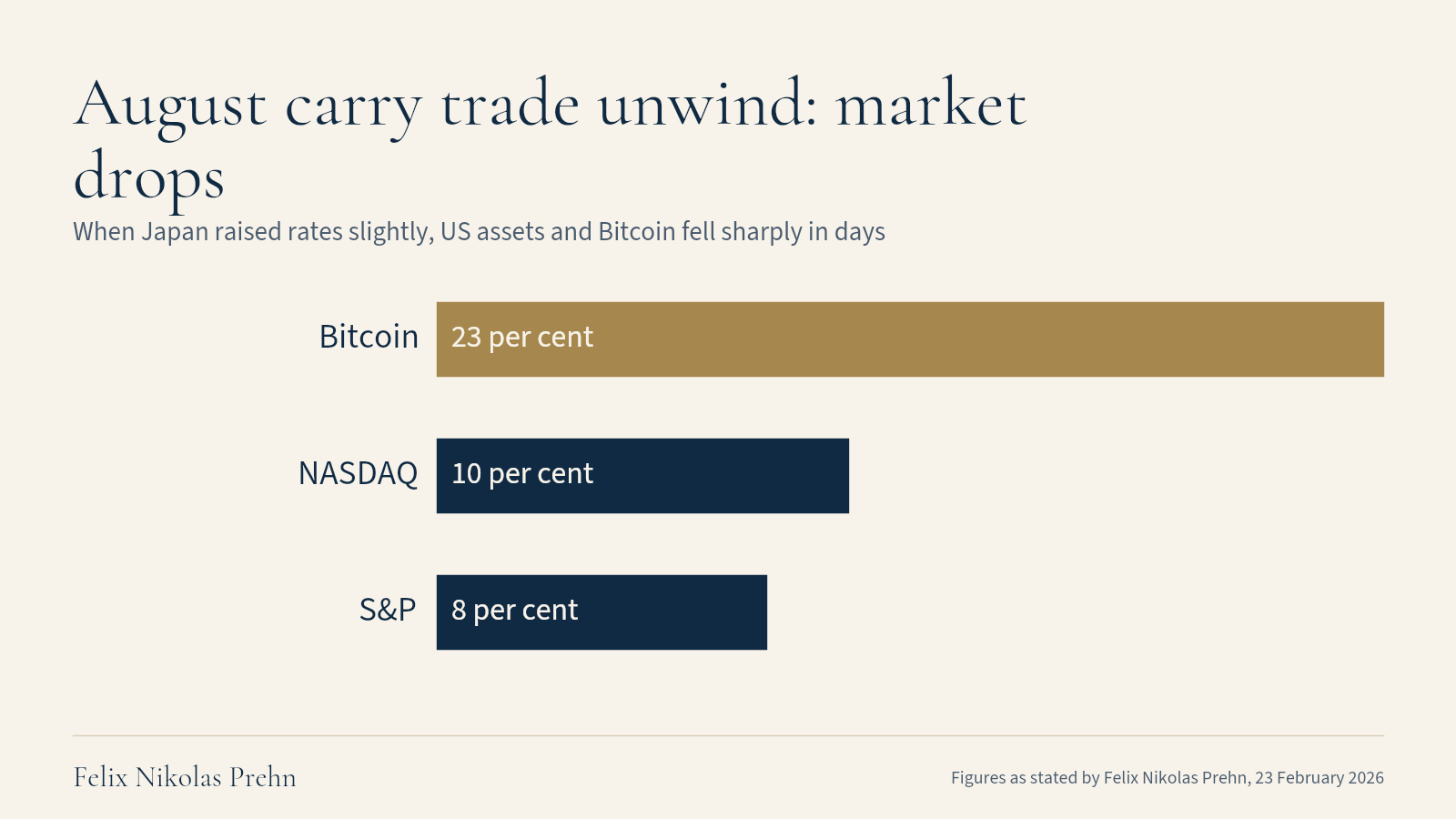
In Felix's view, a partial unwinding occurred in August after Japan raised interest rates by a small amount.
In the days that followed, Bitcoin fell 23 per cent. The NASDAQ fell 10 per cent. The S&P fell 8 per cent.
The 20 trillion dollars of Japanese money started leaving America because the carry trade no longer made sense. Investors could collect higher interest rates at home in Japan.
Headlines from late 2026 describe the risk of the yen carry trade unwinding as a threat to American stocks and global bond markets. The risk is reported as growing as yen strength builds.
America's mirror image
American debt is 120 per cent of its economy. The government runs a trillion dollar deficit every single year.
Felix argues that the United States is about 10 to 15 years behind Japan on the same debt path, but moving much faster. American debt and deficits are growing faster than Japan's did at the same stage, in his view.
Reports from late 2026 confirm that federal debt has surpassed its wartime peak as a share of GDP. The deficit for the last fiscal year was estimated at 2 trillion dollars.
The inflation playbook
Governments that cannot repay debt can default. They can cut spending and raise taxes. Or they can print money and inflate the debt away.
Felix argues that defaulting is unnecessary when a government can paper over the problem. To cut spending and raise taxes is politically suicidal. No elected government will choose either path voluntarily.
The only politically viable option is the third, which is to print money and inflate the currency.
The mechanism runs in steps. The government borrows more money by selling more bonds. The central bank prints money to buy those bonds.
The government spends the borrowed money on deficits, social programmes and defence. Prices rise because more and more money chases the same goods.
The debt becomes easier to repay. The currency is worth less, so each dollar returned to creditors buys less than the dollar originally borrowed.
Long-term government bonds lose value when inflation rises above their coupon rate, the fixed interest they pay. A bond paying 4 per cent loses buyers when inflation reaches 7 or 10 per cent, causing the bond's price to fall as demand disappears.
Japan's experience, where bonds fell from 99.8 yen to 38 yen, is the extreme version of the same process. Cash, despite being insured by the FDIC, loses purchasing power each year. A 4 per cent dividend yield falls short when asset prices rise at 10 or 20 per cent a year.
Historical precedent and government incentives
Japan changed its accounting standards when bond losses threatened its banking system. Other governments have done the same when faced with comparable pressures. The currency absorbs the loss through depreciation.
Gold and silver have survived every currency collapse over 5000 years of recorded history. No fiat system, money backed by government decree rather than a physical commodity, has matched that record. In the 1970s, when the United States carried high debt and inflation, gold went from 35 dollars to 850 dollars, a 24 times return.
Japan chose to alter accounting rules rather than accept a financial collapse. The choice reveals a clear political preference for inflation over default. American debt and deficits are growing faster than Japan's did at a similar stage. Felix argues the United States is on a comparable but accelerated trajectory. Currency debasement, in his view, remains the most politically expedient path for any government unwilling to cut spending or raise taxes.