Japan's bond market sent a signal not seen in more than 25 years. The 10 year interest rate hit 2.35 per cent after a general election.
Japan lent at or near zero for three decades. A rate of 2.35 per cent marks a new regime. The consequences reach the carry trade and assets priced in paper currencies.
Japan elects a stimulus prime minister
In Felix's view, Sanae Takaichi won a two thirds super majority in Japan's parliament. The margin gives her the votes to pass any legislation she chooses.
The opposition, Felix argues, has about 3 seats left. Takaichi faces no gridlock and no need for coalition arithmetic.
Takaichi is promising massive government spending, broad tax cuts and a 2 year suspension of the food tax. Her programme amounts to a fiscal expansion funded, one way or another, by new money entering the system.
A two thirds majority means she can push through whatever policy she wants. The political constraint that usually slows spending, a divided legislature, does not apply.
Interest rates spike to a 25 year high
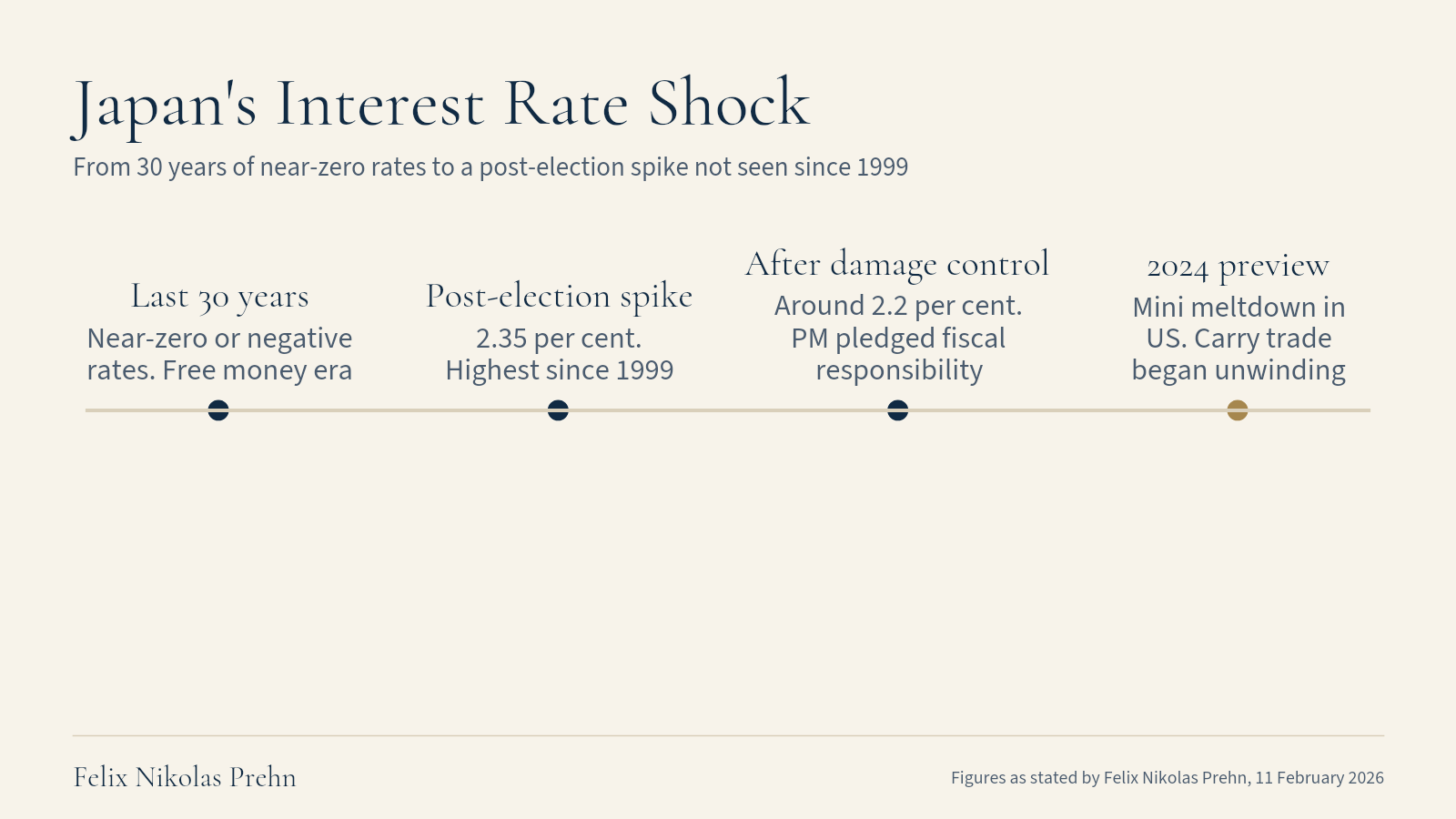
Right after the election, Japanese interest rates spiked to their highest level since 1999. The 10 year rate reached 2.35 per cent. Bond markets (where governments borrow) priced in the spending promises immediately.
In response, Takaichi used the phrase "fiscal responsibility." The 10 year rate eased to around 2.2 per cent. After 30 years of near zero rates, the departure is sharp. Bond investors are raising the cost of Japanese government borrowing without central bank action.
Three decades of free money end
Japan has had near zero or even negative interest rates for the last 30 years. A generation of capital allocation was built on the assumption that yen borrowing costs nothing. Banks, insurers, pension managers and hedge operators structured vast positions on the premise that yen loans were free.
A jump from zero to 2 per cent forces a re-examination of every trade built on the old rate. To close these positions, holders must sell the assets on the other side.
The carry trade explained and under threat
The carry trade means borrowing in one currency to invest in another at a higher rate. It has been one of the largest strategies in global finance.
A trader borrows yen at close to zero per cent. The money goes into US assets yielding around 5 per cent. The difference is profit, minus currency hedging costs.
The carry trade faces a shrinking margin. Japanese borrowing costs have risen above 2 per cent.
US interest rates have come down to around 4 per cent. Currency hedging costs erode the gap further. In Felix's view, the trade is starting to end.
If Japanese investors unwind their positions, they must sell their US holdings to repay yen loans. More selling pushes US stock prices lower. Lower prices trigger automated liquidation by exchange-traded vehicles, pension managers and leveraged accounts.
A preview occurred about a year and a half ago, in 2024. Japan signalled it might raise interest rates.
The carry trade began to unwind. The United States experienced a mini meltdown.
A full unwinding would involve far larger sums and last longer than the 2024 episode.
Japan's 1.4 trillion dollar reserve and the US debt link
Japan has 1.4 trillion dollars in foreign reserves, mostly in US dollar assets. Japan also runs a special account for its currency operations. The latest surplus from that facility came to about 5 trillion yen.
Felix argues that Takaichi is eyeing that surplus to fund her tax cuts without borrowing more money. She cannot print endlessly and claim fiscal responsibility at the same time. The surplus is a source of funds that does not require new borrowing.
If Japan sells US government debt to fund domestic tax cuts, bond supply on the market rises. More supply pushes bond prices down and yields (the interest rate the US government must pay) up.
Higher US rates increase mortgage payments, car loan charges and corporate borrowing expenses. Companies that must pay more to borrow earn lower profits, and stock prices fall in turn. The dollar strengthens, which hurts American exporters.
Geopolitical tensions in the US-Japan relationship
Japan has promised to invest 550 billion dollars in the United States. Trump lowered tariffs on Japanese goods in return. The 2 countries signed a rare earths deal important for technology and defence.
Felix argues that Trump endorses Takaichi because they are politically aligned. She favours higher defence spending, a harder line on adversaries and an assertive national identity. Trump is promising the Dow Jones index will reach 100,000 points by the end of his term.
Takaichi's spending agenda conflicts with that target. An unwinding carry trade would force selling of US stocks.
If she funds tax cuts by offloading US government debt, American interest rates rise. The dollar strengthens.
Neither outcome suits the White House. The US administration may value Japan as an ally. Takaichi's domestic agenda conflicts directly with the White House's own economic targets.
Competitive devaluation and hard assets
Felix argues that when Japan prints money, the yen weakens. Other countries must respond or watch their exports become more expensive. The result is a race to devalue paper currencies.
Europe is already printing. If Japan floods its system with stimulus, the Federal Reserve will have to keep rates lower. The alternative is a debt spiral.
Gold and silver gain when governments print money. So do high quality companies with real earnings and low debt.
Certain firms have products so good that they can raise prices faster than inflation. Loyal customers continue to buy at higher prices, which protects margins during inflationary periods.
A company that can raise prices faster than inflation keeps its margins intact. Firms loaded with debt and no pricing power get crushed by rising rates and falling currency values.
In the 30 days before the latest data, gold dropped nearly 9 per cent. Silver fell more than 26 per cent.
Gold and silver cannot be printed. No central bank can manufacture either metal.
Japan's shift from free money to large scale stimulus threatens the carry trade. If the carry trade unwinds, Japanese investors sell US assets and prices in America fall.
Takaichi could fund her tax cuts from the reserve surplus. To do so she would offload US government debt. American borrowing costs would rise.
A weaker yen makes other countries' exports more expensive. Other central banks respond by printing more. Japan's stimulus forces Europe and America to match or accept costlier exports.
All three currencies, the yen, the euro and the dollar, lose purchasing power in the same period. In Felix's view, gold, silver and businesses with genuine earnings keep their worth while paper money depreciates. Companies with pricing power and low debt retain value in that environment.