
JP Morgan is targeting an S&P 500 level of 7,200.
The bank's institutional research lays out two paths for markets. Each is determined by one variable: the Middle East ceasefire.
One path leads to a tech rally, a weaker dollar and rising precious metals. The other leads to 150 dollar oil and a firmer dollar. JP Morgan sees money flowing into energy and defence in that case.
JP Morgan's S&P 500 Target and the Tech Rally Case
JP Morgan expects technology stocks to rally sharply. The bank gives two reasons.
Earnings season is approaching, and the bank expects results to be good.
Tech stocks have been beaten down during the conflict period. A wave of doubt about the commercial viability of artificial intelligence added to the selling.
The sell-off created a gap between price and expected earnings.
Institutions have been bearish on large technology companies for weeks. JP Morgan sees a catch-up trade, where institutional positioning lags behind improving fundamentals.
The bank describes its outlook as a "love letter to the Magnificent 7 stocks." The 7 are the mega-cap technology firms that dominate index weightings.
Hedge Fund Borrowing and What It Signals
Hedge funds borrow to trade. A fund with 1 billion dollars of its own capital might borrow 25 times that amount. Some take on 40 times that amount in debt.
Borrowed money amplifies returns. The amount a fund borrows determines how much it can buy.
Felix argues that hedge fund borrowing has dropped from the high of the past 12 months.
Headlines elsewhere report mixed signals. Some funds have added short positions. At least one collapse has been linked to record borrowing.
The aggregate drop in borrowing leaves money available. If the ceasefire stays intact, hedge funds are expected to put that money to work. Technology stocks would be the destination.
The buying pressure from renewed borrowing would concentrate in the same beaten-down tech names JP Morgan favours. The conditionality remains: all of it depends on the ceasefire.
Retail Sentiment and Historical Positioning Data
Stocks have been sold on 7 of the past 8 trading days this month. The pattern has been consistent for most of the month.
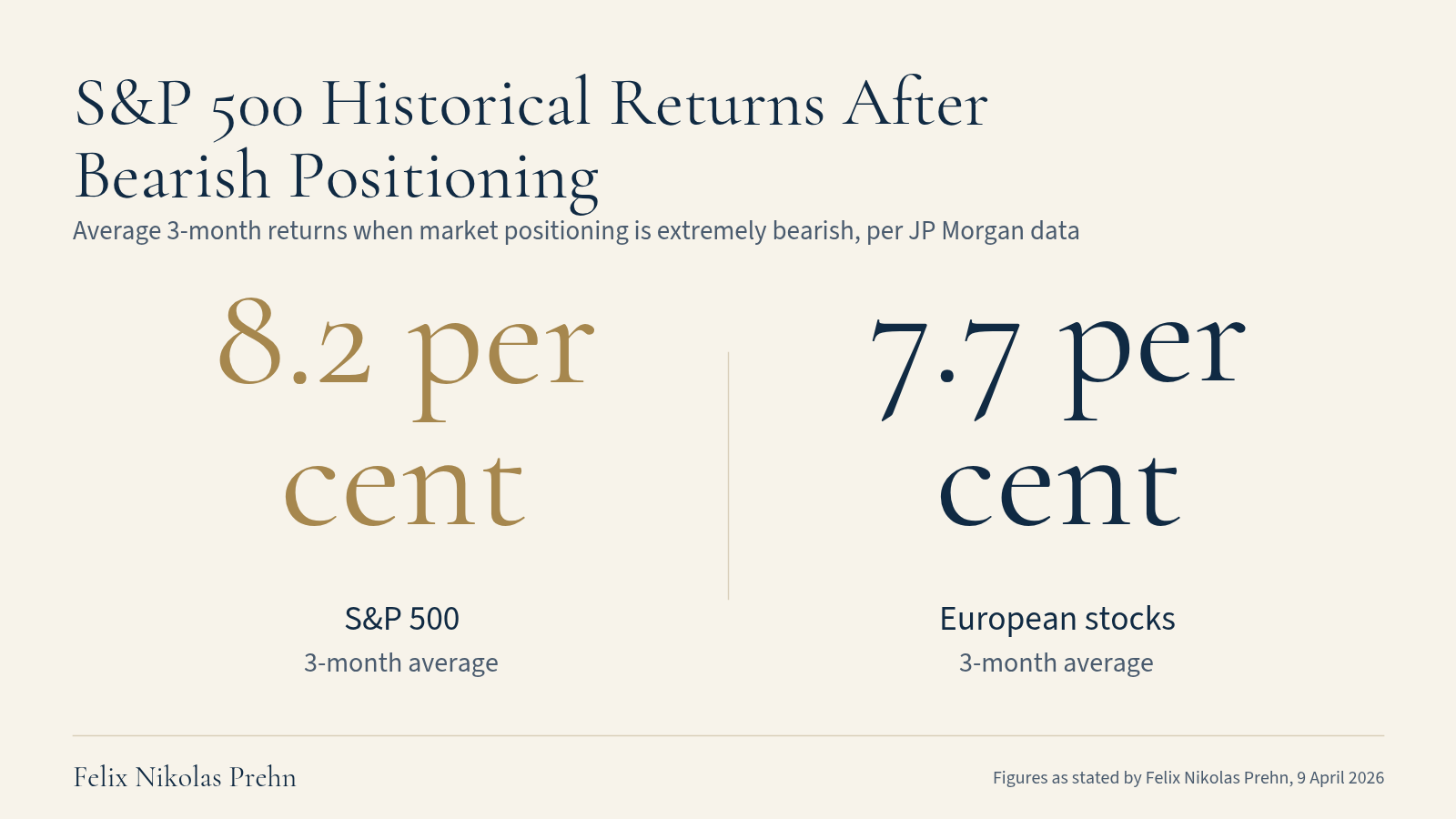
JP Morgan's data show a pattern. When positioning has been this bearish, the S&P 500 has returned 8.2 per cent over the following 3 months.
European stocks in similarly extreme positioning have returned about 7.7 per cent over the subsequent 3 months on average.
JP Morgan presents the figures as historical observation.
The pace of selling creates the potential for a reversal as money flows back into a falling market. Leveraged exchange-traded products (vehicles that use borrowed money to multiply daily index returns) can amplify such moves.
The Bullish Scenario: Dollar Weakness, Sector Rotation, and Precious Metals
In the ceasefire-holds scenario, JP Morgan expects the US dollar to weaken. A falling dollar has a well-documented relationship with precious metals. Gold and silver tend to rise when the dollar falls.
JP Morgan lays out a specific sequence for the stock rally.
The Russell index of small-capitalisation companies goes up first. The NASDAQ, heavy with technology stocks, follows. The S&P 500 comes last.
Beyond technology, JP Morgan is bullish on home builders, retailers and financials in this scenario.
JP Morgan expects spending on housing and retail to rise as sentiment improves.
For financials (banks and insurance companies), the bank expects good earnings, and notes that selling pressure has been heavy. The bank sees a bounce driven by lower interest rates and cheap oil.
Precious metals would see a rebound as the dollar pulls back. Metal miners may see a bid on recent tariff changes.
The Bearish Scenario: Oil Shock and Dollar Strength
The bearish scenario begins with the Houthis. If attacks continue, Houthi forces backed by Iran would close the Red Sea.
JP Morgan expects Saudi oil production to go offline in that case.
Saudi Arabia has already cut output to its lowest level this year. Attacks on its infrastructure, including a pipeline, have been described as a serious threat to production. Saudi Arabia is reportedly planning operations to secure the Red Sea corridor.
If Saudi production goes offline, JP Morgan expects oil prices to reach 125 dollars and then 150 dollars.
JP Morgan expects the dollar to strengthen in this scenario. A firmer dollar would cause stocks, gold and silver to sell off, the reverse of the bullish case.
Bearish Sector Picks: Energy, Defence, and Fertilisers
In the bearish scenario, JP Morgan identifies a narrow set of sectors that would benefit. JP Morgan names energy stocks, oil services firms, and storage and pipeline operators. Defence firms and fertiliser stocks round out the list.
A 1.5 trillion dollar military budget has been proposed. A 200 billion dollar request from defence companies would likely get approved if the conflict escalates. The proposed budget is stalled after Congress passed a short-term funding bill, and remains a subject of political debate.
Airlines would be particularly hurt. Some smaller carriers could go out of business.
Two Scenarios, One Variable
JP Morgan's research presents two distinct outcomes for markets, contingent on the stability of the Middle East ceasefire. In the first scenario, the bank expects the dollar to fall, gold and silver to rise, and money to flow into technology, home builders, retailers and financials. If it collapses, the bank sees oil at 150 dollars, a stronger dollar, and buying concentrated in energy, defence and fertiliser stocks. JP Morgan's 7,200 target on the S&P 500 rests on the ceasefire holding. In the bearish case, JP Morgan expects oil at 125 dollars rising to 150, with capital moving into a narrow set of commodity and defence names.