
The Strait of Hormuz Blockade
Iran's guard corps declared that not a litre of oil will pass through the Strait of Hormuz. The strait carries 20 per cent of the world's oil supply. One barrel in five has been removed from daily global flow.
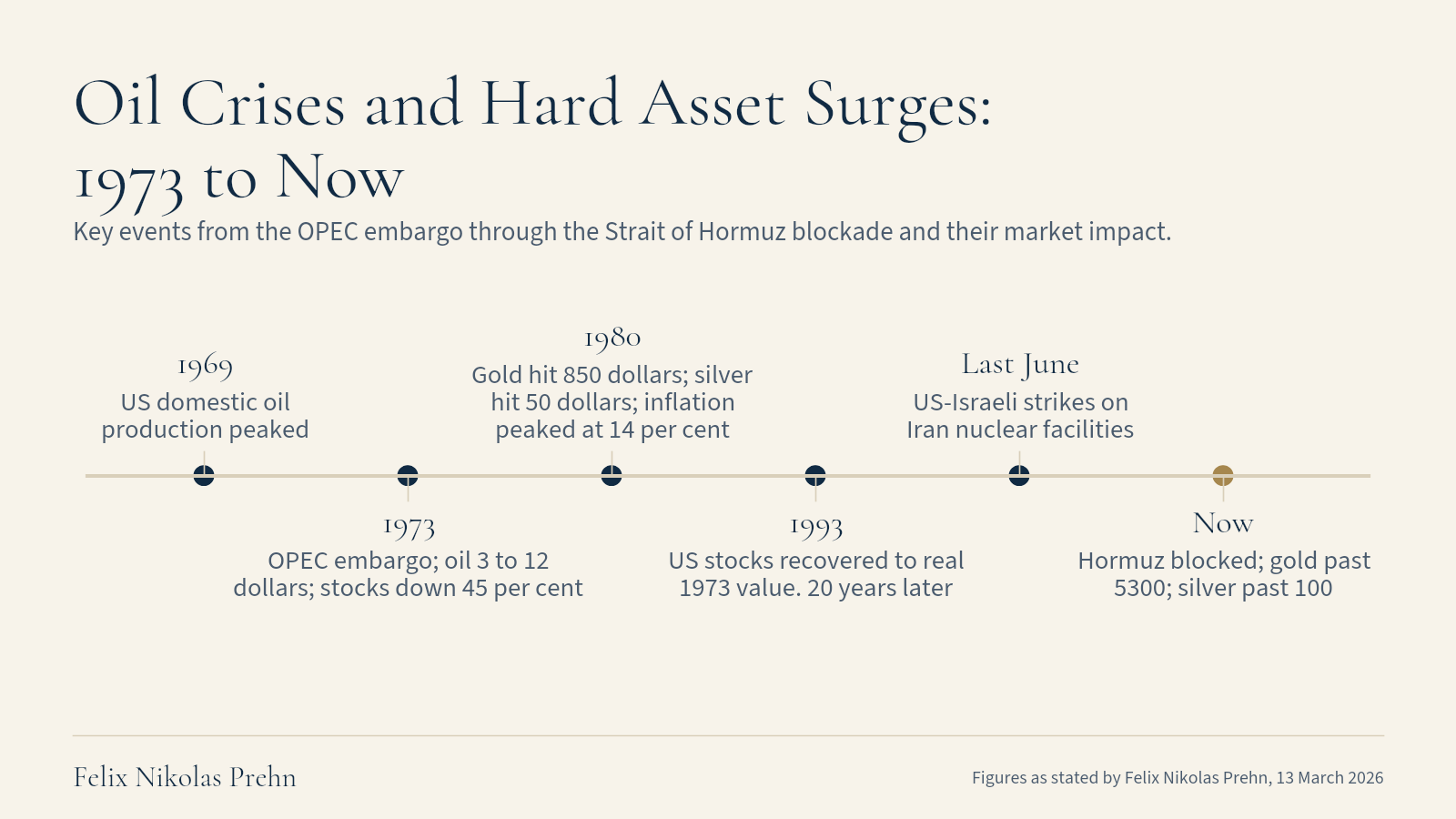
Brent crude oil prices are above 100 dollars a barrel. Around a thousand ships are stranded in the Persian Gulf. Tankers have accumulated near the strait, with crews unwilling to risk transit.
Iran does not need a large navy to enforce its threat. Disruption can be achieved with minimal military capability, such as drones carrying simple ordnance, sufficient to threaten passage through the chokepoint.
Wire services and satellite trackers give conflicting accounts. Some tankers are still moving, and oil continues to flow in reduced volumes. The disruption is severe enough to sustain price pressure, even if the blockade is not total.
The 1973 Playbook
American domestic oil production had peaked in 1969. The United States was importing about 35 per cent of its oil from the Middle East. Oil was cheap, and nobody questioned the dependence.
In October 1973, Egypt and Syria attacked Israel. The United States backed Israel. In retaliation, Saudi Arabia and other Arab OPEC nations embargoed oil exports to the United States.
Oil prices quadrupled from 3 dollars a barrel to 12 dollars. Food prices rose 19 per cent during the crisis because fertiliser is an oil-derived product.
The pattern today resembles 1973. A Middle East conflict targets oil supply as a weapon. The percentage movements differ because the United States is a much larger oil producer now than it was then, but the cost shock is still present.
The Inflation Spiral
The cost of living in the 1970s shot up 8 per cent almost immediately after the embargo. It peaked at about 14 per cent by 1980. A decade of compounding inflation cut the purchasing power of cash roughly in half.
US inflation is running at 2.4 per cent. Economists project it could hit 3.5 per cent or higher because of oil at 100 dollars a barrel.
Energy disruptions create inflation, which in turn destroys paper wealth. Transport, manufacturing and food costs all rise with the oil price.
Higher inflation means interest rates will not fall. Higher rates weigh on technology, fintech, biotech and AI stocks.
Stock Market Devastation Then and Now
The stock market fell 45 per cent during the 1973 crisis. London lost 73 per cent of its value in the same period.
The American stock market did not recover to its real, inflation-adjusted value until 1993. Recovery took 20 years because inflation eroded nominal gains so thoroughly that real purchasing power stayed below the 1973 peak for two decades.
Gold and Silver in Crisis
In 1971 Nixon took the United States off the gold standard. Gold was no longer pegged at a fixed price of 35 dollars an ounce. It was free to find its real price while the government was printing money.
Gold moved from 35 dollars to 120 dollars by mid-1973. It reached 850 dollars an ounce in 1980, a rise of more than 2,000 per cent from the 1971 price.
Gold was pricing in the 1973 crisis before the embargo began. The metal surged while oil was still cheap, and the cutoff followed months later.
Silver reached 50 dollars an ounce in 1980. Silver is a monetary metal like gold, but it is also used in solar panels, electric vehicles, AI infrastructure and medical devices. In bull markets silver outperforms gold because it carries manufacturing exposure on top of its safe-haven bid.
Gold surged past 5,300 dollars straight after the US-Israeli strikes on Iran's nuclear facilities. Silver broke 100 dollars for the first time ever.
Central banks have been buying the metal at a pace the World Gold Council calls historic. Kazakhstan's central bank, however, has moved to reduce its gold reserves.
Felix argues that China has restricted silver exports. Headlines have not confirmed current silver export restrictions from China, though Beijing has imposed controls on other materials including rare earths.
Emergency Reserves and the Current Response
The International Energy Agency proposed the largest release of emergency oil reserves in history at 400 million barrels. The United States is tapping its strategic petroleum reserve. Only 172 million barrels remain.
Last June, US and Israeli strikes hit Iran's nuclear facilities. The Department of Defense estimates the operation set back Iran's programme by 2 years. Iran's guard then declared that not a litre of oil would pass through the strait.
Emergency reserve drawdowns do not restore supply through the strait. The market treats reserve releases as a temporary measure, not a structural solution. Oil prices have remained above 100 dollars a barrel despite the announced drawdowns.
After the 1970s crisis, the Carter administration invested in alternative energy. Carter's energy investments eventually led to fracking, which made the United States an oil exporter. The shale era acted as a pressure relief valve, and complacency about the security of shipping lanes returned.
Supply Deficits and Forward Forecasts
Silver has been in a supply deficit for 6 years running. Industrial applications account for 60 per cent of demand for the metal. Silver demand from manufacturing remains the larger share of consumption.
JP Morgan says gold could hit 6,000 dollars this year. Silver forecasts run up to 150 dollars an ounce.
If oil remains above 100 dollars, inflation will not fall. Persistent high rates will weigh on technology, fintech, biotech and AI stocks.
A conflict has removed oil from the market, and the resulting price shock feeds into inflation. As inflation erodes the real value of financial assets, capital moves into commodities with constrained supply.
The 1973 episode took a full decade to resolve. If the strait remains closed, inflation will keep rising. Real returns on financial instruments will decline, as they did through the late 1970s.