
The Rate Hike That Should Not Have Happened
The Federal Reserve raised interest rates for the first time since 2023. Oil is above 100 dollars. Diesel, fertiliser and agricultural inputs are up between 40 and 140 per cent this year.
Rate rises make sense when inflation comes from demand. Too much money chases too few goods, so the central bank cools spending and eases price pressure.
An oil shock is a different problem. Prices are rising because energy and food cost more to produce.
Energy costs feed into diesel, fertiliser and factory inputs. When oil goes up, production costs follow.
Higher interest rates do not touch the cause of supply side inflation. Oil remains expensive because Houthi forces are attacking shipping infrastructure in the Middle East.
In Felix's view, half the world's fertiliser comes out of Iraq. Felix argues that Russia and China control the largest share of the rest.
The rate rise punishes borrowers such as families with mortgages, small businesses, and farmers financing seasonal costs. Their cost of money increases at the exact moment their input costs have already surged.
As families and firms cut back on spending, the economy slows. Prices remain high, however, because the underlying supply-side causes are unaffected.
The Oil Shock on the Ground
American farmer John Boyd Jr. is paying 7 dollars a gallon for diesel. A combine harvester takes 140 gallons. One full tank costs about 1,000 dollars.
Higher input costs pass through the supply chain. The farmer charges more for grain to cover those costs.
The haulage firm pays more for diesel and raises its transport price. The shop pays more for delivery, so the loaf on the shelf costs more.
An original oil price spike is multiplied 3 or 4 times over by the time it reaches the consumer. Each step in the supply chain adds cost before goods arrive at the till.
Headlines from September 2026 confirm that American farmers face severe input cost pressure. High input costs are already weighing on planting decisions for the next season.
The 1970s Parallel
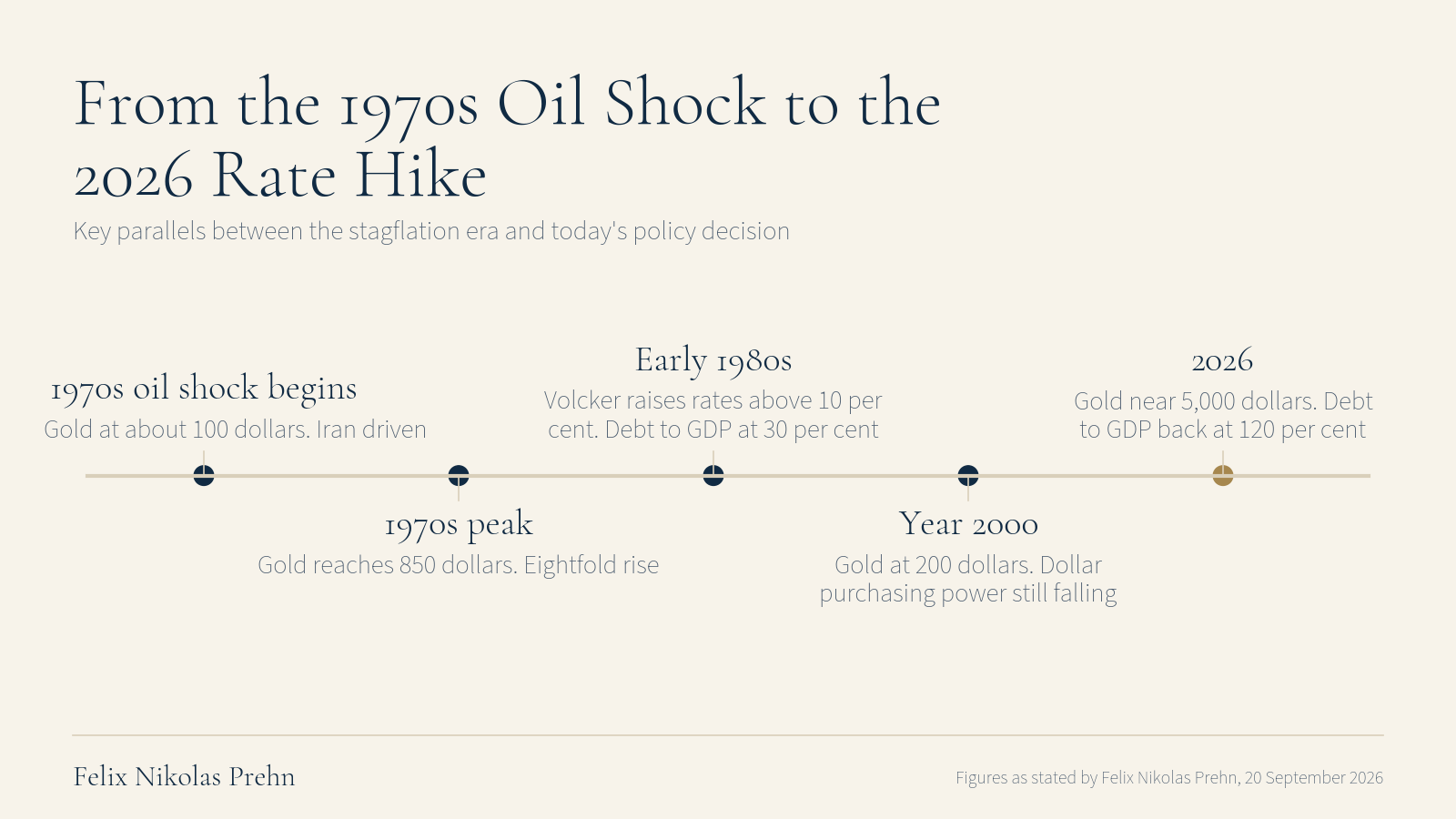
Gold rose from about 100 dollars to 850 dollars in the 1970s stagflation period. As the Iran-driven oil shock took hold, interest rates and inflation rose in tandem.
The Federal Reserve tightened into a supply shock. The economy stagnated while prices climbed.
After COVID, the government printed 4 trillion dollars of new money and said it would not cause inflation. Official government inflation peaked at 11 per cent.
Financial commentators are drawing parallels between the current environment and the 1970s. The central bank tightens credit. Energy prices, the source of the inflation, do not respond to interest rates.
The Debt Refinancing Trap
The Financial Times reports that 8 trillion dollars of government IOUs come due in the next 12 months. Old debt carried an average coupon of 3.3 per cent. The current interest cost is closer to 5 per cent.
The jump from 3 per cent to 5 per cent on 8 trillion dollars adds about 130 billion dollars a year. Every notch higher on rates makes the government's own debt more expensive.
At the recording date, 457 billion dollars of government debt had to find a buyer within 4 days. If there are not enough buyers, the government must offer higher interest rates to attract them.
Higher rates to sell debt mean more expensive borrowing everywhere else. Money moves into bonds because the government offers a large, risk free interest rate.
The alternative is for the Federal Reserve to print money and buy the government's debt. Felix argues that this is the 1940s playbook.
Fresh currency absorbs the debt. Each additional dollar dilutes the purchasing power of those already in circulation.
Why Volcker Cannot Be Repeated
Paul Volcker crushed inflation in the early 1980s with double digit interest rates above 10 per cent. He could do so because debt had already fallen.
It dropped from about 120 per cent of the economy to about 30 per cent. The government could absorb punishing rates at that level.
US government debt to GDP is back at about 120 per cent. The last time it reached that level was the 1940s, after World War II.
Felix argues the government cannot hold rates high enough to kill inflation today. Sustained rates at those levels would bankrupt the treasury first.
In Felix's view, the quarter point rate hike is a piece of theatre. The increase is too small to restrain prices. It still raises the cost of refinancing the government's own liabilities.
The government budget would collapse before interest rates could reach the levels Volcker used. Instead, prices will rise and the currency will lose value, shrinking the national debt in real terms. At 120 per cent debt to GDP, inflation shrinks the real value of what the treasury owes.
The Dollar Melt and Hard Assets
A 1971 dollar is now worth about 7 cents according to government statistics. The United States cut the last link between the dollar and gold in 1971. After that, the government could print as much money as it wanted.
The average US home price went from 160,000 dollars to about 450,000 dollars in the last 25 years. Gold went from 200 dollars to about 5,000 dollars since the year 2000.
An energy driven price surge now coincides with a rate rise the Federal Reserve cannot sustain. At 120 per cent of GDP, the government cannot raise rates to Volcker levels without bankrupting itself.
Felix argues the only option left is to let inflation stay hot. Higher prices erode the real value of the debt over time.
Central bank gold buying is rising at the fastest pace since about 1997. The institutions that print the currency are buying gold rather than accumulating their own paper. Felix argues that the people who print the dollars are buying gold, implying a lack of confidence in the money they themselves create.