
The sulfuric acid crisis
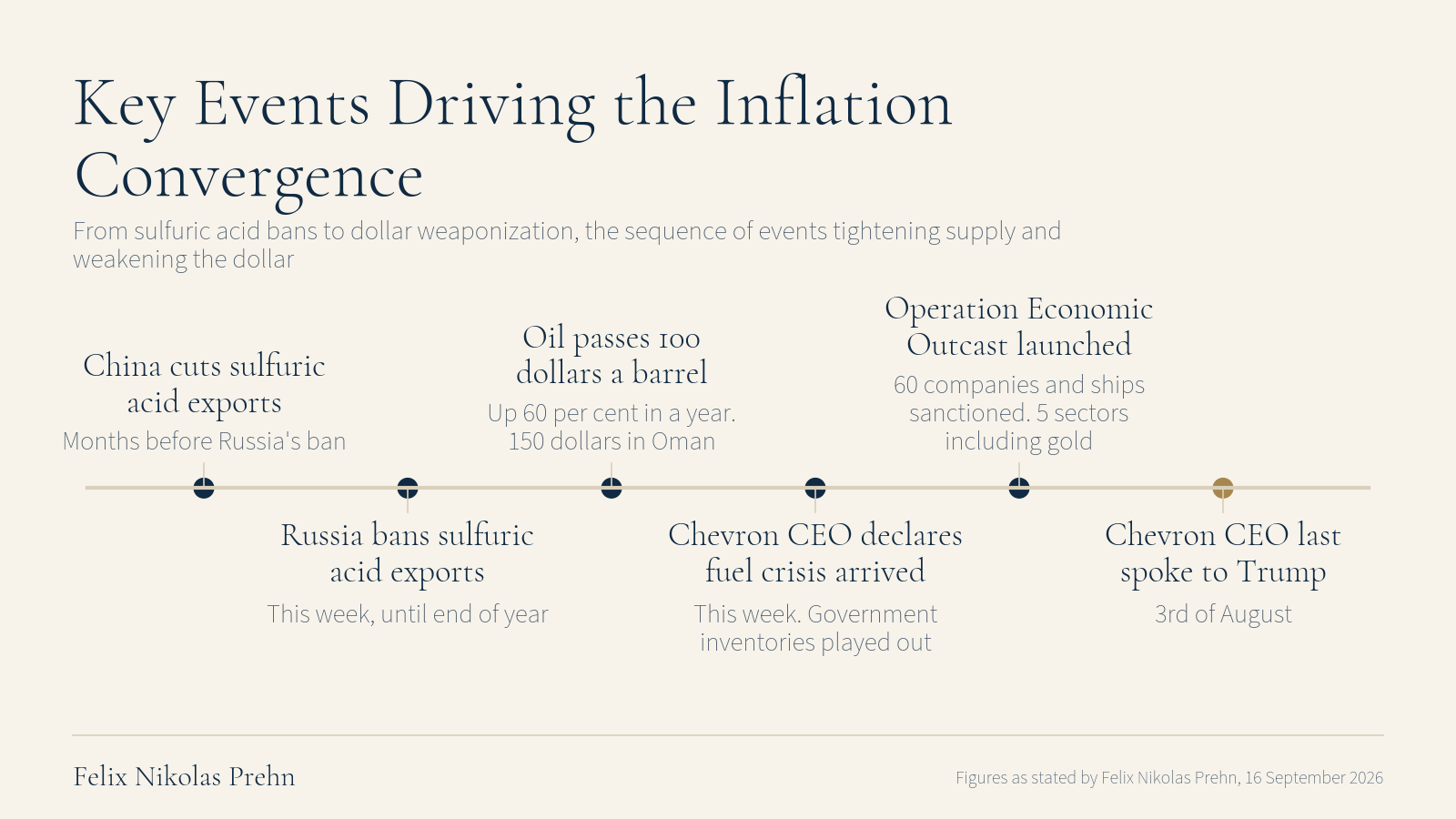
Russia banned sulfuric acid exports until the end of the year. China had already cut its acid shipments months before. Russia and China between them are the 2 largest suppliers, and Felix argues they recognise a shortage is forming.
Sulfuric acid is the chemical required to process copper, nickel, uranium and fertiliser.
The Middle East produces half of the world's sulfur, the raw material for the acid. In Felix's view, the vast bulk of acid production capacity is in that region.
Australia closed most of its smelters. The country came to rely on imports, which have stopped.
Half of global sulfur and 20 per cent of the world's oil pass through the Strait of Hormuz. The strait is in a conflict zone. Reports describe continued disruption to traffic, with freight costs remaining high.
Fertiliser is choked off because the acid cannot be made.
Food yields drop and prices rise. In Felix's view, shortages of food bring governments down.
Administrations always choose the printing press over a riot.
Oil above 100 and the energy squeeze
Oil is trading well over 100 dollars a barrel, up 60 per cent from a year ago. In Oman the price is 150 dollars a barrel. Lorries, ships and planes all burn fuel, and when oil goes above 100, everything that moves becomes more expensive: transport, manufacturing, plastics.
Chevron's CEO said publicly this week that the fuel crisis oil executives warned about has officially arrived.
Government inventories used to soften prices have been played out. Chevron's CEO added that he has not spoken to Trump since the 3rd of August.
Oil surged above 100 dollars a barrel on intensifying Middle East conflict, though prices have fluctuated in subsequent sessions.
Felix argues the oil shock and the fertiliser crisis arrive together. Oil at these levels raises the cost of moving goods. Without acid, fertiliser becomes scarcer and food dearer.
Operation Economic Outcast and dollar weaponisation
The US government launched something called Operation Economic Outcast. The Treasury Secretary called it a financial D-Day, sanctioning 60 companies and ships in 5 sectors, including gold. Any country caught helping Iran faces removal from the dollar system under the programme.
Washington turned the dollar into a weapon against one state.
Felix argues that neighbouring countries are watching closely. Washington could do the same to another country.
Felix argues that fear alone pushes governments to shift reserves out of dollars and into gold.
Central banks bought 22 billion dollars of gold in the last 3 weeks, from available data. Central banks have publicly increased their gold reserves as part of a broader trend away from dollar holdings.
Hedge fund borrowing in US Treasuries
Hedge funds have 2.2 trillion dollars of US government debt, Felix argues, 3 times the level of 5 years ago.
Most of that sum, he contends, is inside leveraged basis trades. In a basis trade, a fund buys a bond and sells the futures contract against it.
It borrows heavily to pocket the tiny gap between the 2 prices.
A fund can borrow 20 or 30 times over, or more. The trade only works when the market is calm.
The moment prices move against the fund, it must unwind immediately. To unwind, a fund must sell government bonds into a market that is not full of buyers.
Felix argues a 1 per cent drop in bond values costs such a fund 40 per cent. A 2 per cent drop wipes out 80 per cent. Long-term interest rates are the highest they have been since 2007.
When hedge funds dump bonds, interest rates spike further. A buyer getting 6 per cent risk free from government debt has less reason to own a riskier stock. Gold, which pays no income, suffers too.
If rates go up, the government's borrowing bill becomes unpayable. If the Fed buys bonds to force rates back down, it prints money. Money creation on that scale feeds directly into higher prices.
Gold and silver positioning by institutional money
Professional traders, hedge funds and algorithmic desks bought 22 billion dollars of gold futures over 3 weeks, a 10 year record. Central banks bought the same amount in the same period, from available data. Russia, as Felix puts it, is selling gold to fund its wars rather than adding to reserves.
One Wall Street trading desk placed a call option on silver at 90 dollars within 30 months.
The strike is roughly 50 per cent above current levels. The silver market is tiny next to gold.
When money pours in, sellers are scarce. The price jumps violently.
Felix argues that gold tends to fall at first when a conflict begins.
Oil causes inflation. Inflation causes higher interest rates.
Higher rates mean more risk free income from government debt, drawing money away from gold.
The dollar's long decline and the printing press
The dollar came off the gold standard in 1971.
A 1971 dollar is worth a couple of cents today, by the government's own inflation figures. Successive administrations printed dollars to fund spending, win elections and stimulate economic activity.
The purchasing power eroded gradually over 5 decades.
A trillion dollars is in a Treasury account, ready to deploy. The federal buyback programme was doubled, repurchasing Treasury bonds and injecting cash into the financial system.
More dollars are going to be created. Fewer countries want to own them, given Washington's willingness to weaponise the currency. Felix calls that the textbook recipe for inflation.
Low interest rates covered the strain for years. Felix compares the effect to a rug rolled over a stain.
When rates rise, the cracks become visible. Every small and medium enterprise on a flexible loan rate faces a higher bill.
Felix argues the cumulative cost creates a recession.
The chain runs from sulfuric acid bans through oil prices, fertiliser shortages and food inflation to the printing press.
In Felix's view, more dollars will be created and fewer countries will want to own them. Professional traders bought 22 billion dollars of gold futures over 3 weeks.
Central banks matched that figure in the same window, from available data, as Felix puts it. Felix reads that flow as a bet against the dollar's purchasing power. Hedge funds borrowing 20 or 30 times over against 2.2 trillion dollars of Treasuries face losses of 40 per cent on a 1 per cent bond price drop. Each link in the chain, from blocked acid exports to 150 dollar oil to sanctions that punish dollar holders, adds to the inflationary pressure that erodes the value of cash.