
Goldman Sachs traders have said plainly that the Federal Reserve is "much more passenger than driver." A corporate borrowing wave now controls long-term interest rates. The consequences run through government bond yields, inflation, gold and silver. AI companies need more capital than the bond market has ever been asked to supply.
Goldman Sachs says the Fed lost the wheel
Three of the most senior cross-asset traders at Goldman Sachs made the statement on camera. Mark Wilson, who runs equity franchise sales, appeared alongside specialists in macro and European rate strategies.
AI has become a bond market and credit story. The Federal Reserve sets an overnight rate, a very short-term cost of borrowing.
Mortgage costs, car loans and the government's own interest bill depend on the long-term rate. When AI companies issue a trillion dollars in new debt, yields on the bonds that set mortgage costs and sovereign interest bills rise. A trillion-dollar borrowing wave originated outside the Federal Reserve, and no tool in the central bank's kit can counteract it. The central bank has no way to offset it.
The most capital hungry investment cycle in history
Goldman Sachs calls the AI data-centre buildout the most capital-hungry investment cycle in history. The large technology companies need data centres, power plants to run them and chips to fill them.
Their profits are high, but not enough to cover the full cost. So they turn to the debt market.
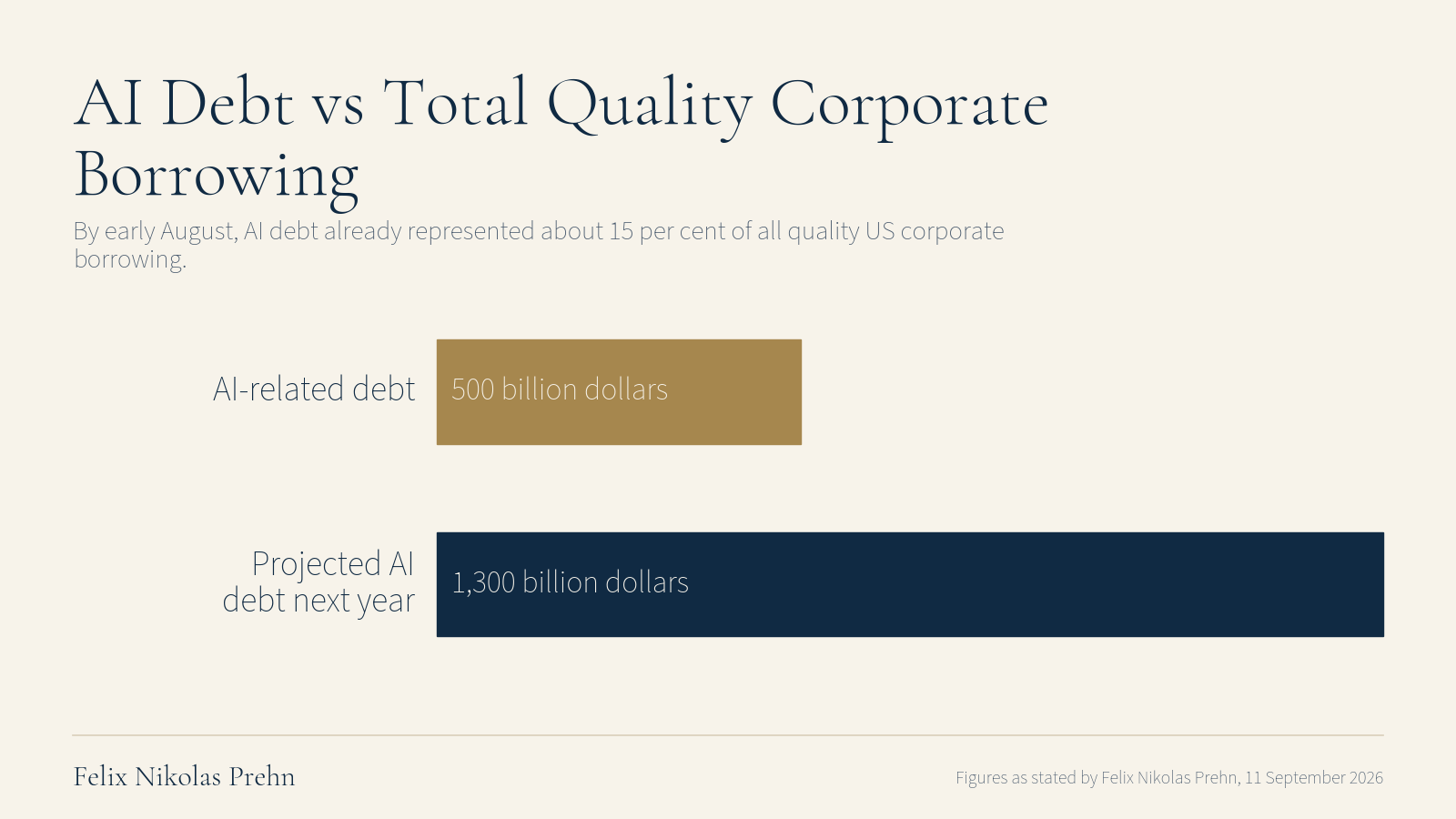
AI-related debt had climbed towards 500 billion dollars by early August this year. The figure accounts for about 15 per cent of all quality corporate borrowing in America.
Goldman Sachs expects AI-related companies to need 1.3 trillion dollars in debt next year. The bank says that next year a handful of tech firms will issue more debt than the United States government.
When tech companies flood the market with new debt, buyers must find cash somewhere. They sell what they already have, government and mortgage debt, to buy the new corporate paper that offers higher returns.
When government bonds are sold, their prices fall and the yield (the interest the bond pays) rises. The government must then offer higher interest to attract buyers. The higher rate feeds into mortgages, car loans, credit cards and the government's own interest bill.
The AI buildout is, in Goldman's description, implicitly inflationary. All the spending and borrowing arrive now. The productivity gains remain in the future. The gap between present cost and future return generates inflation.
The savings glut is over
For decades, economists described a world awash in savings. Capital exceeded the supply of bonds. Yields fell and stayed low. Goldman Sachs says that era is over.
AI companies need money for data centres. Governments need money to fund deficits and defence. Factory rebuilding at home needs it too. All of them are bidding for the same pool of savings at the same time.
The competition for capital forces yields higher. The Federal Reserve has no policy lever that addresses so many borrowers bidding for the same finite pool of savings.
Why government buybacks cannot help
Treasury Secretary Scott Bessent has expanded the government's bond buyback programme. Under the scheme, the state repurchases its own debt to support prices. One Wall Street trader described the effort as a firecracker in a hurricane.
Bessent spends between 8 and 16 billion dollars a week repurchasing government debt. Against 1.3 trillion dollars in AI-related borrowing arriving next year, the figure is irrelevant.
A concentration risk in index funds adds to the exposure. Roughly 70 per cent of the S&P 500 index is allocated to just 10 AI-linked companies.
The same firms are planning the massive borrowing. The index meant to spread risk is loaded with the very firms whose debt issuance is reshaping the bond market.
Gold is in an elongated pause, not a peak
Tony Kim runs global metals trading at Goldman Sachs. Kim called the recent decline an elongated pause and said new record highs are still coming.
Kim identified two shocks landing at the same time. The first is uncertainty around the new Fed chair, Kavan Walsh.
The market is still trying to work out how Walsh will behave. Uncertainty slows the flow of money into gold.
The second is the US-Iran conflict. Disruption linked to Houthi attacks on Red Sea shipping did not hit oil alone. Energy, food and metals prices all moved at the same time. The disruption scrambled the normal flow of reserves into gold.
Some of the usual buyers had to sell because they were not selling oil and needed cash. The price took a breather.
The flow that did not disappear is central bank buying. Before Russia invaded Ukraine, central banks bought about 400 to 500 tons of gold a year.
Central banks buy well above 1,000 tons a year, roughly a third of all production. They bury it in vaults. It does not return to the market.
Central banks accelerated gold purchases after the West effectively confiscated Russian reserves held in New York, London and European institutions in 2022. Every central banker in the world paid attention.
Central bank gold buying is, in Felix's view, a permanent condition. Central banks have no reason to reverse course and sell their gold for American debt again. Gold stored at home cannot be seized by any foreign authority.
Under the old relationship, higher interest rates are bad for gold. A bondholder collects interest; a gold bar generates none. Goldman Sachs considers that relationship broken. Higher rates stem from worry about government finances. When fiscal strain drives yields higher, gold buying follows.
A government that owes more than it can comfortably repay has limited exits, and each one cheapens the currency. A government can inflate the debt away, which erodes every unit of money in circulation. It can hold rates down while running hotter inflation, which erodes the currency's purchasing power just the same.
Kim adds that whenever official policy intervention appears, capital tends to move into gold. Goldman Sachs, for its part, views 4,000 dollars as a floor under the price.
The supply squeeze that amplifies every dollar
Kim supplied the figures that explain the mechanism. The world mines about 3,500 tons of gold a year. 3,500 tons is the total new supply for every ring, bar, coin and gold fund on Earth.
Central banks now take roughly a third of that output. The portion left for jewellery, coins and investment funds has shrunk.
Thinner supply means it takes less new money to move prices. Kim's conclusion is that a modest wave of buyers fighting over the smaller remaining pile can move prices far more than the money involved would suggest.
The Silver Market
About half of all silver demand is industrial, going into solar panels and electronics. Only about 20 per cent of the silver market is investment demand. The thin 20 per cent slice is the portion that sets the price.
When investment demand increases sharply, the price moves are extreme. Goldman Sachs suggests silver could spike from 50 to 80 to even 100 dollars per ounce. The range depends on how many buyers arrive at once. The bank warns of violent drops of 20 to 30 per cent because silver is a trader market.
Central banks buy gold but not silver. Gold therefore has a steady, permanent demand flow beneath it. Silver's price is set by a thin investment slice prone to sharp swings.
Goldman Sachs calls the AI buildout the most capital-hungry in history. Corporate debt issuance from AI companies now sets long-term rates more than central bank policy does. The borrowing is inflationary and raises the cost of government debt.
Higher rates reflect fear about government finances. When rates rise because of fiscal strain, gold buying follows. Central banks buy well above 1,000 tons a year, roughly a third of all new mine output. Felix argues the buying is a permanent condition, because gold stored at home cannot be confiscated. Corporate debt issuance of 1.3 trillion dollars next year adds to the strain on the same savings pool. Governments must compete for the same shrinking pool of capital. Government bond yields rise as a result. Sovereign debt loses its status as a reliable store of value. No foreign authority can seize gold stored in a central bank's own vault. After the seizure of Russian reserves in 2022, central banks have no incentive to sell their gold and buy American debt again.