
Goldman Sachs and JP Morgan arranged a 5 billion dollar loan for AI chips. They chose not to keep most of it on their own balance sheets.
The loan finances 36,000 Nvidia GPUs for a company called Volta Infrastructure. The two banks placed 3.7 billion dollars on a best efforts basis. They do not guarantee buyers will be found.
The banks retained only 1.3 billion dollars. Leases and cash back that portion, not the chips themselves. They were willing to underwrite a claim on lease income but refused exposure backed by the GPUs.
Reports from several financial outlets confirm that the two banks are capping their stake in the deal.
The Volta Infrastructure Loan
Volta Infrastructure was founded in 2026 and has its origins in Bitcoin mining.
Volta has signed a 6 year computing deal with Anthropic. It is buying 36,000 Nvidia GPUs to service the contract.
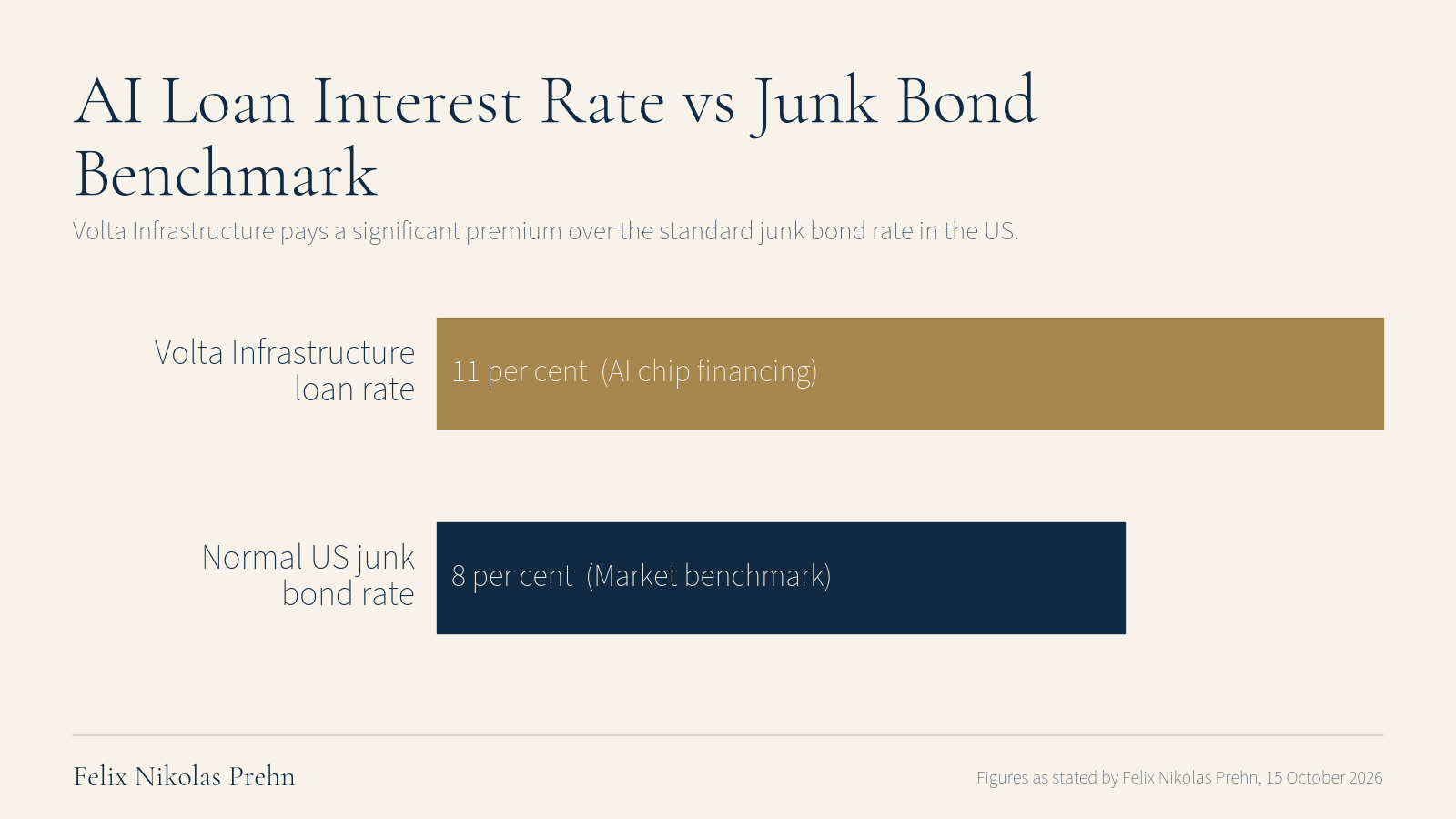
The loan to finance the purchase carries an interest rate of 11 per cent.
Goldman Sachs and JP Morgan collected their fees on the arrangement. They then distributed 3.7 billion dollars of the resulting credit on a best efforts basis. The bank markets the loan but assumes no obligation if a tranche finds no buyer.
The 1.3 billion dollars the banks kept has a different structure. Leases and cash back that slice, while the chip-backed portion was distributed to outside buyers. Its value depends on 36,000 GPUs retaining their worth over the life of the loan.
The Fee Machine
When Goldman Sachs arranges a 5 billion dollar loan, the bank earns roughly 2 or 3 per cent upfront.
On a deal of that size, the fee amounts to 100 to 150 million dollars. Goldman collects the fee the moment the transaction closes, and repayment over five years has no bearing on revenue already booked.
Goldman therefore has an enormous incentive to close deals. It has very little cause to worry about borrower solvency. Fees are earned the moment the deal is done, not over 5 years.
A loan on the books ties up capital. It forces the bank to set aside reserves against default. It limits the balance sheet available for the next deal.
So Goldman sells the loan. The fee stays with the bank. The risk moves to pension schemes and insurance companies.
Banks earn fees and distribute risk to less sophisticated buyers.
The pattern has repeated through every major credit cycle. In 2006 the asset was mortgages.
In 2014 it was energy. In 2026, the asset is AI chips. The fee structure and the method of distributing risk remain the same.
The 11 Per Cent Interest Rate
The interest rate on the Volta loan is 11 per cent. A junk bond is debt issued by a company with a poor credit profile.
The normal American rate for such paper is about 8 per cent. Volta pays 3 percentage points more than the going junk rate. The market considers the risk very high.
Nvidia is an investor in Volta Infrastructure. The chip maker is a part owner of the company borrowing at 11 per cent to buy its own product.
Volta has a 6 year deal with Anthropic that gives it a revenue anchor. Yet the 11 per cent interest rate suggests lenders see considerable risk in the business.
Price Targets and the Fee Cycle
BNP Paribas has a price target on Meta of 885 dollars.
The stock trades more than 100 dollars below that figure. Truist has a price target on Meta of 1,000 dollars per share.
Cantor Fitzgerald has a price target on Micron, a memory chip company, of 2,000 dollars per share.
Among 55 Wall Street analysts, the average Nvidia price target is about 322 dollars. Some targets run as high as 515 dollars. The consensus recommendation is buy.
Published price targets serve a commercial function beyond information. When a bank publishes a target, financial media pick it up.
The resulting attention keeps sentiment warm. A warm market mood is the precondition for new share offerings, new loan syndications and new fee opportunities.
Goldman's research desk recommends buying Nvidia while its traders tell institutional clients that investors are pulling back from AI financing.
The syndication arm, meanwhile, placed 3.7 of the deal's 5 billion dollars with outside buyers.
A buy note from a major bank serves the bank's deal pipeline.
The bank's revenue comes from transactions, not from client returns.
The Traders Say Something Different
Goldman Sachs has a share trading division separate from its research analysts. The traders manage live capital and watch actual money flow each day.
Goldman Sachs traders sent a note to institutional clients.
The note stated that investors had continued to derisk from AI spending and AI financing exposure. AI capex means outlays on data centres, chips and infrastructure.
AI financing exposure means the loans and bonds that fund those projects.
Goldman's research arm recommends buying Nvidia.
Its trading desk told institutional clients that investors had continued to derisk from AI financing. Its syndication team distributed 3.7 billion dollars of the Volta loan to outside buyers.
Reports indicate banks are struggling to find buyers for AI debt. Several are trying to offload it.
Oracle and the Cracks in AI Lending
Oracle took out a 38 billion dollar construction loan for data centres in Texas and Wisconsin. 6 months into the project, a 1,000 million dollar portion of that loan remains unsold. The cost of insuring Oracle's bankruptcy risk is at the highest level since 2009.
Original lenders on the Oracle loan are selling their debt at a discount.
They want to exit their positions entirely. The original lenders are willing to take a loss because they want no remaining exposure to the deal.
Oracle has been building data centres at a rapid pace funded by borrowing. The resulting paper trades below face value.
Oracle's lenders are selling at a loss 6 months after the deal closed. Goldman Sachs and JP Morgan distributed the Volta loan's risk from the outset.
Risk Migration and the Balance Sheet Shell Game
Meta moved billions of dollars of AI investment off its main balance sheet.
The company placed the debt into special purpose vehicles, separate legal entities structured like shelf firms. The vehicle carries the debt, keeping it off the parent's accounts.
Reports in the financial press have drawn comparisons to off-balance-sheet techniques used in earlier corporate scandals.
JP Morgan and other large arrangers have been moving AI related loans off their balance sheets. They are approaching the limits of how much AI financing they will carry.
Meanwhile, research desks at the same institutions continue to publish buy recommendations on AI stocks. The arranging banks sell the loans they originate, and the borrowing companies move debt into separate vehicles.
Massive AI borrowing is consuming available credit. The volume of new debt is driving up interest rates on mortgages and other lending.
A data centre is an energy product with computing hardware inside. It consumes extraordinary amounts of electricity, cooling and grid infrastructure. When the AI lending machine slows, data centres stop being built at the current pace.
Energy contracts that power those facilities become uncertain. Grid projects planned to serve them slow down.
Goldman Sachs, JP Morgan and the other large arrangers earn fees the moment a deal closes. They then distribute the resulting credit to pension funds and insurance companies.
Such funds tend to buy late in the cycle. They are managed by less aggressive people. They end up with losses when credit conditions turn.
The pattern is visible in every lending boom of the past 2 decades. The fee structure matches what preceded the mortgage crisis of 2007. It appeared before the dot-com collapse and again in the energy lending boom of 2014.
The arranging bank earns 100 to 150 million dollars per deal the moment it closes. It then passes the credit to less sophisticated buyers. Volta pays 11 per cent, 3 percentage points above junk. Goldman's own traders reported to institutional clients that investors had continued to derisk from AI financing exposure.