
The debasement of currency by governments spending beyond their means is a recurring historical pattern, visible from Rome to Weimar Germany, the Soviet Union, and the British Empire.
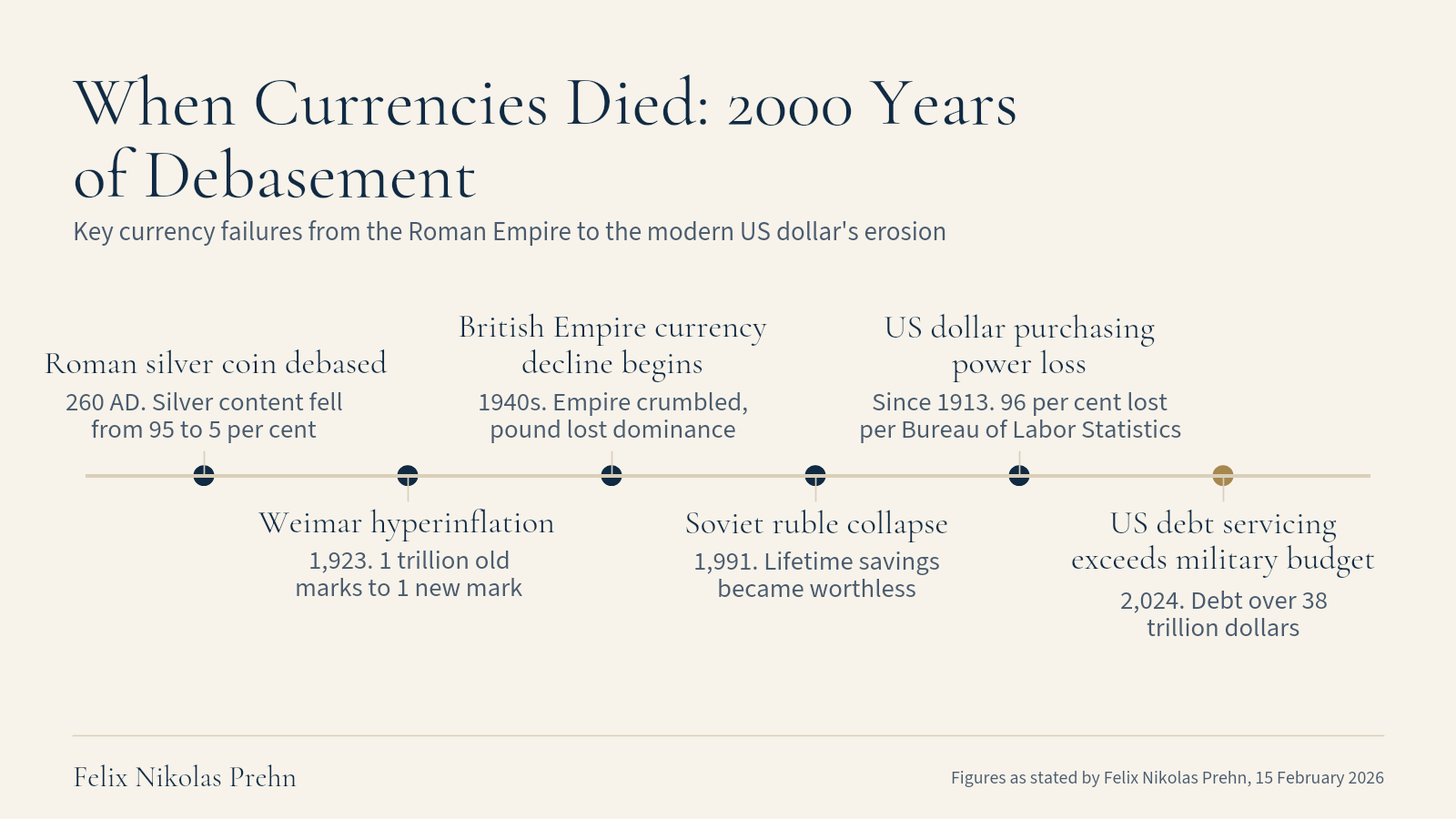
In each case, printing money to cover fiscal gaps eroded purchasing power. The same sequence is visible today in the United States.
The Roman Blueprint
In 64 AD Emperor Nero faced a ruined capital and expensive wars to fund.
He enjoyed spending money he did not have. Unable to operate a printing press, Nero took the analogous step of debasing the coinage.
Nero cut the metal content of the Roman coin from about 95 per cent silver to roughly 90 per cent.
His successors continued the practice. Around 260 AD the silver content had fallen to about 5 per cent. Some excavated coins contain as little as 2 per cent of the metal, a copper disc with a thin wash sprayed on top.
The consequences took 2 centuries to mature. Hyperinflation spread and trust in the coinage collapsed.
Soldiers demanded payment in goods because the coinage was worthless, having become a token no one believed in.
A Pattern Across Empires
The German Weimar Republic's currency died in 1923. The old mark was replaced at a rate of 1 trillion to 1.
The Soviet ruble collapsed in 1991. Lifetime savings became worthless virtually overnight.
The British Empire's currency began its decline in the 1940s when the empire crumbled.
Britain had the world's reserve currency before the United States. Reserve status does not prevent debasement.
It only delays the process. The pound's long slide after the 1940s illustrates the point.
A government spends more than it collects and prints money to cover the gap. The new money dilutes the old, and the currency buys less.
The Dollar's Quiet Erosion
Since 1913, the year the Federal Reserve was created, the US dollar has lost 96 per cent of its purchasing power according to Bureau of Labor Statistics data. What cost 1 dollar for earlier generations now costs 30 dollars.
The erosion is not dramatic on any given day. Prices rise a little faster than wages.
A savings account earns about 4 per cent if lucky. Prices of goods people buy climb at 7, 8, or 10 per cent a year. The gap compounds year after year.
The incentives for politicians make the pattern self-perpetuating. A politician who cuts spending and raises taxes loses the election. The alternative, funding everything and handing out money, keeps a leader popular.
The consequences land years or decades later, when that leader is retired or dead.
More dollars exist after each round of printing. Each dollar is therefore worth less.
The process amounts to a slow, steady transfer of wealth from those who save in paper currency to owners of real assets. No tax bill arrives, and the loss shows up only in what a dollar can buy.
Debt Spiral and the Threshold
The US government crossed a threshold in 2024. Interest payments on federal debt now exceed spending on the entire military.
The government carries roughly 38 to 39 trillion dollars in debt. The annual cost of that debt exceeds 1 trillion dollars.
New borrowing pays the interest on existing obligations. Old debt produces new issuance in turn. Each fresh obligation then generates its own interest charge, and no new programme or war is needed to sustain the spiral.
A default would end the system. Sufficient spending cuts are politically impossible.
Tax rates above a certain point cause the tax base to leave. The United Kingdom raised taxes and collected less revenue because billionaires moved to lower-tax jurisdictions such as Monaco, Dubai, Italy and Portugal. Governments then print again, and the currency loses another layer of purchasing power.
Central Banks Follow the Money
Central banks bought 863 tons of gold last year. The total marked the third consecutive year above 800 tons. Central banks are accumulating gold at the fastest pace in 50 years.
The World Gold Council found that 95 per cent of central banks expect global reserves of the metal to increase this year. Nearly half plan to add to their own holdings. Late 2026 data confirm that buying has continued near peak levels, with China's gold imports setting a new high.
Central banks are diversifying out of the dollar. They are preparing for a world where it is no longer the sole reserve currency.
Reserve Currency on Borrowed Time
The average lifespan of a reserve currency is 94 years based on historic data. The US dollar has held reserve status for over 100 years.
A sudden collapse is not the likeliest outcome in the near term. The dollar has, however, passed the historical average.
Britain illustrates what a long currency decline looks like in practice.
UK starting salaries for lawyers have remained roughly flat for 20 years, with a first legal salary cited at 28,000 pounds a year. Costs over the same period have risen sharply.
The pound has lost considerable value against other currencies.
UK pensions tied to the domestic stock market have grown about 2 per cent a year, compared with about 13 per cent a year for the equivalent US period. A war in Europe has given the UK market a brief lift, because wars tend to be profitable. Real living standards have declined slowly over 2 decades.
The Divergence of Real and Paper Assets
Gold and silver carry no counterparty risk. Their value does not depend on any government promise.
A dollar is a promise from an issuer who can create unlimited new obligations. Gold is a physical element and does not need a counterparty to retain value.
In every currency crisis, gold and silver re-enter the conversation when trust in paper currencies erodes and governments push the printing press too hard.
In an inflationary environment, stocks are among the best places to be. Companies can raise what they charge. Their profits grow, and share valuations follow.
More money circulating in the economy inflates asset prices in general. Real estate moves up with inflation because a house is a physical asset unaffected by monetary policy, and the supply of houses does not suddenly increase.
Savings accounts paying 4 per cent lose ground when the cost of goods people buy rises at 7, 8, or 10 per cent.
Fixed-income recipients whose payments grow 3 per cent a year fall behind when costs climb 6 or 8 per cent.
Currency debasement through deficit spending has produced the same outcome in Rome, Weimar Germany, the Soviet Union and Britain. Governments printed money. Prices rose faster than wages. Wealth moved from savers to owners of land, metal and company shares.