
The 30-Day Precious Metals Rout
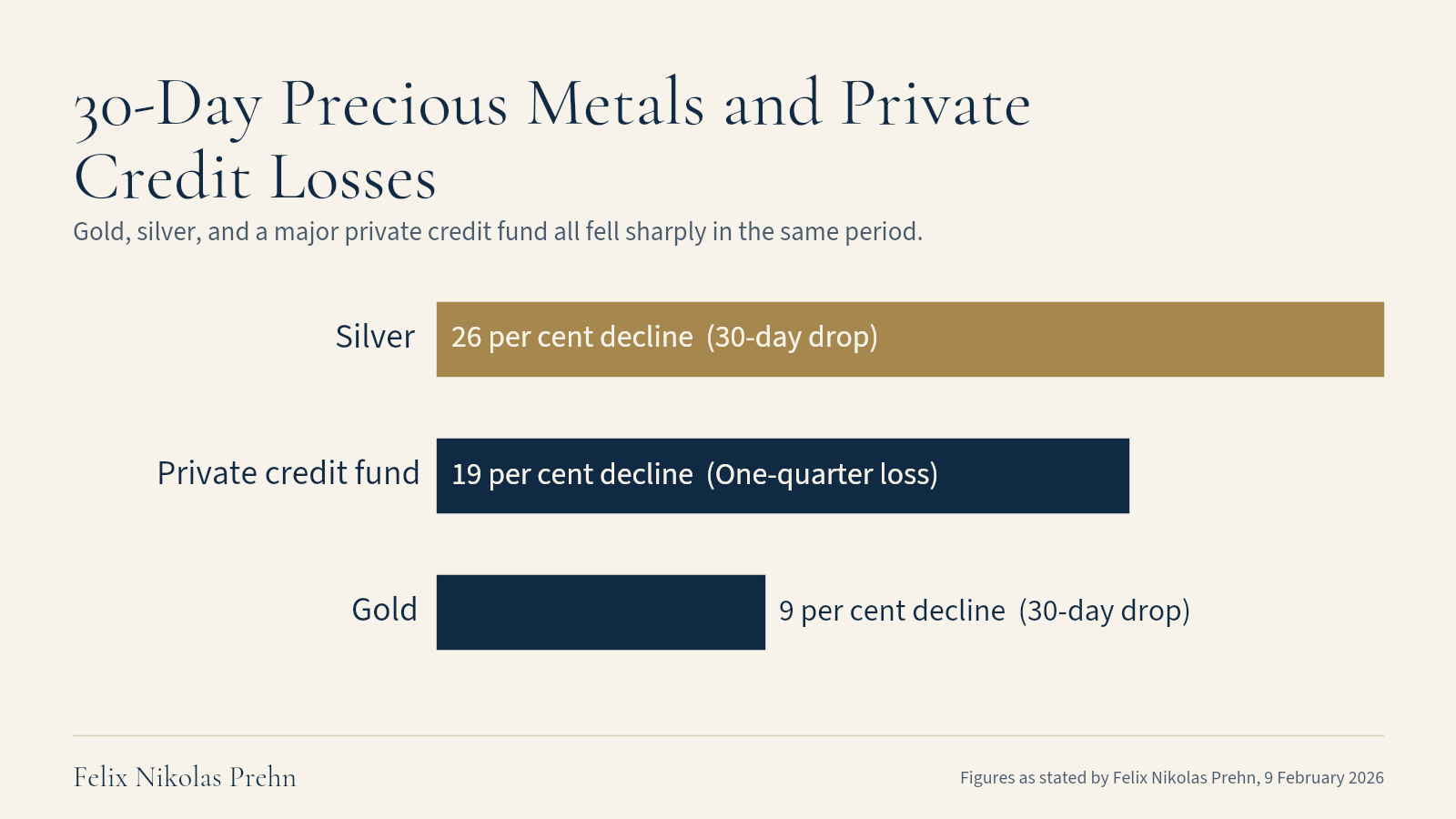
Gold fell nearly 9 per cent in 30 days. Silver crashed more than 26 per cent over the same period. A major private credit fund run by the largest asset manager on the planet lost 19 per cent of its value in a single quarter.
The sell-off in metals traces to a specific mechanism. The Chicago Mercantile Exchange (CME), where gold and silver futures trade, raised its margin requirements. Margin is the cash deposit a trader must post to keep a position open.
When the CME lifts that requirement, traders who lack the extra cash must sell.
Hedge funds borrow at ratios of 20 to 1. A 2 per cent margin increase requires far more than 2 per cent extra cash.
At a borrowing ratio of 20 to 1, the margin rise is multiplied by 20. The trader needs 40 per cent more cash. Traders borrowing at that ratio rarely keep large cash reserves, so positions are liquidated.
JP Morgan, UBS and others have been fined by the Commodity Futures Trading Commission for manipulating precious metals markets. The banks paid the fines and continued operating.
When gold drops, mining stocks drop harder. Gold and silver miners have therefore fallen harder than the metals themselves.
Why 1933-Style Confiscation Will Not Repeat
In 1933, Franklin Roosevelt ordered Americans to surrender their gold through an executive order. The United States was on a gold standard. Every dollar was backed, at least in theory, by physical gold.
The Federal Reserve could not print more money without more gold reserves. Confiscation was the mechanism the government chose to expand the monetary base.
Compliance with the order was abysmal, with only about 20 per cent of private gold turned in. Most owners ignored the order and hid their metal. The government made a few examples but did not raid homes on a mass scale, because doing so risked civil conflict.
3 conditions have changed since then.
First, in 1977 Congress passed the International Emergency Economic Powers Act. The law removed the president's authority to seize gold except during a declared war.
Second, confiscation on that scale cannot be carried out. Between 33 and 50 million Americans own gold and silver.
Owners keep the metal in home safes, private vaults, backyards and overseas storage. No central registry exists.
Door-to-door confiscation among tens of millions of armed households is not a credible policy option.
Third, the federal government no longer needs private gold to expand the money supply. The United States runs a fiat system. The Federal Reserve does not need gold to create money.
Private gold in the United States is worth something like 200 billion dollars. The national debt is 37 trillion dollars.
All private gold would cover a fraction of 1 per cent of that obligation. No government would accept the political cost for that return.
Stealth Confiscation Through Taxation and CBDCs
Taxation poses a greater threat than seizure. A 28 per cent capital gains tax on gold and silver already exists in the United States. Taxes on stocks are lower.
I argue that Wall Street's lobby is larger and better funded than the gold industry's. The gap in tax treatment reflects that imbalance.
Some states are considering wealth levies and exit charges on unrealised gains. The cause is fiscal: decades of mismanagement, large deficits and pension obligations the states cannot meet. California has floated a wealth tax proposal, though late 2026 reporting suggests it was headed for defeat.
An unrealised gains tax forces owners to sell assets to pay tax on profits they have not collected, penalising long-term wealth accumulation. Wealthy residents leave, taking the revenue base with them.
CBDCs (central-bank digital currencies), a form of programmable money issued by a monetary authority, pose the longer-term threat. Several central banks have discussed the idea, though late 2026 headlines do not confirm active development programmes at the Fed or the ECB.
In my view, gold ownership in a CBDC world could be neutralised. A central bank could flag precious metal transactions for review, preventing conversion of gold into digital currency. The owner still has the metal in a safe, but turning it into spendable money is blocked.
The Private Credit Crisis
Private credit consists of loans made by non-banks: hedge funds, asset managers and similar firms. The market has grown to about 1 trillion dollars.
The market is opaque, with no public reporting and no banking oversight. Nobody outside the lending chain knows what the loans are, who owns them or who borrowed the money.
Banks do not lend to the end borrower directly. Banks lend to hedge funds, which then pass the money on to risky borrowers.
On the bank's books, the exposure is to the hedge fund. The end borrower is invisible.
The structure of indirect exposure resembles the pre-2008 architecture. The TCP Capital Fund is a private credit vehicle managed by the world's largest asset manager. It lost 19 per cent of its value in one quarter.
The private lending market is tied to banks through derivatives called credit default swaps, contracts that transfer the risk of a borrower defaulting. In 2008, AIG needed a 180 billion dollar bailout because of exposure to similar instruments that the firm had not understood.
Banks are deeply connected to private lending through credit default swaps. A collapse in that market would, on this logic, force another system-wide bailout.
Bail-Ins and the Legal Basis for Deposit Seizure
In Cyprus, banks failed and the government did not simply bail them out. Depositors with more than 100,000 euros had 47.5 per cent of that money taken. A bail-in imposes losses on account holders rather than on taxpayers.
After 2008, the United States established a legal basis for the same mechanism. The orderly liquidation authority allows the Federal Deposit Insurance Corporation (FDIC) to convert deposits to equity (shares) in a failing bank. Savings become shares in a bankrupt institution.
Cyprus was still addressing the aftermath of its bail-in as late as 2026, with a reimbursement platform reopened and a relief fund budget approved. The legal architecture for a similar event exists in the United States. Its use depends on the scale of the next banking crisis.
Mining Stocks and the Profit Multiplier
Gold and silver miners amplify moves in metal prices. When gold rises 10 per cent, a well-run miner's stock can rise 30 to 50 per cent.
Mining costs are relatively fixed. Extraction does not become more expensive because the metal is worth more. A price increase flows almost directly to profit.
If a miner's cost is 1,200 dollars and gold trades at 2,000 dollars, profit per ounce is 800 dollars. If gold rises to 2,500 dollars, profit becomes 1,300 dollars. A 25 per cent rise in the gold price produces a 62 per cent increase in profit.
The amplification works in reverse too: when gold falls, miners fall harder.
A miner's quality depends on all-in sustaining costs, production growth, jurisdiction, balance sheet and stage of development. Producers with cash flow from operating mines carry less risk than pre-revenue companies, though earlier-stage firms offer greater upside if the deposit proves out.
Alamos Gold operates 3 mines, 2 in Ontario and 1 in Mexico. All-in sustaining costs are about 1,200 to 1,300 dollars per ounce. Company guidance projects 46 per cent more production by 2028, targeting 1 million ounces per year.
Galiano Gold has a smaller market cap of 670 million dollars. Its Ghana mine yields about 3.4 grams of gold per ton.
New Found Gold Company in Newfoundland, Canada, has discovery grades of 500 grams per ton at only 2 metres depth. First gold is expected in 2027.
Vista Gold owns Mount Todd, one of the largest undeveloped deposits in Australia. At a gold price of 2,500 dollars the company should be worth about 1.1 billion dollars.
One Cause Connects Every Risk
A repeat of 1933-style confiscation is logistically and politically unfeasible. Punitive taxation and restrictions on convertibility through CBDCs pose the real danger. Fiscal pressures of that kind emerge from the same government mismanagement behind a 37 trillion dollar national debt.
The opaque private credit market, now worth about 1 trillion dollars, is accumulating risk with no public oversight. Bank exposure through derivatives creates a structure reminiscent of 2008. A collapse in private credit could trigger a wider banking crisis. Gold and silver prices would likely benefit from such a crisis, while governments would meanwhile seek new ways to control and tax the metals.