
Governments print money to shrink their debts. The cost falls on wages and cash savings.
Nikolas Prehn, also known as Felix Nikolas Prehn, is an economist and former investment banker. He traces the chain from money supply growth through financial repression to stock market concentration.
US debt to GDP is close to 120 per cent. The annual deficit runs at 5 to 6 per cent of GDP.
M2 money supply (the broad measure of cash, deposits and liquid savings) grew 6 to 8 per cent last month. The pace of monetary expansion has not been this fast in 4 years.
The Money Printing Acceleration
M2 money supply (the broad measure of cash, deposits and liquid savings) went up roughly 6 to 7 per cent last month. Some readings put the figure as high as 8 per cent. Money printing is at the fastest rate in 4 years.
After COVID, roughly 20 per cent of new money was added in a single year. The current pace is slower than that episode. It is still rapid by any pre-pandemic standard.
Felix argues that the Federal Reserve is expanding too slowly for the government's needs, so the Treasury stepped in. Felix argues that the government is conducting its own form of monetary expansion.
It buys back long-dated debt (bonds maturing in 10 or 30 years). It funds those purchases by issuing short-dated debt (bonds that come due in months).
Fresh money enters the system each time the Treasury retires old bonds and sells new ones.
Money pumped into the system finds returns. In Felix's view, this monetary expansion supports asset valuations while eroding the real value of cash holdings and wages through inflation. A salary denominated in a currency that is growing at 6 to 8 per cent a year buys less with each passing quarter.
The Debt Trap
The United States government is running a deficit of roughly 2 trillion dollars. Debt to GDP is close to 120 per cent. The annual deficit runs at roughly 5 to 6 per cent of GDP.
Three options exist for a government carrying that burden. It can raise taxes. It can cut spending.
Or it can print money and let inflation reduce the real value of what it owes. The first two options lose elections. The third does not require a vote.
Felix argues that no one will vote for fiscal discipline when a rival promises free money.
Extra money without new debt shrinks the ratio of obligations to the size of the economy. Inflation swells the denominator.
The debt stays fixed in nominal terms. Over a decade, a ratio of 120 per cent can drift toward 60 per cent without a single budget cut.
The deficit itself remains a problem. At 5 to 6 per cent of GDP each year, new borrowing partly offsets the erosion. The process therefore requires sustained inflation above interest rates for years, not months.
The Japan Playbook
Japan has used financial repression (keeping interest rates below the rate of inflation) since the 90s to bring debt down as a percentage of the economy. In Felix's view, the Japanese government owns 50 per cent of its own debt.
Pension funds and banks own the remainder. The bond market became a domestic affair under state control.
The strategy worked on the debt ratio. The cost fell on the currency. The yen lost purchasing power, and households paid through an unlegislated tax on savings.
Felix argues the United States is following the same playbook. The Federal Reserve can buy government debt.
In theory, the government can borrow as much as it wants if the central bank prints money to pay for the bonds. The supply of fresh money is unlimited.
The constraint is inflation becoming visible enough to provoke a political backlash. Global bond markets are signalling concern over government debt and inflation. Japan's situation is being framed as a warning for other large economies.
The Hidden Inflation Tax
Before the 1920s, inflation ran at about 0.2 per cent a year for the previous 100 years. Governments now target 2 per cent and frequently exceed it.
Central banks printed money for decades to service and erode sovereign debt. Inflation rose accordingly.
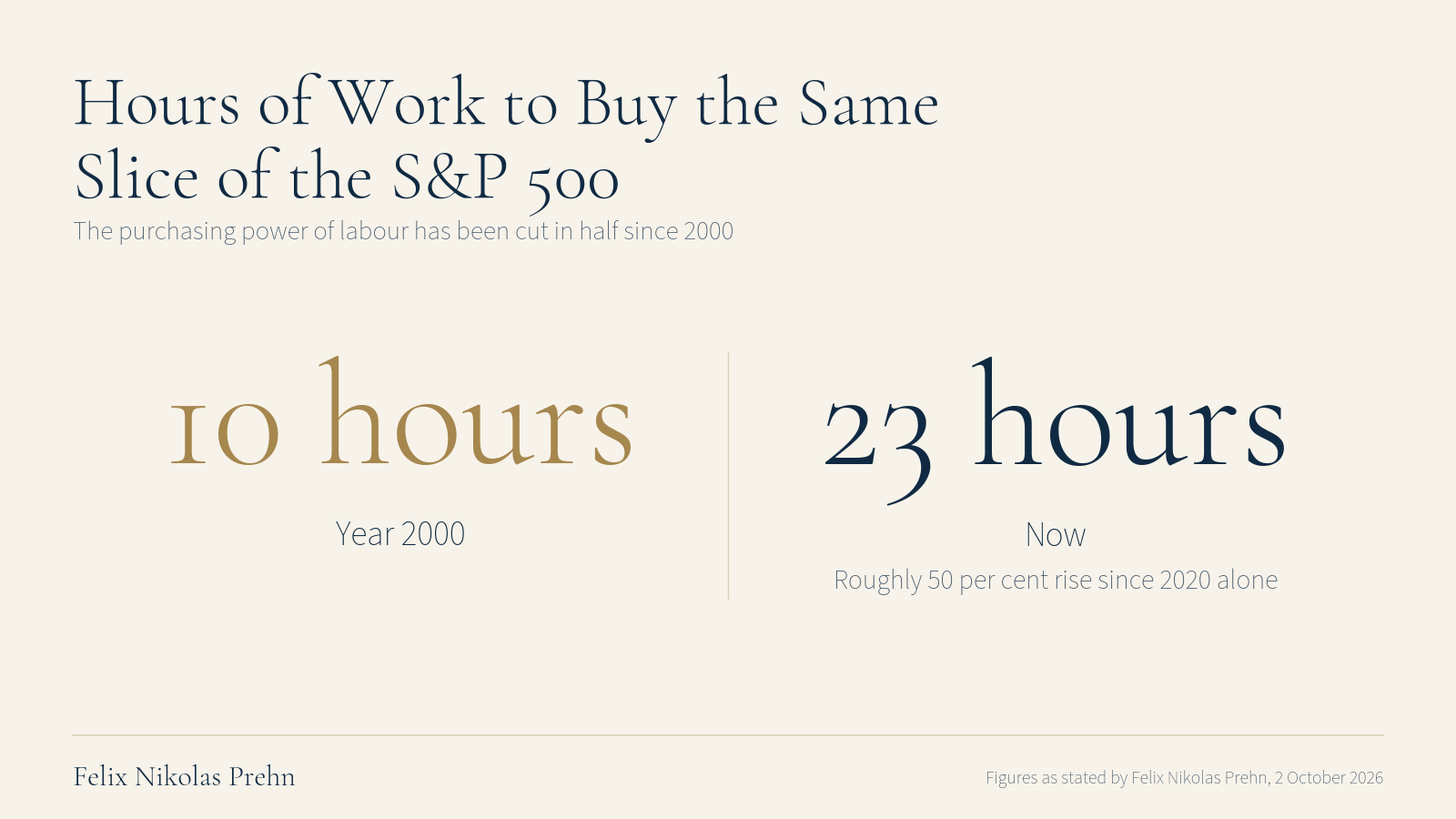
The hours of work index measures the cost of a basket of stocks, gold and housing. It has risen roughly 50 per cent since 2020.
In 2000, the same piece of the S&P 500 cost 10 hours of work. It now takes 23 hours.
Labour cost per unit of financial assets has more than doubled. Consumer price indices do not capture that shift. Asset prices fall outside the standard basket.
Felix argues that prices over the last 20 years rose faster because governments printed more and more money. More money chasing the same stock of houses, shares and commodities raises their price in labour terms.
Wages lag behind. Shares and houses reprice within weeks. Wages adjust over years, if at all.
Markets at Extremes
82 per cent of the S&P 500 is currently below all-time highs. The top 18 per cent, concentrated in artificial intelligence companies, has driven the index to valuations beyond 2000 and 1929 levels. Felix argues that AI is keeping the index afloat while the broader economy lags.
The NASDAQ fell 78 per cent after the dot-com bubble. The index lost more than three quarters of its value, even though the underlying technology proved genuine.
A falling economy can coincide with a rising stock market if interest rates start coming down. Bad economic data can benefit shareholders precisely because it brings rate cuts closer.
The 2 trillion dollar deficit also props up activity: government borrowing flows into businesses, which pay suppliers and staff. Each year's new issuance adds to the total obligation, even as inflation shrinks what the accumulated sum is worth.
The AI Concentration Risk
Nvidia and similar chipmakers are earning margins of roughly 70 per cent on chips. The margin is so large that Google, Intel, AMD and others have every incentive to develop a cheaper alternative. Felix argues that chip prices will come down and compress those margins.
Anthropic brought in roughly 60 to 70 billion dollars in revenue last year with a 2 trillion dollar valuation. Losses ran between 40 and 50 thousand million dollars over the same stretch.
Companies compete to win, so Meta, Microsoft, Amazon and others all spend on the same infrastructure. Felix argues it is highly probable they will create excess capacity and waste capital.
In every major technological transition, roughly 90 per cent of firms went out of business. The original car makers and EV entrants followed that pattern.
The correction in AI stocks will be large, Felix argues, because those companies are the only thing holding up the index. When selling begins on a bad headline, there is nobody left who is not already heavily exposed to buy.
A large discount is needed to attract fresh capital. The bubble will burst, but the eventual long-term benefit of the technology will be far larger than current valuations imply.
The Gold and Geopolitical Shift
After the Russia-Ukraine war, Western governments froze Russian foreign reserves. Central banks worldwide responded by buying gold and storing it domestically.
The freeze exposed how easily foreign-held reserves could be seized. Governments converted dollar and euro holdings into bullion and stored it in their own vaults. Gold in a domestic vault sits beyond the reach of foreign courts or sanctions.
Central banks are buying gold at a high rate, with officials citing geopolitical risk as the reason for shifting reserve composition. Felix argues that gold stores wealth when inflation is expected.
Hard assets have performed well over long periods. Gold and land cannot be printed, which limits supply in a way that currencies do not.
Governments are printing money to inflate away debt, a mechanism that transfers wealth from cash savers and wage earners to asset owners. Japan ran this experiment for 30 years.
The United States, at 120 per cent debt to GDP and with a 2 trillion dollar annual deficit, appears to be on the same path. The dollar will not collapse overnight, as no viable alternative currency exists, but the policy is already producing measurable effects.
The M2 data, the hours-of-work index and central bank gold purchases all record the same process. A 2 trillion dollar deficit and M2 growth of 6 to 8 per cent last month erode purchasing power without any tax bill. Felix argues that no one will vote for fiscal discipline when a rival promises free money, so the incentive to inflate persists.