
Felix Nikolas Prehn, economist and former investment banker, identifies 3 concurrent signals.
The US government is draining its oil reserve. It is buying back its own bonds. It presides over the most concentrated stock market on record.
The government is preparing to inflate away its debt.
Each signal, examined alone, looks like routine management. Together they amount to a monetary reset already in motion.
The 44 year low
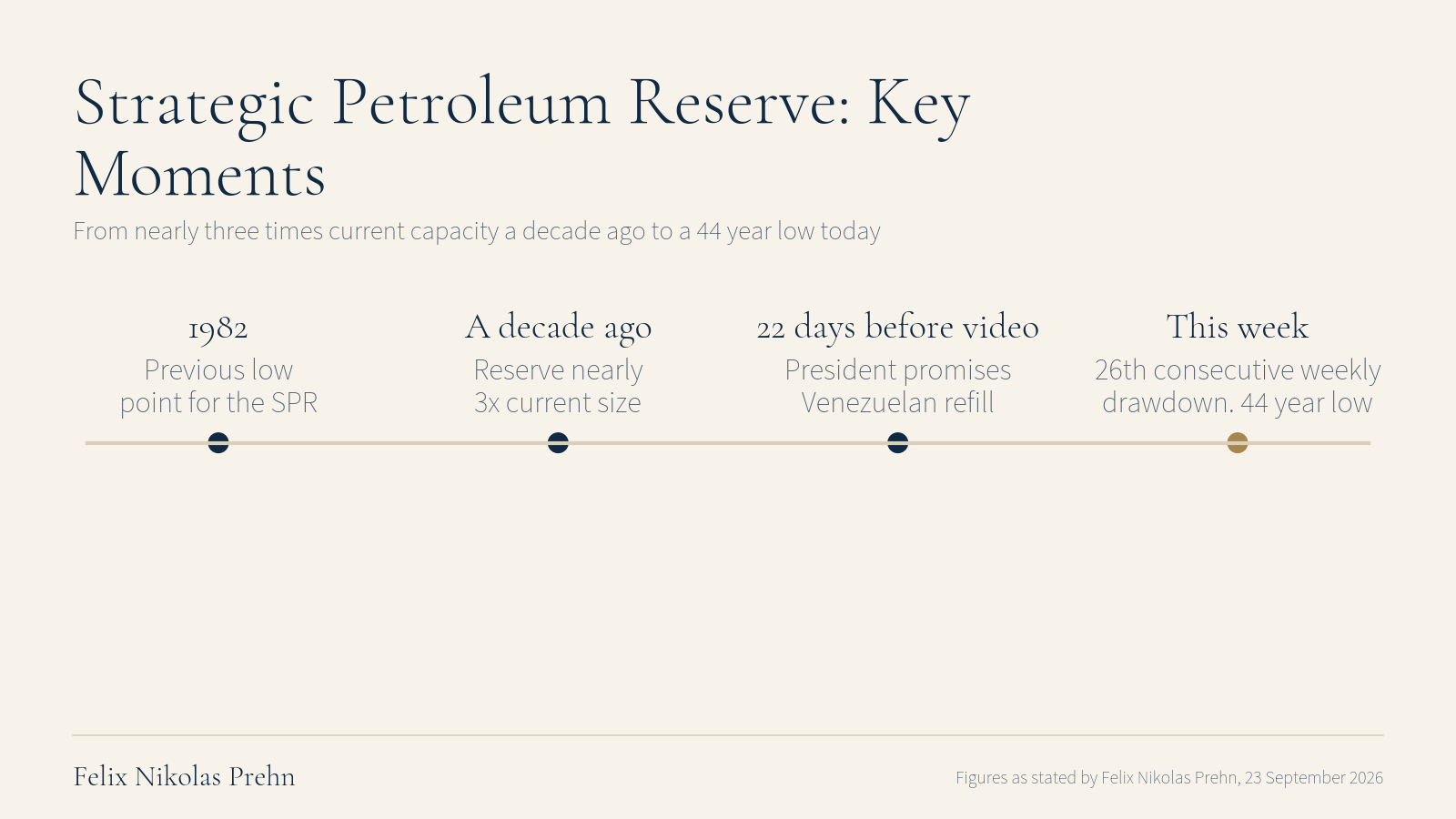
The US government has drawn down the Strategic Petroleum Reserve for 26 consecutive weeks, leaving it at its lowest level since 1982. The government released another 400,000 barrels in the most recent week.
The reserve is roughly one-third of its size a decade ago. The emergency tank is being emptied without a supply shortage, even as the US remains the world's largest oil producer.
The Venezuelan bluff
The president said 22 days earlier that he would refill the reserve with Venezuelan oil. Venezuela produces about 1 million barrels per day. Tankers need about 30 days to load and ship Venezuelan crude out of the country.
Venezuelan crude is heavy and high in sulphur. It does not meet the reserve specifications.
Felix Nikolas Prehn argues the announcement amounts to nothing because the oil is the wrong grade. Venezuelan crude cannot refill the reserve under current specifications.
The Venezuelan oil industry has been in decline for 20 years. Fields are neglected and refineries barely function.
The motive behind the drawdown
Felix Nikolas Prehn argues that the government is using the reserve to keep the oil price low. If the oil price rises further, the inflation rate moves from uncomfortable to uncontrollable. High inflation is the one thing that prevents the government from printing money.
The reserve acts as a shock absorber. Each weekly release keeps the price at the pump looking acceptable. But the reserve has been falling for 26 consecutive weeks and is near its floor.
When the reserve runs dry or a genuine supply shock hits, prices will spike. Diesel rises first because it powers freight transport. A diesel price spike makes everything transported by truck more expensive.
The COVID era offers a reference point. The Federal Reserve and Treasury put roughly 40 per cent more money into circulation within a few years. Official inflation reached 11 per cent.
The government drains the reserve to keep the oil price low. A low oil price keeps the headline inflation number manageable while the printing continues.
The Treasury buys its own debt
The US Treasury announced it will double its debt buybacks, to 4 billion dollars each round. The Federal Reserve creates fresh currency and buys short-term sovereign debt.
The government then uses the proceeds to buy its own longer-term debt, such as 10, 20 and 30 year bonds. The result is lower borrowing costs, set by policy rather than by the market.
The Treasury is buying back its own debt faster than during COVID. The programme is money printing under a different name: each dollar in circulation loses a fraction of its purchasing power.
Japan has pursued the same policy for 20 years. The Bank of Japan became the main buyer of government bonds when nobody else wanted them at the offered price. Ordinary workers there paid the price over those 2 decades, ending up financially much worse off than expected.
Once a country becomes the main buyer of its own debt, it crosses a line. Historical precedent for such a policy is negative.
Wealth behind a locked door
SpaceX, Anthropic and OpenAI are 3 private companies whose combined value exceeds every US company that went public in the last 45 years. Only holders of unlisted stakes can access them. Reports suggest the 3 companies may pursue public listings, but the gains so far accrue to a narrow group with access to private stakes.
About 1 quarter of total US household net worth is tied up in stocks, exceeding the dotcom peak and the 2008 level. The share has never been higher in the recorded data.
The top 5 stocks in the S&P 500 already account for 30 per cent of the entire index. An index fund buys every stock in proportion to its weight, so the S&P 500 version depends on a handful of technology stocks.
Concentration risk and the next crash
After the dotcom bubble burst, it took 15 years to recover the starting value. The S&P 500 has never been this concentrated.
Felix Nikolas Prehn argues concentration accelerates a crash. When everyone owns the same 5 stocks, there is nobody left to buy when sentiment turns. Sellers flood the market with no corresponding demand, and prices collapse.
A 15 year recovery period, as occurred after the dotcom bust, would span most of a working career.
Where the smart money is moving
Central banks are buying gold at the fastest pace seen since 1997. In Felix's view, the institutions printing the money know what will happen to the currency, because they are creating more of it every day.
In the 1970s gold rose eightfold. Central banks are converting paper claims into gold, a hard asset that cannot be printed.
The 1971 dollar is worth only 7 cents in purchasing power today, according to the US government. A dollar lost 93 cents of its value over 5 decades. Each round diluted the currency a fraction further, and the current buyback programme continues the pattern.
When a government cannot afford its debt, Felix argues, it lowers interest rates below the inflation rate and lets the currency depreciate. Japan ran the same policy for 20 years, and ordinary workers paid the price.
The US Treasury's buyback programme continues a pattern of currency dilution. The government drains the oil reserve to keep headline inflation low while the debt buybacks run.
Since 1971 the dollar has lost 93 per cent of its purchasing power. The current buyback programme extends the same mechanism. The Federal Reserve creates fresh currency to buy short-term government debt. The Treasury then channels the proceeds into buying its own longer-dated bonds. Every dollar already in circulation is diluted by the new supply. The oil reserve drawdown suppresses headline inflation. The debt buybacks lower borrowing costs by manufacturing demand for government bonds. Record stock market concentration leaves household wealth dependent on a handful of companies. Felix Nikolas Prehn argues these 3 policies, taken together, amount to preparation for inflating away debt the government cannot repay at face value. Japan followed the same path for 20 years, and the result was a prolonged erosion of real wages and savings.