The 2 Trillion Dollar Shadow Market
The private credit market has grown to over 2 trillion dollars. Moody's expects the figure to double within 3 years.
After the 2008 financial crisis, banks became far more conservative. Regulators tightened the rules.
Credit that banks once extended migrated to private funds. New lenders stepped in to serve borrowers the banking system refused.
Private credit funds lend to companies at high interest rates. They charge management, performance and origination fees on every deal.
The loans do not trade on any exchange. No ticker symbol exists.
No daily price is published. Fund managers alone decide what each loan is worth.
A fund manager who made the loan also grades its quality. The incentive to report honest valuations is weak when management fees arrive regardless of performance.
Exposure in Pension and Insurance Assets
Private credit has been increasingly integrated into retirement products. Target date funds and pension plan options channel savings into these loans. Insurance-linked vehicles do the same, in many cases without the account holder's knowledge.
Some of the largest private credit firms, including Apollo, Blackstone and KKR, have bought insurance companies. They collect premiums from life and annuity policies, then invest that capital into the lending funds they own. Policyholders, rather than fund managers, bear the investment risk on these assets.
An estimated 1.3 trillion dollars in corporate debt must be repaid over the next couple of years. The refinancing burden is called the maturity wall (the point at which old borrowing must be replaced with new loans at today's rate).
Companies that borrowed during an era of zero interest face far higher costs when rolling over those loans. A company that paid 3 per cent on a $100m loan owed $3m each year in interest.
At 7 or 8 per cent, the annual bill jumps to $7m or $8m. For many borrowers, that gap is the difference between survival and bankruptcy.
Redemption Restrictions at BlackRock and Blackstone
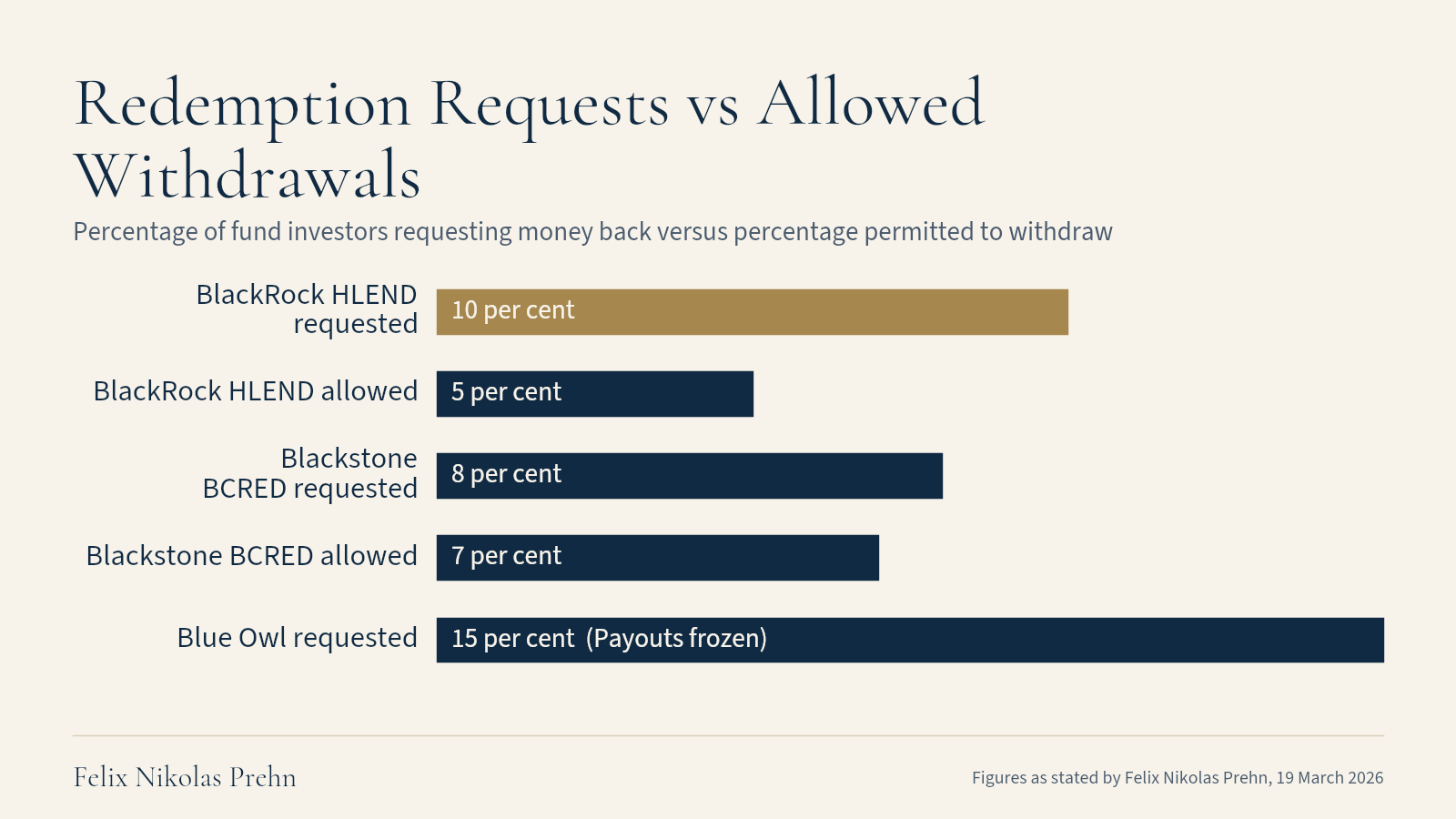
BlackRock manages over 10 trillion dollars in total assets. Its private credit fund, HLEND, is 26 billion dollars in size. About 10 per cent of investors in HLEND requested redemptions, but the fund allowed only 5 per cent to withdraw.
Blackstone runs BCRED, an 82 billion dollar fund and the largest private credit vehicle in the world. 8 per cent of investors wanted out, and the fund permitted 7 per cent to leave. Blackstone added 400 million dollars of its own capital into BCRED to allow those redemptions to proceed.
Recent headlines report that other large funds, including those run by Morgan Stanley and Apollo, have also limited withdrawals.
Blue Owl Capital and AI Disruption
In Felix's view, Blue Owl Capital is the canary in private credit. The firm has a heavy concentration in software and technology lending.
AI is displacing established business models in the sector. Companies that borrowed to grow are finding their products consumed by cheaper, faster alternatives.
15 per cent of investors in Blue Owl's fund requested withdrawals. The firm stopped making regular payouts.
Morningstar reports confirm that AI is making the sector harder for lenders. Some portfolios have so far resisted the pressure.
Reported Valuations and Fire Sales
The default rate on private credit is running at just under 10 per cent. Companies that borrowed at high rates cannot keep up payments and fail. The funds are supposed to absorb the losses.
Some private credit assets valued at 100 cents per dollar were written down to zero 3 months later. Fire sale prices on these assets are showing 30 cents on the dollar.
When a fund must sell to meet redemptions, no liquid market exists. The sale price reflects forced liquidation.
Fund managers grade their own loans and report values to investors. Reported valuations and clearing prices diverge by 70 cents on the dollar in some cases.
Signals from Senior Market Figures
Jamie Dimon, the CEO of JP Morgan, has publicly compared private credit to the conditions before 2008. Felix argues that Dimon's use of the word "cockroaches" implies that visible losses are only a small share of what remains concealed.
Headlines confirm Dimon has warned of a potential credit squeeze. He has questioned corporate America's readiness for higher borrowing costs.
JP Morgan's own wealth division published a report saying fears about the sector are overstated.
Ray Dalio, worth about 15 billion dollars, says the current environment resembles the period before World War II. Felix argues that Dalio, in this context, treats gold as the safest asset.
Recent headlines report Dalio cautioning that a Treasury selloff is far from over. He has also warned of a collision between a growing debt burden and AI's borrowing needs.
In 2008, Warren Buffett invested 5 billion dollars in Goldman Sachs at the height of the panic. Buyers of quality stocks at the bottom of that crash made 300 to 500 per cent over the following decade. The 2008 episode showed that severe credit stress can produce large mispricings in publicly traded stocks.
The Federal Reserve has raised interest rates to combat inflation. Policymakers have signalled at least one further increase before year-end.
Inflation data has been rising rather than falling. Higher rates will crush more funds and more borrowers.
If the credit crunch grows severe enough, the Fed will eventually cut. Treasury bonds are government instruments whose prices rise when interest rates fall.
A Pro-Cyclical Feedback Mechanism
The sequence begins with defaults and moves through a fixed order. Companies that borrowed at high rates cannot service their loans. The default rate on private credit is already just under 10 per cent.
When borrowers fail, funds absorb losses and restrict redemptions. Fund managers control the valuations, so at first the damage stays hidden.
When investors request withdrawals, the fund gates them. BlackRock denied half the redemption requests in HLEND. Blue Owl stopped making regular payouts.
Forced sales then reveal true prices. To meet even partial redemptions, funds must sell loans into a market with no liquid secondary exchange.
Fire sale valuations land at 30 cents on the dollar. The marks that fund managers set are replaced by observable clearing levels.
Traditional banks lend to private credit funds and provide lines of financing. Some carry the same assets on their own balance sheets. When the funds take hits, the banks absorb losses too.
After absorbing losses, banks pull back on business loans, mortgages and consumer credit. Credit becomes harder to obtain.
Businesses stop hiring and cut investment. Consumer spending contracts.
Companies already under strain begin to fail. Their failures produce more defaults, and the cycle returns to its starting point, running faster with each iteration.
Fund managers collect management fees on total assets regardless of performance. When losses mount, the fee still arrives.
HLEND is a 26 billion dollar fund. BCRED is the largest private credit vehicle in the world, at $82bn.
Fee income flows from each regardless of whether the underlying loans pay.
The market has passed 2 trillion dollars, and Moody's projects a doubling within 3 years. No independent pricing exists, and fees flow regardless of performance. Losses stay hidden until a gate lifts or a fire sale clears. Defaults have already started feeding losses back into banks and the broader credit supply.