
JP Morgan's Physical Silver Grab
JP Morgan took delivery of over 12 million ounces of physical silver from COMEX in a single month.
JP Morgan did not settle in cash or roll the contracts forward.
The same bank paid 920 million dollars in fines for spoofing, a form of market manipulation in which fake orders are placed to push silver prices lower.
Felix argues that JP Morgan is now sitting on 750 million ounces of physical silver.
The bank is also the custodian of SLV, the largest silver exchange-traded fund.
SLV holders own units in a trust. No specific bar of silver backs any individual share. SLV holders own units in a trust; the custodian is the same institution that was fined for market manipulation.
The custodian arrangement matters because of counterparty risk, the danger that the other party in a financial contract cannot meet its obligations.
Physical silver carries no such risk. When stress hits the financial system, paper contracts tend to lose value. Physical metal retains its worth even if a fund manager, custodian or counterparty becomes insolvent.
Why the bank is accumulating physical silver at this scale is not entirely clear. Felix argues that a 3 trillion dollar private credit bubble could blow up and cause stress throughout the financial system, making paper positions risky. In that scenario, paper silver looks fragile, and JP Morgan appears to prefer the physical metal.
The 3 Trillion Dollar Private Credit Bubble
The private credit market has grown from 500 billion dollars a few years ago to 3 trillion.
At its 2007 peak, the subprime mortgage market stood at 1.3 trillion dollars and triggered the global financial crisis.
The private credit sector is more than twice that size.
Private credit funds emerged because banks could not make certain loans after regulations imposed following 2008. The funds stepped in as shadow banks, lending to riskier borrowers outside the regulated banking system and collecting higher interest rates for doing so. The arrangement lacks regulatory oversight and transparency.
UBS warned that default rates in private credit could spike to 15 per cent.
Borrowers who cannot service their debt are surviving through payment in kind, a mechanism where unpaid charges are added on top of the loan.
Banks are the final source of funding for private credit institutions.
Insurance companies and pension funds are also exposed.
A crisis in the sector would spread beyond the original lenders. The Bank of England has begun testing the sector for systemic risk. A large wall of debt is reportedly looming over leveraged buyout backed companies.
Voices of Warning
Jeffrey Gundlach is one of the most respected bond investors in the world. He called private credit "the ultimate sin" and said it would trigger the next financial crisis.
Dimon's remark on private credit was blunt: one cockroach usually means hundreds more are hiding.
Dimon runs JP Morgan, the bank that is simultaneously accumulating the largest known stockpile of physical silver.
Felix argues that when sophisticated investors see systemic risk of this kind, they start positioning for the fallout. A private credit blow-up at that scale would dwarf the 1.3 trillion dollar subprime peak that preceded the 2008 crisis. In Felix's view, the response is a flight into physical metal that carries no counterparty risk.
Silver as a Strategic Industrial Metal
Silver is the most electrically conductive element on Earth.
It is used in solar panels, electric vehicles, AI infrastructure and the broader energy transition.
No substitute matches silver's conductivity in these applications.
Solar panels consume 25 per cent of annual silver supply.
Solar's share of silver consumption is expected to double by 2030.
Silver in photovoltaic cells remains irreplaceable. Electric vehicles use 3 to 4 times more silver than a conventional petrol vehicle.
China has classified silver as a strategic resource, according to Felix. One recent policy announcement indicated that China will continue suspending export quota management for silver while retaining regulatory oversight.
Industrial demand consumes silver in a way that gold is not consumed.
Silver goes into solar cells, circuit boards and electrical contacts. Most of it is never recovered.
Investment demand, meanwhile, hoards silver as a hedge against monetary instability.
The COMEX Supply Squeeze
COMEX physical silver inventory was at 120 million ounces in March.
The figure fell to 86 million, a decline of more than a third in less than a year.
Recent reports present a mixed picture, with some analysts noting partial reversals in the drawdown while others continue to flag delivery stress. Felix argues that the trend is one of rapid depletion.
Paper claims on COMEX silver total about 240 million ounces.
Registered physical inventory stands at 86 million ounces.
The ratio is roughly 3 paper claims for every ounce of real metal. If half the holders of those contracts demanded physical delivery, as JP Morgan has done, the system would break.
Silver has been money for 5,000 years.
It has experienced 5 consecutive years of supply deficits.
About 800 million ounces have disappeared over the last 5 years.
Industrial consumption uses silver up. Investment demand hoards it as a hedge. Mines have not kept pace with the combined drain.
One industry report noted overall demand may be down 5 per cent this year on weaker jewellery purchases. The deficit in physical metal persists.
Jane Street and the Quiet Money
Felix argues that Jane Street acquired about 20 million shares of the iShares silver ETF in a single quarter. The firm became the largest reported holder of SLV, larger than BlackRock's position. Felix argues that this move is a telling signal.
Jane Street is a quantitative trading firm.
It operates as a market maker, a firm that provides liquidity by standing ready to buy and sell securities.
Market makers do not usually make large directional bets. Their business model depends on capturing small spreads in millions of trades.
When a firm built on neutrality suddenly becomes the largest holder of a silver ETF, the position looks like a deliberate directional bet.
The regulatory filings, as Felix presents them, show the scale of the accumulation. Available public headlines have not confirmed the position.
The CEO Cash Out Signal
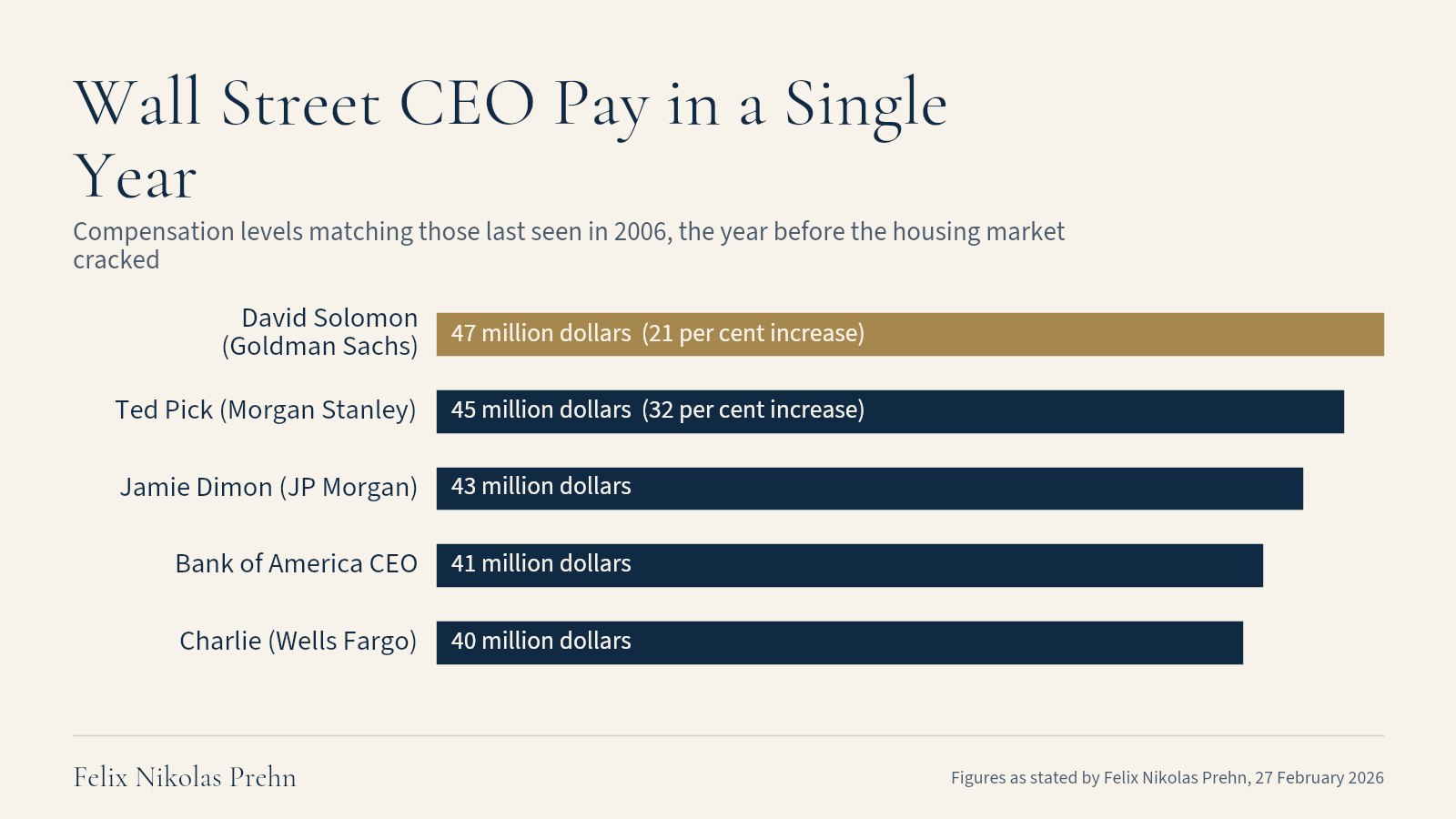
Total compensation for the chief executives of six large Wall Street banks reached 258 million dollars.
Goldman Sachs CEO David Solomon was paid 47 million dollars, a 21 per cent increase. Morgan Stanley CEO Ted Pick received 45 million dollars, a rise of 32 per cent.
Dimon's own package came to 43 million dollars.
Wall Street CEO compensation has hit levels not seen since 2006.
2006 was the year before cracks appeared in the housing market.
The worst financial crisis since 1929 followed in 2008. Felix argues that when executives cash out at these levels, they may sense risk the market has not yet priced.
Felix argues that JP Morgan has amassed 750 million ounces of physical silver.
Jane Street, he contends, became the largest reported holder of SLV in a single quarter. He treats each position as insurance against systemic stress.
Investment hoarding coincides with rising industrial consumption from solar and electric vehicle manufacturing. The combined drain has produced 5 consecutive years of supply deficits. About 800 million ounces have left above-ground stocks over that period.