
Felix Nikolas Prehn, argues that Washington is engineering a slow currency devaluation. The method combines a downward adjustment to the inflation metric with Treasury liquidity injections. Official inflation then appears low enough to justify rate cuts. Groceries, rent and fuel keep rising. The gap between the published number and the cost of living shifts wealth from those who save to the government that borrows. The chain runs from bond yields and mortgage costs to corporate borrowing that ignores the price of money. Dearer credit raises transport, warehousing and inventory charges before goods reach the shelf. A recalibrated inflation gauge and the Treasury acting as a de facto central bank complete it.
Mortgage rates reprice overnight
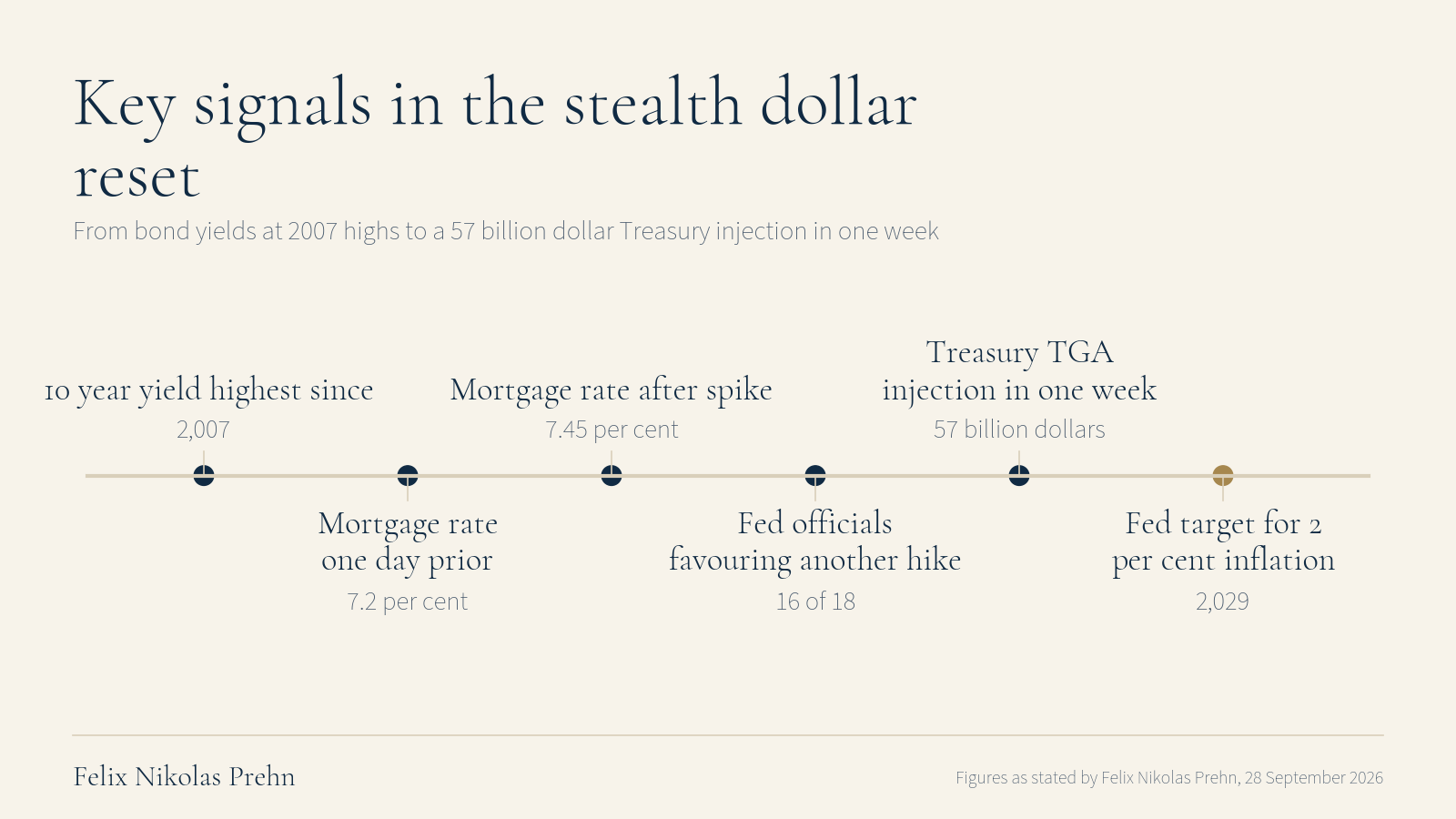
American mortgage rates jumped to 7.45 per cent from 7.2 per cent in a single day. Traders in the mortgage market expect rates to move toward 8 per cent. A quarter of a percentage point overnight reprices every home purchase in America.
The 30 year fixed rate mortgage in America follows the 10 year Treasury yield, the interest Washington pays to borrow for a decade. When investors require more to lend to the government, banks charge more on home loans. The 10 year Treasury yield reached its highest level since 2007.
16 out of 18 Federal Reserve officials pencilled in another interest rate hike, making home loans and construction finance more expensive.
The Fed may be making inflation worse
Billionaire hedge fund manager Bill Ackman publicly stated that the medicine may now be feeding the disease. Rate hikes are supposed to cool demand. Firms and households borrow less and spend less.
AI companies, the largest corporate borrowers today, are indifferent to the cost of money. Ackman argued that the race to build artificial intelligence has, in his words, an infinite return on investment. A company convinced the prize is that large will not stop buying chips and power stations because a loan rose by a quarter of a percentage point.
Corporations are expected to sell roughly 500 billion dollars in new debt this year solely to finance artificial intelligence. The borrowing proceeds regardless of where rates are.
In the past, rate hikes cooled the economy. The issue then was excess demand, too much money chasing too few goods.
Felix argues that the present constraint is supply, not demand. The shortage, in his view, runs through housing, energy, chips, diesel and fertiliser. Higher borrowing costs do not add houses or refine more diesel.
The Federal Reserve raises rates to fight inflation. Interest is a core business cost, so higher rates raise costs throughout the supply chain. Firms pass the increases on as higher prices, which in turn prompt further rate rises.
Interest costs feed through the entire supply chain
Interest costs are embedded in every stage of the supply chain. They run through transport financing, warehousing, inventory credit and construction loans.
When the Federal Reserve makes money more expensive, each of those costs rises. Firms pass the increase on.
Prices on the shelf rise in response, and the inflation figure the central bank is trying to bring down goes up instead. The Federal Reserve sees higher prices and raises rates again.
The inflation target keeps receding
The Federal Reserve admits inflation will not return to 2 per cent until 2029. Consumer inflation expectations stand at 4.6 per cent. The gap between the target and what households expect is wide, and it is not closing.
The previous multi-decade environment of falling interest rates supported certain asset accumulation strategies. Rates and prices are rising together, and that earlier pattern no longer applies.
A century of quiet erosion
From 1800 to 1940, prices in America rose about 0.2 per cent per year. Over 140 years, cumulative inflation totalled roughly 28 per cent. Money placed in a drawer would have bought nearly the same goods a few decades later.
Since 1940, inflation has averaged 3.7 per cent per year. Cumulative inflation since 1940 amounts to 2,200 per cent. An item that cost 1 dollar in 1940 costs 22 dollars today.
The two figures, 0.2 per cent and 3.7 per cent, look small in isolation. The cumulative difference is 28 per cent against 2,200 per cent.
Felix Nikolas Prehn describes the effect as a quiet transfer from savers to borrowers. The United States government is the largest borrower on earth.
Devaluation at 3.7 per cent a year shrinks the real value of federal debt. Congress does not need to vote for the erosion to proceed, because it happens through the arithmetic of compounding.
The inflation gauge is being recalibrated
The Federal Reserve uses core PCE (personal consumption expenditures excluding food and fuel) as its preferred inflation gauge. The government is changing how PCE is calculated.
Wall Street strategist Tom Lee believes the methodology change could shave half a percentage point off reported inflation. No price in any American shop needs to fall. The decline in the published figure is purely methodological.
Tom Lee argues the lower reading could be positive for stocks in the short term. Markets will see a lower headline figure and respond accordingly.
Felix Nikolas Prehn reads the change differently. If the gauge the Federal Reserve watches is adjusted downward, the central bank gains cover to cut rates.
Rate cuts reduce the government's interest bill. The debt shrinks in real terms, a little each year, and the currency loses purchasing power by the same margin.
The Treasury becomes the shadow central bank
The TGA is the government's current account, kept at the Federal Reserve. The Treasury injected 57 billion dollars into the financial system in a single week through it. Headlines in late 2026 report that the Treasury is considering investing its surplus cash in the private overnight lending market.
In the week before that injection, the TGA grew by roughly 1 trillion dollars while bank reserves fell. A small American bank collapsed recently.
When the Treasury does not inject money, cash flows into federal coffers and out of bank reserves. Liquidity drains from the system and banks can fail.
In Felix's view, the Treasury has become the de facto central bank. The Federal Reserve raised rates and told the world it would be strict about inflation.
The Federal Reserve cannot simultaneously reverse course and print money. The Treasury faces no such constraint and has been injecting cash through the TGA.
Officials at the New York Fed discussed letting the Treasury place surplus cash into the overnight loan market. The proposal would let the government channel its cash pile into the funding markets banks rely on.
Headline data may suggest rates are rising and price growth is falling. Felix argues that the published figure understates the cost increases people pay at the till. The difference compounds each year in the government's favour.
The gap functions as an annual transfer of wealth from savers to the government. The United States is the largest borrower on earth.
Each year of understated inflation erodes the real value of federal debt. Congress does not need to pass a law for the erosion to continue. Official inflation at 2 per cent and consumer expectations at 4.6 per cent leave a gap that benefits the borrower. Reversal would demand an explicit policy choice that no administration has an incentive to make. The devaluation therefore continues by default, year after year, embedded in the arithmetic of debt service and price measurement. A reversal would require an administration to accept higher reported inflation and the borrowing costs that follow.