Transcript
Just a few months ago, the biggest banks on Wall Street were fighting each other to lend money into the AI world. And just now, one of them tried to sell half a billion of those loans to literally anybody who would take them off its hands. And another just bought insurance in case the AI borrowers go bust. Now, banks don't run from their most profitable business for years unless there is a good reason for it. their run because they've seen the numbers.
And they're not the only ones heading for the door. You got Michael the Bur, the investor who saw 2008 coming and made a fortune on it. He just told the world, "Get out of Nvidia before it's too late." And there's a good reason for that. I want to explain that to you. This isn't doom and gloom.
But it is the most valuable company on the planet. And it is definitely sitting in your pension fund. It's definitely sitting in the index funds that you've been told are so safe. So, the banks are backing out of the loans. The man famous for calling the last major crash is telling you, well, run away from the thing you all own.
And my goal with this video for the next few minutes is to make sure that by the end of it, you understand what they understand and show you one number that made me move real money. So, stay with me. If you're wondering who the heck I am and that was Winston, of course, brains behind it all. My name is Felix Nicholas Pin. I'm an economist, former investor, banker.
I'm founder of the PIN Institute. We do research of financial markets. We teach people how financial markets actually work. My mentors teach that. And we take zero sponsorship, zero endorsements ever.
And that way I can say whatever I like, whichever way I like to say it. Now, ton of stuff coming up in the next few minutes here. All the numbers, every source, every bank. I've put that into a short report for you. You can read it in 10 minutes.
You can keep it. It's yours free. And you can download that at felix.org/banks. links down in the description down below. And honestly, the fact that you're even here trying to understand something as convoluted as bank lending and what the bur is thinking, uh, puts you ahead of almost everybody else out there because people find this stuff out from the headlines. And at that point, of course, it is too late to do anything about it.
So, well, done you, he says. Does that sound condescending? It's not meant to. I I genuinely mean that. I'm always impressed how many people watch this.
Um, so what happened here? Well, let's start with ING, one of the biggest banks in Europe. And oddly enough, when I started working in banking here in Hong Kong, the bank I was working for, um, Aussie Bank, they bought ING's team.
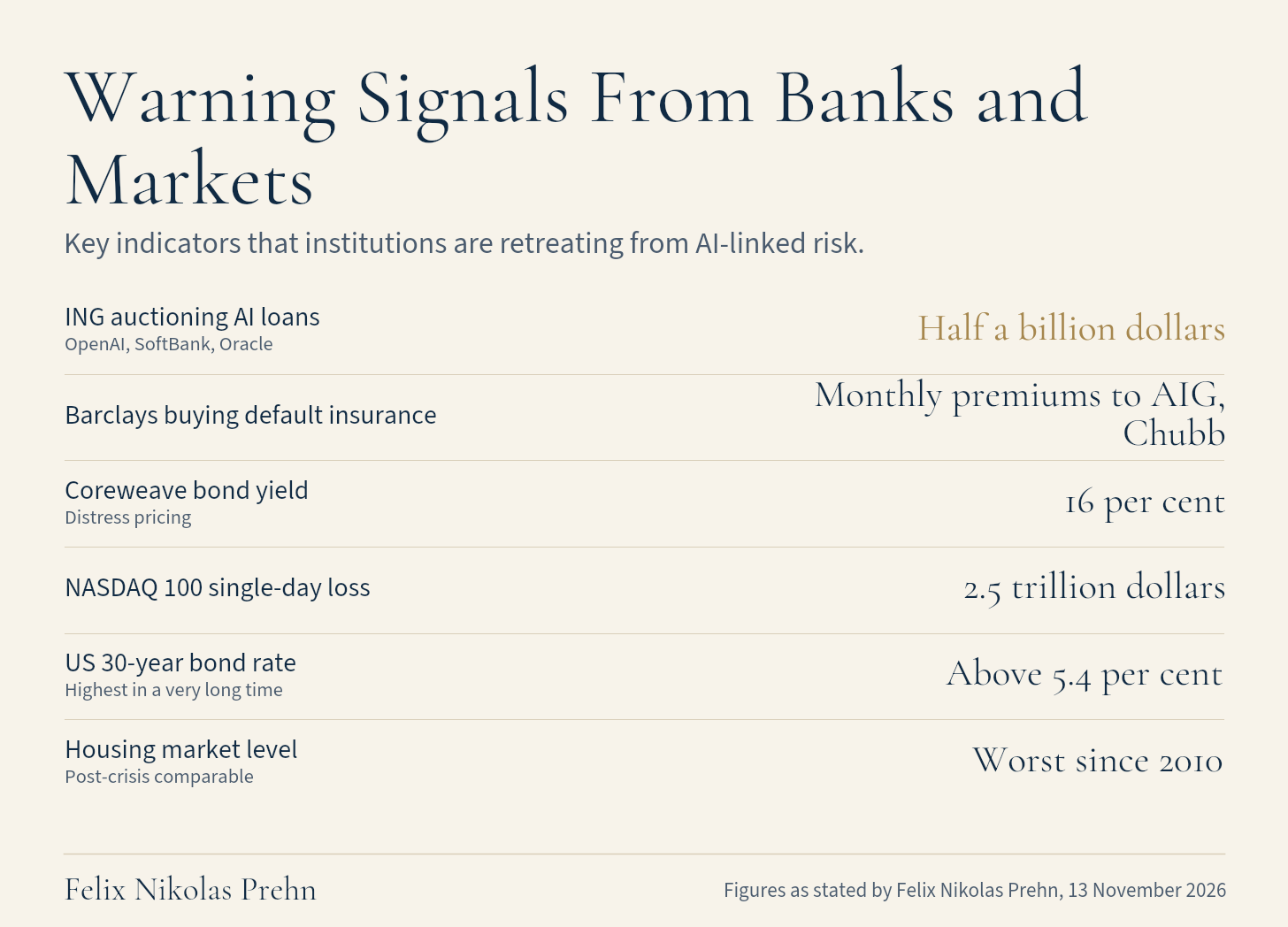
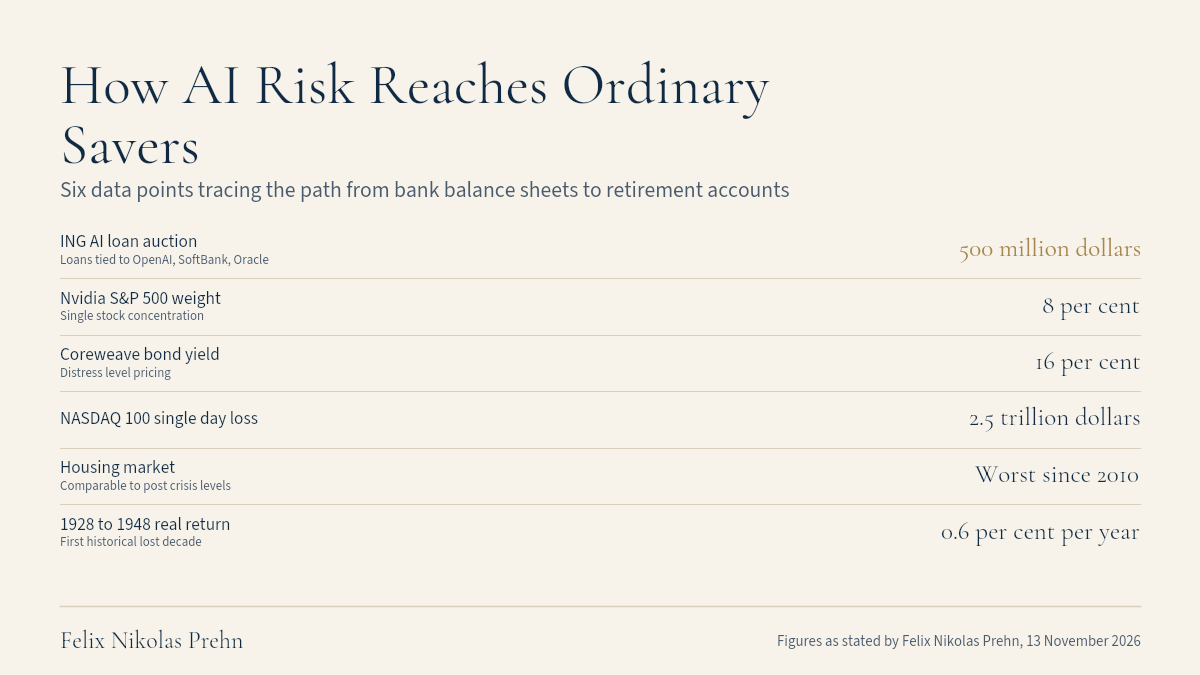
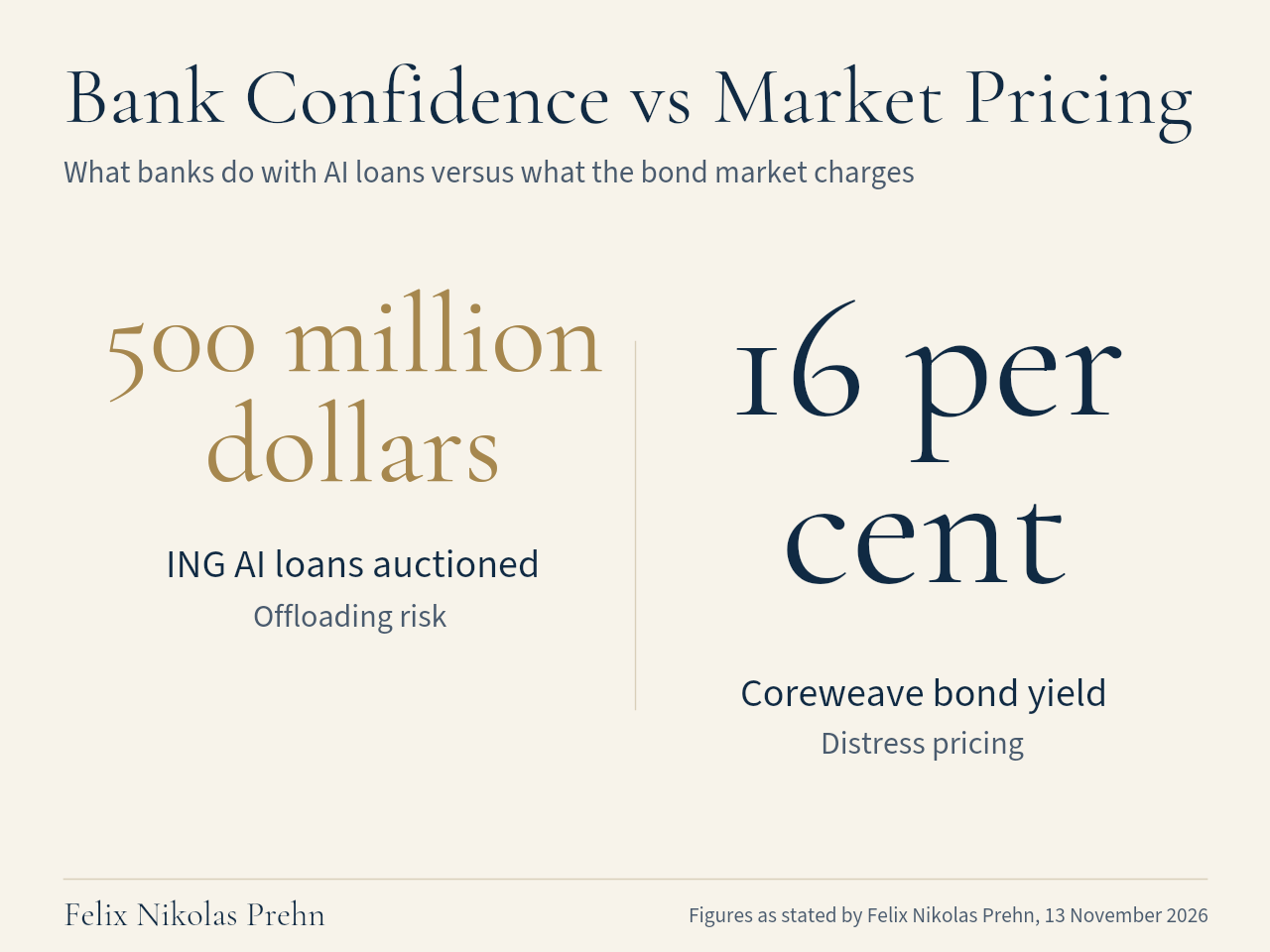
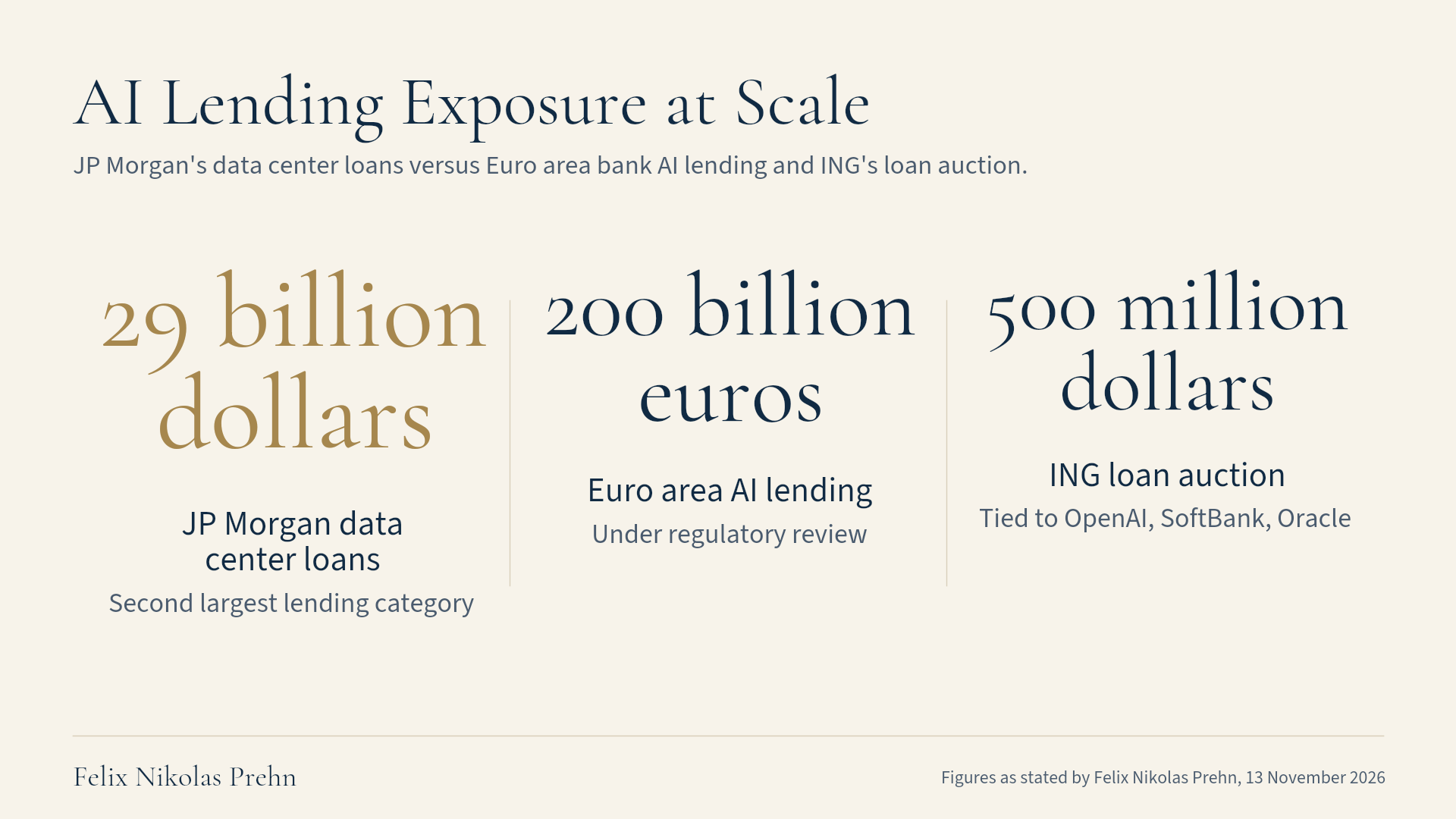
Um, so I was working in ING in a sense for a little while, uh, which was which was quite interesting. Anyway, a year ago, these guys were happily lending into the AI, data centres, chips, anybody who wanted money. Now they've just put those loans up for auction. Half a billion dollars of that and it's tied to not some random micro data centre, no startup someone's making in his mum's kitchen. No, it's open AI, Soft Bank, Oracle.
And they invited other buyers to bid for this junk, sorry, these highquality loans. And if you think about what that really means, why does a bank sell its best? Well, they do it because they want to get risk of the risk before people figure out what the risk really is, right? Have you watched margin call about 2008? Right?
That's what they were doing. And then there is another lovely bank called Barclays and a handful of others actually doing the same thing at the same time.
They're buying insurance on their own loans and they pay every month a premium like you would for a life insurance or a health insurance or car insurance and they pay that to companies like AIG chub big insurance companies. So if their AI borrowers cannot pay, somebody else eats the loss. And that again sounds very much like what margin call 2008 was all about because you remember like American Insurance Group and all these companies, they were like almost bankrupt in 2008 because it insured all this mortgage junk, right?
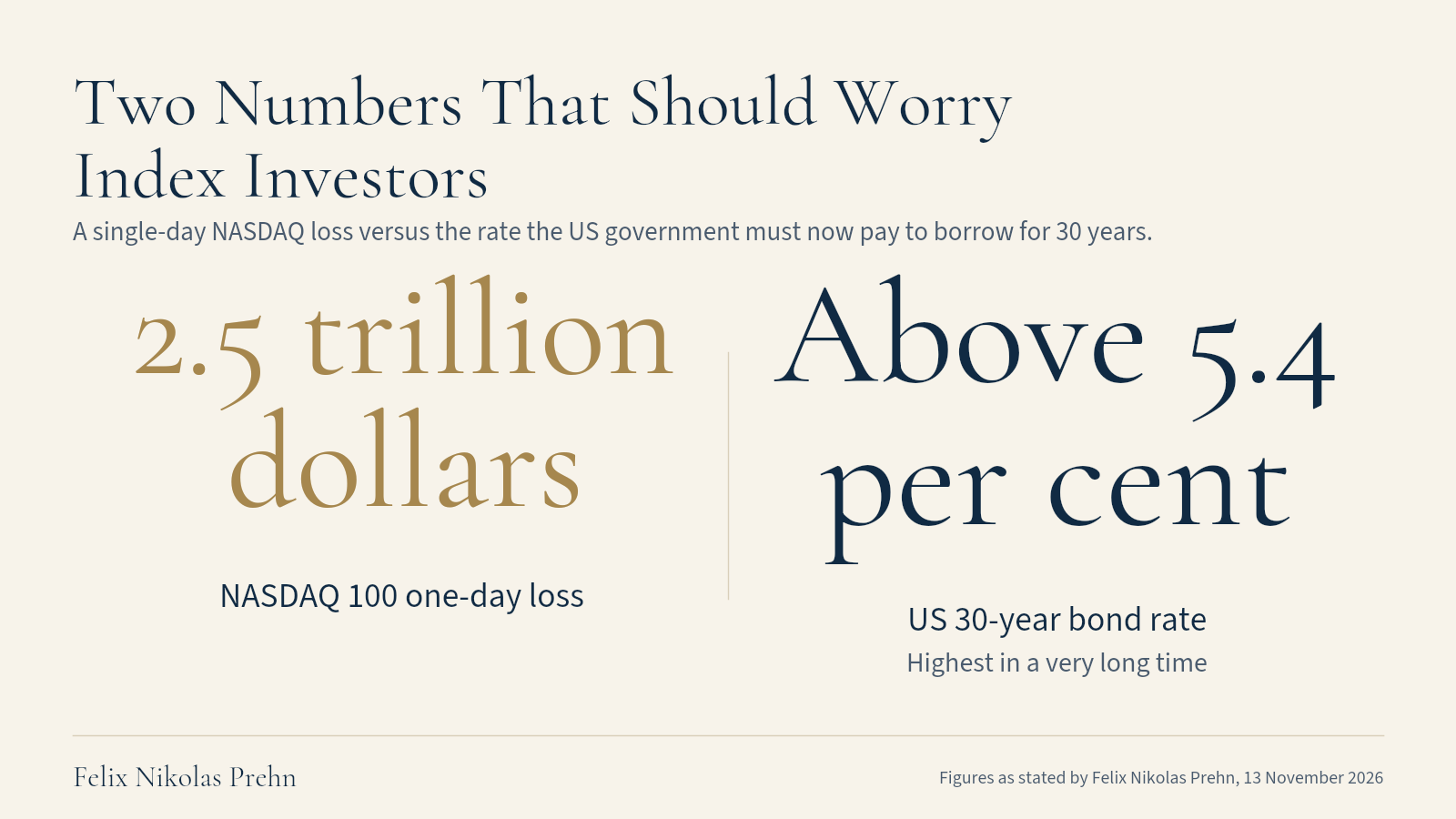
Obviously this time is very different. So the market gave us a little preview of what is going to happen at some point down the road. not necessarily this week or this month or even this year, but $2.5 trillion was lost on the NASDAQ 100, America's 100 biggest tech companies in just one day, which is bigger than the economy of, you know, most countries. And you might still be thinking, yeah, but this doesn't really affect me and all that. And I get that we kind of always want to push these things away, right? Stop talks.
Tell me about some good news. There'll be some good news. I tell just give me a minute. It'll be good news. Really good news, actually.
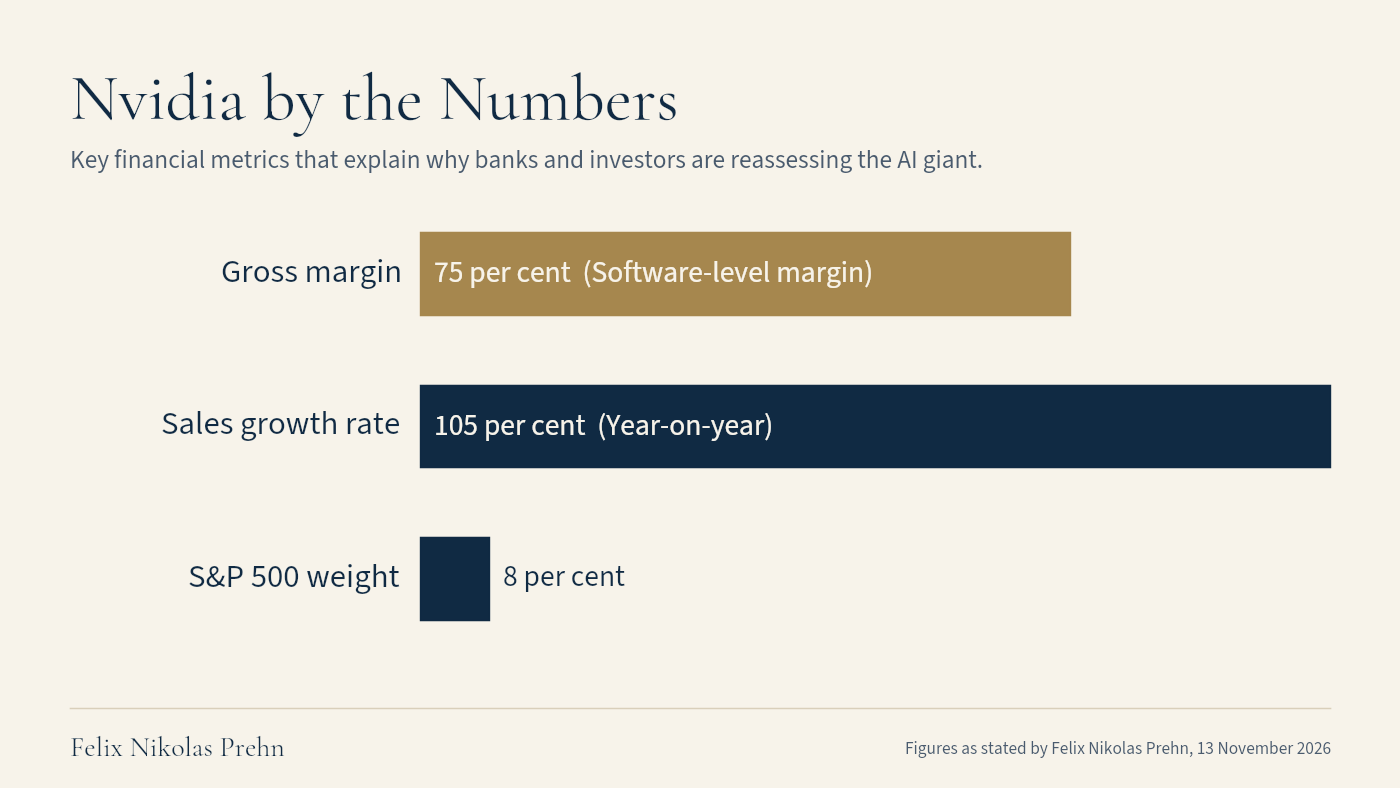
But if you own an index fund like the S&P 500, which most pensions in the world basically do, you own Nvidia. It's like 8 per cent of that. You own the big tech, you own the exact risk that the banks are now paying other people to take off their hats. So about 8 per cent of your money is in Nvidia if you own index funds, right? And Michael Bur, who's a smart guy, he's not always right.
He told people to sell. Why? Not because of the Jensen hangs, you know, can't keep himself to himself sort of thing, which is hugely surprising. Oh my god, a guy who made hundred billion dollars has got girlfriends. Amazing, right?
Let's all panic. It's never happened, has it? It didn't happen to Bezos. No, it definitely didn't happen to Bill Gates. It hasn't happened to Elon.
He's got, you know, 98 children by, you know, 200 aliens or something. So, big surprise. That's not what he's talking about. He's talking about the fact that a business like Nvidia, which is one of the greatest businesses on the planet, no doubt about it, that makes a product that is better than, you know, sliced bread.
Um, at some point that product is no longer as rare as it once was because of the nature of the system we live in. Other people copy, right? Other people hire some Nvidia staff and then they build something similar and they get closer and closer and therefore what happens? Their prices go down somewhat. they can no longer charge quite at the premium that they're presently charging. And Nvidia, and let me just pull it up for you here in um if I could spell Nvidia, there's something that we look at as sort of, you know, fundamentalist investors, and that is margins.
They have a gross margin of 75 per cent. That is a margin you would associate with a software company. Why? Because once I make a piece of software, say you're Microsoft and you know the first thousand users cost you some money that 1,000 and first user cost you almost nothing at all because you've already built the system, you already got the software and the systems and the servers and everything else. So that one's basically pure profit.
And that's what they're doing. And they also grew at 105 per cent their sales. And the law of numbers just tell you that this isn't going to continue forever after. So these margins are going to come down. That's essentially what the Bur is saying and I think he's he's right.
I think that's just logical to happen to every great business ever in the world especially if they make hard ones. But the real problem is that the fund that you were told is diversified. It is an enormous bet on what the banks are presently run away from. They're protecting themselves and telling you about it. So who's protecting you?
Let me show you something. I've pulled this chart up before because I think it's the most important chart in the world. If you only take one thing away from it, take a screenshot of this, please, and post it everywhere in the on the world because people need to understand this. People get this really badly wrong. So, let me slow down for a second.
You've been told, I've been told, Winston's been told all of our life that the stock market on average will make about 10 per cent per year. Right?
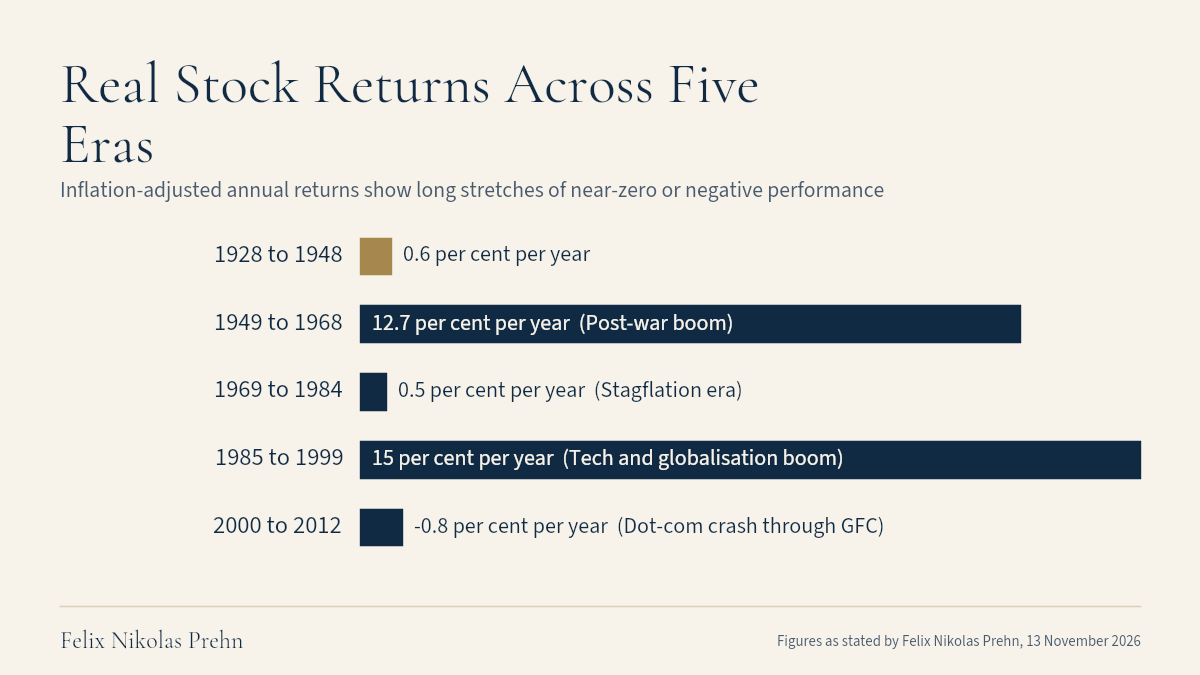
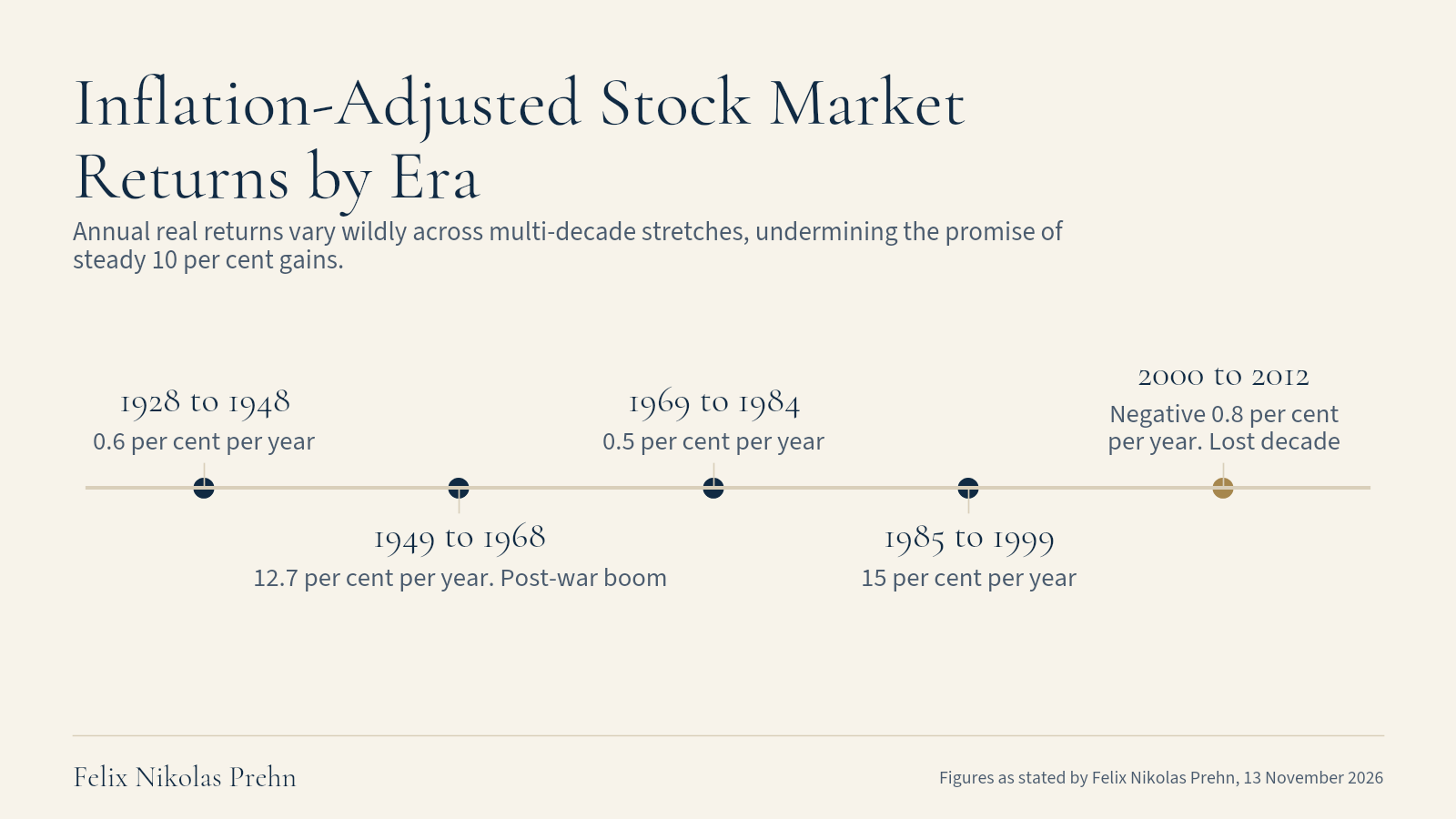
That's what we've all been told. Every financial advisor tells you this. Everyone talks about this, but the trouble is that 10 per cent a year never really happens in any given year. Look at what real returns look like over a stretch of years, right? Not selling your financial product here.
Well, if we go back in time, 1928 to 1948, per year, and this is inflation adjusted, the market made 0.6 per cent. Right now from 1949 postw war to 1968 the market made 12.7 per cent. Woo. Right then 1969 to 1984 which is sort of the period of you know Vietnam war and and and Nixon and and and all that stuff the market made 0.5 per cent. Right now from 1985 to 1999 we made 15 per cent.
Woohoo. uh and then from 2000 to 2012 we made a negative 0.8 per cent. That's a 12 year period. Now for the last 12 13 years we made about 12 per cent per year. So we're all like it's always GOING TO BE 12 per cent FOREVER AFTER this is amazing. I'm going to retire.
I'm going to be a squillionaire. It' be great. I'll buy another pitch. Yeah. So the average of all of this is that 10 per cent that financial advisor chuck at you.
But if you retired at the start of one of these periods, you did not get what you were promised. You got a lost decade or longer. 10 years of putting money in and watching it set still while you're spending the money because you're retired. So this average up here is marketing bollocks from the fund industry, right? It is not a promise.
It's not going to happen. But I can tell you that the smart guys, the trained guys, the skilled guys on Wall Street, they were not sitting from, you know, from 2000. Let me get a pen. You can actually see from 2000 to just 2012, the market made minus0.8 per cent on average after inflation. I can tell you Wall Street did better than that.
I can tell you fund managers did better than that. Hedge fund guys did better than that. the traders did better that and plenty of people who simply understood how money moves made a lot more money than that and that's a skill and you probably haven't been taught it which isn't your fault but what if I told you that in that same period 2012 so this is the S&P what if I told you that there was a sector an industry that made like 165 per cent in that time period wouldn't you want to know what that was and how people found it because it life changing between like you know living off sardines uh which my cats would quite like but for most of us is a little bit stale. So when the market returns 0 per cent for 10 years you're in trouble unless you learn how to position your money so that this flat ugly 10 years doesn't wipe you out and can actually be the making of you. So that is the thing I am most passionate about teaching here. energy went up 165 per cent in that time period, right? 2020 2016.
And I'd love to pull you by the ears and the nose and the ponytail and drag you into about a twohour live trading, which will be fun, I promise you, and eye opening, and actually teach you how to prepare for that because the likelihood is, and I haven't got a crystal ball. I don't know what's going to happen tomorrow. Nobody does. People who tell you are just plain out making up. when you have periods that are extraordinary, right? And we've just had a period, we're at the tail end of a period that's been extraordinary.
Making money in the market has never been easier. Doesn't mean it's easy, but it's never been easier. Isn't the likelihood that we're therefore going to get another period where just not a lot happens and then we're going to get another glorious period where lots of good stuff happens. But that period here could be the next 10 years of your life. So if you want to come and be prepared for that and actually enjoy that period because I certainly will be.
Come and go to how to prepare.org. Link is down below in the description. It's also in the pinned comment. We're very efficient that way. And join me on Saturday.
I think it's 9:00 a.m. New York time. It should be about 2 or 3 p.m. somewhere in Europe or London. Uh and and and you know, God knows wherever else you are in the world. Stay up for it because we won't have a replay and we'll do it live and you can ask me questions and I'll actually teach you that.
That sounds good. You want to be prepared, write prepared in the chat or just a PP to really confuse people who haven't made it this far on the video. Okay, so now that you know what to do about it, right, come come and learn with me on Saturday because this bank story goes actually a lot deeper than just a couple of loans and a couple of random European or British banks. There is a thing that banks do and it is called structured risk transfer and it sounds technical but it's quite simple.
When a bank has one enormous loan to say a single data centre, and that loan is just too big, too concentrated to just be really comfortable with, they slice it up. So they keep the safe looking top slice and they push the riskiest crap, the bottom slice, out to private credit funds and insurers because they're a little bit more uh gullible. So the most dangerous part of the AI boom is being posted to somebody else and they're doing it really really quickly so they can get rid of the risk before you know stuff hits the fan. And honestly just think for a second where the risk goes because risk doesn't vanish goes into insurers pension funds because they're run by lunatics who want a few percentage points more yield and don't understand risk. So maybe your bank's going to get out clean, right?
But it'll end up in your pension fund. So you're going to get hit with this through a different door, right? The hot potato basically gets passed around to the dumbest lunatic running a fund or a pension fund or something like that. And it isn't just one little random corner of the market. JP Morgan, right, the greatest bank in America, just ask, I'll tell you.
They're sitting on about 29 billion dollars of data centre linked loans. It's their second largest piece of um lending essentially. And then look at the price that the market is putting on this. Coreweave, one of the big AI infrastructure players, has bonds trading at a 16 per cent interest rate. Now, when people pay a 16 per cent interest rate, uh it means it's dodgy as hell because there's no one willing to lend to you at, you know, 7 per cent 8 per cent 10 per cent.
And everyone's going, "No, but pay me 16 and some crazy person will lend you money." Right? That's usually the way it works. It's a bit like if you get a credit card and you've got like bugger or credit rating, they're going to charge you 30 per cent interest, right? And I pray to God that you don't have a balance on your credit card at the end of the month. Pay that stuff off.
Nothing else you do in life matters if you got credit card balance. But this is basically distress pricing. It's really bloody obvious. But what makes this so dangerous is the way this financial industry now works is that one AI company will invest billions in another and then that one spends money on buying chips and cloud computing from the first company and then from a third and then the third signs a giant supply contract back with the first and on paper everyone is BOOKING RECORD REVENUE GROW. GOD, THE GRACE is amazing.
But in reality, it's basically the same pile of money just doing around with a bunch of people. And most people don't understand that circle. They don't want to hear about it. I get it. It's not positive news.
But the banks understand it, right? They've helped to build it. They created the circle and the regulators have, you know, done it too. Europe is really great at one thing and regulation, right? Innovation.
Nope. technology. Don't know what that is. But regulation, who they are, they are the world's best at that. And they are weighing up a formal review of how much its banks have lent into AI because across the Euro area, it's about 200 billion euros, which is the monkey currency that they use in Europe. It's sort of a a dollar, you know, but it makes no sense.
Now, the Bank of England is asking its own banks some hard questions about speculative data centre loans. And when these guys wake up, it's usually fairly late because they're pretty sleepy institutions, right? They'd rather sit in their wood panel room, swigary, and you know, talk about monetary policy. Uh so if you put all of this together, the banks are auctioning off loans, insuring loans, slicing the loans, and shoving the rubbish out the back door to insurers and other gullible money managers. And the central banks are waking up out of their slumber and going, "Oh my god, really?
What happened? What happened? What happened? Someone someone someone do a review or something at least that way we can say we were looking into it right you don't really do this if you think everything is wonderful and hunky dory do and then there is Michael Barry let's revisit our friend now Barry ran a fund called Seon in and in the mid200s what everybody else was saying house prices only ever go up forever after because it's happened like that for the last 10 years right which is the recency bias idiocy that we've all been infected with. Um he said they're rotten and he bet against American housing markets.
Brilliant films made on it. It's quite entertaining. And he was early. He was mocked and then eventually he was right and then he made a fortune. And I know he's still mocked but he's got a fortune.
So he no longer gives a hoot about what was said. And he just said get out of Nvidia before it's too late. And he gave two reasons for it. Reason number one is Jensen Huang, the boss of Nvidia, Bori basically said he is well an enormous amount of Nvidia's power sits inside that one man lap. Right now we realise since that other people sat in that lap.
So um the trouble with that is a lot of these relationships circular financing all this stuff it was done by Jensen the Huang personally. So, you take him out of the picture, which they've just done. Um um they've hung him up, hung him up. Um well, these customers suddenly no longer have that emotional friendship relationship to Envidia.
So, maybe they're going to slow down their orders a little bit. Maybe they're going to push back a little bit on price. Maybe they're going to walk across the road to a competitor. And that is a potential problem. Now the second reason is Nvidia has been helping to finance its own customers purchases.
Nvidia sells the chips. Nvidia helps provide the money for its customers to buy those chips. So some of that record-breaking revenue is basically Nvidia's own money going out one door and then strolling back in another door and going, "I knew revenue. I knew money." Honest. It looks wonderful, but it's a company lending to itself in a circle and calling it growth, right?
And I made a video on that more than a year or two ago. You can look that up if you like. And people were like, "You're crazy." I'm like, "Well, am I?" Um, it's entirely possible, of course, that I'm, you know, self-deifiable. But the lending to its own customers, the money going around between a few giants, the record revenue, the same cash to lapse, right? He's basically pointing to that.
And he says that's what the banks are running from. But it's not some random tech company. No, it is the most profitable biggest tech company in company quite frankly in the world. And if you just pull this up here in the Winston app, look at revenue growth, right? Look at that.
More and more and more and more and more and more every quarter. Growth rate 106 per cent. Just mathematically there is no business that will keep growing under 106 per cent. because it means you double from one quarter to the previous year's quarter and it's just never going to happen because at some point well you would be bigger than the whole world right so there is a ceiling to growth even if you are Nvidia and you you know make the best thing since sliced bread and you cure cancer which is the anthropic pitch I thought that was quite good anthropic CEO comes out and says we know we're going to cure cancer in just be a few years AI is amazing buy my IPO Okay. Um, this is, you know, obviously the six times over subscribed as I'm recording this, so it's obviously working. Um, I'm not telling you run out and say sell your Nvidia or your tech stocks.
It's your decision. It's your money. What I'm telling you is that the guy famous for calling the last crash, he's basically saying this thing Nvidia, be very, very careful. And don't get me wrong, Nvidia will be around in 10 or 20 years. I think it'll be a great business.
But the valuation, not so much. And there's one more door that I want to open up for you because it kind of ties together everything I just talked about into the bigger picture and it shows you where the really big money actually sits.
This week, America sold about $25 billion, which is quite a bit of money, and they sold basically debt, right? So, it's a it's a loan essentially that people are giving the American government, and it's a 30-year loan, 30 years. and they had to pay borrowers more than 5.4 per cent to take those 25 billion off their their hands. And maybe you think, well, random doesn't sound too expensive. Well, it is, I think, the highest number they paid in a very very very long time. And that number actually matters to you.
It isn't some abstract about, oh, the debt's going to get bigger. Who cares? The 30-year bond rate sets the tone for your mortgage, every business loan out there. It's essentially the cost of money on Earth. And if you look at the American housing market, let's tie this back to 2008, it's at the worst level since 2010.
So, it's at the stage that it was at after the wreckage of the global financial crisis, which is all about American housing.
High borrowing costs freeze the whole thing. Basically, nobody can afford to buy at these mortgage rates. Nobody who already has a cheap mortgage wants to sell and give up the mortgage rate they already have. So, what happens? Well, when housing goes, it tends to drag a lot of stuff with it because so much of most people's wealth in America is tied up in their home, right?
And then you've got Scott Bessant, the mighty Treasury Secretary, basically saying, "Well, we can just bend the debt problem. We can um create more growth and we can bring spending under control." Now, that's been promised to us for many, many decades, which is never going to happen. Neither one nor the other. If you stopped spending, you're going to get a huge freaking recession for many, many, many years. You could try to grow. outrun the debt.
Yeah, that's not really going to happen either because actually mathematically that's virtually impossible. So the only thing that they can actually do again is print money. And they're doing that at an extraordinary rate right now. So if you zoom out for a second and and let me ask you how comfortable you feel right now, I'll just put it in one word in the comments. The banks are selling AI.
The government is paying 5.4 per cent 4 per cent to get people to give it money, which is going to push up mortgages even further. Housing market's already completely frozen over. And the guy who runs the market, the sorry money, he thinks he runs the market, but he just runs the money. Bessent, he says, "Well, we could we could just spend less. We could just cause some real pain on everybody." Um, which isn't going to happen, by the way, but it just shows how little of a plan they have.
And then remember that chart I showed you again, you know, the one about the lost decades. It's not a random thing. It happens again and again and again and again. It's part of the system. Um, if you made no money of your investments on the next 10 years, what would life look like for you?
What would retirement look like for you? Maybe you'd be fine. Um, but I think there is a way to enjoy every decade. No matter what the market does, there's a way to enjoy every decade. no matter what the politicians do. And the way to get to that, it runs through training.
It runs through being a trained money operator because you already operate your money. You already manage your money. You could panic. You can sell everything. You'll definitely lose.
Don't do that, please. That's a really, really dumb idea. But what you can do instead, come and learn. And that's what this whole community is about here. We've taught 25,000 people or so the last six or seven years.
And it's what me and my mentors enjoy the most. It's incredibly rewarding. It also makes up for the fact that we were bankers at some point which obviously, you know, got a lot of our our maras to say. So come to hydrop.org. Grab yourself a seat and I look forward to seeing you live on Saturday.
And if you got some value out of this, if some of this was a little bit of a jolt that maybe you needed, share it with somebody. That the only thing I'd ask and I wish you all the best. Right now, I think we're going through some sort of weird phase transition. And normally when you get bad economic news or you get bad jobs data that people are going to fly to safety into the bond.