
Banks Are Dumping AI Loans
ING, one of Europe's largest banks, put roughly half a billion dollars of AI-related loans up for auction. The borrowers attached to those loans include OpenAI, SoftBank and Oracle.
A year ago, banks competed to lend into the AI sector. ING is inviting buyers to take the exposure off its books. In Felix's view, ING wants to shed the risk before the market grasps what the loan book contains.
Barclays and other lenders have chosen a separate route. They pay monthly insurance premiums to AIG and Chubb.
The cover protects against default by their AI borrowers, and the decision to insure a loan book signals doubt about the borrower's ability to repay. Felix argues the choice is informed by internal data on what those loans are worth.
Banks also use a technique called structured risk transfer. Sometimes a loan to a single data centre is too large for comfort. The bank slices it up, keeps the safer top slice and pushes the riskiest bottom layer out to private credit funds and insurers.
The NASDAQ Warning Shot
On a single trading day, 2.5 trillion dollars was wiped from the NASDAQ 100. The loss was concentrated in the same technology names that dominate passive index funds.
The Index Fund Problem
Nvidia accounts for about 8 per cent of the S&P 500 index fund. Any fund that tracks the S&P 500, and most pension allocations do, carries that weighting automatically.
Nvidia has a gross margin of 75 per cent, a level associated with software companies rather than hardware manufacturers. Once the system is built, each additional user costs almost nothing.
The sale is close to pure profit. Nvidia grew its sales at 105 per cent.
Growth at that pace cannot persist indefinitely. Felix argues that 105 per cent growth hits a mathematical ceiling.
At that pace, Nvidia would need to double sales every year. No chipmaker has sustained that rate.
Felix argues that Nvidia's margins will come down. Competitors will hire Nvidia staff and copy its designs.
As more firms enter the market, Nvidia's pricing advantage narrows. Once alternatives exist, the premium Nvidia charges today will erode.
An S&P 500 tracker carries 8 per cent exposure to a single chipmaker. Banks are already hedging against that chipmaker's borrowers.
JP Morgan, Coreweave, and Distress Pricing
JP Morgan has roughly 29 billion dollars of data centre linked loans on its books. Data centre lending is the bank's second largest loan category.
Coreweave is an AI infrastructure company. Its bonds, debt instruments that pay a fixed rate to the lender, trade at 16 per cent.
As Felix puts it, 16 per cent signals that no lender was willing to provide capital at a conventional cost of borrowing. The rate is distress pricing, a market signal that the borrower's ability to repay is in serious doubt.
Financial regulators are beginning to respond. The Bank of England is questioning its banks about speculative data centre loans.
Headlines indicate the European Central Bank is considering a similar review. Formal action has not yet been taken, but the questioning itself signals concern.
The Circular Financing Problem
In the euro area, banks have lent roughly 200 billion euros into AI, and the lending is entangled with a pattern Felix describes as circular financing. One AI company invests billions in another. The second participant spends that money buying chips and cloud computing from the first.
A third signs a supply contract back with the first. On paper, every participant books record revenue growth. The same pool of capital circulates between a small group of firms.
Michael Burry warned investors to get out of Nvidia before it is too late. In Felix's view, many of Nvidia's commercial relationships and circular financing arrangements were built personally by Jensen Huang.
Without Huang, customers lose that personal connection. Buyers may slow orders or turn to a rival chipmaker.
As Felix puts it, Nvidia has been helping to finance its own customers' chip purchases. Nvidia sells the hardware and helps provide the money for its customers to buy those chips. Some of that record revenue is effectively Nvidia's own capital being recycled through its buyers.
Felix argues this constitutes a form of circular financing, where a company lends to itself to generate reported growth.
Lost Decades and the Myth of 10 Per Cent
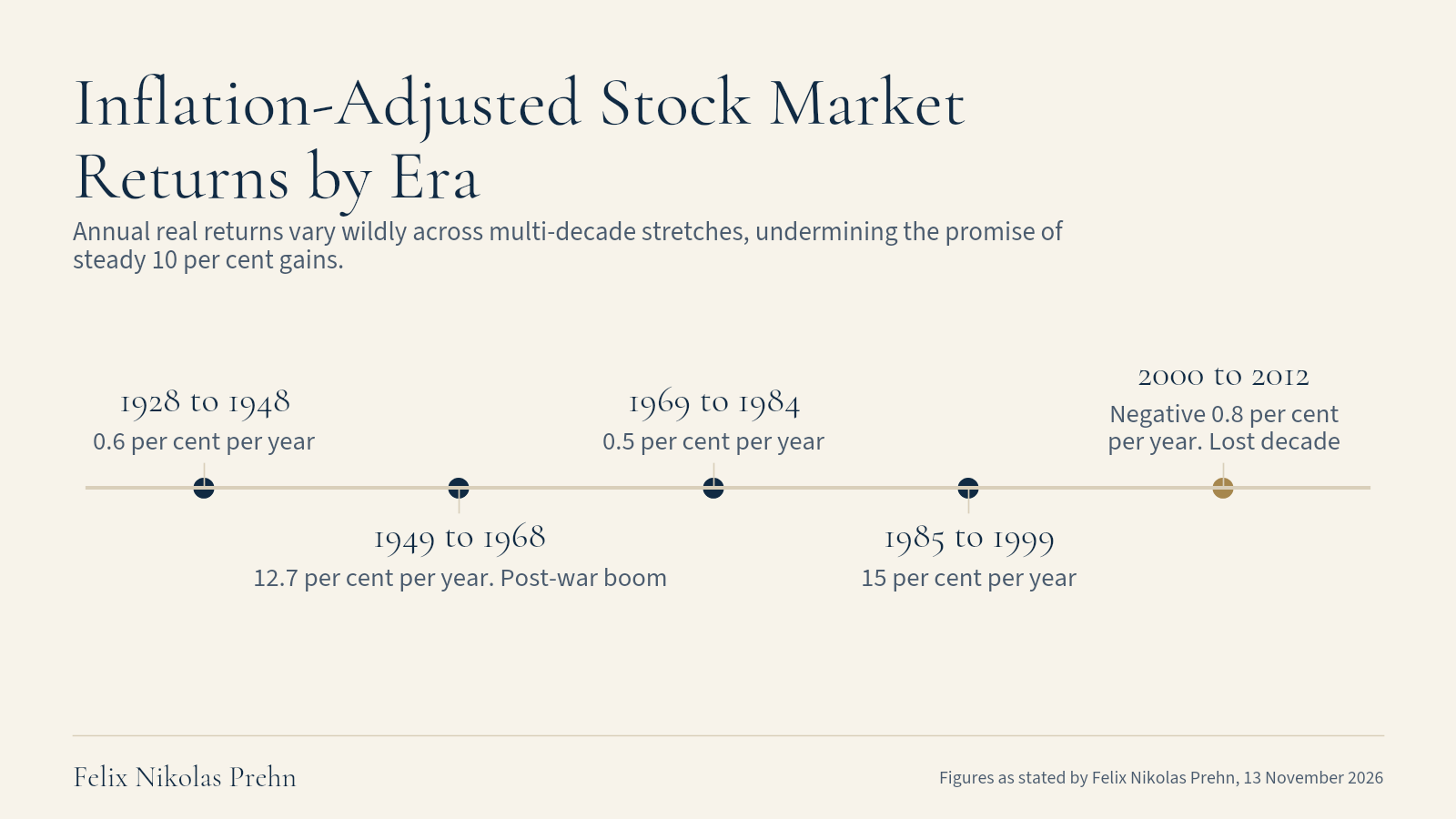
The American stock market has alternated between decades of high real returns and periods near zero. From 1928 to 1948, the inflation-adjusted return was 0.6 per cent per year. From 1949 to 1968, the real return was 12.7 per cent per year.
From 1969 to 1984, the real return fell back to 0.5 per cent per year. From 1985 to 1999, it rose to 15 per cent per year.
From 2000 to 2012, the annual real return was negative 0.8 per cent, yet the energy sector rose 165 per cent over the same period.
The 30-Year Bond and the Housing Freeze
The United States sold about 25 billion dollars of 30-year debt. As Felix notes, the government paid buyers more than 5.4 per cent. Felix describes the rate as the highest in a generation.
The 30-year bond rate is the interest the government pays to borrow for 3 decades. It sets the tone for mortgage rates and every business loan. The rate prices long-term money for the entire economy.
The American housing market is at its worst level since 2010, a year that followed the global financial crisis. High borrowing costs freeze the market.
High mortgage rates price new buyers out. Homeowners who locked in cheap fixed rates refuse to sell and give up the low payment.
When housing weakens, it tends to pull wealth down with it. So much household net worth in America is concentrated in property.
The government cannot outgrow its debt. Felix argues that is mathematically close to impossible.
A spending cut of the required scale would cause a severe recession. The remaining option, as Felix sees it, is to print money.
The largest banks have identified concentrated risk in AI lending and are offloading it through auctions, insurance and structured transfers. Private credit funds, insurers and pension allocations absorb the offloaded risk. Their managers accept a few extra percentage points of yield without fully pricing the exposure.
An S&P 500 tracker allocates 8 per cent of its weight to Nvidia. Circular financing flatters the company's reported revenue growth. A rate above 5.4 per cent on 30-year debt freezes the housing market and raises the cost of every long-term loan in the economy.