Transcript
This metal is set to explode. And no, it's not gold. It is not silver. Everyone's arguing about gold being overextended, whether they missed silver, whether it's manipulated with AI as a bubble. And meanwhile, there is something physical that is tightening underneath the market that almost nobody is watching.
By the end of this video, you'd understand exactly what this metal is, why it's structurally different from any other commodity, and I'll give you my 3-step framework for positioning yourself without chasing hype. My name is Felix Prehn. I'm an ex-investment banker. Winston back there, our metals specialist. And we've seen how the market works on the inside.
We've also founded the Goat Academy where my retired Wall Street mentors teach regular investors institutional strategies. We've taught well over 20,000 students in the last 6 years. I'm also the co-founder of trademission.io where we have access to insane level of data. And our mission here is very simple, is to spread the institutional knowledge and patterns and rules and pass them on to you so you can have more fun.
The metal we're talking about is, drum roll, it is copper. Now, before you run away thinking copper, that's boring, let me ask you something. What do AI data centres, electric vehicles, every defence system in the world and the entire US power grid have in common? What do you think is behind your light switch? Copper. And they all need a lot of it.
Now, most retail investors don't understand this because they think commodities work like tech stocks. Prices go up, supply goes up, problem solved. That's true in software. If you build something cool like ChatGPT came out, I actually think it's a fairly evil piece of equipment, but came out and then Claude came out and then Grok came out and then hundreds of others of these things sprouted up. But in geology, you can't really do that. You can't download copper from the cloud.
Let me give you some numbers that should wake you up. JP Morgan is forecasting copper prices to hit $12,500 this year. Not anytime this year, but by the second quarter of this year. Now, is that therefore definitely going to happen? I don't know. JP Morgan, pretty powerful, pretty good connection to the top, it seems. But no, this isn't financial advice. I'm not a registered financial adviser. I'm just telling you the research and the patterns and the rules that I've been taught by my mentors.
There is an organisation called the International Copper Study Group. I know, exciting. Get yourself that subscription. You know you want it. And they're saying that the market is going to shift from surplus, as in too much copper, to a deficit, as in we haven't got enough of that stuff. That deficit is going to be 150,000 tons, which seems like a lot.
Bloomberg is warning we're entering a structural deficit, not a temporary one, a structural one. You see the data centre chaps, they are going to build data centres no matter what copper costs because they're like, we need this. We need more chatbots. We need more immediate girls in bikinis dancing generated by AI. That's essential.
If you look at the data, and we have a copper dashboard in our community there, obviously on gold and silver and so on, but it shows you the demand growing, supply growing very very slowly, and then if you look at the price history, yes it's accelerated but actually maybe not as much as you might think. It explains the whole thesis of where it's coming from, where it's going, inventory statuses on COMEX and in London, and they're pretty low, and then also how do we invest in it.
You want to check that out, there's a link down below. It's like £6 a week or something. We like to make institutional data very very affordable and very available. And we also explain what this actually all means. So check it out down below if you want to get more into this.
Copper is unique because it has pricing power. Think about it this way. Think you're going to spend $5 billion to build a data centre. Some great big shed with a roof. Amazing drawing, right? I should be an artist. What if copper goes up 20%? Are you going to cancel your $5 billion data centre that you have a contract with Microsoft with? No, you're not. You're just going to pay more for copper.
And the same thing is if you're a Tesla and you're building one of these, again, this is clearly exactly what a Tesla looks like. Well, if it cost you an extra $100 in copper, you're still going to build the car, right? If you're the US military and you build these things, that is meant to be a rocket, rather timely right now, you don't give a hoot what this thing costs. You just want more of them faster. You're going to pay whatever it takes for copper. And that is very unusual.
Now, maybe you're thinking, okay, interesting thesis, but why isn't the media talking about copper? Well, if you're wondering that, put a copper down below in the comments because I'd like to see how many of you are starting to connect the dots here. Because you see gold and silver, they get all the attention. It's very unfair because they are shiny, they are sexy, and people like to panic buy them when the world is ending. Copper is what you need when you're actually building something. And guess what? The world is trying to build everything at once.
And for the last 40 plus years, what have we all been told to buy? We've been told to buy financial assets, right? Stocks, real estate, bonds. And during that time, commodities were starved of money. And this has been going on for so long that as all the money was flowing here and very very little of it was flowing into mining and exploration and paying geologists, and that meant very very little mining and exploration happened.
In fact, there are not even very many geologists being trained because who wants to do a job that doesn't pay any money because apparently we should all invest in software, right? And this has created a setup that happens very rarely, about every 50 years. Commodity bull markets do not do this. No, commodity bull markets look like that, and then they start to break out and then they potentially go parabolic. Very long dormancy, sudden repricing and then we tend to hold on to this for quite a long period of time.
Copper spent most of the last decade hanging around between $2 and $4 per pound. It's trading just under $6 and it was breaking out above $6. And that's because demand is colliding with decades of underinvestment.
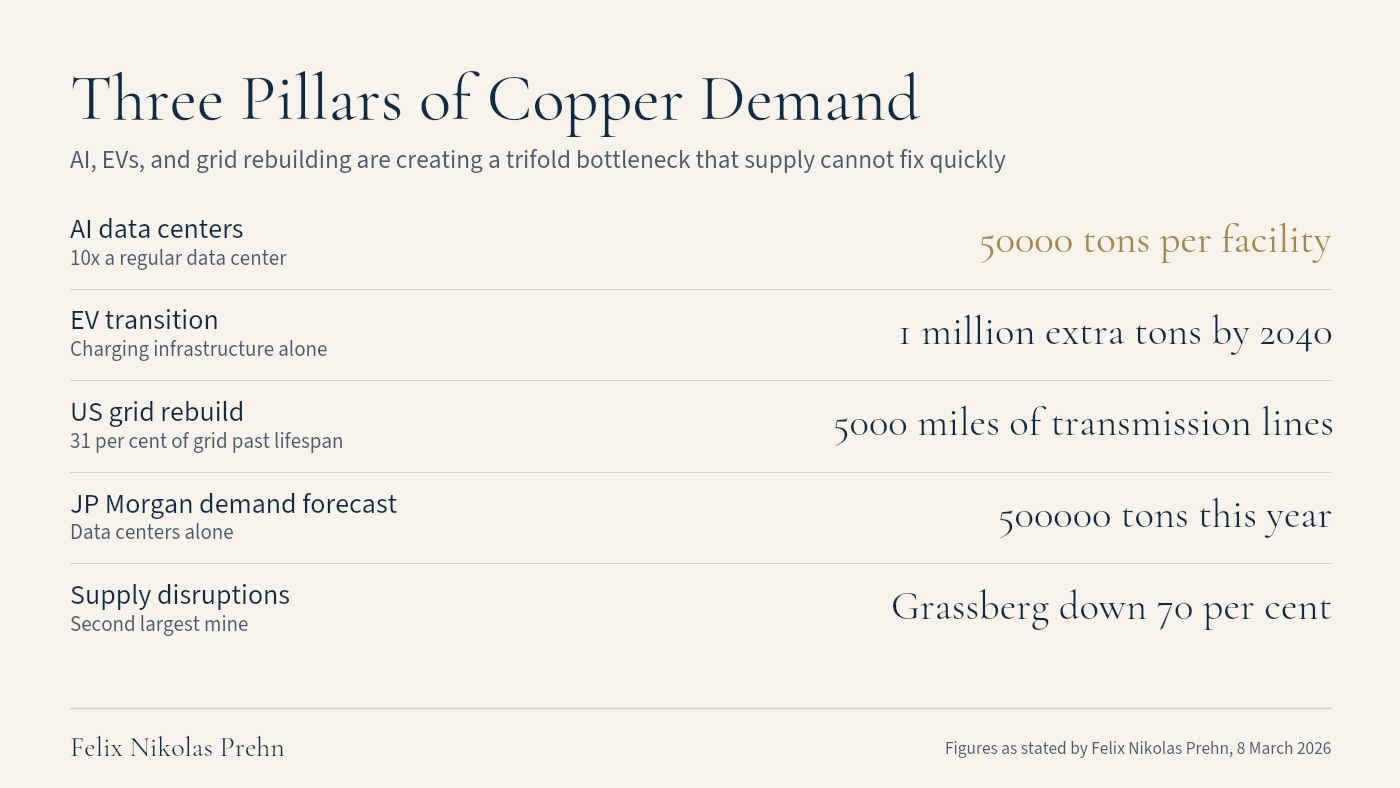
Now, whenever it does that, people say, oh, it's temporary, don't get involved, it's risky, and all that kind of stuff. And yes, it's risky. I'm telling you that too. The reality is there isn't that much more mining. In fact, there was a fatal mudslide at Grasberg. This is a word you might want to write down. You might want to hear a bit more about that in about 6 months' time on mainstream media. That's the 2nd largest copper mine in the world. Shut down 70% of their production until the middle of the year.
There is severe flooding in Congo at a mine called Kamoa-Kakula, which sounds like a great song. Peru is politically a little wobbly. There are challenges at the Chile mines and JP Morgan says that the supply is falling down 1.4% than their previous estimates. Now 1.4% doesn't sound like a lot, but this is half a million tons. Think about how many wires and cables and things that are right now.
Maybe you're thinking, okay, maybe I need to understand these kind of market patterns better. Maybe I need to understand how these markets work better. Well, come and join our metals community there. There's also a ton of stock features in there, by the way. Stock scanners and all that kind of good stuff. Say you wanted to look into one of the biggest copper miners out there, FCX. You just type FCX into the search bar here and it tells you very quickly, is this actually a decent business? Margins, return on capital, cash flow, do they have a lot of debt? And it gives you a very quick snapshot, not the be all end all to your research, but it's certainly a pretty good beginning. And it's that kind of data that we make available to you.
But I want to explain to you why copper is different from our friends gold and silver that most people know more about right now. And let me know if this is useful for you by the way. Put a useful down below in the comments and I understand this is landing then. And so I'm going to give you a 3 pillar framework. Pillar 1 is AI, the AI infrastructure explosion. Pillar 2 is the electric vehicle multiplier and then pillar 3 is the grid rebuild.
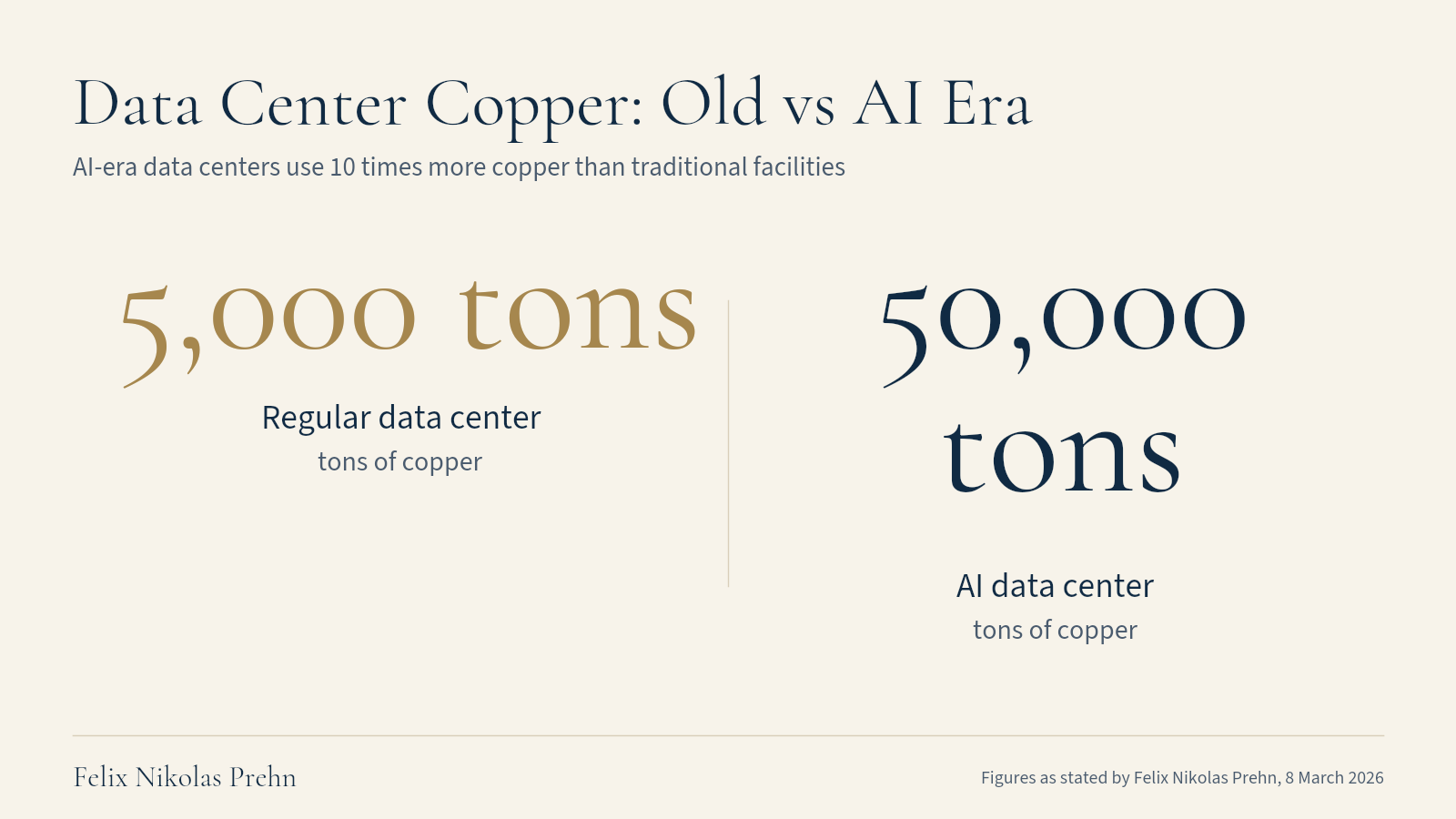
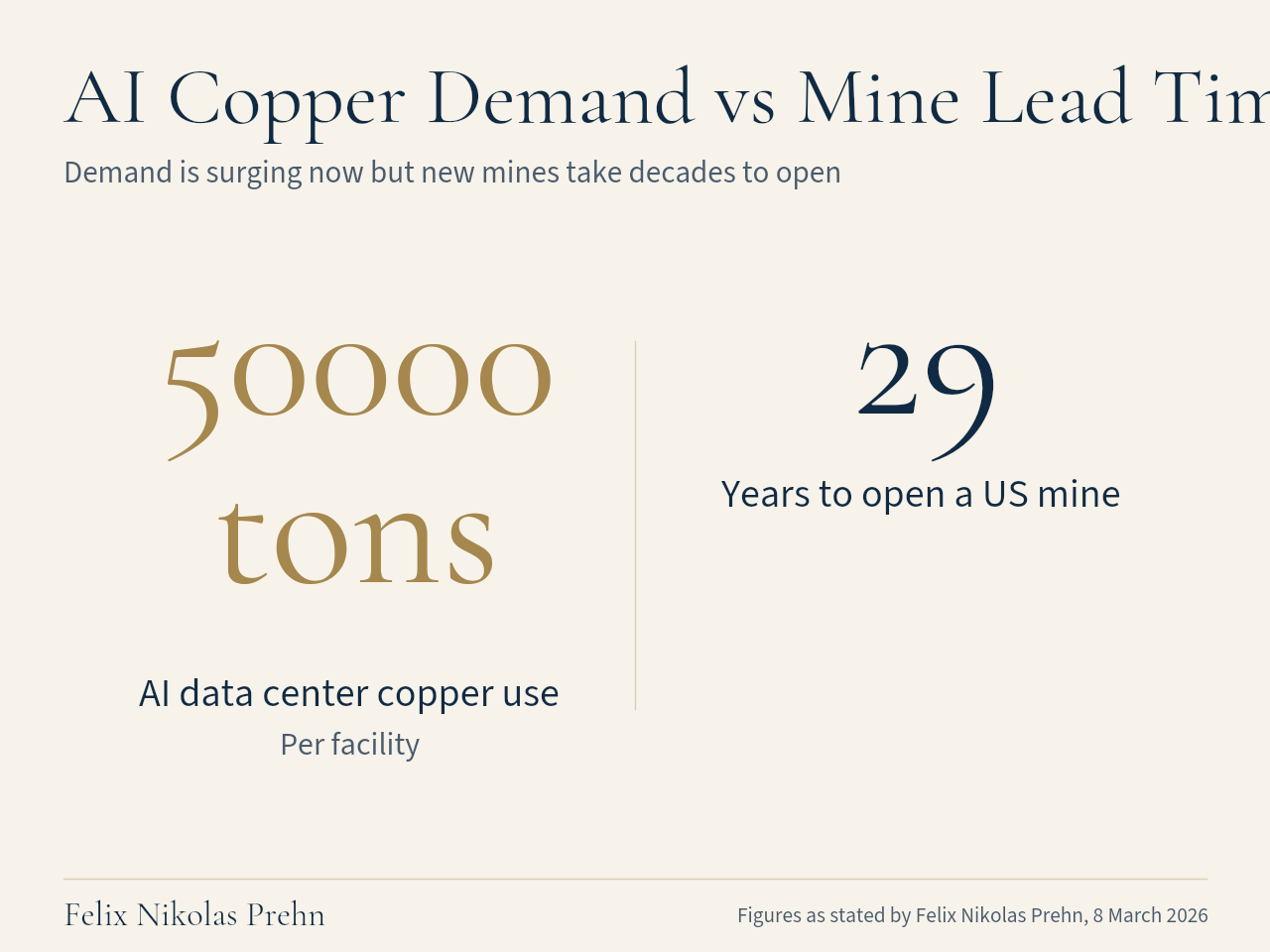
Each of these alone would be important but together they're creating a trifold bottleneck that the supply literally cannot fix quickly. So let's talk pillar number 1, AI, specifically AI infrastructure data centres. The kind that are housing Nvidia's latest systems, they can use up to 50,000 tons of copper per facility. Now a regular data centre was like 5,000. So this is a massive 10x increase in demand for copper.
And our friends at JP Morgan, who always have the little investor in mind when they put out their data, JP Morgan are saying that data centre installations could account for about 500,000 tons of copper demand this year alone. That is a global increase of 5x of copper demand. It's needed for wiring, for the cooling systems, for the transformers, for bringing the power in. Well, if you think that's bullish for tech stocks, wait until you see what that does for the metal that makes the tech possible. We're essentially a step below the tech that we normally talking about here.
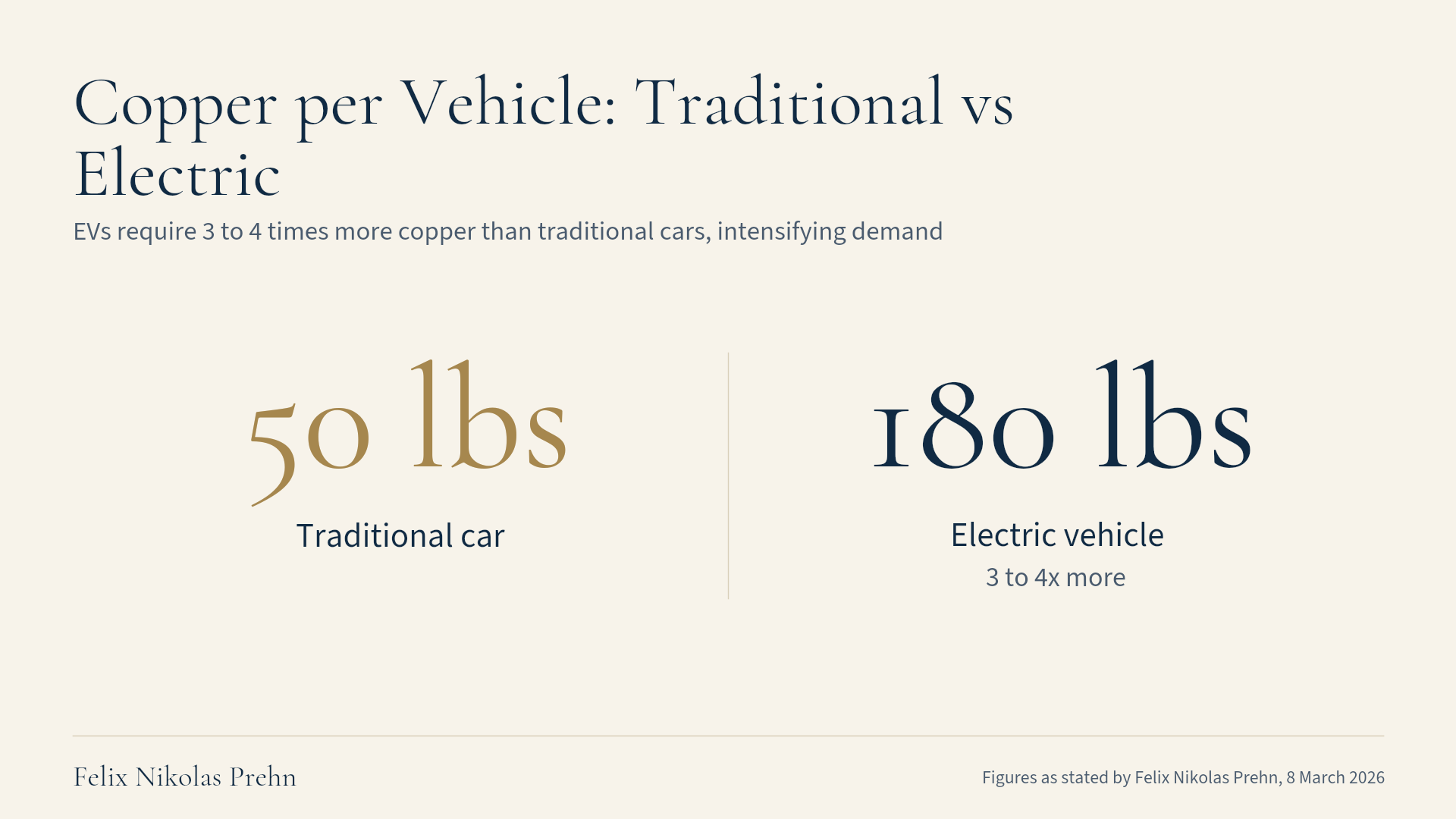
Right now, let me show you this. A traditional car uses about 50 pounds. It's about a bag of sugar of good old copper. An EV car, so gas guzzler, I should have probably written gas guzzler rather than EV. How much do you think is in there? Give it a guess. 180 pounds. That's like 3 to 4x what is usually in a car.
And then of course you have the charging infrastructure. Charging infrastructure is thought to require about an additional 1 million tons of copper by 2040. And if you were to replace every ICE vehicle with an EV vehicle, according to the University of Michigan, that would need more copper than has ever been extracted from the ground in human history.
But I'm sure it'll be just fine and I'm sure there won't be a deficit. How many of you are driving an EV or own an EV, a Tesla or something? Put EV in the comments down below. Let's see your vote there. And then pillar number 3, we have the grid. And it's not sexy as well, nobody talks about it, but the grid is showing its age, it needs a facelift.
31% of infrastructure is near or past its lifespan. So we're just going to say it's old, that needs to be replaced. 46% of the distribution infrastructure is the same, needs to be replaced. The US of A needs to build 5,000 miles of transmission lines. I know, and that literally will require hundreds of thousands of additional tons of copper per year. So global copper demand for power generation and transmission lines is going to go through the roof.
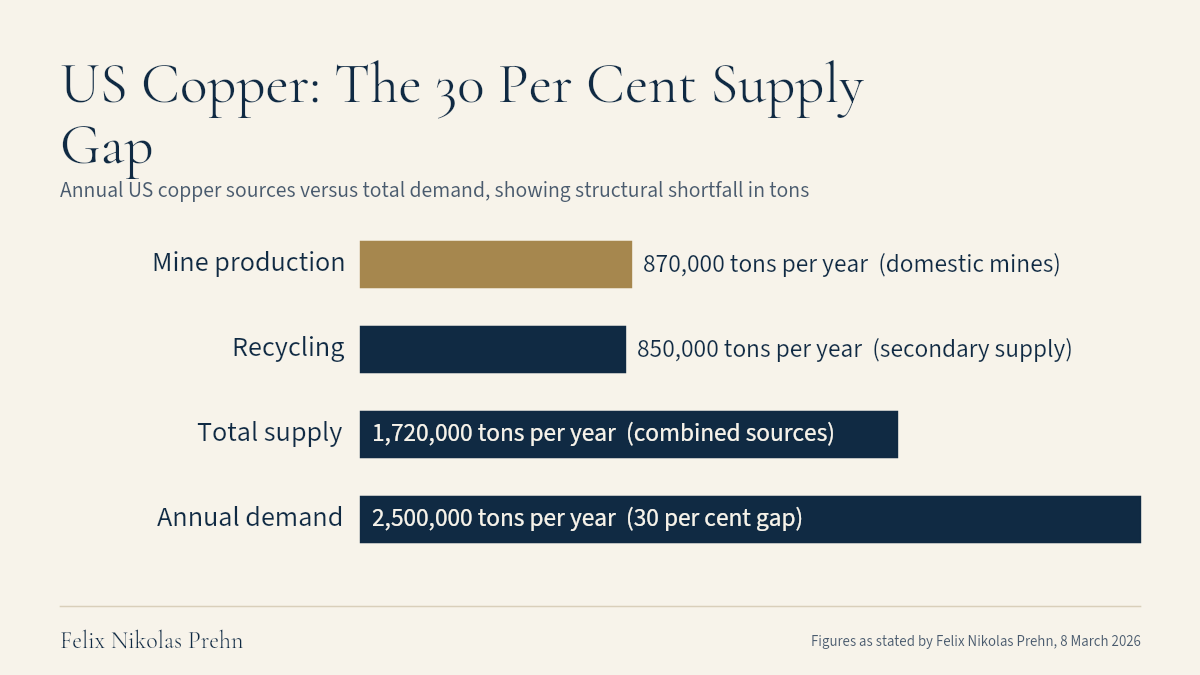
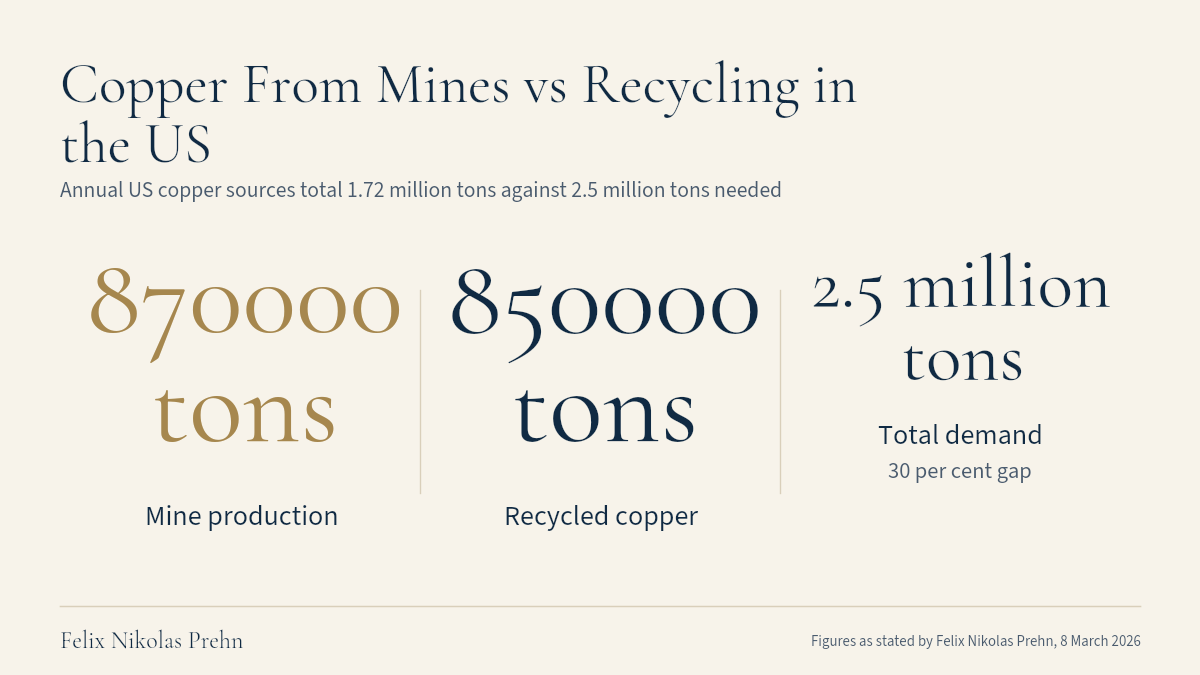
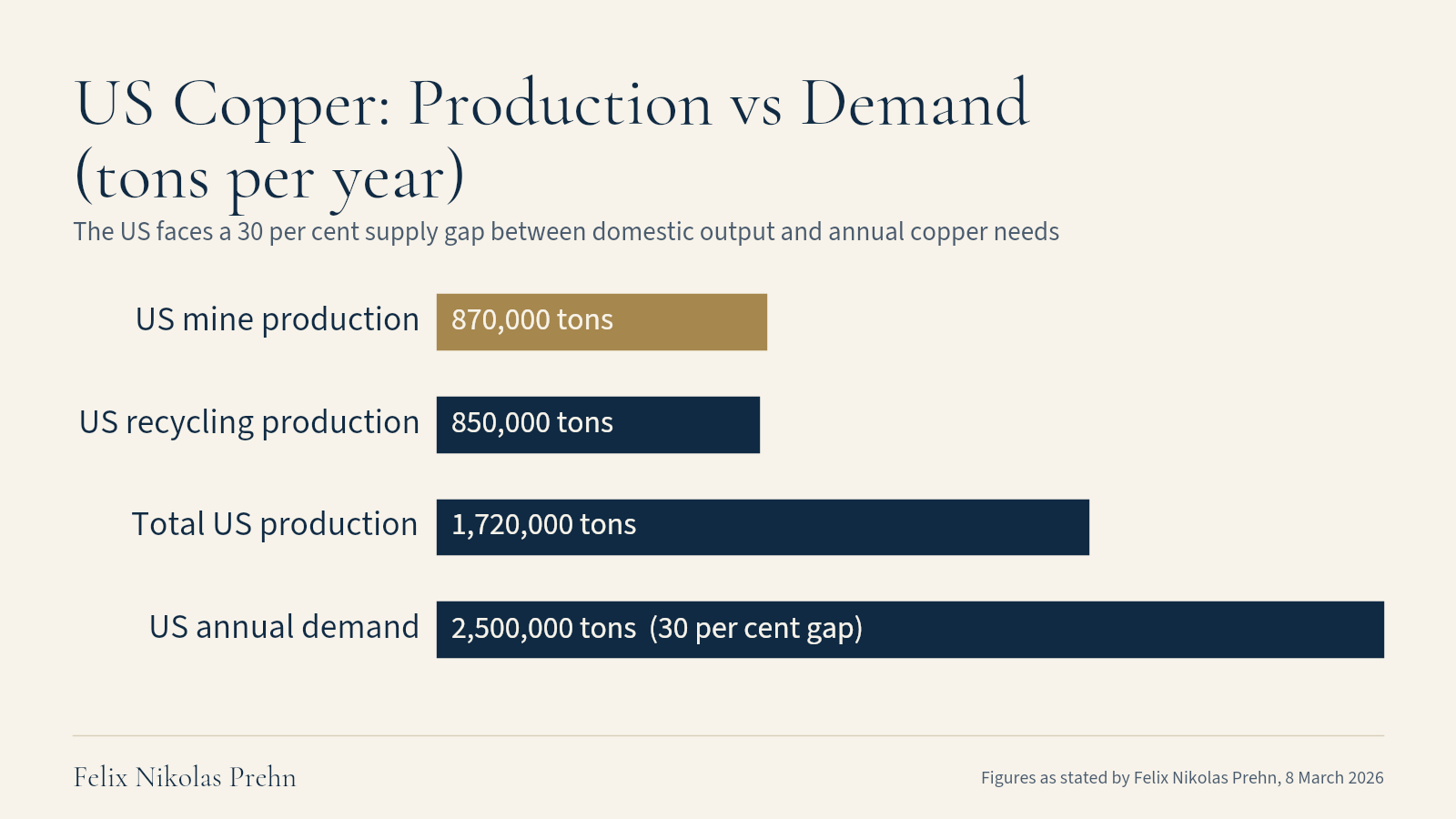
The US of A produces 870,000 tons a year from mines. It produces about another 850,000 tons a year from recycling. Can anybody add that together? What is that? 1.72 million tons. That is production. How much do you think the US needs? The US needs 2.5 million tons per year. And that is what is a deficit.
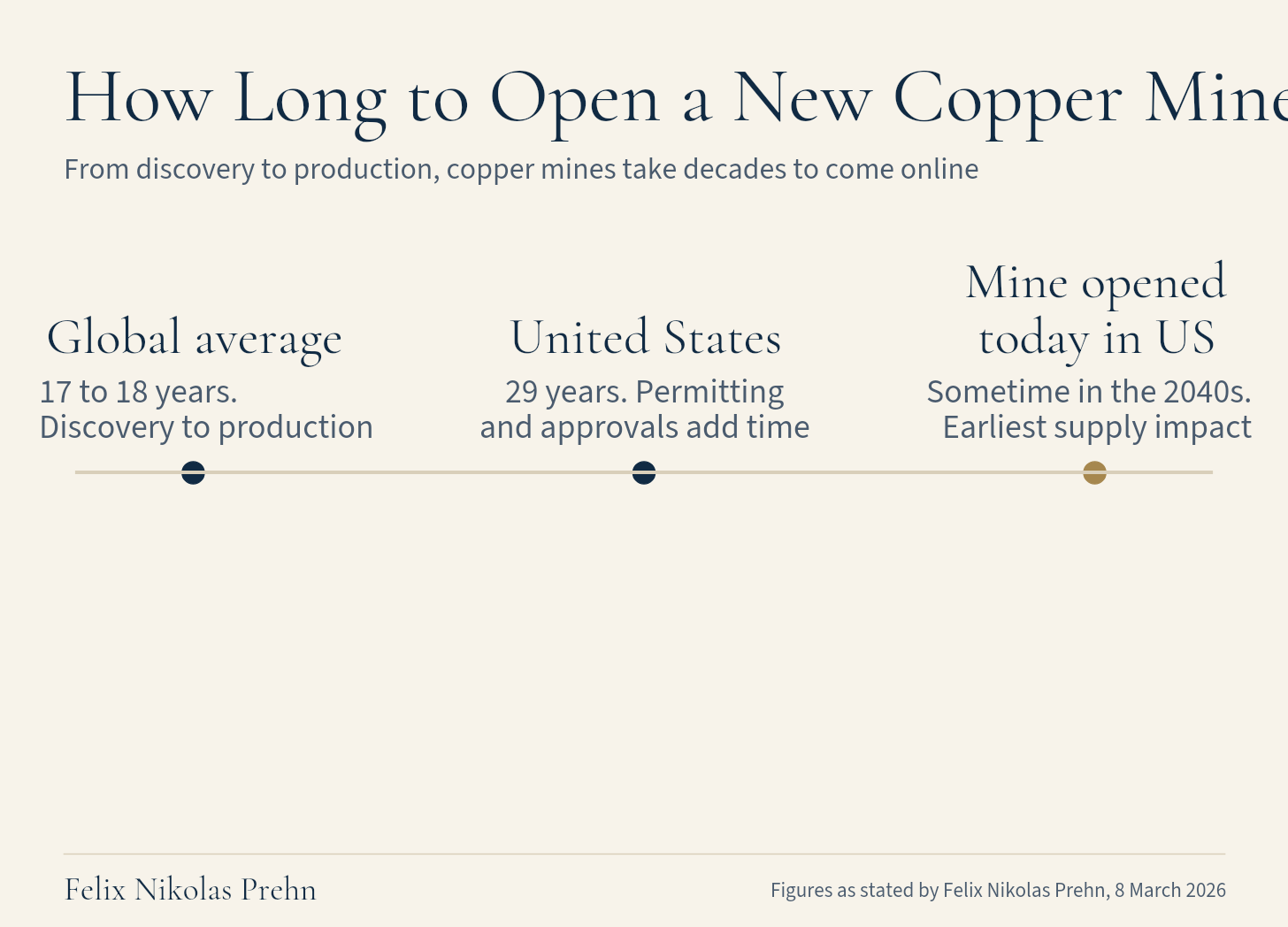
And that likely means copper prices go up. It's a 30% supply gap. Now, most people will think, oh, it's fine, someone's just going to open another mine, aren't they, just going to dig it out of the ground. Well, copper is fundamentally different from other investments. Mining doesn't work like software or data centres. You can't just scale up copper production because copper prices have gone up. It is going to typically take 17 to 18 years to bring a copper mine online.
Crazy, right? Now, maybe you thought that was crazy, but that is in the world. In the US, things are a little bit crazier. In the US, it typically takes 29 years to bring a copper mine online. So 29 years to open one new mine. So if you opened a mine today, it would impact supply until when would it impact supply? Sometime in the 2040s, right?
Why? It's discovery, it's permitting, it's infrastructure, environmental approvals. Every frog and toad and bird and insect is going to complain about it. You need financing, you need construction. And people know this, so people don't want to finance it because it just seems like a looney bin of investments, right?
The other problem is that when you dig out a great big rock, so this is a rock, special rock, I am a rock. Now, how much copper is in that? Well, they're little bits, there's a bit here, a bit there, a little bit here, a little bit there. New rocks we're getting out of the ground, they have less copper in them or copper of poorer quality. So new discoveries are rarer, they're also lower underground and there's less copper in them.
Gold and silver investing is generally speaking fear. Copper investing and copper demand is when the world is building stuff. Right now, the world is building the biggest change in how we live with AI, robots, data centres, automations, and all of that needs copper. And prices could double. This rock is still the same rock, still no easier to get it out of the ground.
Now, how does copper pricing really work? Three phases to that in my humble opinion. Phase number 1 is the breakout. So you get this lull, you break out of the lull, that is your breakout. So you basically move above this very long-term sideways action. Right now, headlines will usually say it's speculative, it's temporary, it's spiked, it's scarily risky now.
And then you get phase 2, which is institutions moving in on this thing. Let me show you a chart here. This is a copper miner ETF, it's called COPX. And what do you see? You see a chart that was doing absolutely bugger all, going sideways, started breaking out in September. The same time volume spiked, which is institutions doing their thing. And from that moment, from that Wall Street rule of pattern recognition, copper is up 72% in the last 129 trading days. Every dip was an opportunity along the way there. By the way, again, I'm not telling you what to buy, I'm just saying.
Then the third phase, which is what nobody really understands, is the miners get repriced. Why do the miners get repriced? Miners have fixed costs. Let's say it costs a miner $3 to get a pound of copper out of the ground, right? So if the price of copper is $4, what do they make? They make $1 profit, right? Now, if the price of copper goes to $6, what happens? They make $3 profit. So their profits have gone up 3x even though the price of copper only went up half an x, 50%. You get the idea.
So there is leverage essentially built into miners and their profits double or triple or quadruple. And that's why these copper guys are going nuts. I'm not going to run through every copper miner out there, I've just put in some of the biggest ones out there. There are others. If you wanted to dive into those deeper, again, put it down below in the comments, just write "miners" in the comments and I'll be happy to do that.
Let me tell you one thing, and this is actually advice, right? I always say I don't give advice, I'm going to give advice. You are not going all in on copper or copper miners, right? You're forbidden from doing that. Winston says don't do it. We are not assuming copper prices are going to go up in a straight line because they will be volatile. Copper can move 30% in a bad quarter easy. Mining stocks can move 50% easy. We've seen it many times.
So risk management matters more than some sort of conviction. This is not financial advice, these are just some guidance points. For most investors, an ETF is the cleanest and easiest approach. There are a couple of them out there. There is COPX, for example, 40 different copper mining companies in there. Relatively affordable, there are some others, I'll put them down below in the community already.
Now, if you want pure copper exposure and you don't want to buy futures because that scares you, then there is an ETF that tracks copper futures and that is called CPER. That is basically futures without having to understand futures. Now, that costs 1.06% in fees. So someone's making money out of your not knowing this. So you don't want to hold that for too long because that's a ridiculous amount.
And then you want to think about how much exposure you have. And I'm not saying you should buy copper, I'm just saying if you are going to buy some, don't make a reckless allocation, right? Generally speaking, I would still stick to 5 to maximum 15% of portfolio. It's generally a pretty good rule for almost anything you want to invest in portfolio.
If you want to invest in miners, make those positions small. I would generally say 1 to 3%. Because what we do is we get some exposure, we tilt into an idea. We don't gamble and put everything on there because stuff could go wrong, right? There could be a massive recession. Someone could come up with another metal that is just better and cheaper. Maybe all the AI data centres get cancelled and we all go back to smoke signals.
Now, if you have some copper exposure already, you're thinking about it, put the ticker symbol in the chat or the multiple ticker symbols in the chat that you have exposure to. Be curious to see what our community here is investing. And if you still think gold and silver is still the better play, again, let me know down below in the comments because it'd be interesting to see your POV there.
But even if you strip away all the AI hype, the grid is ageing. Electrification is happening no matter who's in power or countries. Defence budgets are rising and the commodity underinvestment has lasted 40 years. So copper doesn't really need a crisis, it just needs a continuation of what we're already seeing. We don't need inflation, we just don't need massive new investments. So it's just a rebuild, and rebuild needs copper.
Gold and to some extent silver thrive on fear, thrive on inflation. Copper happens when you build. It happens when you electrify. And right now, we're electrifying faster than we ever have in the history of humankind.
So if you got some value out of this video, do me a favour, share it with somebody else, that's really all I ask. And if you want to go deeper, you want to understand copper on a deeper level, join the community down below as well. And let's see if Winston has any final insight. Winston. Winston, this is our metals analyst who's sleeping very sweetly and soundly because you went on a big hike this morning, didn't you, Winston? We say thank you for watching.
And wish you beautiful