
The metal nobody is watching
Gold and silver attract attention during periods of uncertainty. Copper's industrial importance receives far less. The metal is a component in electrical wiring, transformers and cooling systems, yet its market fundamentals receive little scrutiny.
The supply is running short. JP Morgan forecasts copper prices to hit 12,500 dollars by the second quarter of this year.
Copper spent most of the last decade trading between 2 and 4 dollars per pound. The price is just under 6 dollars per pound and has recently traded above that level.
Gold and silver thrive on fear and inflation, whereas copper demand is driven by construction and electrification. AI data centres, EV fleets and grid rebuilding are all expanding at once, and each one is copper-intensive.
I argue that copper does not require a crisis. A continuation of current trends is sufficient: an ageing grid, accelerating electrification, rising defence budgets and 40 years of commodity underinvestment.
A structural deficit emerges
The International Copper Study Group says the market for the metal is going to shift from surplus to a deficit of 150,000 tons. Bloomberg warns that the shortfall is structural, not temporary.
A fatal mudslide at Grassberg, the world's second largest copper mine, shut down 70 per cent of production until mid-year. Severe flooding in Congo at Camoa Cakula compounded the shortfall.
Reports from late 2026 confirm that the operator of Camoa Cakula has cut its copper outlook.
JP Morgan says copper supply is falling 1.4 per cent below their previous estimates. The 1.4 per cent shortfall amounts to half a million tons.
Pillar one: AI infrastructure explosion
AI data centres can use up to 50,000 tons of copper per facility. A regular data centre uses about 5,000 tons.
The difference is a 10-fold increase in copper intensity per facility.
JP Morgan says data centre installations could account for about 500,000 tons of demand for the metal this year alone, a 5 fold global increase. Some analysts have questioned whether AI demand will prove as large as projected, and copper prices have shown volatility around those doubts. The scale of planned construction, however, remains visible in corporate capital expenditure announcements from the largest cloud and AI firms.
I argue that data centre builders will pay whatever copper costs. A company spending 5 billion dollars on a data centre will not cancel because copper rose 20 per cent. The builder absorbs the higher copper cost.
The same logic applies to defence procurement. A military programme does not abandon a weapons system over a rise in input costs.
Copper therefore has pricing power that few other industrial metals possess.
Pillar two: the electric vehicle multiplier
A traditional car uses about 50 pounds of copper. An EV uses about 180 pounds.
The EV figure is roughly 3 to 4 times the copper content of a conventional car.
EV charging infrastructure is thought to require about an additional 1 million tons of copper by 2040.
The University of Michigan has calculated the copper cost of full replacement. A full swap of every internal combustion engine vehicle for an EV would consume more copper than has ever been extracted from the ground.
EVs may be less fashionable in some markets than they were 2 years ago. Electrification programmes in China and elsewhere continue to expand.
China is undertaking large power and transport upgrades. An oil price shock, were one to occur, would pull EV adoption forward and with it copper demand.
Pillar three: the grid rebuild
Grid infrastructure in the United States is ageing and in many places deteriorating. 31 per cent of the grid is near or past its lifespan. 46 per cent of distribution networks need replacement.
The United States needs to build 5,000 miles of transmission lines, a process which is copper-intensive.
Governments will fund the rebuild regardless of commodity prices.
Electrification is happening no matter who is in power. In my view, the grid rebuild alone would sustain higher copper demand for years, regardless of what happens to AI construction.
The US supply gap and the mining timeline problem
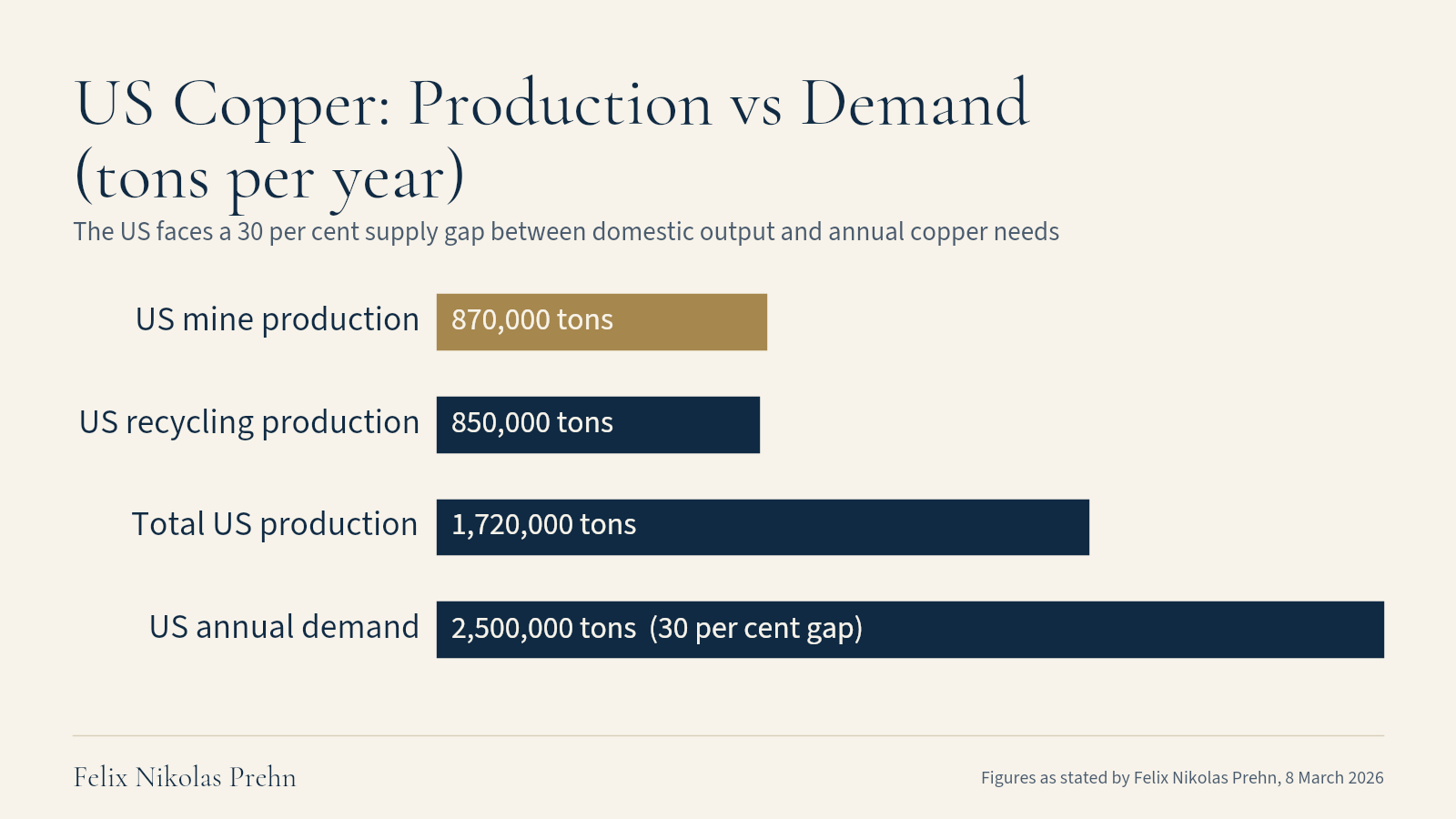
The United States mines 870,000 tons of copper a year and recycles another 850,000. The total is 1.72 million tons.
The country needs 2.5 million tons per year. The gap is 30 per cent of consumption.
Higher prices do not call new copper supply into existence quickly.
A new copper mine takes 17 to 18 years to reach production globally. In the United States, the figure is 29 years.
The timeline includes discovery, permitting, infrastructure, environmental approvals, financing and construction. I argue that the length of the process deters capital.
Investors look at a 29 year payback horizon and walk away. New discoveries are rarer, lie deeper underground and contain less copper per ton of rock. The ore grade (the concentration of copper in the rock) is declining.
Decades of underinvestment and the market response
Commodities have been starved of investment for over 40 years as money flowed into financial assets. Stocks, real estate and bonds absorbed capital that might otherwise have funded mining and exploration.
Few geologists were trained because the profession did not pay. I argue that fewer students chose geology because the profession did not pay, as capital chased software companies instead.
The copper miner ETF called COPX is up 72 per cent in the last 129 trading days after breaking out in September with a volume spike.
Copper miners have fixed costs. If it costs a miner 3 dollars to extract a pound of copper and the price is 4 dollars, the profit is 1 dollar.
When the price moves to 6 dollars, the profit triples to 3 dollars. The commodity price rose 50 per cent but the profit tripled.
Miners' profits can double, triple or quadruple on a relatively modest move in the underlying metal.
The copper market faces three simultaneous demand shocks from AI, EVs, and grid rebuilding. Given permitting timelines of 17 to 29 years, new mining supply cannot respond to this demand on any relevant schedule. Some analysts question the scale of AI-driven demand, and prices have shown volatility around those doubts. The broader market view is that the deficit is structural. If the shortfall persists as long as permitting timelines suggest, the price will reflect that scarcity for years.